The 7 Most Common Electrical Estimating Mistakes That Kill Profit Margins in 2026

Your most expensive employee isn’t the journeyman on the job site; it’s the invisible error hiding in your bid. It’s a frustrating reality for many contractors who realize too late that their hard-won projects are actually draining their bank accounts instead of filling them. You know the grind of spending hours on manual takeoffs, only to watch your profit margins vanish because of uncaptured labor or a sudden spike in material costs.
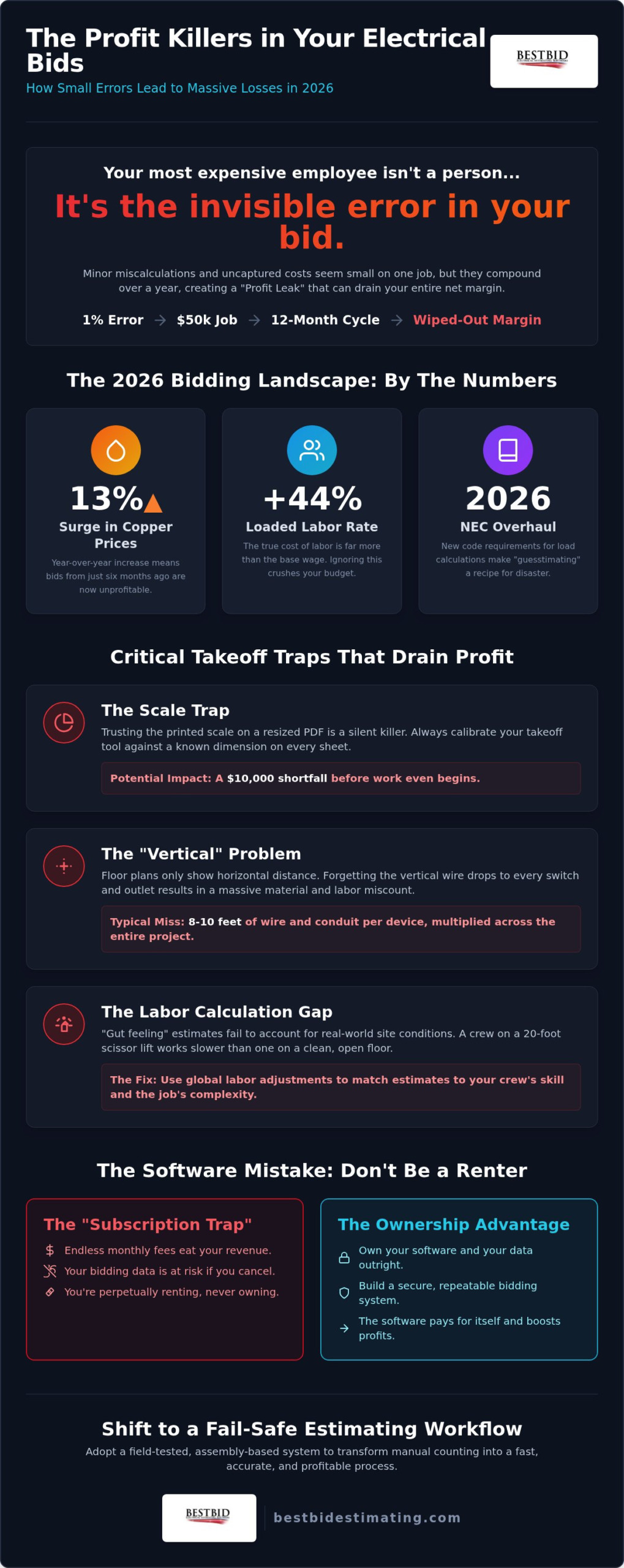
These common electrical estimating mistakes are more than just clerical slips. They’re profit killers in a year where copper prices have already surged over 13% and the 2026 NEC has overhauled the rules for load calculations.
We understand the daily pressure of the trade because we’ve been in the trenches for over 50 years. You deserve a bidding process that provides security, not stress. This guide will teach you how to identify and eliminate the costly bidding errors that drain your electrical contracting profits.
We’ll preview the seven critical traps of 2026, from the “subscription trap” that eats your monthly revenue to the danger of ignoring labor rates that are often 44% higher than the base wage. It’s time to move toward a repeatable, accurate system where your software pays for itself and every win is a profitable one.
Key Takeaways
- Recognize how small, uncaptured labor hours and tiny calculation errors compound into massive profit leaks over a 12-month cycle.
- Avoid the “scale trap” and learn why factoring in vertical wire drops is essential for maintaining accurate material counts on every PDF takeoff.
- Identify common electrical estimating mistakes like the “subscription trap” that drains your monthly revenue and puts your bidding data at risk.
- Adopt a field-tested, assembly-based workflow that transforms manual counting into a fast, repeatable, and accurate bidding system.
- Shift from being a software “renter” to an owner with tools designed by industry veterans who truly understand the daily grind of the trade.
The Hidden Cost of Inaccurate Electrical Bids
Your estimate is the heartbeat of your contracting business. It isn’t just a price tag; it’s the blueprint for your project’s cash flow. One of the most common electrical estimating mistakes is treating the bid as a hurdle to clear rather than a financial strategy. When you view estimating as a chore, you miss the subtle errors that eventually sink your ship. A 1% error might seem small on a single $50,000 job. However, if that error repeats across your entire 12-month cycle, the cumulative “Profit Leak” can easily wipe out your entire net margin. This creates a cycle of bidding “blind,” which carries a heavy psychological toll. You shouldn’t have to lose sleep wondering if your numbers will hold up once the first shovel hits the ground. A professional cost estimate provides a precise balance of material, labor, and overhead to ensure your business stays in the black.
Why Traditional “Guestimating” Fails in 2026
Relying on “price per square foot” is a recipe for disaster in 2026. Copper prices saw a 13% year-over-year increase as of July 2026, meaning a bid that worked six months ago is now a loser. Digital PDF sets are also getting more crowded and technical.
If you’re still manually counting, you’re likely missing the complex requirements of the 2026 NEC, such as new load calculations for Energy Management Systems. Using outdated labor units is equally risky. In 2026, the fully loaded labor rate is approximately 44% higher than the base wage.
Failing to account for this leads to projects that are chronically understaffed and over budget before the first wire is pulled.
The Real ROI of Estimating Accuracy
Accuracy is your best marketing tool. GCs and owners notice when a contractor provides a detailed, defensible bid. It builds a level of professional trust that protects you from being “shopped” for a lower price.
They want to know you’ve actually read the specs, not just guessed at the numbers. Beyond winning the job, precise takeoffs directly reduce field waste. You won’t have expensive conduit and wire sitting unused because of a sloppy count.
By leveraging historical data from your previous projects, you can refine your future bids to target the high-margin work you actually want. This isn’t just about counting parts; it’s about building a predictable, profitable future for your crew.
Technical Takeoff Errors: Beyond Simple Counting
The scale trap is a silent profit killer. If you trust the 1/8″ scale printed on a PDF without calibrating your digital takeoff tool, you’re inviting a financial disaster. Drawings are frequently resized to fit screens or specific paper sizes, which renders the printed scale useless. This is one of the most common electrical estimating mistakes, often leading to a $10,000 shortfall before you’ve even purchased your first stick of conduit. You have to verify your measurements against a known dimension every single time you open a new sheet.
Then there’s the “Vertical” problem. Many estimators look at a floor plan and only see the horizontal distance from point A to point B. They forget the eight feet of wire going up the wall to a switch or the ten feet dropping from the ceiling to an outlet.
When you multiply those missed vertical feet by every device in a large commercial building, your wire count is doomed. Similarly, overlooking “Home Runs” for branch circuitry means you’re essentially donating your labor and materials to the client. Automated conduit and wire length calculations prevent these manual math errors by building those vertical drops directly into your digital takeoff workflow.
The Labor Calculation Gap
Estimating labor by “gut feeling” is the fastest way to close your doors. You have to account for the actual site conditions. A crew working in a cramped crawl space or on a 20-foot scissor lift won’t hit the same labor units as a team on an open, clean floor.
You need global labor adjustments that reflect your specific crew’s skill level. If your software doesn’t allow you to pivot these units based on the reality of the job site, you’re just guessing at your most volatile expense.
Material Pricing Volatility
In 2026, using material prices from even three months ago is a massive gamble. With copper wire costs showing a 13.09% year-over-year increase as of July 2026, your margins are already razor-thin. Real-time pricing integration, like NetPricer, eliminates the quote-chasing bottleneck by providing live market data as you build your bid. Don’t ignore the “nickels and dimes” either. Fittings, supports, and small hardware add up fast. If you miss the small parts, you’re leaking profit on every single circuit. Using a system like Best Bid Next Generation ensures these technical details are captured automatically, so you can focus on winning the job with confidence.
The “Subscription Mistake”: Is Your Software Eating Your Profit?
Many contractors view software as a standard utility, like electricity or water. They sign up for a $200-a-month plan without a second thought. But over a decade, that “utility” costs you $24,000 per seat. When you multiply that across a team, you’re looking at a staggering amount of capital that could’ve stayed in your pocket. This is one of the most persistent common electrical estimating mistakes in the modern era. You aren’t just paying for a tool; you’re adding a permanent weight to your overhead that never goes away, regardless of how many jobs you win.
Then there’s the “Data Ransom” problem. What happens to your estimates if you decide to stop paying? With most cloud-based models, your access is cut off. Your history, your assemblies, and your hard-earned bidding data are effectively held hostage. We believe in a different philosophy: you should buy your tools and own them. Transitioning to a model like Best Bid Next Generation allows you to secure a 5-user license for approximately $2,500. This single investment can replace enterprise systems that often cost between $15,000 and $75,000 when you factor in initial licenses and recurring maintenance fees. For more details, check out our Small Contractors guide to no-subscription software.
Built-in Takeoff vs. Third-Party Add-ons
Paying for separate On-Screen Takeoff (OST) tools is another unnecessary drain. When your takeoff tool doesn’t talk to your estimating software, you’re forced into a manual data-entry loop. This causes “click fatigue” and opens the door for transcription errors.
An integrated system allows for a seamless OST-to-estimate transfer. This speeds up the bidding process significantly. Since our software was designed by field electricians who understand the daily grind, every feature is built to reduce clicks and maximize your time.
Lifetime Updates and Support
Maintenance fees are often just a way for software companies to keep their hands in your pockets. Why should you pay an annual fee just to keep the software you already bought? We provide free lifetime updates to ensure you stay current with 2026 NEC standards without extra costs.
This “Buy it and Own it” model provides long-term business stability. You get a modern, reliable system that stays up to date, backed by a partner who actually wants to see you succeed, not just collect a monthly check.
Building a Fail-Safe Estimating Workflow
Speed is a liar if it isn’t backed by a solid system. One of the most common electrical estimating mistakes is treating every bid like a brand-new invention instead of following a repeatable process. You need a workflow that catches errors before they ever reach the General Contractor’s desk. We’ve seen too many good shops struggle because they lacked a standard operating procedure for their bids. A fail-safe workflow starts with four non-negotiable steps. First, you must standardize your assembly-structure so one item can morph into any part the job requires. Second, implement a 1-click backup system. Your bidding data is your most valuable asset, and losing it to a hardware crash is a mistake you can’t afford. Third, utilize digital takeoff tools to measure directly on your screen. Finally, always conduct a “Bid Day” review. This is your last chance to catch scope gaps and ensure your overhead is fully covered before you hit send.
Leveraging Assembly-Structure Logic
Searching through a database of 50,000 individual parts is a massive waste of your time. Instead, use assemblies that adapt to the specific needs of the job. You can create a repeatable “logic” for common installations, like 2×4 troffers or standard office receptacles.
When you select a fixture, the system should automatically pull in the wire nuts, MC cable, and supports. This level of automation slashes the learning curve for new estimators. They don’t need to be a 30-year veteran to know every fitting required for a circuit; the assembly handles the heavy lifting for them.
It ensures consistency across every bid your company produces, regardless of who’s behind the keyboard.
Digital Takeoff Best Practices
Visual clarity is your best defense against missing devices. We recommend using color-coding to differentiate your systems. Power might be blue, lighting yellow, and low-voltage green. This makes it easy to spot a missed circuit or a forgotten panel at a single glance. Modern features like “DigiCount” allow for automated device counting, which eliminates the human error inherent in manual clicking. When you’re evaluating electrical bidding software for contractors, look for built-in tools that support this level of precision without requiring expensive third-party add-ons. You want a system that provides a clear “before and after” picture of your takeoff, ensuring that what you counted is exactly what you’ve bid. Stop guessing and start winning with a system built for electricians, by electricians.
The Steve Griffin Method: Field Experience Meets Software
Most estimating tools on the market today are built by software developers who’ve never stepped foot on a job site. They understand code, but they don’t understand the pressure of a bid-day deadline or the complexity of a commercial service change. Best Bid Next Generation is different.
It was shaped by Steve Griffin, an industry veteran with over 50 years of experience as an electrician and contractor. Steve’s time in the trenches is baked into every feature, ensuring the software solves the actual problems you face daily. It’s a tool built by a Master Electrician for Master Electricians, prioritizing the practical realities of the trade over flashy, useless features.
We operate on a “No Ultimatums” philosophy. Your software should support your specific workflow, not bully you into a rigid process that doesn’t fit your business. Whether you’re a one-man shop or managing a large team, the system adapts to you. By using the Best Bid Academy, you can skip the decades of trial and error that most contractors endure. It’s about giving you the shortcut to accuracy that usually takes a lifetime to learn. Failing to invest in your own technical education is one of the most common electrical estimating mistakes, but it’s also the easiest one to fix.
Training for Long-Term Success
Software is a powerful engine, but it’s only as good as the person driving it. You can have the most sophisticated system in the world, yet still lose money if you don’t understand the logic behind the numbers. Our Online School for Electrical Estimating is designed to turn your estimators into precision experts. We help you move from “survival mode,” where you’re just trying to get a number out the door, into “growth mode,” where every bid is a strategic move for your company’s future. Education is the foundation of permanence in this industry.
Conclusion: Owning Your Future
Success in 2026 requires more than just hard work; it requires a system that eliminates the common electrical estimating mistakes that kill profit margins. We’ve covered the seven critical areas where contractors lose money: inaccurate takeoffs, labor gaps, material volatility, the subscription trap, itemized counting, flawed logic, and a lack of training. Each of these leaks can be plugged with the right tools and mindset. It’s time to stop renting your tools and start owning your success. Don’t let recurring fees and manual errors drain your bank account for another year. Check out Best Bid Next Generation today and take total ownership of your bidding process.
Take Command of Your Project Margins
Every project you bid is an opportunity to build your legacy. You don’t have to stay stuck in a cycle of bid-day stress and vanishing margins. By addressing common electrical estimating mistakes like manual takeoff errors and the high cost of recurring software fees, you’re choosing a path of long-term stability. This isn’t just about software; it’s about reclaiming your time and protecting your hard-earned revenue. You’ve spent years mastering the trade, and your bidding process should reflect that level of professional excellence.
Our mission is to empower professionals with tools that reflect the practical reality of the job site. With 50+ years of field experience baked into every feature, our system is rated #1 for best value because we focus on what actually works. This is a one-time purchase with no subscriptions, ensuring your bidding data stays in your hands where it belongs. Stop Paying Monthly Fees and Own Your Estimating Software Today. You have the experience to build great things. It’s time your estimating process provided the security and profit you deserve.
Frequently Asked Questions
What is the most common mistake in electrical takeoff?
The most frequent error is failing to calibrate digital plans, which leads to massive scaling inaccuracies. Many estimators also overlook the “vertical” footage needed for wall drops and ceiling transitions. These common electrical estimating mistakes can result in thousands of dollars in missed material and labor costs. You must verify a known dimension on every new PDF sheet to ensure your digital takeoff tool matches the actual building footprint.
How do I calculate labor hours accurately for a complex electrical bid?
Accurately calculating labor requires moving beyond base wages to fully loaded rates, which include payroll taxes, insurance, and benefits. You also need to apply difficulty factors for specific site conditions like high ceilings or restricted access. Instead of guessing, use industry-standard labor units that can be adjusted globally based on your crew’s skill level and the unique physical challenges of the project environment. This ensures your bid covers the real cost of the work.
Why should I avoid subscription-based estimating software?
Subscription models create a permanent drain on your overhead that never ends. Over several years, a monthly fee can cost you tens of thousands of dollars more than a one-time purchase. Additionally, these models often lead to “data ransom,” where you lose access to your bidding history if you stop paying. Owning your tools outright provides financial clarity and ensures your business data remains your property forever without recurring financial burdens.
Can I use a spreadsheet for electrical bidding in 2026?
While you can use spreadsheets, they are prone to broken formulas and lack the speed required for modern bidding. Spreadsheets don’t integrate with real-time material pricing or digital takeoff tools, forcing you into slow, manual data entry. In a market with high material volatility, the time spent double-checking a spreadsheet often costs more than the investment in a professional, automated system that eliminates these manual math errors and transcription risks.
What is an assembly-structure workflow in estimating?
An assembly-structure workflow groups all the individual parts needed for a specific installation into a single logical unit. For example, selecting a “receptacle assembly” automatically includes the box, bracket, device, plate, and wire nuts. This method prevents common electrical estimating mistakes like forgetting small but essential fittings. It allows you to estimate complex systems in seconds rather than counting every single screw, connector, and wire nut manually.
How much does professional electrical estimating software cost?
Costs vary wildly across the industry, with some enterprise systems reaching upwards of $15,000 plus annual maintenance. However, we offer a class-leading price point of approximately $2,500 for a 5-user license. This is a one-time fee, meaning you own the software for life without monthly subscriptions or mandatory maintenance charges. This model is designed to be a software investment that pays for itself through increased bidding accuracy and reduced overhead.
Is on-screen takeoff (OST) included in Best Bid software?
Yes, on-screen takeoff is fully integrated into Best Bid Next Generation. You don’t need to purchase third-party add-ons or separate licenses to measure directly on your screen. This integration allows your takeoff measurements to flow seamlessly into your estimate, which reduces click fatigue and eliminates the transcription errors that happen when moving data between two different programs. It’s a complete, all-in-one bidding solution for the modern contractor.
Do I need special training to use Best Bid Next Generation?
Our software is designed to be intuitive for anyone with field experience, but we offer comprehensive resources for those who want to master it quickly. The Online School for Electrical Estimating provides structured training to help you move from manual processes to modern efficiency. Steve Griffin built this system to support the estimator’s logic, so the learning curve is significantly shorter than the complex, developer-heavy platforms sold by many generalist competitors.