Outsource Electrical Estimating: 2026 Strategic Guide

As an electrical contractor in 2026, you’re likely facing more bid deadlines than ever before. When your team is stretched thin, the temptation to outsource electrical estimating can be overwhelming. You see promises of fast turnarounds and expanded capacity, and it seems like a quick fix for the stress of “Bid Day.”
But is it the right long-term strategy? Many contractors who go down this path discover a world of hidden risks: inaccurate counts from overseas sweatshops, a loss of control over their data, and estimates that don’t reflect the realities of the job site. The initial solution for overflow quickly becomes a liability that threatens their reputation and profit margins.
This guide offers a different path. Instead of handing over your company’s future to a third party, we’ll show you how to build a powerful, scalable, and profitable bidding process in-house. It’s time to move from tactical fixes to a strategic foundation built on ownership and control.
The Strategic Shift: Why Contractors Are Re-Thinking Outsourcing
The primary driver for considering outsourcing is pain. It’s the pain of missing a bid deadline, the stress of an overburdened estimator trying to do it all, and the fear of miscalculating a complex commercial project. Contractors look for a safety net, especially during peak seasons or when an opportunity arises in a new sector like industrial or institutional work.
However, experienced contractors in 2026 are realizing that traditional outsourcing often replaces one set of problems with another. The perceived cost-to-benefit ratio doesn’t account for the long-term damage of inaccurate or generic bids. Entrusting your most critical business function to a faceless firm that lacks field experience is a gamble most are no longer willing to take.
- Managing “Bid Day” Stress: The goal is to reduce stress, but waiting on an external estimate you can’t verify often increases it.
- Avoiding the Overburdened Estimator Trap: Outsourcing doesn’t solve the core issue; it just shifts the work. The better solution is empowering your existing team with more efficient tools.
- Expanding into New Sectors: Entering a new market requires deep expertise. A generic takeoff service that just provides counts cannot offer the strategic insight needed to bid on specialized industrial or commercial work profitably.
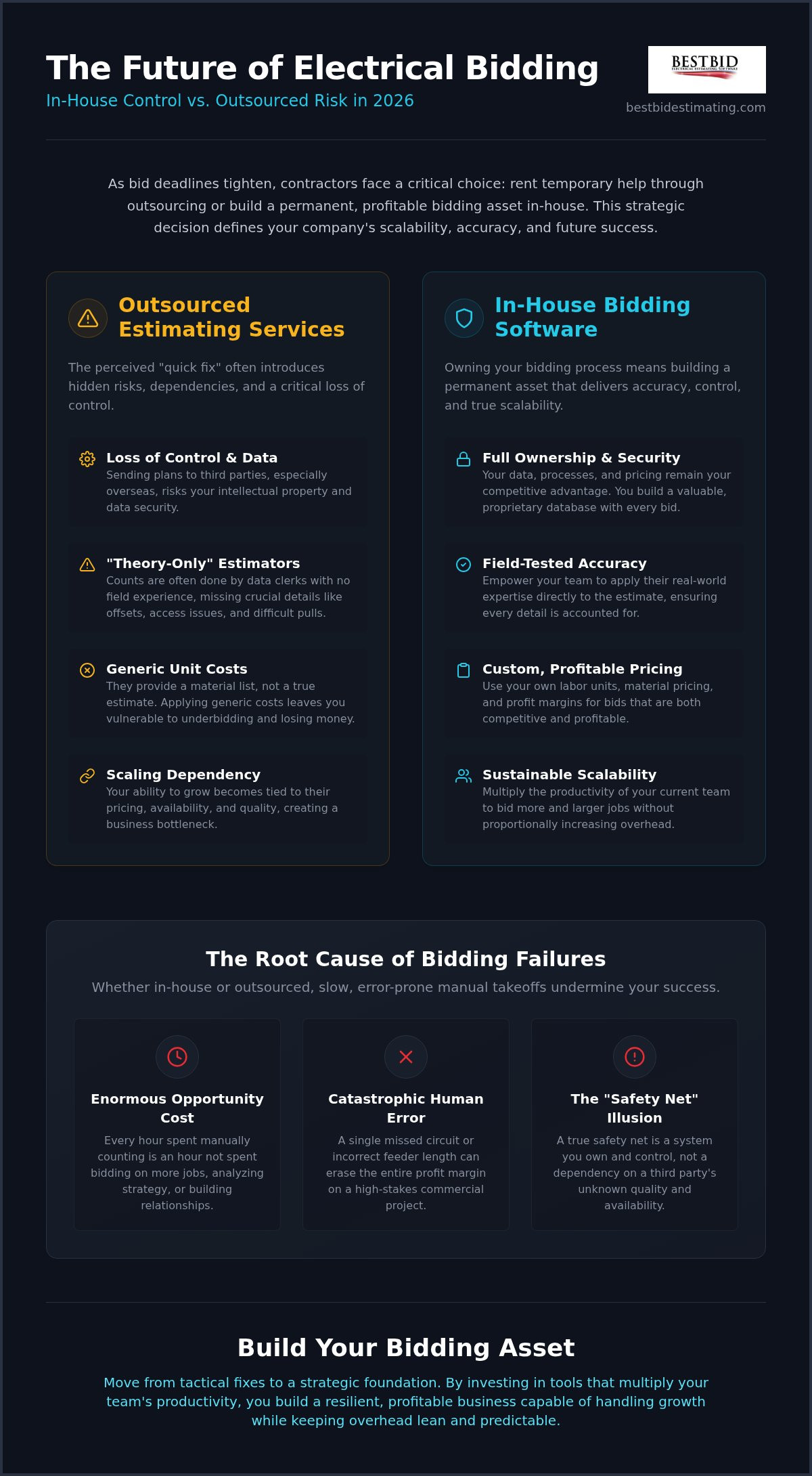
- The “Safety Net” Illusion: A true safety net is a system you own and control, not a dependency on a third party whose quality and availability are beyond your influence.
The Hidden Costs of Manual Takeoffs
Whether performed in-house or by an outsourced team, manual takeoffs are the root cause of many bidding failures. The process is slow, tedious, and dangerously prone to error. Every hour spent manually counting fixtures or measuring conduit runs on a PDF is an hour not spent analyzing the bid, refining labor units, or building relationships with general contractors.
- Calculating Lost Time: A senior estimator’s time is valuable. Spending days on manual counting for a single bid is an enormous opportunity cost that could be better invested in bidding on two or three additional projects with the right software.
- The Risk of Human Error: A single missed circuit or an incorrect feeder length can erase the entire profit margin on a project. In high-stakes commercial bids, these small mistakes have catastrophic financial consequences.
- “Theory-Only” Estimators: Many outsourced services employ data entry clerks, not electricians. They count what they see but don’t understand the practicalities of an installation. They fail to account for field realities like offsets, difficult pulls, or access issues—details a seasoned professional knows to look for.
Scaling Your Business Without Increasing Overhead
The ultimate goal is to bid on more and larger projects without hiring a massive administrative team. The flexibility of project-based fees seems attractive compared to a full-time salary. However, true scalability isn’t about renting temporary help; it’s about building a permanent, efficient system.
Relying on outsourcing means you never develop the in-house capacity to handle growth. You become dependent on an external service, and your ability to scale is tied to their pricing, their turnaround times, and their quality. The smarter approach is to make a one-time investment in tools that multiply the productivity of your current team, allowing you to scale your bidding capacity while keeping overhead lean and predictable.
Freelance Services vs. Bidding Software: A Comparison Framework
The choice between outsourcing your estimating and owning your software is a choice between renting a temporary solution and owning a permanent asset. While freelance services promise a quick fix for overflow, they often fail to deliver the control, accuracy, and long-term value that professional software provides.
In 2026, the debate is less about a hybrid workflow and more about strategic independence. Contractors who own their bidding process can respond to opportunities faster, protect their data, and build a proprietary database that becomes more valuable with every bid. They aren’t just winning jobs; they are building a more resilient and profitable business.
The Promises and Pitfalls of Freelance Services
Outsourcing companies make compelling promises: 24-48 hour turnarounds, access to “specialists,” and the ability to bid on any project. But what’s the reality behind these claims?
- The Myth of “Specialized Expertise”: Many large-scale outsourcing firms are generalists. They may claim expertise in industrial projects, but their process often boils down to a simple material count performed by someone with no electrical field experience. They provide a list of parts, not a true estimate.
- The Danger of Generic Unit Costs: A real estimate isn’t just a count of materials; it’s a careful calculation of labor, overhead, and profit. Outsourced firms that apply a generic “unit cost” to their counts are providing a guess, not an estimate. This leaves you vulnerable to underbidding and losing money or overbidding and losing the job.
- Loss of Control and Data Security: When you send your blueprints to a third-party service, especially an overseas one, where does your data go? Who owns the final takeoff? You risk your intellectual property and lose control over the most critical data in your business.
The Case for Non-Subscription Software
The most powerful alternative to the risks of outsourcing is to own your estimating software. This approach puts you in complete control, turning your bidding process from a liability into a strategic asset. The key is to choose a non-subscription model that eliminates recurring costs and empowers you for the long term.
- The Freedom of the “Buy it and Own it” Model: Imagine making a single investment that pays for itself for years to come. With a one-time purchase model, you get lifetime access, including updates and support, without the “subscription tax” that drains profits every single month.
- Build an In-House Asset: Your database of assemblies, labor units, and past projects is one of your most valuable business assets. With your own software, you build and protect this asset, refining it with every bid to become faster and more accurate over time.
- Speed and Agility: For the majority of residential and small commercial quotes, an experienced estimator with the right software is far faster than any outsourced service. You can turn around urgent bids in hours, not days, giving you a critical advantage. Learn more about the benefits of software ownership versus subscription.
Essential Criteria for Evaluating Outsourced Estimating Partners
If you are still considering an outsourced partner, it’s crucial to evaluate them with extreme scrutiny. Most services look good on the surface, but a few pointed questions can reveal major red flags. Use this framework not just to choose a partner, but to understand why bringing the process in-house is often the safer, more profitable choice.
- Field Experience: This is non-negotiable. Ask them: “Is the person doing my takeoff a licensed electrician or just a data-entry clerk?” If they can’t confirm that a seasoned professional is overseeing the work, you are paying for a simple count, not an expert estimate.
- Software and File Compatibility: Will they deliver the estimate in a locked PDF or in a format you can import, control, and modify? If you can’t integrate their work into your own system, you are completely dependent on them for any changes or future bids.
- Pricing Integration: How do they price materials? If they use a static, outdated price list, your bid will be inaccurate from the start. Demand a partner who uses real-time material pricing integration like NetPricer to ensure your costs are current.
- Licensing and Credentials: A reputable service should be transparent about its team’s credentials. The oversight of a Master Electrician is the bare minimum for ensuring an estimate accounts for code and real-world installation practices.
Technical Proficiency and Digital Takeoff
The tools an outsourced partner uses are a direct reflection of their quality. Many services stitch together multiple third-party programs, creating a clunky workflow that is prone to data transfer errors. A truly professional system uses a single, integrated platform.
- Integrated On-Screen Takeoff (OST): A built-in OST is far superior to a separate tool. It ensures that counts and measurements from the blueprint transfer directly into the estimate with a single click, eliminating the risk of manual entry errors.
- Assembly-Structure Workflows: Ask how they build their estimates. Are they picking individual parts from a massive database, or are they using smart, assembly-based structures? An assembly-structure workflow dramatically reduces errors and ensures all necessary components (connectors, supports, etc.) are included automatically.
- Accurate Calculations: How do they calculate complex runs? Verify their method for accurately calculating conduit and wire lengths, as this is a common area for costly mistakes.
Confidentiality and Data Ownership
In a digital world, your project data is your intellectual property. Handing it over to a low-cost, high-volume takeoff shop can be a massive security risk. You need to be certain that your blueprints, customer information, and pricing strategies remain confidential.
- Protecting Your Intellectual Property: A formal non-disclosure agreement (NDA) is essential. Ensure your project data will not be shared, sold, or used to inform bids for your competitors.
- Avoiding “Locked-In” Service Models: Some services deliver estimates in proprietary formats, effectively holding your bids hostage. If you want to make a change, you have to go back to them and pay another fee. Always insist on receiving your data in an open, accessible format.
Leveraging the Best Bid Ecosystem for Bidding Accuracy
The ultimate strategy for bidding accuracy and long-term growth is not to find a better outsourcing partner, but to become your own best estimator. The Best Bid ecosystem was designed by a Master Electrician for electrical contractors, providing the tools and training you need to take back control of your bidding process and your future.
This is a system built on 50+ years of in-the-trenches experience. It’s not about theory; it’s about what works on the job site. From the one-time-fee software to expert-led training, every component is designed to make you more independent, more competitive, and more profitable.
- Built by Steve Griffin: With over 50 years of experience as a Master Electrician, contractor, and software developer, Steve Griffin built the tools he wished he had in the field. That practical expertise is embedded in every feature.
- The Power of Best Bid Next Generation: Ranked #1 for Best Value, this software provides a complete, integrated solution with built-in on-screen takeoff and a lightning-fast workflow, all for a single, one-time fee.
- A Clear Path to Independence: Best Bid offers a seamless way to move from needing occasional support to complete in-house ownership of your estimating process.
A Different Kind of Support: Expert Project Assistance
While we advocate for in-house excellence, we understand that some complex projects or sudden overflow may require an extra set of expert hands. Best Bid’s professional estimating and drafting services are fundamentally different from anonymous outsourcing.
This isn’t a “takeoff shop.” This is project assistance provided by a US-based team led by a Master Electrician. We use our own powerful software to deliver meticulous, field-accurate estimates that you can trust. Our goal is to help you win a strategic bid while showing you the power of a professional system, empowering you to handle the next one yourself.
Training for Long-Term Independence
The most valuable investment you can make is in your own skills. The Online School for Electrical Estimating is designed to teach you the art and science of bidding, moving you permanently beyond the need for outsourcing. Authored by Steve Griffin, the curriculum is based on decades of real-world lessons.
- Master the Entire Process: Go beyond simple takeoffs. Learn advanced techniques for labor management, risk mitigation, material purchasing, and building winning relationships.
- Learn from a Master: Benefit from the wisdom shared in Steve’s book, “Everybody Has a First,” and learn how to avoid decades of unnecessary and costly mistakes.
- Build a Bidding Powerhouse: Equip yourself and your team with the knowledge to bid any project with confidence and accuracy. Get started with our 2026 Contractor Training Guide.
Implementing a Scalable Bidding Strategy for 2026
Ready to stop renting solutions and start owning your success? Follow this four-step strategy to build a scalable, in-house bidding machine that will serve your business for years to come.
- Audit Your Current Bidding Process: Analyze your win-rate, your average time per bid, and the direct and indirect costs of your current method. Identify the bottlenecks and the projects you’ve lost due to speed or accuracy issues.
- Categorize Your Project Types: Differentiate between your “routine” bids (e.g., residential, small commercial) and more “complex” targets (e.g., industrial, multi-story). This will help you focus your initial training and process improvements.
- Invest in Non-Subscription Software: Make the strategic, one-time investment in a professional estimating system like Best Bid Next Generation. This is the cornerstone of your new process, providing the speed and accuracy needed for all your bids.
- Train Your Team for Mastery: Use your new software and expert training resources to build your team’s skills. The goal is to create an in-house system where you can confidently and profitably bid on any project, routine or complex, without ever needing to rely on an outside firm again.
Future-Proofing Your Business Against Monthly Fees
In 2026, the subscription model is a significant burden for small and mid-sized contractors. These recurring fees eat into your profits every month, whether you are busy or not. By choosing a solution with a one-time fee, you gain financial certainty and a lower total cost of ownership.
- The Failing Subscription Model: Monthly software fees create a permanent line item on your overhead. The “pay forever” model benefits the software company, not the contractor.
- The Power of a Perpetual License: With a one-time purchase, you get lifetime updates and free technical support. You own your tool, your database, and your assembly structures forever, giving you a permanent competitive advantage.
Your Next Steps to Bidding Success
It’s time to take control. Stop gambling with outsourced takeoffs and start building a reliable, in-house system that powers your growth. The path to winning more profitable jobs begins with owning the right tools and the right knowledge.
Once your bidding process is optimized, the next step is finding high-quality leads; to see where homeowners are currently requesting contractor help, you can visit Clientele Signal.
- Request a demo of Best Bid Next Generation to see the speed and power of a fully integrated, non-subscription estimating system.
- Schedule a consultation to discuss your specific needs and learn how our software and training can transform your bidding process.
- Final CTA: Own your software and your future at Best Bid.
Frequently Asked Questions (FAQs)
- What are the primary risks of outsourcing electrical estimating?
- The main risks include inaccurate takeoffs from personnel with no field experience, loss of control over your confidential project data, receiving generic “counts” instead of true estimates with accurate labor units, and becoming dependent on a third party for a core business function.
- How much does it cost to hire a freelance electrical estimator in 2026?
- Costs vary widely, but they are typically charged per project or per hour. While it may seem cheaper upfront for a single project, the long-term cost is often higher than a one-time software purchase, especially when you factor in the financial risk of an inaccurate bid.
- Is outsourced estimating more accurate than doing it in-house?
- No, it is almost always less accurate. A professional contractor using dedicated software understands the nuances of an installation that a remote data clerk cannot. In-house estimating with the right tools ensures that bids are based on real-world experience, accurate labor units, and your specific business costs.
- Can I get expert help from Best Bid without long-term outsourcing?
- Yes. Best Bid offers professional, US-based estimating services led by a Master Electrician. This is not generic outsourcing; it’s expert project assistance designed to help you with a complex bid while demonstrating the power of our system. Our ultimate goal is to equip you to handle all future bids independently.
- What documents do I need to provide for an outsourced electrical takeoff?
- Typically, you will need to provide complete sets of digital blueprints (PDFs), project specifications, and any relevant addenda. However, be cautious about where you send this sensitive information.
- How do I know if an outsourced estimator has actual field experience?
- Ask directly for the credentials of the person who will be performing the work. Request to speak with them and ask specific, technical questions about installation methods or code requirements. If they cannot provide a licensed, experienced electrician to oversee your project, it is a major red flag.
- Does Best Bid offer drafting services as well as estimating?
- Yes, Best Bid provides professional freelance drafting services to supplement your in-house capabilities, helping you produce clean, accurate shop drawings and as-builts that reflect real-world installation techniques.
- How do I transition from outsourcing to using Best Bid software internally?
- The transition is straightforward. Start by requesting a demo of Best Bid Next Generation. Our team will show you how the software works. Once purchased, you can use the Best Bid Academy and our free support to get your team trained quickly, allowing you to start bidding in-house within days.