Electrical Contracting Profit Margins, Costs and Benchmarks

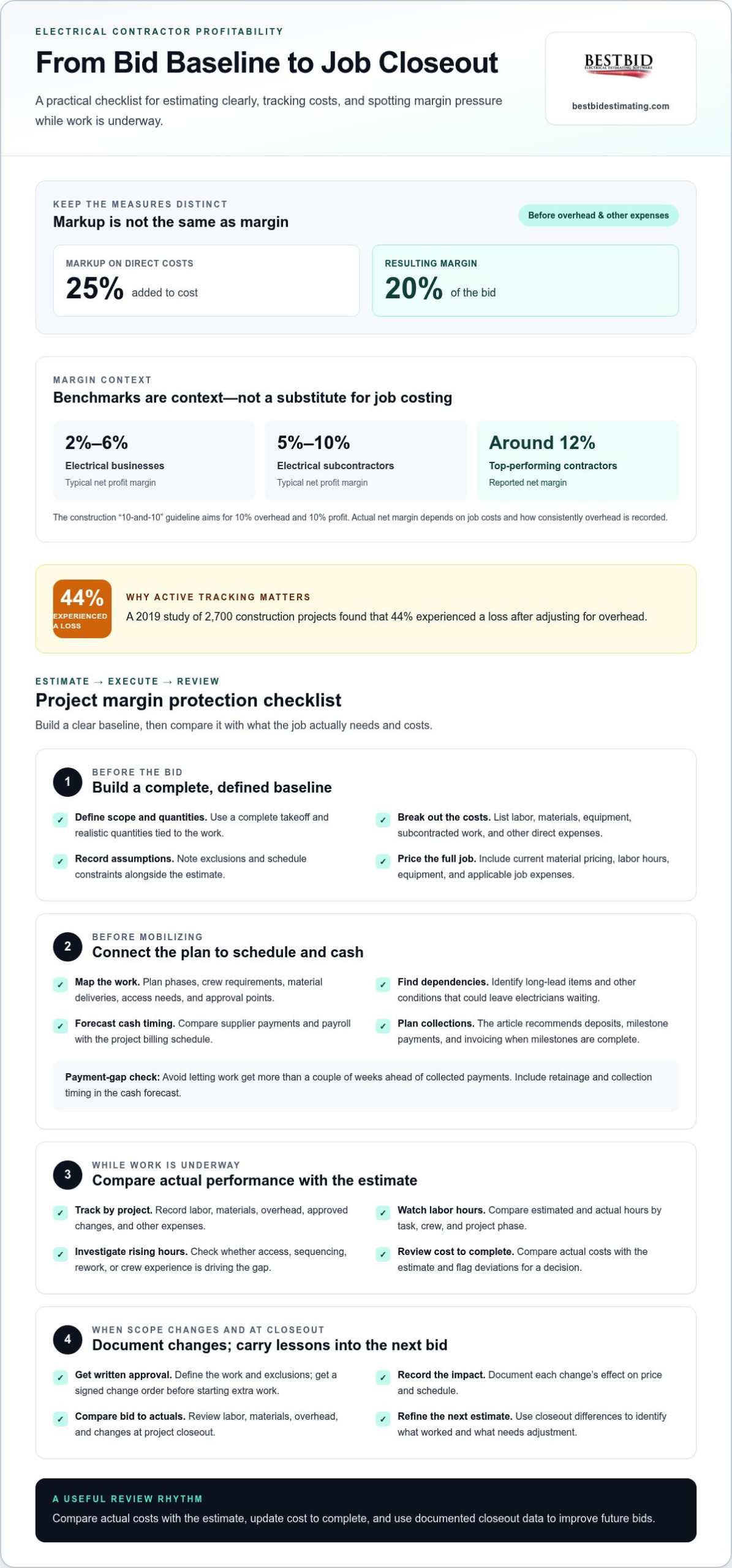
A 25% markup produces a 20% margin, so the markup on your bid isn’t the same as the profit you keep. Electrical businesses typically have net profit margins of 2% to 6%, while electrical subcontractors usually net 5% to 10%. Understanding how to protect profit margins in electrical contracting starts with knowing which figure you’re measuring, then tracking what each job actually costs.
A full schedule can make a business look healthy, but it does not guarantee strong profits. Labor overruns, missed takeoff items, and costs left out of an estimate can quietly shrink the difference between the bid amount and the profit left when the job is done.
This article explains gross and net margin benchmarks for electrical contractors, how estimating and fully burdened labor costs affect profitability, and how accurate takeoffs and job tracking help protect margins. Comparing estimated costs with actual performance shows where a process is working and where it may need adjustment.
Key Takeaways
- Compare gross and net margins separately so overhead and other business costs don’t blur what a job actually earned.
- Build estimates from clear job costs, then compare actual performance with the original bid to spot where profit is slipping.
- Calculate labor using its full cost to the business, not just the crew’s base wages, and track hours against the estimate.
- Use detailed electrical takeoffs to reduce missed quantities and pricing gaps before they reach the job site.
- Choose estimating tools that fit your workflow when manual takeoffs and bid tracking make consistency harder to maintain.
1. Electrical Contractor Profit Margins: What’s Normal?
A markup and a profit margin measure different things. A 25% markup on direct costs produces a 20% margin before overhead and other business expenses. Electrical businesses typically have net profit margins of 2% to 6%, while electrical subcontractors usually net 5% to 10%. These benchmarks are useful context, not a substitute for calculating your own results.
The construction industry’s “10-and-10” guideline aims for 10% overhead and 10% profit. But your actual net margin depends on what you include in job costs and how consistently you record overhead. Top-performing contractors report net margins around 12%, according to the Construction Financial Management Association. A bid can look profitable on paper and still fall short after payroll, insurance, licensing, permits, and administrative expenses are accounted for.
To estimate accurately and avoid underbidding, base each estimate on a complete takeoff, current material pricing, labor hours, equipment, and applicable job expenses. Apply overhead and profit targets consistently, then compare estimated costs with actual results at closeout.
Contract terms that manage scope creep should define the work, list exclusions, and require written approval for changes. Get the customer’s signature on a change order before starting extra work, and document its effect on price and schedule. Clear records make it easier to bill for added work rather than absorb its cost.
Overhead, insurance, licensing, and permit costs reduce the share of revenue available as profit, whether they’re company-wide expenses or specific to a job. Allocate business overhead consistently when pricing work, and include project-specific expenses in the estimate. The U.S. self-employment tax rate is 15.3%, according to the Internal Revenue Service; self-employed owners should account for it when assessing take-home income, separate from a job’s operating margin.
2. Estimating discipline and project performance tracking
A disciplined bid starts with a defined scope, realistic quantities, and costs tied to the work. Break the project into labor, materials, equipment, subcontracted work, and other direct expenses. Record assumptions, exclusions, and schedule constraints alongside the estimate. This gives the project team a clear baseline when site conditions or customer requests change.
Use project type as context, not as a substitute for job-level costing. Profit margins can vary considerably between residential service work and commercial projects, so compare like with like. Compare like with like: service calls and larger projects have different scopes, cost structures, and operating demands.
Estimating discipline matters after the bid, too. A 2019 study of 2,700 construction projects found that 44% experienced a loss after adjusting for overhead. Track estimated versus actual labor hours, material commitments, approved changes, and expenses as work progresses. If hours rise faster than completed work, investigate the cause while there’s still time to adjust staffing or sequencing.
Project planning turns estimate figures into practical decisions. Before mobilizing, map work phases, crew requirements, material deliveries, access needs, and approval points. Identify long-lead items and dependencies that could leave electricians waiting. Review the schedule alongside cost to complete, and record decisions and responsibility for each open issue.
Startup costs can create a cash gap before customer payments arrive. Forecast supplier payments and payroll against the project’s billing schedule, then set terms that bring in cash as work advances. Collect an upfront deposit, tie payments to milestones, and invoice when each milestone is complete. Avoid letting work get more than a couple of weeks ahead of collected payments.
Payment timing matters even when the estimate shows a profit. In one example, a job with a 15% gross margin and 10% retainage leaves 5% of the margin available during the project. That gap can put pressure on payroll and material purchasing. Build retainage and collection timing into the cash forecast, rather than treating awarded work as cash already received.
Use a consistent review rhythm: compare actual costs with the estimate, update the cost-to-complete, and flag deviations for a decision. A material buffer of about 10% is a common estimating rule for new construction. Apply any contingency deliberately, document its basis, and refine future bids with closeout data. Accurate tracking turns each completed project into practical information for the next bidding decision.
3. Labor efficiency and fully burdened labor costs
Labor can consume 35% to 45% of electrical contracting revenue, so estimating crew hours accurately matters. Compare estimated hours with actual hours by task, crew, and project phase. If installations repeatedly exceed the target, identify whether access, sequencing, rework, or crew experience is driving the gap. A labor budget based only on wage rates misses the full cost of putting people on the job.
Many contractors use 1.3 to 1.5 times an employee’s base wage as a working estimate of total employee cost. That multiplier helps account for payroll taxes and other employment costs, but refine it with your own payroll records. The employer FICA tax rate in the United States is 7.65%. Apply the applicable burden consistently when estimating, and compare that estimate with actual payroll and hours charged to each project.
Prevailing-wage requirements, sales taxes, and state or local rules can affect labor, material, and permit costs. Before bidding, identify the requirements that apply to the project and location. Account for their effects on payroll classifications, taxable materials, and required fees in the estimate.
Labor cost escalation can undermine a bid when wage assumptions no longer match the project schedule or staffing needs. Review labor assumptions before submitting a bid and whenever timing or scope changes. If a job requires specialized skills, extended shifts, or extra supervision, include those needs in the labor plan instead of relying on a broad average. Keep the bid competitive by pricing the actual work, not by cutting hours without a production basis.
Reducing labor costs doesn’t mean rushing crews. Prevent callbacks and rework with clear drawings, coordinated task sequences, and checks at key installation stages. Confirm quantities and material availability before dispatch, then record returns, damaged materials, and repeat visits against the project.
Labor typically accounts for 20% to 35% of total construction project costs, so small avoidable losses can affect the job’s result. Review hours and material waste together at closeout; use the findings to adjust crew plans and future estimates.
Fully burdened construction overhead often reaches 20% to 30%. Keep labor reporting separate from overhead allocations, so job reports show both direct labor performance and the wider cost of operating the business. That distinction helps owners see whether a project missed its target because of crew productivity, payroll burden, or business expenses.
4. Accurate electrical takeoffs and margin protection
A takeoff turns drawings and specifications into quantities that can be priced in your estimate. Count devices, panels, boxes, fittings, and equipment, then measure conduit and wire runs. Separate quantities by system, floor, or drawing area.
This organization helps catch omissions and gives purchasing and field teams usable information. For contractors asking how to protect profit margins in electrical contracting, a consistent takeoff process is a practical starting point.
First, confirm the drawing set and its revisions. Review plans, schedules, details, and specifications together: a device schedule may clarify a symbol or quantity shown elsewhere. Record assumptions about unclear routes or scope boundaries.
Then measure, count, and organize each material category consistently, making revised drawings easier to compare with the earlier takeoff. Note which quantities came from counts and which from measured lengths.
A 10% underestimation of materials or labor in an electrical takeoff can erase projected profit in the example provided. The bid still covers the planned scope, but actual job costs rise beyond the estimate. Knowing where quantities come from helps estimate teams revisit the right drawing, route, or labor assumption when field conditions differ. A key part of how to protect profit margins in electrical contracting is making those assumptions visible before the bid goes out.
Apply margin and markup correctly after calculating direct costs. The markup formula is target margin divided by one minus the target margin. A desired margin of 20% therefore requires a 25% markup on direct costs.
Confusing those terms can leave the bid below its intended margin, even when every takeoff quantity is correct. Keep the calculation consistent across estimates so pricing comparisons remain meaningful.
Takeoff accuracy is only part of the test. Compare estimated job costs with actual costs at closeout, then classify the variance by materials, labor, or scope changes. A 10% to 15% variance between estimated and actual job cost is common, while a 25% to 30% variance indicates a pricing problem. Look for repeat misses, such as recurring conduit length differences or overlooked fittings, not just the final difference.
Use a repeatable review before submitting every bid. Check the drawing revision, verify counts and measured lengths, compare quantities with specifications, and review exclusions. Have another estimator inspect high-impact items and unusual routes.
Document the basis for key quantities so questions can be answered from the estimate, not memory. Estimators who understand how to protect profit margins in electrical contracting use this review to catch avoidable errors before they become job costs.
Digital takeoff tools can calculate lengths and organize measured quantities, but they still rely on careful drawing review. Check scale calibration, confirm measurement units, and verify a sample of calculated lengths against known dimensions. Keep revisions traceable when addenda change the plans. A clear revision record prevents outdated quantities from reaching purchasing or field work.
Finally, connect takeoff changes to job-cost reporting and cash flow. If a revised drawing changes quantities, update the estimate and purchasing plan before ordering. Compare commitments with the current budget, and flag added scope for approval before work begins. This keeps material quantities, customer billing, and expected project margin aligned.
5. Electrical contractor gross and net profit margin benchmarks
Gross and net margin answer different questions. Gross margin shows what remains after direct job costs, such as labor and materials. Net margin shows what remains after overhead and other business expenses.
Compare the same measure across businesses and reporting periods. Strong gross margin can still result in thin net margin if equipment, insurance, payroll, and administration consume too much revenue.
Benchmarks vary by specialty and cost structure. Specialty electrical subcontractors typically achieve gross margins of 26% to 34%, according to Hubstaff. Profit margins can vary across specialty trade and infrastructure contractors, so treat broad benchmarks as context rather than targets for every electrical contractor. These figures describe different groups, so don’t treat them as interchangeable targets for every electrical contractor.
Top-performer benchmarks can provide a point of comparison, but results vary across electrical businesses and should be interpreted in context. Keeping overhead under control can help more gross profit flow through to net profit. By comparison, the industry-average benchmark gives electrical businesses overhead of 20% to 30%. Read these numbers together: overhead consumes the room between job-level gross performance and the company’s final net result.
Treat benchmarks as diagnostic prompts, not a verdict on an individual project. A service contractor and an electrical subcontractor may have different labor mixes, equipment needs, and scopes. Separate service work from larger project work in financial reports, then compare gross margin, overhead, and net margin within each category. This can help identify whether weak performance stems from estimating, job execution, or business expenses.
For a practical review, calculate your gross and net margins from consistent records. Check that direct job costs include the same categories each period, then reconcile overhead and operating expenses against revenue. Review equipment costs separately, particularly when ownership or use varies between jobs.
Compare completed projects with estimates and investigate recurring differences. A benchmark is useful only when the underlying figures are classified consistently.
Don’t chase a top-performer figure by simply raising bids or cutting necessary costs. Test whether your margin is improving through better cost control, more accurate estimates, and reliable project reporting. Electrical contractors who want to strengthen estimating practices can explore the Online School for Electrical Estimating as a focused way to build estimating skills.
Best Bid: Best Bid Next Generation
Best Bid Next Generation helps electrical contractors prepare detailed estimates with on-screen takeoff, automatic conduit and wire length calculations, and tools for building project bids. Use it when manual quantity counts or scattered bid details make estimates harder to keep consistent and traceable. The one-time purchase includes lifetime updates and support, with no recurring subscription fees.
Contractors who prefer another estimating workflow can use Best Bid Hybrid Pro and Accura Cadd PDF Draw. The Online School for Electrical Estimating offers training to strengthen estimating knowledge, and freelance estimating provides project support when you need estimating work completed.
Explore electrical estimating tools and resources or contact Best Bid to discuss your estimating needs.
Build a stronger estimating routine from your next bid
Protecting profit becomes part of the workday when every bid follows a repeatable process. Choose an upcoming project and use it to improve your estimating routine: document assumptions, keep revisions traceable, and compare the completed job with the original estimate. Carry one specific lesson into the next bid. This feedback loop turns project experience into clearer decisions instead of relying on memory when schedules get busy.
Knowing how to protect profit margins in electrical contracting means making those decisions visible, from the first takeoff through closeout. If you’re ready to refine your estimating workflow or want support choosing a practical next step, contact Best Bid about estimating support.
Keep the process clear, learn from each project, and give your next estimate a stronger starting point.
Frequently Asked Questions
Electrical Contractor Profit Margins: What’s Normal?
Electrical businesses commonly report net profit margins of 2% to 6%, while electrical subcontractors usually range from 5% to 10%. Compare your net margin with businesses doing similar work, then track your own results by project type and over time. If your margin falls, check whether the cause is lower bid coverage, unplanned costs, or overhead growth. Your own consistently calculated numbers reveal whether performance is improving.
What is a healthy gross profit margin for electrical contractors in the United States?
A useful benchmark depends on the type of electrical work and how gross margin is calculated. Top-performing electrical businesses are benchmarked at gross profit margins of 70% or more. Specialty electrical subcontractors typically achieve 26% to 34%, according to Hubstaff.
These are different comparisons, not one universal target. Define which costs you deduct as direct job costs, then compare similar work using the same accounting method.
How should electrical contractors calculate labor burden and set billable hourly rates?
Start with an employee’s base wage, then add employer payroll taxes and other employment costs to calculate fully burdened labor. Many contractors use 1.3 to 1.5 times base wage as a working estimate of total employee cost. To set a billable rate, divide the loaded labor cost by productive billable hours, then account for overhead and the desired profit. Use actual payroll and time records to refine the calculation.
How should electrical contractors price materials, markup, and account for price changes?
Price materials from current supplier costs, quantities, and project requirements, then apply a markup that supports the target margin. Calculate markup as target margin divided by one minus the target margin. For example, a 20% target margin requires a 25% markup on direct costs.
Review material costs quarterly and update estimates when prices change. Keep the pricing assumptions attached to each bid so revisions have a clear basis.
What software and job costing practices help electrical contractors track profitability by project?
Use electrical estimating software to organize takeoffs, calculate conduit and wire lengths, and create detailed bids. Best Bid Next Generation includes these features, but protecting job profitability also requires actual cost records. Assign labor, materials, equipment, and change-related costs to the correct project in your accounting workflow. At closeout, compare actual costs with the bid and note which categories explain the difference.
How can electrical contractors handle competition and price jobs without sacrificing profit?
Compete with clear scope, accurate quantities, and reliable bid details, not blind cost-cutting. Before submitting, calculate the price needed to cover direct costs, allocated overhead, and your profit target. If the customer’s budget is lower, identify scope options that can be priced transparently instead of removing necessary labor or materials. Track which types of bids lead to profitable completed work, and focus future bidding on projects that suit your capabilities.