Residential Electrical Estimating: The 2026 Contractor’s Guide to Profit
How much of your hard-earned profit are you handing over to software companies every single month just for the privilege of bidding on jobs? If you’re still relying on gut feelings or outdated square foot pricing, you’re likely leaving money on the table or losing bids to trunk-slammers who don’t even know their own costs. We understand the frustration of watching copper prices spike by 25% while monthly software rent eats into what’s left of your margin. Mastering residential electrical estimating shouldn’t feel like a gamble or a subscription trap.
You deserve a repeatable system that accounts for every EV charger and smart home hub without the guesswork. This guide provides a field-tested bidding framework designed to protect your profits and give you total ownership of your tools. We’ll show you how to move away from the stress of manual calculations toward a modern, reliable system built by veterans with over 50 years of field experience. You’ll learn how to build accurate assemblies that account for 2026 material volatility; you’ll also discover how to finally stop paying for software you don’t actually own.
Key Takeaways
- Move beyond risky square foot guesses by learning how to account for 2026 material price spikes and updated code requirements.
- Speed up your workflow with digital PDF takeoff tools that allow you to count devices and measure runs in a fraction of the time.
- Protect your bottom line by mastering a residential electrical estimating system that eliminates monthly subscription fees and ensures you own your data forever.
- Calculate your true 2026 labor rates and overhead to ensure every custom home feature, from EV chargers to smart panels, is fully covered.
- Identify the best software fit for your specific needs, whether you focus on high-volume production housing or complex custom residential projects.
The Pitfalls of Square Foot Pricing in 2026 Residential Work
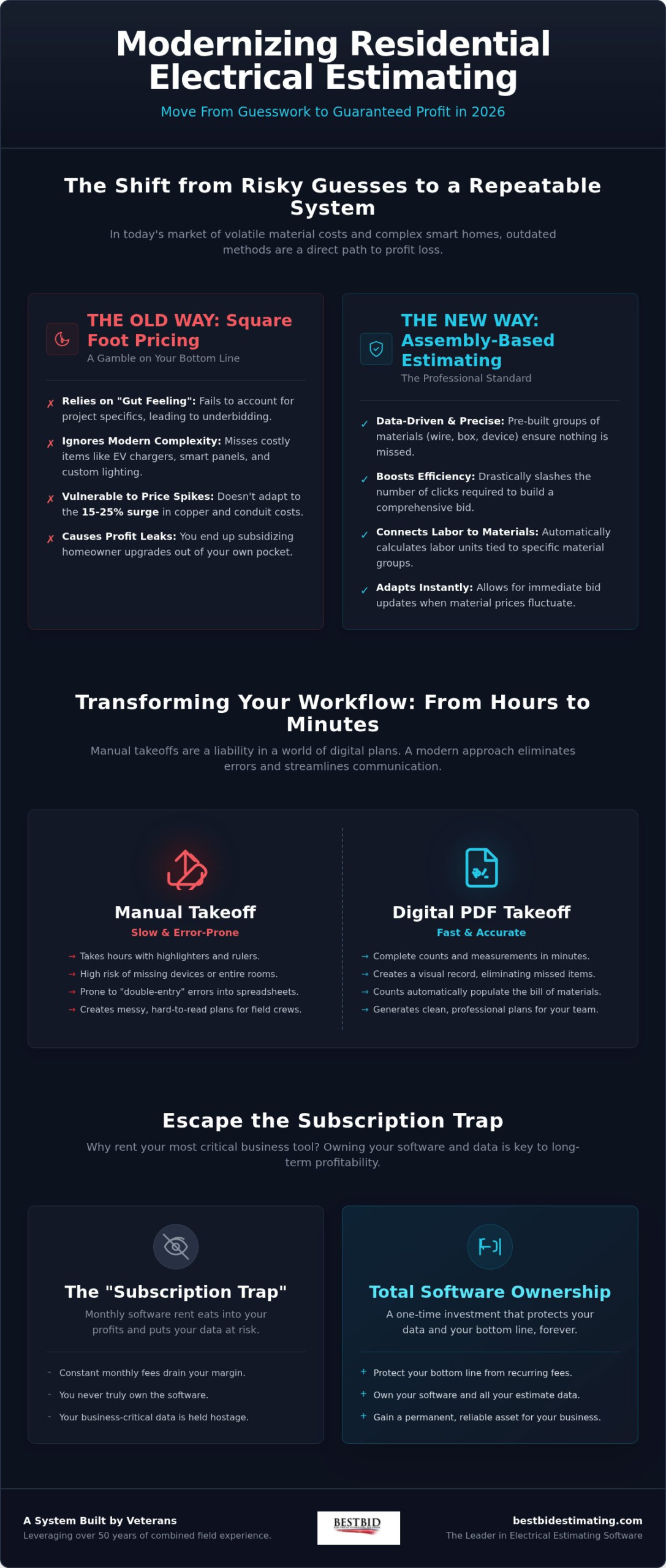
Many contractors still rely on the gut feeling of square foot pricing, but in 2026, that’s a fast track to a profit leak. While some general guides suggest this method is an industry standard, it fails to account for the actual cost estimation principles required for modern profitability. Relying on a fixed price per foot ignores the reality of 2026 code requirements and the 15% to 25% surge in copper and conduit costs driven by global demand. Today’s homes aren’t just boxes with outlets; they’re integrated technology hubs. When you guess, you lose.
Custom lighting packages and smart home integration have effectively broken the traditional pricing models. A 2,500 square foot home with basic builder grade fixtures has a completely different cost profile than the same sized home featuring automated shades, smart panels, and high end architectural lighting. If you aren’t bidding based on the specific count of these features, you’re essentially subsidizing the homeowner’s upgrades out of your own pocket. Professional residential electrical estimating requires a shift from a price-per-home gamble to a precise, data-driven mindset.
The Hidden Costs of Residential Service Upgrades
Modern electrical work must account for the massive demand for EV chargers and heat pumps. These aren’t simple add-ons; they often require full service upgrades and complex panel configurations that square foot models miss entirely. Steve Griffin, a Master Electrician with 50 years of experience, often notes that every estimator has a “first” mistake where they underbid a project by ignoring the small stuff.
Beyond the hardware, missing permit fees or the time spent on municipal inspections can evaporate your margin before the first wire is pulled. You need a system that captures these variables every time.
Assembly-Based Estimating: The Professional Standard
The professional standard for residential electrical estimating is moving toward assembly-based logic. An assembly is a pre-built group of materials, such as a complete 20A circuit that includes the specific wire, box, device, and plate. This approach offers several advantages over manual counting:
- It slashes the number of clicks required to complete a digital bid.
- It ensures that labor units are tied directly to material groups.
- It allows for instant updates when material prices fluctuate.
This method transforms your workflow from a “price-per-home” gamble to a repeatable, professional system. Assembly-based bidding ensures no wire nut or staple is left off the bill of materials. By using these pre-defined groups, you can produce a bid in minutes that is more accurate than one that took hours to calculate by hand.
Mastering Residential Digital Takeoff for Speed and Accuracy
Still using a highlighter and a scale ruler? In the fast-paced world of 2026 residential electrical estimating, that approach is a liability. High-volume residential work now moves almost exclusively through digital PDF plans. To keep up, you need a way to perform a residential takeoff in minutes, not hours. Digital counting tools allow you to mark devices and measure runs with a simple click, creating a visual record that eliminates the risk of missing a bedroom or a kitchen island.
By linking your takeoff directly to your estimate, you eliminate the “double-entry” errors that plague manual methods. When your digital count automatically populates your bill of materials, you know your numbers are solid. These PDF markups also serve as a communication tool for your field crews. Instead of a messy set of hand-marked plans, your team gets a clear, professional visualization of the circuit layouts, reducing on-site questions and costly rework.
The Advantage of Built-in On-Screen Takeoff (OST)
Many software providers treat on-screen takeoff as an add-on, forcing you to pay a “tax” for a third-party tool. We believe that’s an unnecessary burden on small project profits. With a “One-Click” transfer system, you move directly from a plan count to a final price without leaving the program. Discover how Best Bid Hybrid Pro includes built-in OST to streamline your workflow and keep your overhead low.
Calculating Branch Circuits and Feeders Automatically
Measuring wire runs digitally is a game-changer. You no longer need to guess the distance between the panel and the furthest bedroom. Modern tools measure these runs instantly while accounting for vertical drops in multi-story residential builds. This is critical for 2026 material costs, where every extra foot of copper wire impacts your margin. For those handling complex custom homes, Best Bid Next Generation offers the speed and precision required to stay competitive without sacrificing accuracy. This level of detail ensures your bid is grounded in reality, not just a rough estimate that might leave you short on materials.
Costing the Residential Project: Labor, Materials, and Overhead
What does it actually cost to keep your trucks on the road in 2026? Accurate residential electrical estimating requires looking far beyond the material invoice. You have to calculate your “True Labor Rate” to stay profitable. While a Journeyman may earn between $60 and $90 per hour, your billable rate must account for the “unbillable” reality of residential work. Travel time, site setup, and those long homeowner consultations about smart switch placement all eat into your day. If you don’t bake these hours into your base rate, you’re essentially working for free.
Overhead calculations must also include insurance, vehicle maintenance, and your office expenses. One area where you can actually claw back your margin is by evaluating your software costs. Instead of paying a perpetual “rent” that drains your project profits every month, owning your tools outright changes the financial health of your business. View pricing for Best Bid’s non-subscription software to see how a one-time investment compares to the thousands of dollars lost in recurring subscription fees over time.
Real-Time Pricing with NetPricer
Material volatility is a massive threat to your 2026 margins. With copper and conduit prices forecasted to rise by up to 25% due to data center demand, using six-month-old pricing is a recipe for disaster. You need a direct link to your local supplier’s actual shelf prices.
NetPricer integration allows you to pull real-time data into your estimate, ensuring your bill of materials reflects today’s market reality. This gives you 100% control over your database without the manual data entry grind that leads to errors.
Adjusting Labor Units for Difficulty
Not all hours are created equal. A rough-in for a new custom build is a completely different beast than an “old work” rewire in a cramped attic or a damp crawlspace. High-quality residential electrical estimating accounts for these difficulty factors by adjusting labor units based on the specific environment. Our “Assembly-Structure” workflow allows you to apply these factors instantly. If a project involves working in a 120-degree attic, you can adjust the labor factor for those specific assemblies to reflect the slower pace. This level of precision ensures you aren’t just winning bids; you’re winning bids that actually make money.
The ‘Subscription Trap’ vs. Total Software Ownership
How much is your software actually costing you? Most contractors don’t realize that a “standard” $150 monthly subscription translates to more than $9,000 per user over five years. When you’re managing tight margins in residential electrical estimating, that’s a massive drain on your cash flow. This is the “Subscription Trap.” It’s a model designed to keep you paying forever, often with the hidden threat that if you stop, you lose access to your historical data. We call this being a “Data Hostage.” If you can’t access your previous bids to defend a change order or reference a past project, you don’t truly own your business tools.
Contrast that with a one-time purchase model. For approximately $2,500, a single-location shop can secure a 5-user professional license. That is a permanent asset for your company, not a monthly liability.
Because we provide free support and updates for life, you never have to worry about your tools becoming obsolete or being hit with a surprise bill. It’s a straightforward, pro-contractor move that puts you back in the driver’s seat of your own finances.
Calculating the ROI of One-Time Licensing
Owning your software outright does more than just save you money; it improves your company’s valuation. When you go to sell your business or seek financing, owned assets look much better on a balance sheet than recurring “software rent” that never ends. Comparing the upfront cost of Best Bid to the endless payments of competitors reveals a clear winner in long-term ROI. Many professionals find that Why Small Contractors Choose No-Subscription Software comes down to this simple, unavoidable math.
Data Security and Local Control
Keeping your bids on your own hardware is fundamentally safer than trusting everything to a distant cloud server. You shouldn’t have to worry about a server outage or a third-party data breach when you’re trying to land a critical job. With 1-Click backups, you maintain total control over your intellectual property. You deserve the security of owning your bid data without third-party interference. This local control ensures your residential electrical estimating history remains yours, regardless of what happens to a software provider’s corporate strategy or pricing hikes.
Ready to stop renting your tools and start owning your future? Explore our professional estimating software today.
Choosing the Right Tool: 1st Choice vs. Hybrid Pro
Choosing the right tool is about matching your software to your daily workload. Too many companies treat residential work as “Commercial Lite,” but we know it’s a distinct, high-volume workflow. Whether you’re wiring 50 identical homes a year or bidding on a single $5 million custom estate, your software needs to reflect that reality.
If you’re a custom home builder, you need the depth of Best Bid Hybrid Pro to handle mixed-use projects or high-end architectural specs. If your focus is purely on speed and volume, 1st Choice is your go-to.
The goal is to reduce the learning curve for new estimators. You shouldn’t need a computer science degree to land a job. Our intuitive workflows ensure that you can move from a digital plan to a final price without getting lost in complex menus. This efficiency is what allows small shops to compete with the big guys without hiring a massive office staff. When your residential electrical estimating process is streamlined, you spend less time behind a desk and more time growing your business.
The 1st Choice Advantage for Residential Specialists
1st Choice is specifically designed for residential specialists who focus on production housing. It’s built for that overlooked segment of contractors who need to get in, count the devices, and get out with a professional bid. Once your counts are finalized, you can perform complete estimates in minutes. This speed is vital when you’re bidding multiple lots in a new subdivision where margins are thin and deadlines are tight. If your business model relies on speed and consistency, Learn more about Best Bid Next Generation to see how the latest features support high-volume growth.
Trench-Tested Training from Steve Griffin
Software is only half the battle. You also need the “trench-tested” wisdom to use it effectively. Steve Griffin, a Master Electrician with over 50 years of experience, founded the Online School for Electrical Estimating to help contractors avoid decades of unnecessary mistakes. This education goes beyond the software. It covers the practical realities of residential electrical estimating, including labor management and relationship building with general contractors.
Learning the art of the bid means understanding how to protect your profit when the GC asks for “one more quick change.” Through the Best Bid Academy, you gain access to a seasoned veteran’s perspective on how to handle 2026’s unique industry challenges. Check out our Electrical Estimating: 2026 Contractor Training Guide for a deeper look at how professional education can transform your bottom line. Integrating the right tools with expert-led training ensures you aren’t just guessing; you’re building a sustainable, profitable business.
Take Control of Your Profit and Your Future
The days of guessing on square foot prices are over. To thrive in 2026, you need a system that handles material volatility and complex smart home features with precision. Mastering residential electrical estimating means moving toward digital takeoff tools and assembly-based logic that protects every cent of your margin. You’ve seen how the subscription trap drains your cash flow; now it’s time to choose a permanent solution that grows with your business.
Best Bid was founded by Steve Griffin, a Master Electrician with over 50 years of experience, to give contractors the edge they deserve. Our software includes built-in OST and lifetime updates, all for a single one-time fee. There are no monthly payments to eat your profits and no cloud servers holding your data hostage. You deserve a tool that is an asset for your company, not a recurring liability on your balance sheet.
Stop Renting Your Software-Own Best Bid Residential Estimator for Life
You have the skills to do the work; it’s time you had the tools to get paid what you’re worth. We’re here to help you make that transition with confidence and clarity. Let’s get to work on building your most profitable year yet.
Frequently Asked Questions
Is residential electrical estimating software necessary for a solo contractor?
Yes, it is a critical investment for solo contractors who need to compete with larger firms. Software eliminates the manual calculation errors that lead to profit leaks and allows you to produce professional bids in minutes. Instead of spending your evenings with a calculator, you can use a system built by industry veterans to ensure your residential electrical estimating is accurate and competitive from day one.
How do I estimate a whole-house rewire accurately?
Accurate rewire estimates require a deep dive into “old work” labor factors and a precise material count. You must account for the difficulty of fishing wire through existing walls, attic access, and crawlspace conditions. Using an assembly-based workflow allows you to group devices, wire, and boxes into a single unit while applying a labor multiplier for the added difficulty of a rewire compared to new construction.
Does Best Bid software work for both residential and commercial projects?
Yes, our software suites are designed to handle the full spectrum of electrical work. While Best Bid Next Generation offers the fastest workflow for high-volume residential projects, it also contains the depth required for complex commercial bids. You can manage everything from a simple bedroom addition to a large-scale retail build-out within the same platform, maintaining total control over your material database and labor units.
Can I perform an on-screen takeoff with the residential estimator?
Absolutely. Unlike many competitors who charge extra for third-party tools, Best Bid includes built-in on-screen takeoff (OST) functionality. You can import PDF plans, count devices, and measure circuit lengths directly on your screen. This data transfers instantly to your estimate, which slashes the time spent on manual entry and ensures your material counts are always tied directly to the project blueprints.
What is the difference between Best Bid Next Generation and Hybrid Pro?
Best Bid Next Generation is our most advanced platform, optimized for the fastest possible workflow and maximum database flexibility. It is the top choice for single-location shops looking for the best value. Best Bid Hybrid Pro is a robust, stable version that remains a favorite for contractors who prefer a slightly different interface while still benefiting from built-in takeoff and real-time pricing integration. Both versions offer a one-time purchase model.
How do I calculate labor hours for a residential service upgrade?
Calculating labor for a service upgrade involves more than just the panel installation time. You must factor in the time for the service entrance cable, grounding, and bonding, along with “unbillable” time for permit acquisition and utility coordination. Professional software allows you to use pre-built assemblies for 200A or 400A services that automatically include these labor units, ensuring you don’t miss the small tasks that eat your margin.
Does the software include a database of residential materials?
Yes, the software comes with an extensive, unlimited database that is fully controllable by the user. It includes all standard residential materials, from Romex and plastic boxes to high-end smart home devices. You can also integrate real-time pricing through NetPricer to ensure your residential electrical estimating reflects the actual shelf prices at your local supply house, protecting you from 2026 material price spikes.
Are there any recurring fees for Best Bid technical support?
No, there are never recurring fees for technical support or software updates. When you purchase a license, you own it for life. This includes access to our support team and all future software updates at no additional cost. We believe in total software ownership, which means eliminating the monthly “rent” that many other providers use to trap contractors into endless payment cycles.