How to Reduce Stress During Electrical Bidding With Better Planning

A calmer electrical bid starts before the numbers do. Reducing stress during the electrical bidding process means reviewing the full bid package, setting aside time for a careful estimate, coordinating inputs, and checking general requirements and contract language before submission. Clear proposals and complete documents help prevent avoidable last-minute surprises.
It’s easy to focus on takeoff and pricing as a deadline approaches. But a missed addendum, unclear scope, or overlooked contract condition can create just as much pressure as a tight estimate. A little structure up front makes the work easier to track and decisions easier to explain.
This article walks through practical ways to plan your bid, review drawings and required forms, coordinate supplier and subcontractor quotes, and write a transparent proposal. It also shows why checking meeting requirements, Division 1 General Requirements, payment terms, substitutions, submittals, and the completion schedule belongs in your bid routine, not in a last-minute scramble.
Key Takeaways
- Screen each opportunity before committing estimating hours, and flag scope uncertainties and job risks early.
- Build a repeatable document check so required forms, wage considerations, and bid conditions don’t get lost in the rush.
- Bring supplier and subcontractor pricing into the estimate early to reduce late changes and coordination gaps.
- Make your proposal easy to evaluate by separating the core scope, exclusions, and optional alternatives.
- Use electrical estimating tools to organize takeoffs and calculations, leaving more time for careful bid and contract reviews.
1. Allowing adequate preparation time and assessing project risks
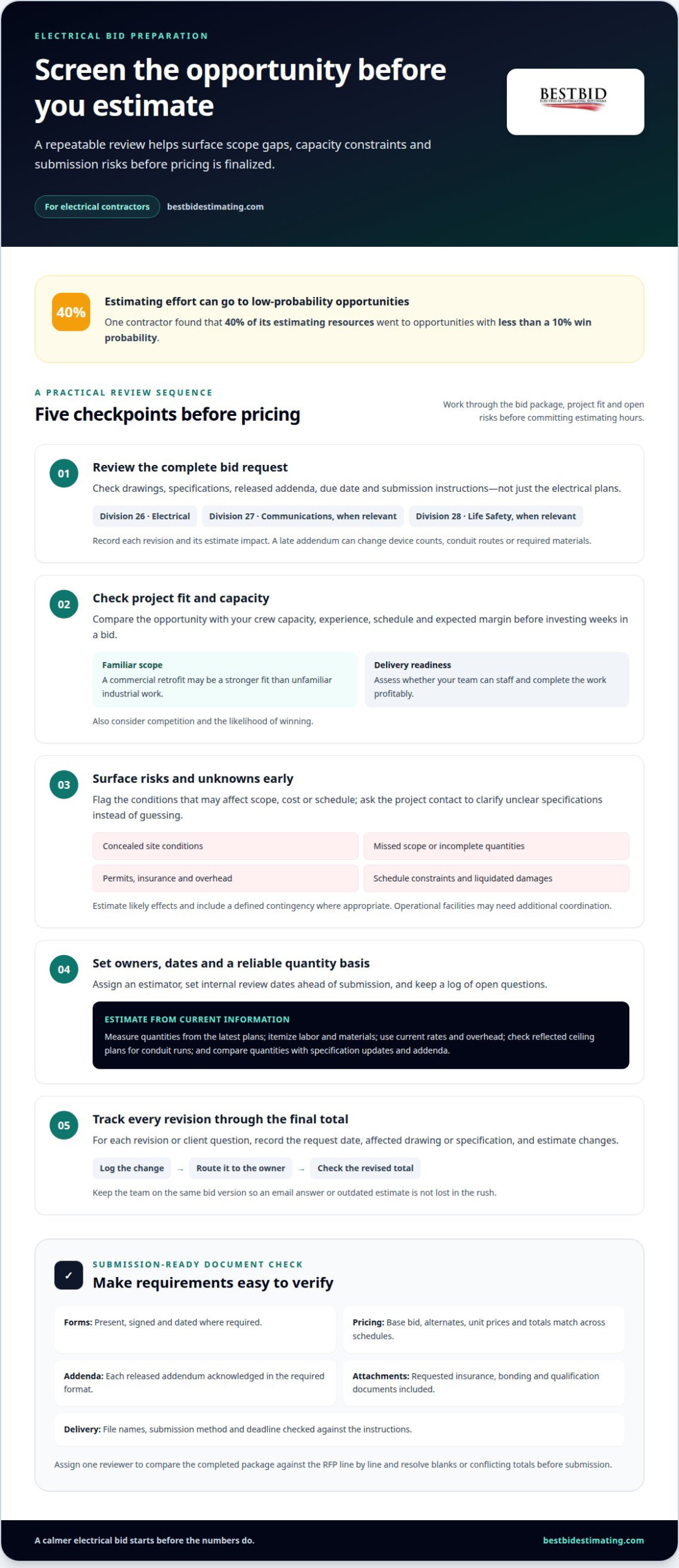
Start with the full bid request, not just the electrical plans. Review drawings, specifications, released addenda, the due date, and submission instructions before assigning estimating hours. Include Division 26 electrical documents, plus Division 27 Communication or Division 28 Life Safety when they affect the scope.
A late addendum can change device counts, conduit routes, or required materials. Record each revision and its effect on the estimate.
Select projects against your crew capacity, experience, schedule, and expected margin. Before investing weeks in a bid, assess whether the electrical contractor can staff and complete the work profitably. Compare the scope with completed jobs: a familiar commercial retrofit may be a stronger fit than a new industrial system requiring unfamiliar labor or project management.
Also consider competition and the likelihood of winning. One contractor found that 40% of its estimating resources went to opportunities with less than a 10% win probability.
What causes stress during the electrical bidding process? Compressed deadlines, incomplete information, late revisions, and uncertainty about labor, materials, and contract conditions all add pressure. A repeatable review sequence helps reduce stress during the electrical bidding process by surfacing issues before pricing is finalized.
U.S. licensing, bonding, and insurance requirements depend on the jurisdiction and project bid documents. Identify the applicable licensing criteria and any stated bond or insurance requirements in the solicitation, then assess whether your business can meet them before estimating the job.
To make preparation manageable, assign an estimator, set internal review dates ahead of the submission deadline, and keep a log of open questions. Ask the project contact to clarify unclear specifications rather than guessing what the drawings mean. For accurate labor and material estimates, measure quantities from the latest plans, itemize labor and materials, and use current rates and overhead. Check reflected ceiling plans for conduit runs, then compare quantities with specification updates and addenda.
Common risks include concealed site conditions, missed scope, incomplete quantities, permits, insurance, overhead, and schedule constraints. A subfloor condition such as mold can add thousands of dollars to a project budget. Identify risks, estimate their likely effect, and include a defined contingency where appropriate. Operational facilities may require additional coordination, while liquidated damages can increase schedule exposure.
For revisions and client questions, keep a dated record of each request, the affected drawing or specification, and any estimate changes. Route each update to the person responsible for pricing or scope review, then check the revised total before submission. This helps prevent an email answer from being lost or an outdated bid version from being sent.
2. Completing bid forms and required documents
A complete construction bid depends on more than a sound estimate. Treat the request for proposals (RFP) as a submission checklist, then assign every requested document an owner and completion date. Follow the instructions for format, signatures, attachments, delivery method, and deadline. A correct price can still be difficult to evaluate if a required schedule or signed form is missing.
Build one document register for each project. Record the RFP section, required item, responsible person, status, and final review date. Include the bid form, scope response, pricing schedule, addenda acknowledgments, and any requested qualifications or insurance documents.
If a form asks for a number that differs from the estimate, pause and reconcile the difference before submission. Keep final versions together so the estimator and reviewer work from the same package.
Labor compliance belongs in estimating, not as a final paperwork fix. According to the U.S. Department of Labor, the Davis-Bacon and Related Acts apply to federally funded or assisted construction contracts in excess of $2,000, affecting labor costs in electrical bids.
For a covered project, use the applicable wage determination and classifications when building labor costs. Check the RFP for the project’s funding and wage documentation, then carry the resulting labor assumptions consistently through the estimate and required forms.
Review the National Electrical Code (NEC) requirements named in the contract documents and project specifications. The bid should reflect the stated electrical scope and applicable standards, not rely on a generic template. For prevailing-wage work, compare the classifications in the project documents with the labor categories used in estimating. If the RFP asks for a compliance statement, answer directly and keep the statement consistent with the priced scope.
Before final review, check these common construction bid details:
- Confirm every requested form is present, signed, and dated where required.
- Match the base bid, alternates, unit prices, and pricing totals across all schedules.
- Acknowledge each released addendum in the format the RFP requires.
- Check that requested insurance, bonding, and qualification documents are attached.
- Verify file names, submission method, and delivery deadline against the instructions.
A successful submission makes compliance easy to see. Assign one reviewer to compare the completed package against the RFP, line by line, and resolve blanks or conflicting totals before sending it. A written checklist also helps new estimators learn the process; electrical estimating resources can support a more consistent document routine.
Electrical bids should account for applicable prevailing-wage requirements, including Davis-Bacon Act classifications. 32 states have prevailing wage laws for public construction projects, and the Davis-Bacon Act requires wage rate determination on all Federal Government construction projects. Check current prevailing wage rates where the project is located when estimating labor costs; overtime wage rates on construction projects can be as much as double the prevailing wage rate. Electrical contractors can also use software to check bids automatically for compliance with bid requirements.
3. Coordination with architects, engineers, and subcontractors
Coordination starts with a shared scope of work. Before pricing, compare the electrical drawings with architectural and engineering plans for conflicts affecting devices, pathways, access, or installation sequence. For example, a ceiling layout may place lighting where an HVAC plan shows ductwork.
Record sheet references and send a focused question to the project team. A clear answer gives the estimator a traceable basis for quantities and reduces late interpretation changes.
Give each coordination request an owner and a response date that leaves time for estimating. Track the question, affected drawing, response, and resulting bid adjustment in one log. When an architect clarifies a room layout or an engineer revises equipment requirements, update the estimate from the latest document, not an older email attachment. This helps the electrical contractor maintain accurate quantities and ensures the proposal reflects the scope discussed by the team.
Subcontractor and supplier quotes need the same scope discipline. Request pricing based on the relevant drawings, specifications, quantities, and schedule assumptions. For each trade to be subcontracted, seek bids from at least three companies, then compare coverage before totals.
A lower quote may exclude equipment, delivery, installation, or coordination tasks included elsewhere. Mark each exclusion and allowance so the estimator can identify gaps instead of carrying an incomplete number into the bid.
Prequalify subcontractors against the project’s actual demands. Review relevant work experience, proposed scope, schedule fit, and quote clarity. Focus the comparison on what each bidder will provide, not just the bottom line.
If one quote includes material and installation while another covers labor only, normalize the scope before deciding. This makes the subcontract amount more useful and protects the electrical contractor’s margin from hidden coverage differences.
Use a simple quote comparison record to keep decisions visible:
- Match each quote to the same drawing set and specification revision.
- Record included labor, material, equipment, and stated exclusions.
- Flag unanswered questions, allowances, and schedule assumptions.
- Assign a team member to resolve gaps with the supplier or subcontractor.
- Carry the selected quote and its scope notes into the estimate file.
Coordination with the project team matters after quotes arrive, too. Share relevant updates with the estimator and those responsible for pricing, then revise quantities only after checking the source document. For example, if an engineer changes equipment connections, note the revision and confirm whether conduit, wire, and labor quantities change. A consistent record keeps supplier pricing, subcontractor coverage, and electrical scope aligned, making the final bid easier to explain and defend.
4. Writing clear, transparent proposals
A proposal should let a reviewer understand the electrical scope, price, and assumptions without reconstructing your estimate. Open with a concise project summary and the work included. Then organize the details in the same order as the request for proposals. For example, separate lighting, power distribution, and fire alarm work when the bid documents treat them as distinct scopes.
State inclusions and exclusions plainly. If the price includes wiring and installation but excludes owner-furnished fixtures, say so beside the relevant scope. Separate optional services from the base project budget and label alternates clearly. This makes it easier to compare the base bid with other proposals and reduces the risk of a mistaken assumption becoming a dispute.
Use a consistent proposal structure: cover letter, scope of work, pricing breakdown, assumptions, exclusions, and requested supporting details. Keep quantities and descriptions aligned with the estimate. If the proposal lists a panel, identify the included work rather than relying on a vague phrase such as “electrical installation.” A reviewer should be able to trace each major amount to a recognizable part of the project.
Explain the technical approach in practical terms. Describe how the electrical work will coordinate with the project schedule, access conditions, and other trades. If the plans show conduit routes through a congested ceiling, describe the coordination approach without promising an outcome outside your control. Present value-engineering alternatives, such as a conduit substitution or lighting-control option, as separate choices with clear scope and pricing.
Project visuals can make a technical proposal easier to follow. Use a marked-up plan excerpt, device schedule, or simple scope diagram when it clarifies a route or equipment area. Tie each visual to a written explanation and drawing reference. A graphic should support the proposal, not introduce a different scope or contradict the specifications.
Before sending, compare the final proposal with the estimate and bid request. Check that totals agree, alternates are identified, and exclusions don’t conflict with the stated scope. Make sure every performance claim has a clear basis, such as documented on-time completion, budget adherence, or client feedback. Avoid unsupported claims: precise evidence builds a stronger professional relationship than broad promises.
A final review by someone who didn’t prepare the estimate can catch errors the estimator may overlook. Ask the reviewer to check scope coverage, arithmetic, terminology, and consistency between the cover letter and pricing pages. A clear proposal reduces clarification rounds and gives project management a reliable starting point if the work is awarded.
5. Checking general requirements and contract language
Electrical drawings define the work, but Division 1 General Requirements can define how the work must be delivered. Read those terms before finalizing labor cost, overhead, and schedule assumptions. Look for payment procedures, allowances, substitutions, submittal requirements, and completion schedules.
For example, a required submittal process can add coordination and project-management effort that a drawing takeoff won’t show. Carry each relevant condition into the estimate or proposal.
Check pre-bid meeting instructions first. If attendance is mandatory, a bidder who doesn’t attend isn’t allowed to bid on that project. Record the meeting date, attendance requirement, and any resulting clarifications in the bid file.
Then compare meeting notes with the RFP and contract documents. If a clarification changes the scope, reflect it consistently in the takeoff, pricing, and proposal rather than relying on an informal interpretation.
Contract language also affects whether a competitive price can be delivered profitably. Review how the contract treats payment timing, allowances, substitutions, and completion milestones. Compare those terms with supplier payment expectations, labor scheduling, and overhead allocation.
A tight completion schedule may require a different crew plan; a restricted substitution process may limit material choices. Identify the operational effect before deciding whether to pursue the bid.
Pay close attention to pricing structure. A unit price should account for labor, materials, overhead, and profit for the specified installation. An error in one unit calculation is multiplied each time that item appears, so verify the quantity and price basis together.
For time-and-material work, estimate carefully and define how labor and materials will be documented. A not-to-exceed clause can shift more cost risk to the contractor, so assess its effect before submitting.
Use a contract review record to connect each term with a pricing or delivery decision:
- Mark Division 1 requirements that affect schedule, submittals, payment, or substitutions.
- Record mandatory meeting details and distribute any clarifications to estimators.
- Match allowances and unit prices to the corresponding estimate assumptions.
- Flag clauses that may affect labor cost, overhead, material selection, or completion.
- Assign an owner to resolve each open term before bid approval.
Winning isn’t the only measure of a sound bid. A low number that overlooks a contract condition can erode margin after award. Have a second reviewer trace major assumptions from Division 1 to the estimate and proposal. Best Bid’s electrical estimating tools can support an organized estimating workflow; explore electrical estimating tools for your bid process.
Best Bid: Best Bid Next Generation
Best Bid Next Generation helps electrical contractors organize takeoffs, calculations, and detailed bids in one estimating workflow. Turn to it when manual quantity work slows estimates or makes project costs harder to keep consistent. Built-in on-screen takeoff, conduit and wire length calculations, and bid-building tools help translate plan measurements into bid quantities and organize the project breakdown.
Best Bid Hybrid Pro and Accura CADD PDF Draw offer additional tools for electrical estimating and drawing work. The Online School for Electrical Estimating provides training, and Freelance Estimating offers project-based estimating support. Choose the option that addresses your process bottleneck, whether that’s plan takeoff, bid preparation, or training.
Visit Best Bid’s electrical estimating resources to explore the available tools and support.
Make each bid easier to manage
Make estimating a process your team can improve with every project. After each submission, note where decisions slowed, which handoffs caused rework, and what information arrived too late. Use those observations to refine your workflow before the next request lands. A brief team review can turn a stressful exception into a clearer standard procedure.
A reliable way to reduce stress during the electrical bidding process is to give every bid a defined owner, visible status, and clear next action. Keep the system practical. Your team should be able to see what needs attention without searching through scattered messages or relying on memory. Small, repeatable improvements can make the work feel more controlled over time.
Ready to discuss how Best Bid can support your electrical estimating workflow? Contact Best Bid to discuss your project. Take the next step with a process that works better for your team.
Frequently Asked Questions
What software helps electrical contractors estimate and organize bids?
Electrical estimating software with on-screen takeoff and bid-building tools can help contractors manage quantities and costs in one workflow. Best Bid Next Generation includes built-in on-screen takeoff, conduit and wire length calculations, and tools for detailed bids. Its license is unlimited, with no extra charge for additional installations. Contractors can connect plan measurements with estimate items, then review the resulting bid before submission.
How can electrical contractors manage tight bidding deadlines and multiple requests?
Use a shared bid calendar and assign one owner to each request, with clear internal milestones for takeoff, pricing, review, and submission. Rank incoming opportunities by due date, scope fit, and available estimating capacity. If requests overlap, track their status in one place and reserve review time before the client’s deadline. This makes urgent work visible and helps prevent an unfinished estimate from crowding out a stronger opportunity.
How should electrical contractors evaluate bid opportunities before committing?
Compare each opportunity with your crew capacity, relevant project experience, schedule, and expected margin before committing estimating time. For example, a project requiring specialized controls may be a poor fit if your team lacks that experience or cannot meet its schedule. Consider the quality of the bid documents and your relationship with the general contractor, too. A simple go/no-go record helps explain why the team pursued or declined each request.
How can electrical contractors avoid underbidding while staying competitive?
Build the price from verified quantities and current labor and material inputs, then account for labor burden, overhead, and project-specific risks. Check unit prices against estimate quantities, since a small error can affect every repeated installation. Compare your proposal’s scope with the bid request before adjusting the total. Compete with a clear, complete offer rather than removing necessary costs that protect the job’s margin.