Industrial Electrical Estimating Software: The 2026 Professional Guide
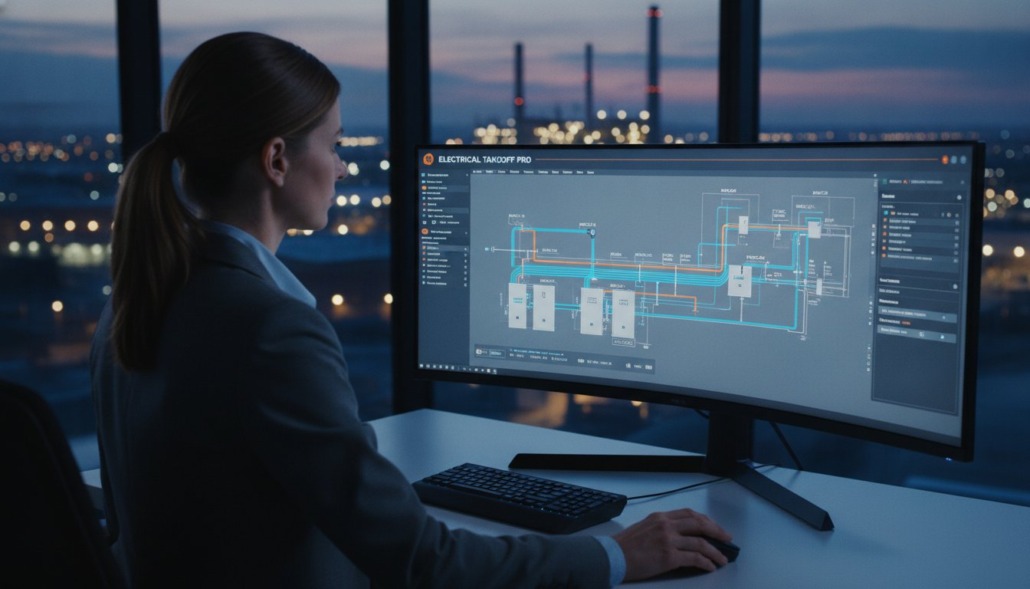
Your estimating software should be a permanent asset, not a monthly liability. It’s time to stop paying “rent” on the tools that run your business. Most industrial electrical estimating software today feels like an endless tax that grows every time you add a user.
You’re facing tighter margins and stricter NEC 2026 requirements, such as the new Article 120 load calculations or updated arc flash labeling. You don’t need another theoretical platform built by people who’ve never stepped onto a factory floor.
We understand the stress of overshooting labor costs on massive assemblies or watching profit margins vanish due to inaccurate takeoffs. This guide will teach you how to master industrial bidding and eliminate recurring software fees while increasing your estimating accuracy. We’ll explore how to achieve 100% ownership of your data, reduce bidding time for large-scale projects, and apply labor units with the precision of a seasoned field veteran. It’s time to move from the anxiety of manual processes to a modern, reliable system that you actually own.
Key Takeaways
- Identify the unique risks of industrial bidding, including hazardous locations and explosion-proof requirements, to ensure every complexity is covered in your estimate.
- Learn how built-in On-Screen Takeoff and advanced assembly morphing allow you to customize complex motor starters and industrial configurations on the fly.
- Discover the financial advantage of choosing industrial electrical estimating software with a perpetual license to eliminate the “subscription trap” and save thousands in recurring fees.
- Master a streamlined takeoff workflow that prioritizes site-specific labor rates and digital drawing tools to improve your bidding speed and accuracy.
- Understand why total software ownership is the key to achieving long-term financial clarity and independence for your electrical contracting business.
The Complexity of Industrial Electrical Estimating
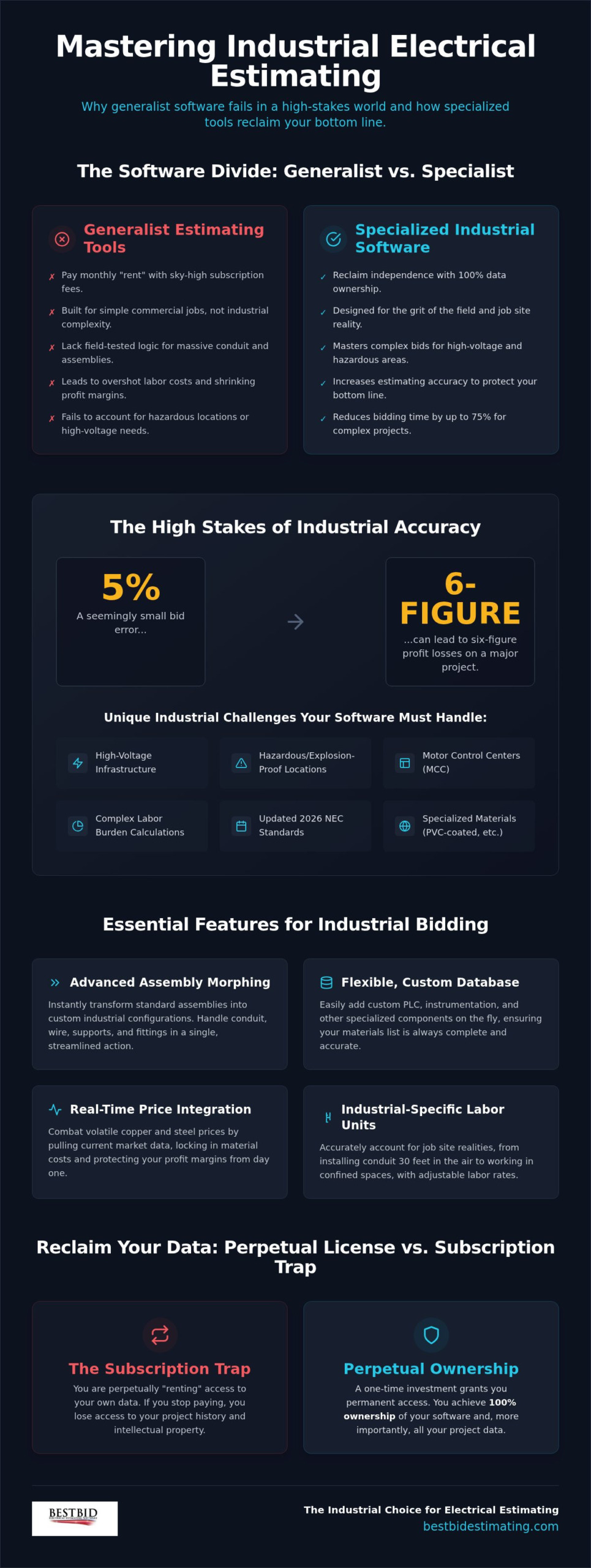
Industrial electrical estimating is the high-stakes science of forecasting costs for high-voltage distribution, complex motor control centers (MCCs), and heavy-duty infrastructure. Unlike commercial work, where you might be counting standard receptacles in a climate-controlled office, industrial projects involve hazardous environments and explosion-proof requirements that demand absolute precision. Does your current tool understand the difference between a standard commercial panel and a 4160V switchgear lineup? If your Construction estimating software treats a refinery the same way it treats a retail box store, you’re already in trouble. Generic tools often lack the specialized assemblies needed for rigid conduit systems or medium-voltage components, making specialized industrial electrical estimating software a necessity rather than a luxury.
Generic platforms force estimators to manually build complex items from scratch. This is a recipe for disaster when you’re bidding against tight deadlines. You need a system that recognizes the unique risks inherent in industrial sites:
- Hazardous Locations: Accounting for Class I, Division 1 fittings and specialized seals.
- Material Volatility: Tracking the fluctuating costs of stainless steel and PVC-coated rigid conduit (RMC).
- Rigid Systems: Managing the labor-intensive nature of threaded RMC installations compared to simple EMT.
Managing these material risks often requires a global perspective; for instance, many firms utilize Buying Office Asia as a procurement partner to source high-quality industrial components directly from Asian manufacturers while maintaining strict cost controls.
Why Industrial Bids Require Specialized Logic
The logic behind an industrial bid is dictated by the National Electrical Code (NEC) and the physical realities of the job site. For example, the 2026 NEC updates introduced stricter requirements for arc flash labeling under Section 110.16 and consolidated branch circuit load calculations into Article 120. Your industrial electrical estimating software must account for these nuances without requiring you to manually override every line item. Labor units aren’t static. They shift dramatically when your crew is working in confined spaces, using heavy-duty lifts, or operating in active production environments where downtime isn’t an option. Specialized logic ensures your labor units reflect the difficulty of the task, not just the quantity of materials.
The High Stakes of Industrial Accuracy
In the industrial sector, there is no room for “ballpark” figures. A minor 5% error on a large-scale project can easily translate into a six-figure loss, effectively wiping out your entire profit margin before the first reel of wire arrives. Field-tested software like Best Bid Next Generation mitigates this risk by automating conduit and wire length calculations based on real-world routing logic. You also have to accurately calculate the “Labor Burden” for specialized projects. Labor burden represents the total cost of employing a worker, including the mandatory safety certifications and specialized high-voltage training required for industrial facilities. Without this data, your bid is just a guess that could cost you your business.
Essential Features for Industrial Bidding Software
Bidding on a massive refinery or an automotive plant isn’t the same as quoting a commercial office build. The margin for error is razor-thin. To win these projects without losing your shirt, you need industrial electrical estimating software that works as hard as your field crews. You can’t afford to waste time flipping between a standalone takeoff tool and a separate estimating spreadsheet. Built-in On-Screen Takeoff (OST) is no longer a luxury; it’s a requirement. When your takeoff and your estimate live in the same ecosystem, every click counts. You eliminate the data entry errors that happen when you’re manually transferring counts from one program to another at 2:00 AM on bid day.
Speed is vital, but flexibility is what keeps you profitable. Industrial projects often require specialized components like PLCs, instrumentation, and explosion-proof enclosures that aren’t in a standard commercial database. Your software should allow you to add these custom items on the fly. More importantly, it should feature “Assembly Morphing.” This allows you to take a standard motor starter assembly and instantly transform it into a custom industrial configuration with NEMA 4X stainless steel housing and specific mounting hardware. Aligning your workflow with project management best practices begins with this level of granular accuracy during the pre-construction phase. For a broader look at how modern electrical estimating tools are reshaping the 2026 technology landscape for contractors, our comprehensive guide covers the full spectrum of integrated takeoff and bidding systems.
For specialized projects requiring custom-fabricated mounting panels or non-conductive guards, CNC Cut to Size offers precision cutting services that can be factored into your custom industrial assemblies for maximum accuracy.
Managing Complex Industrial Assemblies
Industrial work is built on assemblies. You shouldn’t have to click four times to add conduit, wire, supports, and fittings. A true industrial-grade system uses “One Assembly, Many Uses” logic. This means one click captures the entire bill of materials for a 100-foot run of PVC-coated rigid conduit. Because commodity prices for copper and steel are notoriously volatile, your software must integrate with services like NetPricer. This provides instantaneous material cost updates, ensuring your bid reflects this morning’s market prices, not last month’s data. If you want to see how this looks in practice, you can see the full feature list of a system built for this specific purpose.
On-Screen Takeoff for Heavy Industrial Plans
Measuring long conduit runs across massive factory footprints is a breeze when you have the right digital tools. Instead of using a scale and a highlighter, you can digitally trace runs and automate the count of complex components like explosion-proof light fixtures. This is where Best Bid Hybrid Pro really shines. It streamlines the process by keeping your drawings and your dollar amounts in one view. Unlike cloud-heavy competitors that lag when loading large PDF sets, a localized, fast database ensures you can navigate through hundreds of pages of industrial schematics without the “spinning wheel of death” slowing you down.
Subscription vs. Perpetual Licensing in the Industrial Sector
Why would you rent the tools you use to build your business? In the electrical trade, you own your benders, your trucks, and your testers. Yet, many contractors fall into the “subscription trap” when it comes to their industrial electrical estimating software. Software companies have shifted to a model where you never truly own your data. If you stop paying their monthly “rent,” you lose access to your bids. This creates a cycle of dependency that can drain your cash flow. When you analyze the math, a $500 monthly subscription for a single estimator adds up to $30,000 over five years. For a team of five, you’re looking at a $150,000 overhead expense just to keep your lights on. That’s dead money that could have been profit. If you’re actively searching for the best non-subscription alternative to Stack, you’ll find that moving to a one-time purchase model can protect your profit margins and eliminate the risk of losing access to your own historical bid data.
Best Bid advocates for a “Buy it and Own it” philosophy because we believe in contractor independence. Total ownership of your estimating data isn’t just about saving money; it’s about security. You shouldn’t have to worry about a software provider raising rates or changing terms in the middle of a busy season. There is a common myth that a lower price point must mean fewer features. This simply isn’t true. High-quality industrial electrical estimating software can include built-in On-Screen Takeoff (OST) and massive assembly databases without requiring a mortgage-sized monthly payment. You’re paying for the logic and the field experience built into the code, not for a corporate skyscraper’s overhead.
Financial Impact on Small to Mid-Sized Industrial Firms
For a growing industrial firm, predictable overhead is the key to scaling. Fixed software costs allow you to calculate your burden more accurately and protect your margins. When you own your license, you benefit from lifetime updates and support without a recurring bill hanging over your head. This stability is vital when bidding on long-term industrial contracts that might span several years. To see how these savings look for your specific team size, you can view a transparent breakdown on the Best Bid pricing page.
Accubid vs. Best Bid: The Value Gap
The cost difference between legacy enterprise systems and modern alternatives is staggering. A 5-user license for a competitor like Accubid can easily exceed $25,000 upfront, often followed by mandatory annual maintenance fees. In contrast, a full purchase of Best Bid Next Generation for a similar team sits around $2,500.
Beyond the price, consider the learning curve. Enterprise software is often unnecessarily complicated, requiring weeks of training just to navigate the interface. We believe “Enterprise” shouldn’t be a synonym for “complex.” A streamlined system with a low-to-medium learning curve allows your estimators to get back to what they do best: winning profitable work.
Optimizing Your Industrial Takeoff Workflow
Efficiency in the industrial sector isn’t just about moving fast. It’s about moving accurately without repeating your work. A chaotic workflow leads to missed fittings and blown labor budgets. To stay profitable, you need a repeatable process that bridges the gap between a set of blue prints and a final number. Your industrial electrical estimating software should facilitate this transition through a structured four-step approach. First, set up your industrial-specific labor rates based on site conditions. A chemical plant with explosion-proof requirements demands a different labor multiplier than a clean-room facility. Second, utilize digital PDF drawing tools for clear plan markups. This ensures your record-keeping is as precise as your installation.
Third, map your OST counts directly to your estimate without manual entry. Every time you re-key a number, you invite a typo that could cost you thousands. Finally, review your “Bid Day” summary to adjust for project-specific risks like accelerated schedules or limited site access. This bird’s-eye view is your last line of defense against a bad contract. If you’re ready to stop the manual data entry grind, you can streamline your industrial workflow today with tools built for the field.
Reducing Clicks with Assembly Logic
Don’t waste your afternoon hunting through a database of 50,000 individual items. Use the “morphing” feature to take a base assembly and adapt it to your specific needs on the fly. For repetitive industrial tasks like complex rack systems or multi-motor layouts, creating custom assemblies saves hours of clicking.
Automated wire length calculations prevent material waste by ensuring your conduit runs and conductor counts are mathematically aligned with the actual routing. This level of precision ensures you aren’t ordering extra copper that ends up in the scrap bin.
Training Your Team for Industrial Accuracy
Software is only as good as the person driving it. We’ve seen too many firms invest in high-end tools only to use 10% of the features. Field-based training is always superior to theoretical tutorials because it addresses the actual obstacles your team faces. The Online School for Electrical Estimating provides industrial-specific modules that teach estimators how to think like project managers. While industrial work has its own set of rules, you can see how it differs from other sectors by checking out our Residential Electrical Bidding Software guide. Understanding these differences helps your team appreciate the specialized logic required for heavy industrial industrial electrical estimating software.
Why Best Bid Next Generation is the Industrial Choice
Choosing the right industrial electrical estimating software isn’t just about comparing features on a spreadsheet. It’s about finding a partner that understands the dirt, the deadlines, and the danger of the industrial job site. Best Bid Next Generation wasn’t built in a Silicon Valley boardroom. It was designed by Steve Griffin, a Master Electrician with over 50 years of hands-on field experience. This background is the “Steve Griffin difference.” It means the software follows the logic of a real installation, not the theoretical flow of a corporate coder who has never bent a piece of rigid conduit. This practical approach is shared by professionals like an electrician Richmond TX who understands the nuances of field work. For single-location shops, this translates to a 5-star speed rating that allows you to turn around complex bids in hours instead of days.
Designed for the 99% of Contractors
While many enterprise platforms build their tools for global conglomerates, we focus on the 99% of contractors who are actually doing the heavy lifting. You need a system that is powerful yet practical. Best Bid Next Generation prioritizes ease of use with features like 1-Click backups and total database control. You shouldn’t need an IT degree to manage your industrial electrical estimating software data. If you want to see how a tool built for your specific needs can transform your business, you can explore the Best Bid Next Generation product page. It’s time to use a system that respects your time and your trade.
Transitioning to a No-Subscription Future
Are you worried about the data you’ve trapped in legacy systems? Transitioning to a no-subscription model is simpler than you think. We help you move your data from outdated enterprise tools so you can finally stop paying rent on your own expertise. There is a profound peace of mind that comes with owning your tools for life. You’ll never have to worry about a monthly bill or losing access to your project history. The path to financial independence and bidding accuracy starts with a single step. We invite you to schedule a demo or view our pricing today to see how we can help you reclaim your profit margins and secure your business’s future.
Secure Your Profit Margins and Your Independence
Industrial electrical projects don’t leave room for guesswork or recurring “rent” on your tools. You’ve seen how the right industrial electrical estimating software can transform a chaotic bid day into a streamlined, accurate process. By embracing a “Buy it and Own it” philosophy, you’re not just saving thousands in subscription fees; you’re taking total control of your business’s data and long-term security. Whether you’re navigating the complexities of NEC 2026 or building custom assemblies for a massive refinery, your software should be a permanent asset that works as hard as you do.
Achieving this level of operational control is just one part of building a resilient enterprise; for owners who want to ensure their company is prepared for a future transition, learn more about Significant Business Results and their expert coaching for the architecture and construction industries.
Beyond technical tools, successful firms also invest in leadership development and organizational evolution to stay ahead in a changing market; to explore training in executive and team coaching, discover Intact Academy.
Building a more efficient operation often involves looking at every aspect of your overhead; for instance, to see how high-quality synthetic turf can reduce your site maintenance requirements, check out EverTurf Inc.
Maintaining a safe and functional site also requires attention to subterranean infrastructure; for professional support with septic field installation and repair, discover Best Cistern Septic Solutions.
Ensuring your facility’s mechanical systems are also operating at peak efficiency is vital for long-term operational success; for expert plumbing and HVAC services, check out First Choice Plus Plumbing & Air.
Just as you prioritize the security of your business through better tools, it is equally important to have expert support for personal legal matters; for dedicated criminal defense in Michigan, discover Law Office of Kevin Bessant & Associates.
For contractors operating in the field who need a reliable partner for residential or commercial projects, satrackelectric.ca provides licensed and insured electrical services that uphold these same standards of professional excellence.
Maximizing business value also involves managing physical assets effectively; if you have surplus precious metals or high-value scrap from industrial projects, visit Houston Empire Gold Buyers to liquidate those items.
For contractors who want to extend their professional success to their own homes, creating a high-quality outdoor living space is a great way to unwind; learn more about Sage Pools, Scapes & Design and their custom backyard renovation services.
Best Bid is proud to be ranked #1 for “Best Value” among single-location electrical contractors. Our systems are built by a Master Electrician with over 50 years of field experience, ensuring every feature serves a practical purpose on the factory floor. It’s time to move toward a future defined by transparency, precision, and financial clarity with a one-time purchase that includes lifetime updates and support.
Stop paying for subscriptions and own your industrial estimating software today!
You have the expertise to win the job. Now, make sure you have the tools to keep the profit. We’re here to support you every step of the way.
Frequently Asked Questions
Can Best Bid handle heavy industrial assemblies like PLC cabinets or hazardous location wiring?
Yes, the system is specifically designed to manage complex PLC cabinets and hazardous location wiring. It includes pre-built assemblies for Class I, Division 1 environments and explosion-proof fittings that you can customize on the fly. This flexibility ensures you aren’t building every technical component from scratch when bidding on refineries or chemical plants.
Is there a monthly fee for the real-time pricing integration?
Best Bid does not charge a monthly subscription fee for our software or its core functionality. While third-party pricing services maintain their own terms, our “Buy it and Own it” model ensures you aren’t paying a recurring software tax just to access your own data. This approach provides the financial clarity that industrial firms need to manage long-term overhead.
How does the built-in on-screen takeoff compare to third-party tools?
Our built-in takeoff tool is faster and more accurate because it eliminates the friction of moving data between separate platforms. Standalone takeoff tools often require you to manually export counts or set up complex links to your estimate. With Best Bid, your measurements sync directly into your bid as you click, removing the risk of data entry errors during a high-pressure deadline. This unified approach keeps your focus on the project logic rather than managing file exports.
Does the software include a database for industrial-grade materials?
Yes, the software comes pre-loaded with an extensive database of industrial-grade materials. You’ll find specialized items like PVC-coated rigid conduit, medium-voltage switchgear, and stainless steel components ready for use. We’ve built this database using 50 years of field experience, so you don’t have to spend your weekends entering part numbers and labor units.
Can I use Best Bid on multiple computers within my estimating department?
You can use the software across multiple machines to support your whole team. For example, Best Bid Next Generation supports up to five users on a single license purchase. This allows your department to collaborate on massive industrial projects without the per-user monthly fees that make enterprise-level competitors so expensive over time.
Is there a learning curve for estimators moving from manual spreadsheets to Best Bid?
The learning curve is significantly lower than typical enterprise platforms because the system follows field logic. Since a Master Electrician designed the industrial electrical estimating software, the workflow mirrors how you actually install work in the shop and on-site. Most estimators find the transition from spreadsheets to be intuitive and fast.
Does Best Bid provide support for industrial-scale bid day adjustments?
Yes, the software features a specialized “Bid Day” summary for final, high-stakes adjustments. You can easily tweak labor multipliers for difficult site conditions or apply specific risk factors for accelerated industrial schedules. This gives you the final oversight needed to ensure your profit margins are protected before you hit the “send” button on a major proposal.
Is training available for my team to master industrial estimating?
Comprehensive training is available through our Online School for Electrical Estimating. We provide specific modules that focus on the technical side of industrial work, helping your team master everything from assembly morphing to digital takeoff. This training ensures your estimators are using the most efficient workflows to stay competitive in the 2026 market.