Advanced Electrical Estimating Techniques: The 2026 Masterclass for Contractors

Is your estimating software actually a partner in your success, or is it just another monthly bill that doesn’t account for the real-world grit of the job site? You know the drill: the plans are complex, the deadlines are tight, and a single missed labor factor can turn a winning bid into a massive financial loss. It’s time to stop the bleeding caused by subscription fatigue and the shrinking margins that come from underestimating the crew’s time. Mastering advanced electrical estimating techniques is no longer just about counting conduit; it’s about shifting your role from a manual takeoff person to a strategic estimator who owns their data and protects every cent of profit.
We understand the daily grind because we’ve been in the trenches ourselves. This masterclass promises to arm you with the high-level workflows and bulletproof labor factoring used by top-tier contractors to win complex commercial bids with confidence. You’ll learn how to leverage assembly-driven automation to slash your bid turnaround times while maintaining total control over your software tools.
We are covering everything from identifying hidden costs to using modern systems that put an end to the monthly subscription tax on your business. Get ready to transform your process into a precise, near-zero variance operation.
Key Takeaways
- Learn how to stop being a “takeoff person” and start acting as a strategic estimator who identifies risks before they eat your profit.
- Discover how advanced electrical estimating techniques like morphing assemblies can slash your takeoff time by 70% while improving accuracy.
- Move beyond basic “book labor” by applying field-proven multipliers that account for the real-world variables of complex commercial projects.
- Master the art of the scope letter and value engineering to position yourself as a professional partner rather than just another bid.
- See the long-term financial case for owning your software and database outright to eliminate the ongoing burden of monthly subscription fees.
From Takeoff Person to Strategic Estimator: The 2026 Paradigm Shift
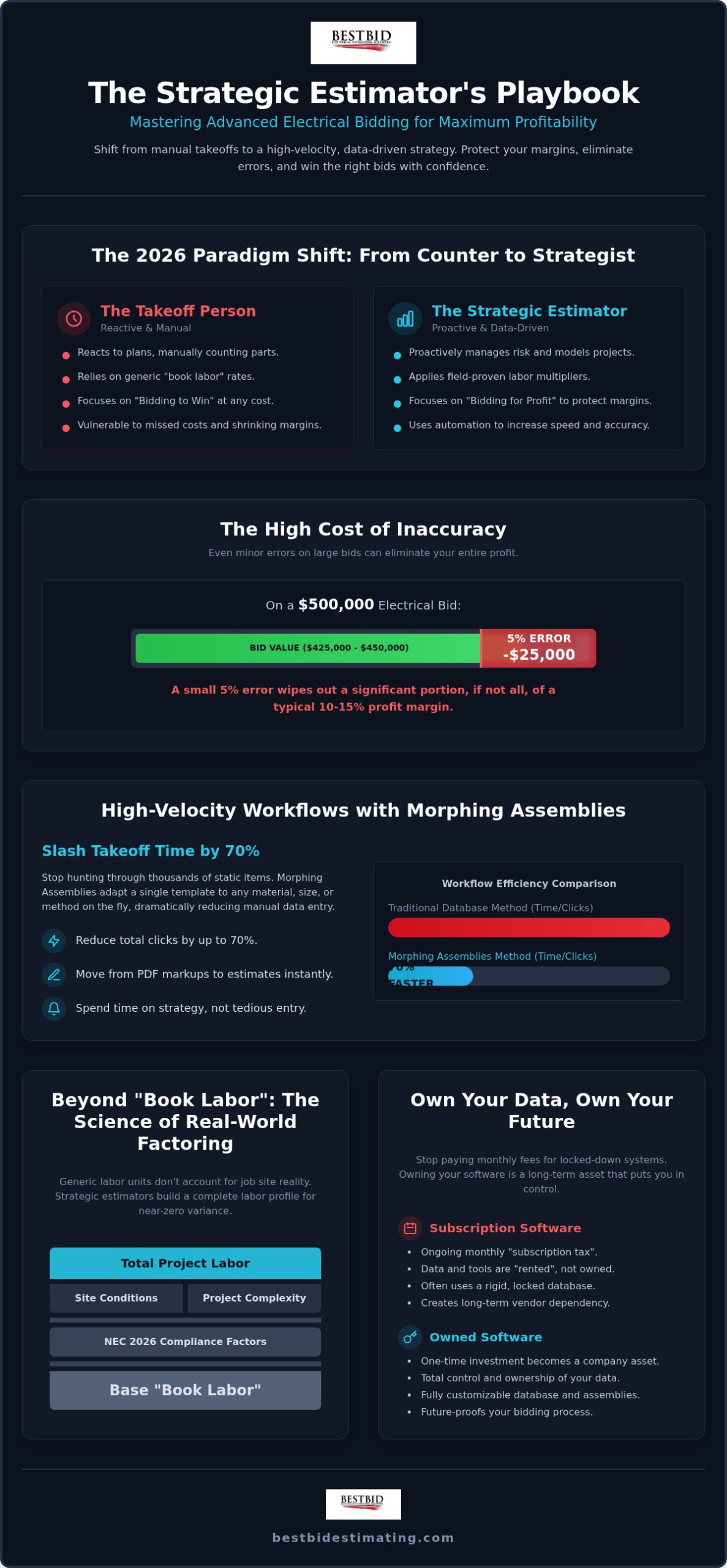
Are you simply counting parts, or are you securing your company’s future? In 2026, the line between a “Takeoff Person” and a “Strategic Estimator” has become the difference between a thriving business and one that’s barely breaking even. A takeoff person reacts to the plans; they count conduit, wire, and boxes, then hope the final number is high enough to cover the bills. This reactive approach often leaves money on the table because it misses the nuances of project flow and site-specific risks. By contrast, a strategic estimator uses advanced electrical estimating techniques to proactively manage risk, ensuring that the 10-15% profit margin typical of commercial work stays protected from erosion.
True success in high-value commercial and industrial bidding requires total ownership of your data. It’s about moving beyond the “book labor” provided by generic databases and applying real-world field experience to every line item. When you transition to a strategic mindset, you’re no longer just counting components. You’re building a financial model of the project that accounts for everything from material price volatility to the specific labor multipliers required for high-elevation work.
The Cost of Manual Errors in Large-Scale Projects
Accuracy isn’t just a goal; it’s a survival mechanism. Consider the impact of a minor 5% error on a $500,000 electrical bid. That’s a $25,000 mistake. For many contractors, that $25,000 represents nearly their entire projected profit. Old school manual methods struggle with the complexity of 2026 projects, where integrated systems and smart building technologies add layers of data that are easy to miss. Shifting your focus from “Bidding to Win” to “Bidding for Profit” requires applying established Cost Estimating Principles to every takeoff. This discipline ensures that your Best Bid Next Generation software is reflecting the reality of the job site, not just an idealized version of it.
NEC 2026 and Modern Compliance Factoring
The 2026 NEC updates have introduced significant shifts in labor requirements, particularly concerning grounding and bonding for renewable energy integrations. If your database isn’t updated to reflect these changes, you’re likely underestimating the labor hours required for compliance. Advanced estimators integrate these code updates into their workflow automatically.
They understand that a change in grounding requirements isn’t just a material change; it’s a labor-intensive process that requires specialized tools and testing. Advanced Estimating is the synthesis of field experience and data-driven precision. It’s the only way to ensure your bids are both competitive and profitable in an increasingly complex market.
High-Velocity Workflows: Mastering Morphing Assemblies and Integrated OST
Speed in 2026 isn’t just about typing faster; it’s about reducing the mechanical friction of your software. Traditional databases often require you to hunt through thousands of static items, wasting precious minutes on every line item. Using advanced electrical estimating techniques like “Morphing Assemblies” changes that dynamic entirely. These assemblies allow a single template to adapt to any material, size, or mounting method on the fly. By utilizing these dynamic structures, you can reduce your total clicks by 70% compared to traditional, rigid databases. This shift allows you to move from tedious PDF markups to real-time estimate generation almost instantly, ensuring you spend your time on strategy rather than data entry.
Building a Dynamic Database for 2026 Materials
A “locked” database is a bottleneck for any contractor aiming for high-margin projects. You need the flexibility to customize assemblies for modern trends like prefabricated components and modular construction. Instead of manually adjusting prices for every bid, integrating tools like NetPricer ensures your material costs reflect current market volatility. This level of precision is essential if you want to successfully estimate electrical tenders in a competitive environment where material prices can shift overnight. Don’t let an outdated database anchor your profit margins to last year’s costs.
Integrated On-Screen Takeoff (OST) Best Practices
Why deal with the lag and data transfer errors of third-party OST tools? When your takeoff and estimating functions live in separate programs, errors are inevitable. Integrated OST allows for automated counting in high-density lighting schedules, ensuring you never miss a fixture. It also handles the complex math for you, such as measuring linear runs with automatic vertical drops for conduit. This is a common area where manual estimators lose significant time and accuracy. Using Accura Cadd PDF Draw provides a seamless plan review experience, keeping your focus on the project’s physical reality rather than software troubleshooting. If you’re ready to stop fighting your tools and start winning more work, it’s time to explore how integrated software solutions can transform your daily workflow.
Precision Labor Factoring: The Science of Real-World Variables
Standard labor units are a great starting point, but they often assume a perfect world. In the field, you’re rarely working in a perfect world. Using advanced electrical estimating techniques means knowing when to apply the “Griffin Method,” a framework built on Steve Griffin’s 50 years of trade experience. This method moves beyond generic book labor by applying specific multipliers to account for the physical reality of the job site. Whether it’s the logistics of a high-rise or the slow pace of a hazardous environment, your bid must reflect the actual hours your crew will spend on their tools. If you rely solely on standard data, you’re likely leaving your profit margin to chance.
The Multiplier Framework for Complex Environments
Height is a primary profit killer that many estimators overlook. Working at 15 feet requires different equipment and significantly more time than ground-level installation. Site congestion and shared trade interference can slash productivity by 20% or more, especially in dense commercial projects. While NECA’s estimator training programs provide a solid foundation for understanding these variables, a strategic estimator builds these factors directly into their software. Establishing “Global Labor Adjustments” in Best Bid Next Generation allows you to scale a bid rapidly while keeping your labor hours grounded in reality. This ensures that site difficulty, multi-story logistics, and confined space premiums are automatically accounted for before the bid goes out.
Labor Management and the ‘Bid Day’ Strategy
The skill level of your specific crew matters just as much as the project specifications. A foreman with 20 years of experience in industrial controls will move faster than a general commercial crew on a complex PLC installation. Your “Bid Day” strategy should account for these differences, as well as the risks of accelerated schedules or mandated overtime.
Risk mitigation involves looking at the project holistically to determine if your crew can actually hit the estimated targets. The labor variable is the #1 cause of project failure. If you don’t own your labor data and understand how to adjust it for real-world conditions, you don’t own your profit margins.
Taking total ownership of these factors is what separates the top-tier contractors from those who struggle to stay in the black.
Advanced Bid Analysis: Risk Mitigation and Relationship Building
Winning a high-value contract isn’t just about being the low bidder. In 2026, it’s about being the most professional and risk-aware partner on the list. Top-tier contractors use advanced electrical estimating techniques to present a proposal that is transparent, defensible, and structured to protect both the owner and the contractor. This level of strategic bid analysis requires you to look beyond the bill of materials. You must identify red flags in large industrial RFPs, such as vague specifications or aggressive liquidated damages clauses, before they become a liability. By offering value engineering alternatives, you show the client that you’re focused on their bottom line without sacrificing your own profit margin.
Strategic relationship building with General Contractors (GCs) and owners is built on this foundation of transparency. When you provide a bid that clearly outlines where the money is going and why specific labor multipliers are necessary, you build trust that “part-counters” simply can’t match. This proactive communication style positions you as an expert consultant rather than just another sub-contractor. It’s the difference between fighting for every change order and being the first person a GC calls for their next complex project.
The Anatomy of a Bulletproof Scope Letter
Your scope letter is your primary legal and financial shield. It defines exactly what is included in your price and, more importantly, what is not. Clearly defining exclusions is the only way to avoid the “back charges” that eat away at your 10-15% profit margin. By using Best Bid Academy principles, you can learn to negotiate better terms by explicitly stating your assumptions about site access, storage, and shared trade interference. Don’t leave your scope to the imagination of the GC; document it with precision.
Bid Day Management for Large Contracts
Bid day is often a whirlwind of last-minute supplier adjustments and finalizing material quotes. Maintaining version control is critical during these final hours. A “1-Click Backup” strategy ensures that you can always revert to a previous version of the estimate if negotiations take an unexpected turn. If your internal team is overwhelmed by a sudden influx of large RFPs, you can always look into when to hire a freelance electrical estimator to manage the overflow without sacrificing accuracy. Handling these final moments with a modern system allows you to stay calm and focused on the strategy rather than the math. If you’re ready to take total ownership of your bidding process, it’s time to upgrade your estimating software to a system built for 2026 realities.
Future-Proofing Your Bidding: The Financial Case for Ownership
How much are you really paying to access your own data? Many contractors fall into the trap of the “Subscription Tax,” where recurring monthly fees quietly drain profit margins year after year. If you’re paying several hundred dollars a month for the privilege of bidding on work, you’re essentially renting your company’s future.
When you choose a one-time purchase model, you aren’t just buying a tool; you’re building equity in your business. Total ownership of your database is a strategic asset that increases your company’s valuation because it represents a permanent, high-performance capability that doesn’t disappear if you stop paying a bill.
The financial contrast is stark. A 5-user license for Best Bid Next Generation costs approximately $2,500. Compare that to the $15,000 to $75,000 range of other major industry players once you factor in their initial costs and ongoing fees. By eliminating those recurring burdens, you can reinvest that saved overhead into mastering advanced electrical estimating techniques and scaling your operations. This is how top-tier contractors stay lean and profitable while their competitors are weighed down by bloated software costs and monthly overhead that never ends.
The ROI of Non-Subscription Software
A “Buy it and Own it” model means your software is a permanent part of your operational infrastructure. This approach improves your company’s valuation by keeping fixed costs low and ensuring your bidding data remains your property forever. We provide lifetime updates and support because we’re committed to your long-term success, not your monthly payment. If you’re currently using general-purpose takeoff tools and are ready for a dedicated electrical solution, making the switch is a critical step toward professional precision. You can find more details on how this transition works in our software FAQ. You deserve a system that grows with you without charging you more for the privilege.
Continuous Education through Best Bid Academy
The best software in the world is only 50% of the equation; training is the rest. Our advanced modules focus on the practical realities of the trade, including labor management, risk mitigation, and business growth strategies. We built the Best Bid Academy to ensure you have the skills to match your tools, helping you transition from a takeoff person to a strategic business leader. By mastering advanced electrical estimating techniques, you’re not just winning jobs; you’re winning back your time and financial freedom. Don’t let your growth be limited by your tools or your training. Take your skills to the next level at the Online School for Electrical Estimating.
Take Total Ownership of Your Profit Margins
The transition from a simple takeoff person to a strategic estimator is the most important move you can make for your business in 2026. By mastering advanced electrical estimating techniques, you’re no longer just guessing at labor or fighting with rigid databases. You’re building a precise financial model that accounts for real-world site variables, height factors, and code compliance. This level of mastery allows you to bid with the confidence of an industry veteran and the speed of a modern tech leader. You’ve seen how morphing assemblies and integrated OST can slash your manual workload, leaving you more time to focus on risk mitigation and relationship building.
We believe you should own the tools that power your success. Founded by Steve Griffin, a 50+ year industry veteran, our system includes built-in OST and offers lifetime updates without the burden of recurring fees. It’s time to invest in your company’s permanent assets rather than renting your workflow. Stop paying the ‘Subscription Tax’ and own your electrical estimating software today. Your future bids depend on the accuracy and ownership you establish right now. Let’s get to work and win those high-margin contracts together.
Frequently Asked Questions
What is the difference between a takeoff person and a professional estimator?
A takeoff person focuses on counting parts and linear footage, while a professional estimator analyzes the entire project for risk and profitability. Strategic estimators use advanced electrical estimating techniques to identify potential site bottlenecks and labor challenges before they impact the bottom line. This shift in mindset moves your business from reactive bidding to proactive profit management. It ensures that every quote accounts for the practical realities of the job site, not just a list of materials.
How do I adjust labor factors for high-rise or multi-story electrical projects?
You should apply specific labor multipliers to account for the added time spent on logistics, vertical transportation, and material handling in multi-story projects. Standard book labor assumes a ground-level environment, which doesn’t reflect the reality of a high-rise site. By using global labor adjustments within your software, you can automatically increase labor hours for work performed at height or in congested areas. This ensures your bid remains accurate as the project scales vertically.
Can I use Best Bid software without paying monthly subscription fees?
Yes, you can use Best Bid software with a one-time purchase fee and absolutely no recurring monthly subscriptions. We believe in total ownership, which is why your license includes lifetime updates and technical support at no extra cost. This model eliminates the subscription tax that many competitors charge, allowing you to keep more of your hard-earned profit. It’s a straightforward approach designed by an electrician for electricians who value financial clarity and long-term commitment.
What are morphing assemblies and how do they speed up the bidding process?
Morphing assemblies are dynamic templates that allow a single assembly to adapt to any material, size, or mounting method instantly. Instead of searching through a database of tens of thousands of static parts, you simply select the base assembly and adjust the variables on the fly. This technique reduces total clicks by approximately 70% compared to traditional methods. It drastically speeds up the takeoff process while maintaining the precision needed for complex commercial bids.
How does integrated on-screen takeoff (OST) compare to using PlanSwift or Bluebeam?
Integrated on-screen takeoff (OST) eliminates the data transfer lag and potential errors that occur when using third-party tools like PlanSwift or Bluebeam. Because the takeoff and estimating functions live in the same program, your measurements and counts flow directly into the bid with a single click. This seamless connection ensures near-zero variance between your plan markups and the final estimate. It provides a more efficient workflow that keeps you focused on the project rather than software troubleshooting.
Is there a specific technique for estimating labor in confined spaces?
Estimating labor for confined spaces requires applying a specific premium multiplier to account for restricted movement and required safety protocols. Workers in these environments often face reduced productivity due to limited access and the need for specialized equipment or monitoring. Using advanced electrical estimating techniques, you can build these hazardous environment factors into your database. This ensures that the extra time required for setup, ventilation, and safety checks is fully covered in your labor total.
How often should I update my material database for advanced bids?
You should update your material pricing as often as the market shifts, which is why real-time integration with tools like NetPricer is essential. In a volatile economy, relying on a database that is even a few weeks old can lead to significant margin erosion. By connecting your software directly to supplier data, you ensure that every bid reflects current market costs. This practice protects your profit from sudden price spikes and keeps your commercial bids competitive.
What is the best way to handle ‘Bid Day’ pressure for a $1M+ project?
The best way to handle high-stakes pressure is to have a reliable system for version control and a clear 1-Click Backup strategy. When last-minute supplier quotes or scope changes arrive, you need to be able to adjust your bid without losing your previous work. Training from the Best Bid Academy can also provide the leadership skills needed to manage these stressful moments. Having total confidence in your data allows you to stay calm and focused on winning the contract.