When to Hire a Freelance Electrical Estimator

How many six-figure projects did you let slip through your fingers last month because you simply didn’t have the hours to count every conduit and coupling? It’s a painful reality for contractors who find themselves buried in blueprints while their profit margins bleed out through rushed, inaccurate material counts. You know the high-stress chaos of “bid day” crunches all too well.
It feels like you’re constantly choosing between sleep and growth. Understanding exactly when to hire a freelance electrical estimator can be the turning point between a business that’s barely keeping its head above water and one that’s scaling with precision.
We’ve been in the trenches and understand that your expertise is best used on the job site, not second-guessing a takeoff at 2:00 AM. This guide will help you discover the specific trigger points when outsourcing your bidding process saves your margins and how to transition from overwhelmed to organized. We’ll provide a clear framework for when to outsource so you can scale your bidding capacity without the burden of increasing fixed overhead. It’s time to move from manual survival to modern efficiency.
Key Takeaways
- Learn how to identify the “Owner-Estimator Trap” so you can recognize exactly when to hire a freelance electrical estimator before your field oversight and profit margins begin to suffer.
- Discover why “Whale” projects and specialized systems like EV infrastructure require a tactical shift in your bidding strategy to avoid costly material count errors.
- Compare the true cost of a senior estimator’s salary against freelance fees to see how to scale your capacity without the weight of permanent overhead and benefits.
- Master the “Trench Test” to vet freelance partners for real-world field experience, ensuring your bids are grounded in practical reality rather than just software data.
- Understand how to use freelance services as a strategic bridge toward total process ownership and long-term in-house efficiency.
Recognizing the Tipping Point: Why Electrical Contractors Outsource Bidding
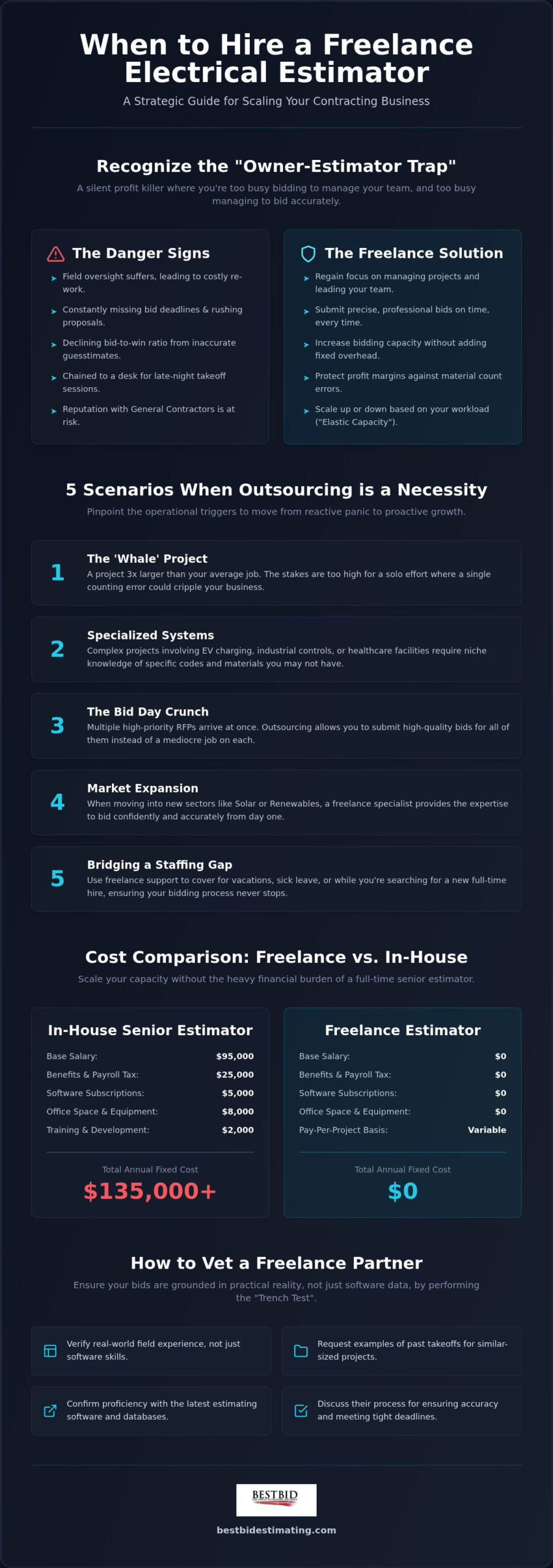
The “Owner-Estimator Trap” is a silent profit killer that creeps up on growing electrical shops. You started your business to lead teams and build high quality projects, yet you find yourself spending every evening squinting at PDF blueprints. If your field oversight is suffering because you’re chained to a desk, you’ve officially reached the tipping point.
When you aren’t on-site, small mistakes by your crew turn into expensive re-work. This creates a vicious cycle where you’re too busy bidding to manage, and too busy managing to bid accurately.
Analyzing your bid-to-win ratio often reveals the damage. Are you missing deadlines or submitting rushed proposals that leave money on the table? Guesstimating might have worked for small residential flips, but it’s a dangerous game in the current market. With the volatility expected throughout 2026, material pricing and labor units are moving faster than manual spreadsheets can track. Knowing when to hire a freelance electrical estimator isn’t about giving up control. It’s about acknowledging that a professional takeoff is the only way to protect your margins against fluctuating costs.
The True Cost of a Missed Bid
Every project you don’t have time to look at represents an opportunity cost that could fund your growth for years. A single missed “whale” project can be the difference between a stagnant year and a record breaking one. Beyond the immediate numbers, late submissions destroy your reputation with General Contractors.
GCs need reliable partners who hit deadlines every time. A single accurate takeoff performed by a pro doesn’t just win a job; it can literally pay for an entire year of freelance support by catching material count errors that would have bled your profit dry during construction.
Capacity vs. Overhead: The Freelance Advantage
Hiring a full-time estimator is a massive financial risk for shops doing under $5M in annual revenue. Between the senior-level salary, benefits, office space, and software subscriptions, you’re looking at a huge fixed cost that doesn’t disappear when the bidding cycle slows down. Utilizing electrical estimating tools through a freelance partner gives you “elastic capacity.” You can scale up during heavy bid months and scale back when the schedule is full. This model allows you to transition away from manual calculations while keeping your overhead lean. It serves as a perfect bridge until your volume justifies a permanent in-house hire, ensuring you only pay for the results you need.
- Eliminate the “Bid Day” Panic: Stop the 2:00 AM office sessions.
- Increase Accuracy: Move beyond “ballpark” figures to precise counts.
- Protect Your Reputation: Never miss a GC’s deadline again.
- Field Focus: Get back to the job site where your leadership matters most.
5 Critical Scenarios When You Should Hire a Freelance Electrical Estimator
Identifying the exact moment to step back from the takeoff software isn’t always easy. Most contractors wait until they’re already drowning. By pinpointing specific operational triggers, you can strategically decide when to hire a freelance electrical estimator before the situation becomes an emergency. It’s about moving from reactive panic to proactive growth. Here are five scenarios where outsourcing isn’t just a convenience; it’s a necessity for protecting your bottom line.
- The ‘Whale’ Project: When a bid crosses your desk that’s three times larger than your average job, the stakes are too high for a solo effort. One counting error on a project of this scale can bankrupt a mid-sized shop.
- Specialized Systems: Modern projects involving EV fleet charging, industrial controls, or complex healthcare facilities require niche knowledge. If you aren’t up to speed on specific NEC 2023 or 2026 requirements for these systems, you need a specialist.
- The Bid Day Crunch: We’ve all seen it. Three high-priority RFPs land in the same week. Trying to handle all three in-house usually means you’ll do a mediocre job on all of them instead of winning the best one.
- Market Expansion: Thinking about moving into Solar or Renewables? Use a freelancer to test the waters. It’s a low-risk way to bid on new sectors without committing to a permanent salary.
- Staffing Gaps: Whether it’s a sudden illness, a planned vacation, or the long search for a new hire, don’t let your bidding pipeline dry up just because a desk is empty.
Handling Complex Industrial and Commercial Bids
Large-scale industrial projects are a different beast. The sheer volume of conduit and wire length calculations can overwhelm even a seasoned owner. These projects demand a level of precision that manual methods simply can’t provide. Modern commercial compliance is also getting tougher as more jurisdictions adopt NEC 2023 and 2026 standards. A professional freelancer uses the logic found in Best Bid Next Generation to handle complex assemblies and multi-layered systems. This ensures every coupling and support is accounted for, leaving no room for profit bleed. If you’re feeling unsure about a technical takeoff, it’s a great time to explore professional freelance support.
Emergency Support for High-Volume Bid Cycles
Sometimes you only have a 48-hour window to turn around a massive proposal. Integrating a freelancer into your workflow during these crunches requires clear communication. You provide your local labor rates and specific preferences, and they handle the heavy lifting of the takeoff. This partnership works best when the freelancer understands the practicalities of the trade. For design-build projects, having a pro who can handle the drafting side ensures your proposal looks as professional as your work. Pairing your estimating workflow with professional electrical shop drawing software gives your submissions the polished, code-compliant documentation that separates winning bids from the rest. It’s the difference between a “maybe” and a signed contract from a General Contractor. Choosing when to hire a freelance electrical estimator can be as simple as looking at your calendar and realizing your current capacity can’t meet the deadline without sacrificing quality.
Freelance Fees vs. In-House Salary: A 2026 Cost Comparison
Deciding when to hire a freelance electrical estimator often comes down to a simple math problem. In the current market, a senior electrical estimator commands a base salary between $80,000 and $120,000. For many mid-sized shops, that’s a massive pill to swallow. When you factor in “The Invisible Costs”, including health insurance, 401k matching, payroll taxes, office space, and specialized equipment, that $100,000 employee actually costs your business closer to $130,000 or more annually.
The beauty of the freelance model is that it transforms these heavy fixed costs into manageable variable costs. Instead of a massive monthly overhead that drains your cash flow even during slow periods, you move to a “Pay-Per-Bid” system. This shift ensures you only spend money when there’s a specific opportunity to make money. It’s a tactical way to protect your margins while you build the volume necessary to eventually justify a full-time seat. Contractors who want to maximize every dollar spent on outsourcing should explore professional electrical bid preparation services that combine expert takeoff support with a system designed to help you win more work in 2026.
Software Subscriptions: The Hidden Profit Killer
Many contractors overlook the ongoing burden of software fees. Most major competitors lock you into “Forever Fees” that can easily top $5,000 per year for a single user. Over a five-year period, you’ve handed over $25,000 just for the right to use your own data. We believe in a different approach. Choosing a one-time fee model for your electrical estimating software changes your ROI calculation forever. A $2,500 one-time license outperforms those expensive subscriptions within the first six months. Plus, with free lifetime updates, your in-house capacity grows without a recurring bill attached to it. The same subscription-free philosophy applies when choosing electrical panel schedule software, where a one-time investment in professional documentation tools can eliminate recurring costs that quietly drain your annual margins.
The Freelance ROI Formula
To find your break-even point, look at your annual bid volume. If you aren’t bidding at least $10M to $15M in work per year, a full-time senior estimator will likely sit idle too often to earn their keep. For commercial contractors, there’s a strategic way to offset these costs.
You should define the “Bid Fee” as a reimbursable pre-construction expense in your proposals. This allows you to pass the estimating cost directly through to the project for commercial clients. By using freelance support as a bridge, you can scale your capacity safely until your win-rate and volume stabilize.
It’s about building a foundation of permanence and financial clarity rather than drowning in monthly subscriptions.
- Fixed vs. Variable: Stop paying for downtime and only pay for the bids you need.
- Eliminate Overhead: No extra office space, insurance, or payroll taxes required.
- Total Ownership: Buy your tools once and stop the “subscription bleed” that kills profits.
How to Vet a Freelance Electrical Estimator for Accuracy
How do you know if the person looking at your plans actually knows how to bend pipe? Most general freelance platforms are flooded with “data entry” estimators who have never stepped foot on a job site. This is where the “Trench Test” becomes your most valuable vetting tool. You should never hire someone who hasn’t worked in the field. An estimator with trade experience understands that a blueprint is just a suggestion. The real world involves structural obstacles and code complexities that software alone cannot solve. When deciding when to hire a freelance electrical estimator, their ability to visualize the physical installation is what protects your profit from disappearing in the field.
Accuracy also depends heavily on the tools they use. Ask if they are proficient in on-screen takeoff for electrical plans. A professional should be using sophisticated systems that allow for real-time pricing integration through services like NetPricer. If they are manually entering prices from a six-month-old catalog, your bid is already obsolete before you hit send. You also need to clarify database ownership. Ideally, they should use a standardized database that you can eventually import into your own system to maintain consistency across all your projects.
Questions to Ask Before Sending the Plans
Don’t just hand over the PDF and hope for the best. Start with these specific questions to gauge their technical depth:
- Can you navigate Master Electrician-level code requirements for this specific jurisdiction?
- Will the final report be compatible with my current software for easy importing?
- Can you provide value engineering suggestions to lower the bid without sacrificing quality?
A true partner doesn’t just count parts. They help you strategize the win by identifying more efficient ways to run a circuit or stack a rack.
Verifying the Takeoff Quality
Trust but verify. Even the best freelancer can miss a detail during a 48-hour turnaround. Spot-check high-volume items like conduit runs and major assemblies. If the counts look too “round” or don’t align with common-sense field logic, dig deeper. This is where resources like Best Bid Academy come in handy. We don’t just provide services; we train your team to recognize exactly what a high-quality takeoff looks like. A fast turnaround is great, but it should never sacrifice the depth of the estimate. If you’re ready to see the difference field-tested expertise makes, get started with our professional freelance estimating services today.
Scaling Your Business: From Freelance Support to Process Ownership
Most contractors view outsourcing as a temporary fix for a busy season. We see it differently. Using freelance electrical estimating services is actually the most effective training ground for your future in-house team. It allows you to observe how a professional takeoff is structured, how assemblies are built, and how labor units are applied without the risk of a bad hire. Knowing when to hire a freelance electrical estimator is the first step toward building a department that you eventually own outright. It’s about using expert support to stabilize your cash flow so you can invest in your own permanent infrastructure.
The transition from “Outsourced” to “In-House” becomes much easier when you use the same tools as the pros. This is the Best Bid Advantage. When your freelancer uses our logic and you eventually move that work to your own desk, the data transfer is seamless. You aren’t learning a new language; you’re just taking the wheel of a system you already understand. This path leads to a subscription-free estimating department where you own your data, your tools, and your time. It’s the ultimate cure for the overhead bloat that keeps so many electrical shops from reaching the next level of wealth. If you’re ready to build that internal expertise, enrolling in an online school for electrical estimating gives your team the structured curriculum to master modern bidding without the cost of a full-time hire. Complementing that training with the right electrical shop drawing software ensures your team can produce professional CAD-quality documentation that meets 2026 NEC standards without the burden of expensive monthly subscriptions.
The Best Bid Growth Path
We’ve designed a logical progression to help you move from overwhelmed owner to organized executive. This isn’t a theory; it’s a practical roadmap used by successful contractors across the country.
- Step 1: Outsource the “Whales” and complex industrial projects to our professional services to protect your margins while you stay in the field.
- Step 2: Purchase Best Bid Next Generation for your daily bidding to build your internal database and expertise.
- Step 3: Eliminate monthly overhead and own your software forever, ensuring every dollar of profit stays in your pocket rather than going to a software subscription.
Final Checklist for Your Next Bid
Before you open that next set of plans, run through this quick evaluation to decide if it’s time to call in reinforcement. Your time is your most valuable asset. Don’t waste it on a bid you aren’t equipped to win.
- Evaluate the deadline: Is there enough time for an accurate internal takeoff, or will a rushed bid lead to “profit bleed” later?
- Evaluate the complexity: Does this project require specialized “trench” knowledge or technical systems you haven’t tackled before?
- Evaluate the opportunity: Is this a client you’ve been trying to impress? A professional takeoff shows a level of sophistication that wins over General Contractors.
Whether you need a one-time takeoff to get through a crunch or you’re ready to stop the subscription madness and own your process, we’re here to help. Get a professional estimate or own the software today and start building a more profitable future.
Take Control of Your Bidding Future
We’ve explored the critical triggers that signal it’s time to step away from the desk and back into the field. Whether you’re staring down a “whale” project or simply trying to escape the crushing overhead of a six-figure salary, knowing when to hire a freelance electrical estimator is about protecting your hard-earned margins. It’s the strategic bridge between being an overwhelmed contractor and a scaled business owner who truly owns their process. You shouldn’t be held hostage by manual takeoff methods or exploitative monthly fees that drain your cash flow every single month.
With over 50 years of field experience, we understand that you need more than just data entry; you need precision that only a veteran can provide. Our systems feature built-in on-screen takeoff to ensure every count is grounded in reality. Most importantly, we’ve eliminated the burden of monthly subscription fees, giving you a permanent path to financial success.
You don’t have to choose between growth and your sanity. It’s time to move toward a more organized, profitable future where you are in total control of your data and your destiny.
Stop struggling with bids-Own your software or hire a pro today!
Frequently Asked Questions
How much do freelance electrical estimators typically charge?
Fees vary based on the complexity of the project and the depth of the required takeoff. Most professionals provide a project-based quote rather than an hourly rate. This gives you financial clarity before the work begins. These fees are often structured as a flat rate per bid package, allowing you to factor the cost directly into your pre-construction budget without any surprises.
Is it better to hire a freelancer or use electrical estimating software?
The most successful contractors use both as part of a long-term growth strategy. Freelancers provide the “elastic capacity” needed during high-volume cycles, while owning your own software builds permanent internal equity. This hybrid approach helps you decide when to hire a freelance electrical estimator based on your current schedule rather than a lack of technical tools. It ensures you aren’t always paying for downtime.
What information do I need to provide to a freelance estimator?
You need to provide a complete set of digital blueprints, specifications, and any issued addenda. It’s also vital to share your local labor rates and specific material preferences. Clear communication regarding your crew’s installation methods ensures the final estimate reflects your actual field operations. Providing these details upfront prevents generic counts that don’t align with your real-world costs.
Can a freelance estimator help with value engineering?
Yes, an estimator with deep roots in the trade can identify significant savings during the takeoff process. They look for opportunities to streamline conduit runs or suggest alternative materials that meet NEC requirements. This proactive strategy helps you submit a more competitive proposal while protecting your margins. It’s a key advantage of working with someone who understands the practicalities of the job site.
How do I know if a freelance electrical estimator is accurate?
Accuracy is verified by spot-checking high-volume material counts and comparing labor units to your historical project data. A professional should provide a detailed breakdown that shows exactly how every assembly was calculated. If the counts are too “round” or lack detail, it’s a sign they might be guesstimating. Always look for a partner who can explain the logic behind their numbers.
Do freelance estimators use my labor rates or their own?
Professional estimators should always use your specific labor rates and burden to ensure the bid is accurate for your shop. They’ll typically ask for your crew’s average hourly cost before they start the takeoff. If an estimator relies solely on national averages, the bid won’t reflect your actual overhead. This distinction is vital when deciding when to hire a freelance electrical estimator for a high-stakes project.
What is the turnaround time for a professional electrical bid?
Turnaround times usually range from 48 hours to a full week depending on the project’s scale. While emergency support can handle tight deadlines, providing more lead time allows for a deeper analysis of the specifications. Rushing a complex bid increases the risk of material count errors. It’s best to engage a freelancer the moment you decide to pursue a specific RFP to ensure the highest quality results.
Will I own the digital takeoff files after the project is complete?
You should always receive full ownership of all digital takeoff files and reports once the project is finished. This data is essential for your project managers to track material orders and labor progress if you win the contract. Owning these files ensures you have a permanent record of the bid logic. Always confirm this ownership upfront so you aren’t locked out of your own project data later.