Electrical Bid Profit Margin: Contractor’s Guide

Why does it feel like you’re winning the contract but losing the business? You’ve spent hours on a takeoff, accounted for every stick of conduit, and yet the money in your bank account at the end of the job doesn’t reflect the sweat you put in. It’s a common trap in this trade.
You’re competing against “trunk slammers” who don’t know their costs, while you’re left wondering if your own math is actually protecting your bottom line. With copper prices jumping 32 percent year-over-year, guessing on your numbers is no longer an option.
We understand the daily grind of the electrical industry because we’ve been there. It’s time to stop guessing and start using a repeatable formula that ensures every project covers your overhead and delivers the net profit you deserve. This guide will walk you through the essential math of bidding, from calculating a fully burdened labor rate to mastering the difference between markup and profit margin.
We’ll also show you how to use a professional electrical bid breakdown template to catch the hidden costs that often slip through the cracks. By the end of this article, you’ll have the tools to bid with confidence, knowing that your numbers are backed by precision and industry expertise.
Key Takeaways
- Learn why confusing markup with profit margin is a recipe for empty bank accounts and how to target the net profit your business actually deserves.
- Identify the hidden overhead costs that most contractors miss, ensuring your break-even point is accurate before you ever add a profit percentage.
- Master a repeatable bidding formula using a professional electrical bid breakdown template to account for rising material prices and fully burdened labor rates.
- Eliminate “margin killers” like manual transfer errors and guesstimated conduit lengths that can quietly strip 10% or more from your bottom line.
- Discover how tools like Best Bid Next Generation automate complex calculations so you can bid faster without the burden of monthly subscription fees.
The Markup vs. Profit Margin Confusion: Why Most Electrical Bids Fail
Most electrical contractors work themselves to the bone only to find their bank accounts surprisingly empty at the end of a big project. It’s a frustrating cycle, but it’s rarely caused by a lack of hard work. Usually, it’s a math problem.
Many professionals in this trade use the terms “markup” and “profit margin” interchangeably, but confusing the two is a shortcut to insolvency. If you don’t understand the difference, you’re likely leaving thousands of dollars on the table without even realizing it.
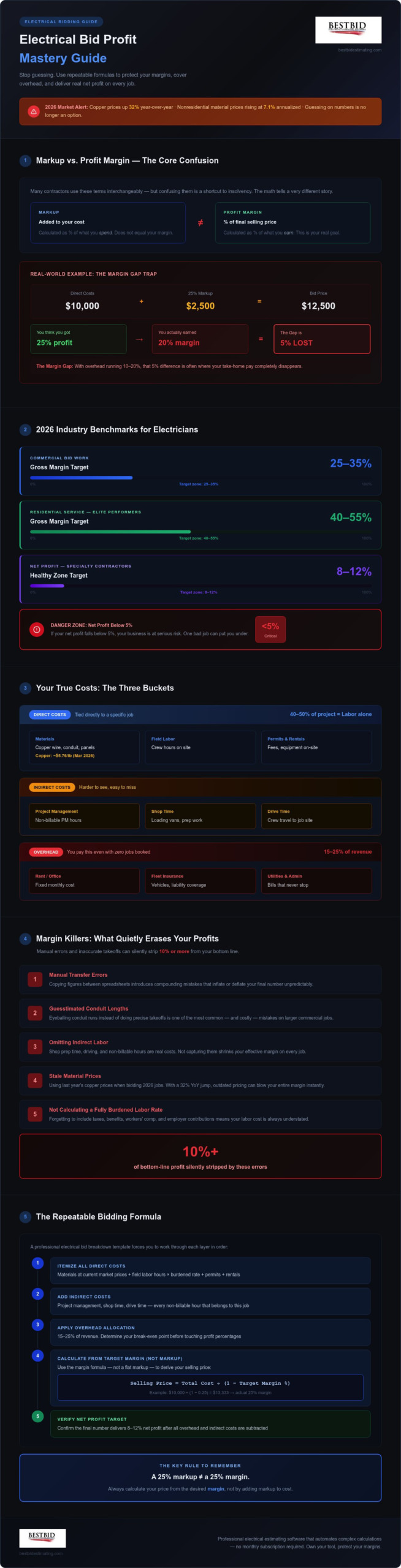
Let’s get the definitions straight. Profit margin is the percentage of the final selling price that remains after all costs are paid. Markup, on the other hand, is the percentage you add to your direct costs to arrive at that selling price. They might sound like two sides of the same coin, but the math tells a different story. If you want a 20% profit margin on a job, adding a 20% markup won’t get you there. It’s a trap that catches even seasoned veterans.
Consider a real-world example. Imagine you have a project where the materials, labor, and permits cost you exactly $10,000. You decide you want a 25% profit, so you apply a 25% markup.
You bid the job at $12,500. At the end of the project, you have $2,500 left over. You might think you hit your 25% goal, but your actual margin is only 20% ($2,500 divided by $12,500).
That 5% difference is the “Margin Gap,” and in a world where overhead typically runs between 10% and 20%, that gap is often where your take-home pay disappears.
Why Markup Leads to Underbidding
When you bid using only markup, you’re calculating based on what you spend, not what you earn. This creates a shrinking profit pool. As your costs for things like copper wire or specialized switchgear rise, a static markup percentage fails to keep pace with the total revenue needed to sustain your business. This is why a professional electrical bid breakdown template is so critical. It forces you to calculate based on the desired margin, ensuring that every dollar of overhead is covered before you even think about your net profit.
The 2026 Industry Benchmarks for Electricians
In 2026, the stakes are higher than ever. Nonresidential material prices have increased at an annualized rate of up to 7.1%, and copper has seen year-over-year price jumps of 32%. To stay healthy, you need to aim for these targets:
- Commercial Bid Work: Aim for a gross margin of 25% to 35%.
- Residential Service: Elite performers are seeing 40% to 55% gross margins.
- Net Profit Goal: A healthy zone for specialty contractors is 8% to 12%.
If your net profit falls below 5%, your business is in the danger zone. Using an electrical bid breakdown template that accounts for these 2026 benchmarks allows you to build in the necessary buffers for material volatility and labor shortages. Don’t just bid to win; bid to grow.
Defining Your True Costs: Direct Labor, Materials, and Overhead
Winning a bid is easy if you’re the cheapest guy in the room. Staying in business while being the cheapest is the hard part. To protect your profit, you have to move beyond “guesstimating” and start itemizing every single penny that leaves your business. Your costs fall into three distinct buckets: direct, indirect, and overhead. If you aren’t using a professional electrical bid breakdown template to track these, you’re essentially flying blind.
Direct costs are the obvious expenses tied to a specific job. This includes materials like copper wire, which reached approximately $5.76 per pound in March 2026, and field labor. In the current market, labor costs constitute about 40 to 50 percent of total project expenses.
Don’t forget permit fees and specialized equipment rentals. If it’s physically installed on the job site, it’s a direct cost. Indirect costs are slightly more elusive.
Think about project management time, non-billable shop time, and the hours your crew spends loading the van. These hours are still “work,” and if you don’t account for them, they’ll eat your margin alive.
Overhead is the silent killer. These are the costs you pay even if you don’t have a single job on the books. Rent, fleet insurance, and utility bills don’t care about your schedule.
For most electrical contractors, overhead ranges from 15 to 25 percent of revenue. To bid accurately, you must convert these annual expenses into a “fully burdened” hourly rate. Most successful shops in 2026 find they need to charge between $85 and $150 per hour to cover these burdens and still see a profit.
Calculating Your Annual Overhead Rate
Start by categorizing your fixed expenses like office rent and variable expenses like fuel. Divide your total annual overhead by your total billable hours for the year. This gives you the “burden” you must add to every labor hour you bid. Using Best Bid Next Generation makes this process seamless by allowing for global labor adjustments. You can update your burden across all projects instantly, ensuring your bids always reflect your actual cost of doing business.
The Impact of Software Subscriptions on Overhead
Many contractors suffer from “death by a thousand cuts” due to monthly software subscriptions. These recurring fees inflate your permanent overhead and make you less competitive on tight-margin bids. We advocate for a “Buy it and Own it” model. By choosing software with a one-time purchase price, you eliminate a recurring fixed cost from your electrical bid breakdown template. This transition from traditional subscriptions to modern efficiency keeps your overhead low and your profit potential high. If you’re ready to stop paying rent on your tools, it’s time to explore a permanent software solution that works as hard as you do.
Step-by-Step: How to Calculate Your Target Electrical Bid Profit Margin
Once you’ve identified your true costs, it’s time to assemble the bid. This isn’t about throwing a dart at a board and hoping for the best. It’s a methodical process that ensures your business stays solvent while remaining competitive. If your electrical bid breakdown template is built correctly, these five steps will become second nature.
Step 1: Total all Direct Costs. Start with the hard numbers. Sum up your materials, field labor, and any subcontractors. In 2026, with copper trading around $5.76 per pound, don’t rely on last year’s pricing. Use current market data to ensure your starting point is accurate.
Step 2: Apply your Overhead Multiplier. As we discussed in the previous section, your overhead is the cost of staying in business. Apply your calculated burden to the direct costs. This number represents your break-even point. If you bid below this, you’re paying the customer to let you work.
Step 3: Determine your desired Net Profit. This isn’t a fixed number. For a straightforward residential panel swap, you might aim for a higher margin. For a high-risk industrial project with complex controls, you’ll need to adjust your profit expectations to account for potential “unknowns” that could eat into your bottom line.
Step 4: Use the Division Method. This is where most contractors fail. Instead of adding a percentage to your costs, you must divide your total costs by the inverse of your desired margin. This ensures your profit is a percentage of the selling price, not just the cost.
Step 5: Sanity check the bid. Look at the final number. Does it align with revenue-per-electrician benchmarks for your area? If the total seems wildly high or suspiciously low, go back to your electrical bid breakdown template and check your labor units. Accuracy at this stage prevents a “winning” bid from becoming a financial nightmare.
The Division Method vs. The Addition Method
Never just add 10 percent to your total cost and call it a day. If your total cost is $8,000 and you want a 20 percent margin, adding 20 percent ($1,600) gives you a bid of $9,600. However, $1,600 is only 16.6 percent of $9,600.
To get a true 20 percent margin, you divide $8,000 by 0.80, which equals $10,000. That $400 difference is the “margin gap” that pays for your next service van.
Factoring in Risk and Contingency
Complex projects require a difficulty multiplier. If you’re working in a high-security facility or a hazardous industrial environment, your labor efficiency will drop. Furthermore, material price volatility in 2026 remains a threat. We recommend using real-time pricing tools like NetPricer to keep your estimates current. For more details on how to integrate these tools into your workflow, refer to the Best Bid FAQ. Protecting your margin means planning for the reality of the job site, not just the ideal scenario.
Margin Killers: Why Inaccurate Takeoffs Erase Your Profits
You can spend hours fine-tuning the formulas in your electrical bid breakdown template, but those formulas are only as good as the data you feed them. Inaccurate takeoffs are the silent killers of profitability. They don’t just happen because of bad math; they happen because of a broken process. If your initial counts are wrong, even the most sophisticated margin calculation will result in a loss.
The most common culprit is the “Transfer Error.” This happens every time you move a number from a set of prints to a yellow notepad, and then from that notepad into a spreadsheet. Every manual touchpoint is an opportunity for a typo or a miscalculation. If you miss a single zero or misread a digit, your profit margin evaporates before the first wire is pulled. It’s a manual burden that modern contractors simply shouldn’t have to carry.
Guesstimating is another major leak. Many contractors “eyeball” conduit lengths or forget to account for the specialized fittings and assemblies needed for complex runs. This lack of precision leads to an average margin erosion of 5 to 10 percent.
When you combine this with labor slips, where you rely on theoretical labor units instead of field-tested data, you’re essentially bidding on a fantasy. Your crew’s actual performance in the field rarely matches the “perfect world” scenarios found in generic estimating books. You need a system that reflects the reality of the daily grind.
The Power of Built-in On-Screen Takeoff
Using third-party on-screen takeoff (OST) software often creates data silos. You have to export data from one program and import it into another, which brings us right back to the risk of transfer errors. We believe in a more streamlined approach. By using tools with built-in OST, you eliminate the middleman. You count items and measure lengths directly on the screen, and those numbers flow instantly into your estimate. This creates a digital audit trail that protects your margin and saves you hours of manual labor. For a deeper look at the tech that makes this possible, check out our comprehensive guide to electrical estimating tools for 2026.
Real-Time Pricing Integration
Relying on last year’s pricing is a recipe for a 0 percent margin in 2026. With copper trading at approximately $5.76 per pound as of March 2026 and nonresidential input prices sitting 44.5 percent above their 2020 baseline, accuracy is non-negotiable. Tools like NetPricer automate this by pulling real-time material costs directly into your electrical bid breakdown template. Accuracy in your costs is the only way to ensure accuracy in your profit. If you want to see how automation can stop the bleed in your business, explore our professional estimating solutions today.
Scaling Profitability with Best Bid: Own Your Estimating Software
Scaling your electrical business shouldn’t mean scaling your monthly expenses. Many software companies in this industry want to treat you like a tenant, charging you “rent” every month just to access your own data. We take a different approach. We believe that a contractor’s tools should be an asset, not a recurring liability. By choosing a one-time purchase model, you permanently lower the overhead costs we calculated in previous sections, giving you a massive competitive advantage on every electrical bid breakdown template you submit.
Ownership is only half the battle; the other half is accuracy. Best Bid Next Generation is designed to automate the complex margin math that often leads to human error. Instead of wrestling with spreadsheets or manual “Division Method” calculations, the software handles the burden. It integrates your labor units, material costs, and overhead multipliers into a seamless workflow. This ensures that the net profit you plan for is the net profit you actually see at the end of the job. Plus, with lifetime updates, your estimating process stays sharp as industry standards evolve without another bill hitting your desk.
Training is the final piece of the puzzle. It doesn’t matter how good your software is if you don’t understand the fundamentals of the trade. That’s why we created Best Bid Academy.
We take electricians who know the field and turn them into master estimators who know the numbers. It’s about replacing the stress of manual takeoff with the security of a modern, reliable system that’s been proven in the trenches for decades.
Why Best Bid is the Best Value for Single-Location Shops
If you’re running a small to mid-sized shop, every dollar counts. High-priced subscription competitors often build features for massive corporations that you’ll never use, yet they charge you for them every month. Our “Buy it and Own it” philosophy is a bold disruptor to that exploitative model.
Every feature in our software is built on Steve Griffin’s 50 years of experience as a Master Electrician. The learning curve is low, meaning you can get your first profitable bid out the door in days. It’s practical technology built by people who actually understand the daily grind of the trade.
Next Steps: Taking Control of Your Margins
Stop letting your profits slip through the cracks of a messy electrical bid breakdown template. Take action today to secure your business’s future. Start by evaluating your current overhead using the formulas we provided. Then, audit your last three bids specifically looking for Markup vs. Margin errors. You might be surprised at how much money you’ve been leaving on the table. When you’re ready to stop paying rent on your tools and start owning your success, view Best Bid pricing to see how affordable total ownership can be. It’s time to bid with confidence and build a business that actually pays you back.
Build a More Profitable Electrical Business Today
Mastering the math of your business is the difference between just having a job and actually running a successful company. You now know that profit isn’t just what’s left over at the end of the month. It’s a number you must build into every estimate from the very beginning.
By moving beyond the markup trap and accounting for your true overhead, you ensure that every project moves your business forward. It’s about working smarter, not just harder.
Accuracy in your takeoff is where this success begins. Using a professional electrical bid breakdown template allows you to catch the hidden costs that often erase your hard-earned margins. It’s time to stop guessing and start bidding with the precision of a seasoned veteran. We’re here to help you make that transition. With over 50 years of trade experience built into our tools, we’ve created a system that respects your bottom line. Best Bid is the #1 rated best value for electrical contractors because we believe in total ownership, zero monthly fees, and lifetime updates. You’ve done the hard work in the field. Now, it’s time to make sure your bank account reflects it.
Stop paying for subscriptions and start owning your profit with Best Bid Next Generation
Frequently Asked Questions
What is a typical profit margin for an electrical contractor in 2026?
In 2026, the median net profit margin for electrical contractors is approximately 5 to 6 percent. Top-performing firms often reach 10 to 12 percent, while exceptionally well-run shops can achieve 15 percent or more. If your net margin falls below 4 percent, it’s a major red flag. This usually indicates your bids aren’t high enough to cover both your direct job costs and your mounting overhead expenses.
How do I calculate my company’s overhead rate?
You calculate your overhead rate by dividing your total annual non-billable expenses by your total billable hours. This includes fixed costs like office rent and insurance alongside variable costs like fuel and vehicle maintenance. Converting these annual costs into an hourly “burden” ensures that every labor hour you bid contributes to keeping the lights on at the shop instead of eating into your personal pay.
What is the difference between gross profit and net profit in electrical bidding?
Gross profit is the money left after subtracting direct job costs like materials and field labor from the selling price. Net profit is what remains after you also subtract your overhead expenses, such as rent, office staff, and software fees. While gross profit shows how efficiently your crew works, net profit is the only number that tells you if your business is actually making a real profit.
Can I use a spreadsheet to calculate my bid profit margin?
You can use a spreadsheet, but it often leads to manual transfer errors that quietly kill your margin. While a basic electrical bid breakdown template in Excel is better than a notepad, it doesn’t automate labor units or provide real-time material price updates. Professional software eliminates these “math traps” by linking your takeoff directly to your final bid price, ensuring every calculation is 100 percent accurate.
How much should I markup my electrical labor and materials?
Markup varies by the type of work you perform. For commercial bid work, contractors typically aim for a 25 to 35 percent gross margin. In residential service, elite performers often exceed 55 percent gross margins. Instead of using a flat markup, you should use the division method to ensure your final price delivers the specific net profit percentage your business needs to stay healthy and competitive.
What happens if I forget to include overhead in my electrical bid?
If you forget to include overhead, you’re essentially paying the customer to let you work. Your direct costs like copper wire and labor might be covered, but your rent, insurance, and vehicle costs will eat directly into your profit. This is why many contractors stay busy but remain broke; they’re winning jobs that are actually losing them money every single hour they’re on the site.
Is there a formula to convert markup percentage to profit margin percentage?
Yes, you find your margin by dividing your markup by (1 + Markup). For example, a 25 percent markup on a $10,000 cost results in a $12,500 selling price, which is actually a 20 percent margin. Understanding this difference prevents you from thinking you’re making 25 percent when you’re only keeping 20 percent. Miscalculating this “margin gap” is one of the fastest ways to lose money on a project.
Why is on-screen takeoff important for protecting my profit margins?
On-screen takeoff is critical because it eliminates the manual counting errors that invalidate your profit calculations. By measuring conduit and counting assemblies directly on the digital print, you create a precise data set for your electrical bid breakdown template. This prevents the 5 to 10 percent margin erosion caused by guesstimating materials or missing items during a frantic manual count on a paper blueprint.