Why No Electrical Estimator Succeeds Alone
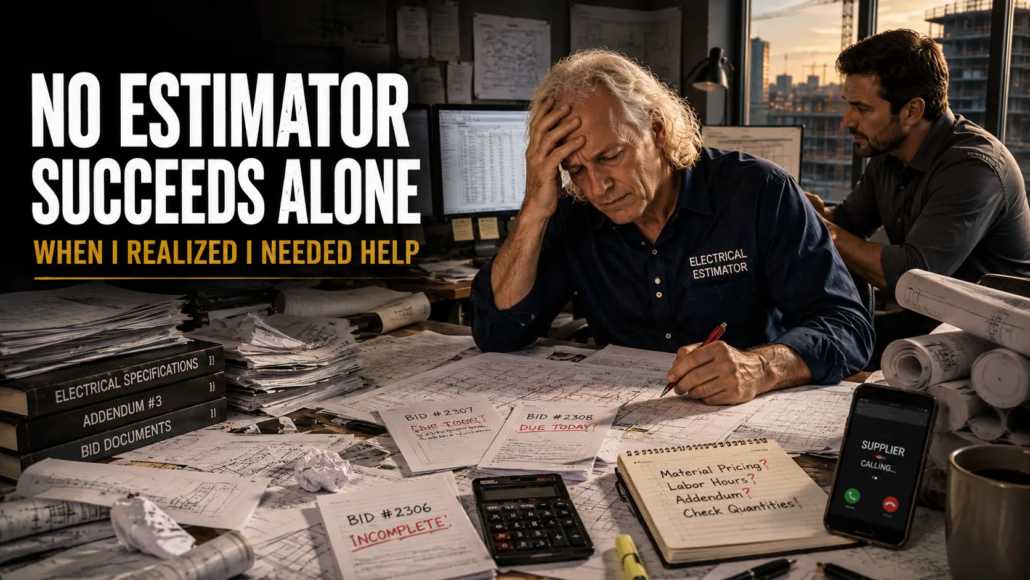
Why No Estimator Succeeds Alone, The Day I Realized I Needed Help
Quick answer: Every electrical estimator eventually hits a wall where the workload, complexity, and pressure exceed what one person can manage. Recognizing that moment and choosing to ask for help—from teammates, specialists, or estimating tools—is the decision that separates estimators who burn out from those who build lasting careers.
I remember the day clearly. It was a Tuesday. I had three bids due that week, a stack of addendums I hadn’t fully read, and a supplier on hold waiting for material confirmation.
My phone wouldn’t stop ringing. My desk looked like a paper hurricane had hit it. And somewhere in the middle of all that chaos, I made a math error that cost us real money.
That was the day I realized I couldn’t do it all myself.
Steve Griffin
Founder of Best Bid Electrical Estimating Software
Electrician • Estimator • Contractor • Author • Software Developer
From digging ditches in 1973 to creating one of the industry’s longest-running electrical estimating software systems, Steve Griffin has spent more than 50 years helping contractors win more work and make more money.
What Does It Feel Like When an Electrical Estimator Reaches Their Breaking Point?
It doesn’t announce itself. It creeps up on you slowly—more jobs in the pipeline, tighter deadlines, more complex drawings. You start staying later.
You skip lunch. You tell yourself you’ll catch up on the weekend. Then one day, the wheels come off.
For me, it wasn’t one catastrophic failure. It was a gradual erosion of accuracy and confidence. I was an experienced electrical estimator with years under my belt, but experience alone doesn’t protect you from overload. Nobody’s does.
Why Do So Many Electrical Estimators Try to Go It Alone?
There’s a myth in this trade that the best estimators are self-reliant. That asking for help signals weakness. I believed that for a long time. Looking back, I can see how much that belief cost me—in stress, in errors, and in missed opportunities to grow.
The reality is this: electrical estimating is too complex, too fast-moving, and too consequential for any one person to manage indefinitely without support. The projects get bigger. The specifications get thicker.
The bid schedules get tighter. Trying to absorb all of that alone isn’t strength—it’s stubbornness.
What Is the Real Cost of an Overworked Electrical Estimator?
Burnout is the obvious answer, but the financial damage is what people underestimate. When I was stretched too thin, I started missing things. Small things at first—a footnote in the specs, a material substitution clause that should have raised a red flag.
Then bigger things. Labor unit errors. Scope gaps.
Numbers that were close but not close enough.
In electrical contracting, “close but not close enough” can mean losing a job you should have won—or worse, winning a job you should have walked away from.
Overworked estimators make costly mistakes. That’s not a judgment. It’s just physics. The brain has limits, and ignoring those limits doesn’t make them disappear.
How Can Electrical Estimators Build a Stronger Support System?
The turning point for me came when I stopped viewing help as a crutch and started seeing it as a strategy. Here’s what actually worked:
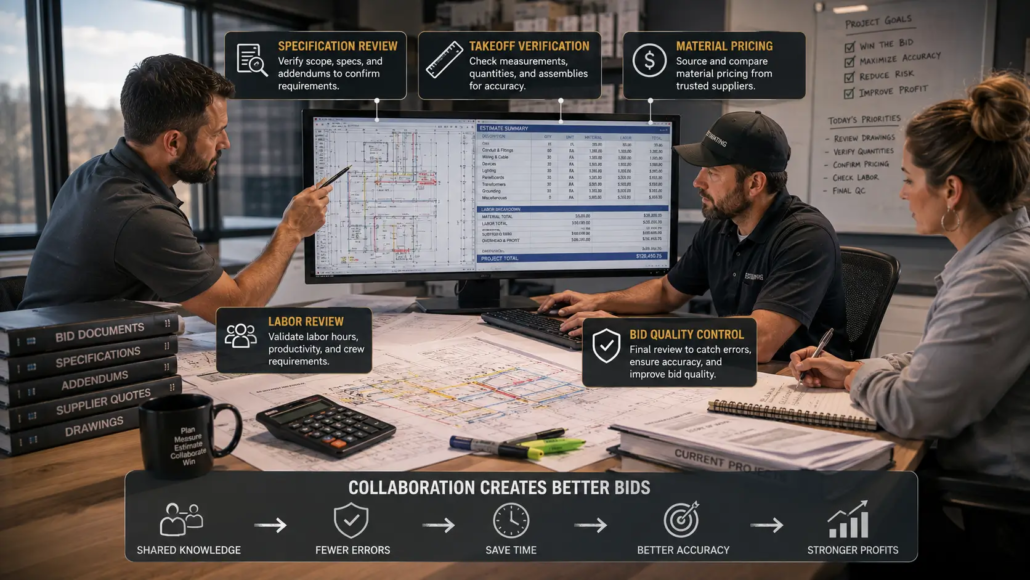
Delegate what you can. Not every task in the estimating process requires your highest-level thinking. Takeoff verification, material pricing calls, drawing organization—these are areas where a capable team member can free up hours in your day.
Leverage the right tools. Best Bid Electrical Estimating Software was built specifically to reduce the mental load on electrical estimators. When your software does the heavy lifting on labor units, material costs, and bid organization, you have more bandwidth to focus on the judgment calls that actually require your experience.
Normalize asking for input. The strongest estimating teams I’ve seen operate with a culture where questions are welcomed. A second set of eyes on a complex bid has saved more jobs than I can count.
How Does Collaboration Improve Electrical Estimate Accuracy and Project Outcomes?
When I finally built a team approach around my estimating process, something unexpected happened: my accuracy improved. Not because I suddenly became smarter, but because I had fewer things competing for my attention.
A collaborative approach means errors get caught before they leave the office. It means someone else can handle the supplier calls while you focus on the specification review. It means bid day doesn’t feel like a one-man emergency.
I wrote about this kind of mindset shift extensively in my book, Everybody Has A First: “Lessons from a Lifetime in Electrical Contracting and Business”. The lesson I kept coming back to is simple—every success I experienced in this industry, I owed in part to someone who helped me get there.
What Happens When an Electrical Estimator Finally Asks for Help?
Relief. That’s the first thing. Then clarity. Then growth.
When I stopped trying to carry everything alone, I could think more strategically. I could look at a bid package and see the full picture instead of just scrambling to get numbers on paper. My estimates got sharper.
My win rate improved. And for the first time in years, I wasn’t dreading Monday mornings.
The contractors and estimators who build long, successful careers in this industry aren’t the ones who work alone the hardest. They’re the ones who figure out how to work smart—with the right people, the right processes, and the right tools around them.
Your Breakthrough Starts With One Decision
No electrical estimator succeeds alone. Not permanently. Not sustainably. The question isn’t whether you need help—it’s whether you’re willing to ask for it before the breaking point arrives.
Start small. Identify one task you can hand off this week. Explore whether your current electrical estimating software is doing everything it could be doing for your workflow. And give yourself permission to build a team, even if that team is just one other person who has your back on bid day.
Your breakthrough doesn’t come from doing more. It comes from doing smarter—together.
Frequently Asked Questions
Many electrical estimators believe that self-reliance is a mark of competence. The culture of the trade often rewards independence, which makes it difficult to acknowledge limits. However, electrical estimating involves enough complexity—specifications, labor units, material pricing, addendums—that sustained solo performance without support typically leads to burnout or costly errors.
Overworked electrical estimators most commonly miss specification details, make labor unit errors, overlook addendums, and fail to catch scope gaps before submitting a bid. These mistakes are not a reflection of skill—they are a predictable result of cognitive overload.
Electrical estimating software like Best Bid Electrical Estimating Software automates time-consuming tasks such as labor unit calculations, material cost tracking, and bid organization. This reduces the mental workload on individual estimators and allows them to focus on the judgment-based aspects of the estimating process.
The right time is before a breaking point occurs. If bid deadlines are consistently stressful, if errors are increasing, or if an estimator is regularly working nights and weekends just to stay current, those are clear indicators that additional support—whether a team member or better tools—is overdue.
A team approach creates checkpoints in the estimating process where errors are more likely to be caught. Multiple people reviewing a bid, handling different components, or verifying takeoffs reduces the likelihood of a single point of failure. Collaboration also improves consistency across bids over time.
Ready to take the next step? I’d love to connect and talk through what’s working in your estimating process—and what isn’t.
 Call or reach out directly through the Best Bid Electrical Estimating Software website. Whether you’re a solo estimator just getting started or a contractor managing a full estimating department, I’m happy to share what I’ve learned over more than 50 years in this industry.