Electrical Estimating Software Cost: 2026 Pricing Guide & True TCO

Renting your core bidding tools has turned standard overhead into a permanent monthly tax on your balance sheet. When you start researching electrical estimating software cost, you shouldn’t have to navigate a maze of hidden pricing, aggressive sales reps, and forced product demos just to get a straight answer. You already know how exhausting it is to dodge sales traps when all you want is clear data to protect your profit margins.
You deserve complete transparency before committing your hard-earned cash. In this guide, you will discover the real cost of electrical estimating software, uncover the sneaky add-on fees that vendors hide in the fine print, and learn how to calculate true lifetime ownership across standalone licenses and recurring SaaS platforms. We will break down the market models side by side so you can choose a powerful takeoff and bidding system that fits your budget permanently.
Key Takeaways
- Evaluate real licensing structures side by side to see how ongoing subscriptions inflate your baseline electrical estimating software cost over several years.
- Spot hidden fees before signing a contract, including separate charges for digital takeoff modules, material database syncs, and mandatory support tiers.
- Calculate a 3- to 5-year Total Cost of Ownership (TCO) to discover why low monthly entry fees often turn into your most expensive bidding option.
- Audit your shop’s project volume and estimator seat requirements so you only invest in capabilities your team actually needs.
- Protect your profit margins by exploring permanent software ownership models that eliminate recurring overhead and include built-in takeoff.
What Determines Electrical Estimating Software Cost?
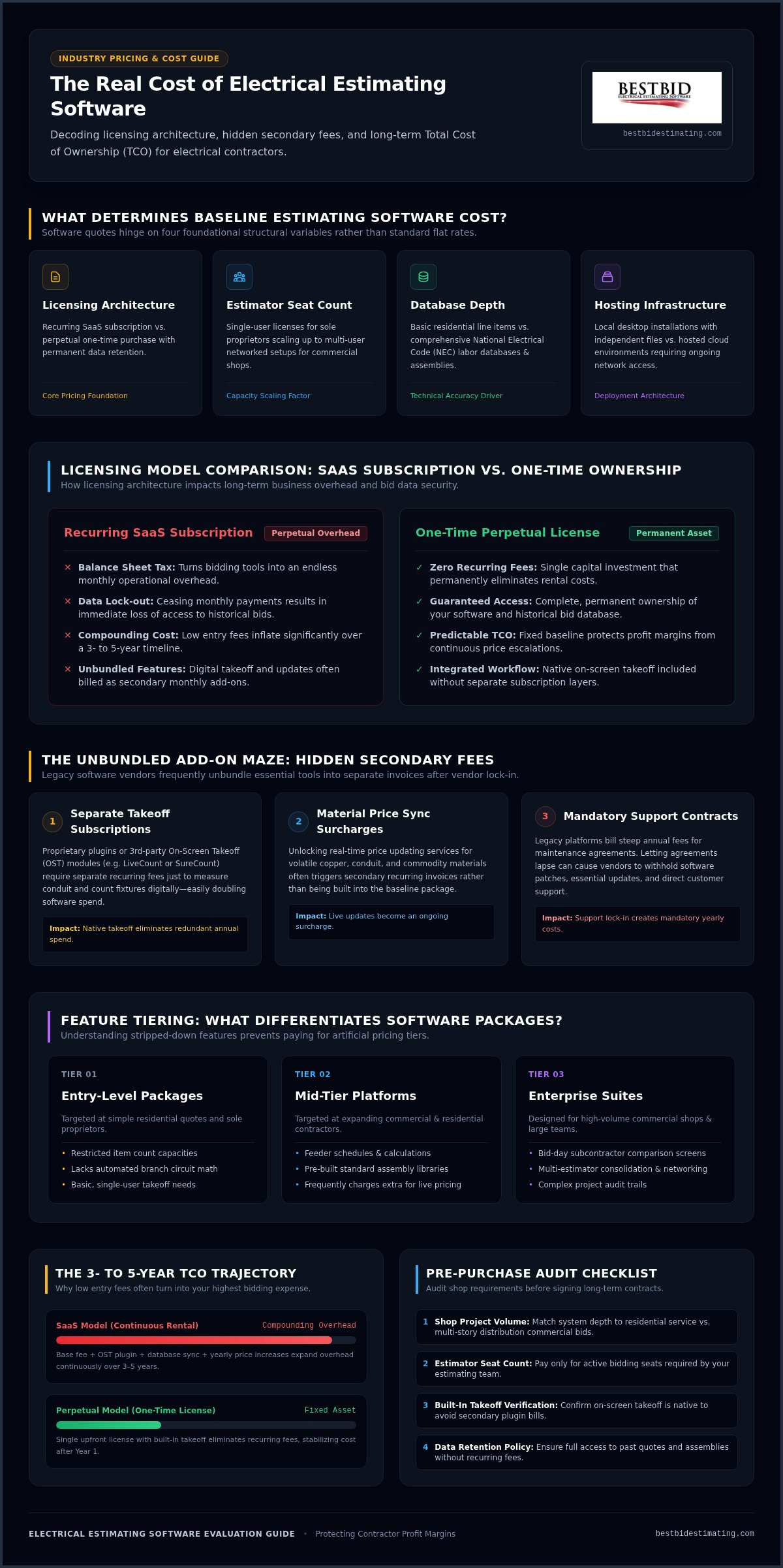
Most enterprise software vendors guard their price tags like state secrets. Instead of publishing clear numbers, they force contractors through high-pressure sales calls and lengthy software demos just to get a basic quote. In reality, your baseline electrical estimating software cost hinges on four primary variables: licensing architecture, seat count, database depth, and hosting infrastructure. Modern construction estimating software ranges from lightweight desktop applications to complex cloud suites, meaning your final bill reflects how the vendor packages core features.
To better understand how different platforms structure their pricing and features, watch this helpful video overview:
Your shop size and bid volume dictate your administrative needs. A sole proprietor doing residential service work requires straightforward takeoffs, while a commercial subcontractor bidding multi-story distribution systems needs multi-user networking and extensive National Electrical Code (NEC) labor databases. Knowing what is essential prevents you from paying for bloated enterprise add-ons.
Subscription SaaS vs. One-Time Purchase Licenses
The industry remains sharply divided between recurring SaaS subscriptions and perpetual ownership models. Monthly cloud subscriptions look inexpensive upfront, but they turn software into a perpetual overhead liability. Stop paying the monthly fee, and you lose access to your historical bids. Perpetual licenses demand a one-time capital expense, but you own the software and your bidding data outright. Comparing upfront software investments against ongoing rental fees on a transparent pricing page reveals the financial freedom of true ownership.
Feature Tiers and Estimating Capabilities
Feature tiering creates drastic swings in overall electrical estimating software cost across competing platforms. Vendors frequently strip out critical bidding capabilities to create artificial pricing tiers:
- Entry-Level Packages: Often restrict item counts and lack automated branch circuit calculations, making them suitable only for simple residential quotes.
- Mid-Tier Platforms: Add feeder schedules and pre-built assemblies, yet they regularly charge extra for live material pricing updates.
- Enterprise Suites: Include bid-day subcontractor comparison screens, multi-estimator consolidation, and complex audit trails designed for high-volume commercial shops.
The Hidden Fees Behind Electrical Bidding Software Pricing
Low upfront quotes rarely tell the whole story. Legacy vendors know that once you spend weeks loading assemblies and training your estimators, switching platforms becomes painful. That lock-in allows them to unbundle critical tools, steadily increasing your electrical estimating software cost through secondary invoices. As documented by industry analysts examining the United States Construction Software Market, technology platforms are pushing contractors toward continuous recurring models that hide true operational overhead behind initial base rates.
Third-Party On-Screen Takeoff (OST) Subscriptions
Many popular estimating engines do not include integrated digital takeoff tools. Instead, they require you to purchase third-party takeoff software or expensive proprietary plugins like LiveCount or SureCount just to measure conduit runs and count fixtures digitally. Paying separate monthly subscriptions for takeoff alongside your base estimating seat easily doubles your annual software spend. Native takeoff built directly into the bidding engine removes this redundant expense entirely.
Database Updates, Support, and Maintenance Contracts
Unlocking reliable material pricing often carries surprise surcharges. Some legacy vendors bill steep annual fees for maintenance contracts, refusing to deliver software patches or customer service if you let that agreement lapse. Real-time material price updating services frequently bill separate recurring charges to keep copper and conduit pricing accurate. For single-location shops trying to maintain predictable budgets, reviewing an upfront pricing breakdown helps you identify models that include lifetime updates without annual maintenance penalties.
User Seat Licenses and Network Access Fees
Scaling your bidding desk shouldn’t penalize your shop’s growth. Yet many platforms use restrictive per-seat billing tactics that drain your margins:
- Named-User Restrictions: Tying licenses to individual email addresses prevents team members from sharing workstations during deadline rushes.
- Implementation and Training Surcharges: Some vendors charge onboarding fees ranging from $2,000 to $10,000 before your team runs a single takeoff.
- Network Access Modules: Legacy desktop programs frequently charge extra licensing fees just to let two estimators access the same database over an office server.
If you want to protect your bottom line, consider exploring contractor-first estimating tools designed around permanent licensing rather than indefinite monthly seat rentals.
Calculating Total Cost of Ownership (TCO) Over 3 to 5 Years
Evaluating an estimating platform solely on year-one cash outlay is an expensive mistake. A vendor advertising an entry fee of $200 per month sounds manageable until you project that expense across three to five years. Factoring in mandatory add-ons, annual support renewals, and database updates reveals your true electrical estimating software cost. To understand your actual financial exposure, calculate Total Cost of Ownership (TCO) using a simple formula: upfront purchase or setup fees, plus cumulative subscription or maintenance costs, plus third-party takeoff add-ons over sixty months.
The 5-Year Subscription Expense Trap
Software subscriptions create an escalating cost curve that never flattens. Consider the financial trajectory of common software setups across five years:
- Compounding Monthly Fees: A single SaaS seat billing $200 monthly totals $12,000 over five years, before accounting for recurring price hikes.
- Add-on Overhead: Layering a separate takeoff plugin and external database subscription can add another $6,000 to $10,000 across that same timeframe.
- The Golden Handcuffs: If cash flow tightens and you pause payments, cloud access vanishes. Your historical estimates, custom assemblies, and bid records become inaccessible overnight.
Perpetual Software Value and Return on Investment
Perpetual licensing flips this dynamic entirely. While the initial capital expense is higher on day one, the cost curve immediately levels off. A flat-fee license often pays for itself after winning just one or two profitable commercial or residential jobs. Once recovered, the software functions as a paid-off shop asset rather than a monthly operational liability.
During economic downturns or seasonal lulls, eliminating recurring software invoices protects your company’s net profit margins. Choosing Best Bid electrical estimating software ensures you own your software licenses, native takeoff tools, and estimating data permanently without facing annual renewal ultimatums. Real ownership keeps your bidding overhead fixed, freeing up working capital to invest in field labor, tools, and business expansion.
Download as HTML
Key Factors to Evaluate Before Purchasing Estimating Software
Protecting your company from unexpected expenses requires a structured evaluation before you hand over credit card details. While vendors prefer steering conversations toward flashy presentation decks, your actual electrical estimating software cost depends heavily on daily usability and contractual fine print. Running a thorough shop audit ensures you only pay for capabilities that actively speed up bid day.
Follow these practical evaluation steps when vetting potential platforms:
- Step 1: Audit your operational scope. Tally your active estimators, average weekly bid volume, and the mix between commercial plan-and-spec projects versus residential service work.
- Step 2: Verify native takeoff capabilities. Confirm whether digital plan takeoff functions directly within the primary program or requires a separate third-party license.
- Step 3: Test database customization speed. Check how quickly you can modify labor units, swap conduit types, and connect supplier pricing without manual data entry.
- Step 4: Measure real onboarding time. Ask how many hours an estimator needs to build a complete bid from scratch without vendor assistance.
- Step 5: Demand written pricing policies. Get firm documentation outlining costs for customer support, version upgrades, and multi-computer installations.
Evaluating Workflow Speed and Learning Curves
Steep learning curves inflict serious financial damage through lost bidding capacity. Complex enterprise programs often force estimators to click through dozens of nested submenus just to build a branch circuit. Flexible platforms allow you to morph pre-built assemblies on the fly, adjusting box depths, wire gauges, and fittings with single keystrokes. Fast onboarding keeps your estimators active on bid day instead of burning billable hours troubleshooting software manuals.
Data Ownership and Vendor Contract Auditing
Review terms of service closely before migrating your estimating records. Some cloud software providers restrict data exports if you cancel service, locking you out of years of historical pricing records and past project benchmarks. For an in-depth breakdown on vetting license agreements, read our guide on evaluating electrical bidding software for contractors.
Take control of your bidding operations by choosing reliable estimating solutions built to protect contractor data ownership without recurring renewal demands.
Why Best Bid Delivers Industry-Leading Value Without Recurring Fees
Software companies shouldn’t treat your bidding desk as an endless recurring revenue stream. Best Bid breaks the standard corporate model by providing complete bidding software through a single, one-time purchase. Instead of watching your electrical estimating software cost climb month after month, you make one straightforward investment and own your platform permanently. Ranked number one for Best Value among single-location electrical contractor shops, this model keeps your bidding tools on the asset ledger rather than inside an overhead expense column.
Every license includes native onscreen takeoff, real-time material price syncing through NetPricer, and free lifetime updates with ongoing technical support. You never receive renewal invoices, surprise support bills, or forced upgrade notices just to keep bidding work.
Best Bid Next Generation: Complete Takeoff and Bidding
Estimators don’t have hours to waste toggling between disconnected takeoff utilities and bid spreadsheets. With Best Bid Next Generation, plan measurements link directly to your core estimating database within a single unified workspace. Trace conduit runs, tally fixtures, and generate detailed bills of materials without exporting files between disjointed apps. Built-in NetPricer integration pulls current supplier pricing instantly, protecting your profit margins against copper and commodity market swings without requiring expensive secondary data subscriptions.
Field-Tested Trade Expertise and Contractor Support
Software designed by corporate theorists rarely survives the practical realities of an active bidding schedule. Master electrician Steve Griffin engineered Best Bid using more than 50 years of hands-on trade and estimating experience. Every branch assembly, feeder calculation, and labor unit reflects real-world job conditions encountered on commercial, industrial, and residential projects.
Contractors also gain access to practical training tools and direct support so your estimators can price complex jobs with absolute confidence from day one. Browse our frequently asked questions page to see how our licensing policies work in practice. Choosing true ownership stabilizes your long-term electrical estimating software cost, giving you dependable tools that protect your bottom line for decades.
Protect Your Profits with Permanent Estimating Ownership
Evaluating your true electrical estimating software cost means looking far beyond initial setup numbers. Monthly subscriptions quietly turn essential bidding tools into permanent overhead, while unbundled digital takeoff modules and mandatory maintenance agreements steadily erode your project profits. True financial control comes from breaking free of the recurring payment trap and investing in software your shop owns outright.
Built by a master electrician with over 50 years of hands-on industry experience, Best Bid gives you a fast, reliable bidding platform without recurring monthly fees. It’s why our software is ranked #1 for Best Value among single-location electrical contracting shops. A single one-time investment delivers native onscreen takeoff, free lifetime updates, and unlimited support without annual renewal threats. Take control of your bidding overhead with Best Bid estimating software today and build a more profitable bidding operation on terms you control permanently.
Frequently Asked Questions
How much does electrical estimating software cost on average?
Across the industry, recurring subscription platforms typically cost between $150 and $300 per user each month, while legacy enterprise packages range from $15,000 to over $40,000 upfront. When factoring in separate takeoff modules, training fees, and annual maintenance contracts, a contractor’s true electrical estimating software cost climbs significantly higher over a multi-year period. Flat-rate ownership models provide a much more predictable alternative.
Why do so many electrical estimating software vendors charge recurring monthly subscriptions?
Most software vendors adopt subscription models because recurring billing generates steady, predictable revenue for corporate parent companies. By hosting software in the cloud and charging per seat, vendors capture recurring cash flow while locking contractors into permanent overhead. This business model benefits software providers rather than contractors, turning an essential trade tool into an indefinite monthly expense that never appears on your balance sheet as a paid-off asset.
What hidden fees should electrical contractors look out for before purchasing estimating software?
Contractors should watch out for unbundled takeoff tools, mandatory onboarding fees, and recurring maintenance contracts. Legacy vendors frequently charge thousands of dollars for initial implementation and classroom training before your estimators can price a project. You should also check for network licensing charges, fees for basic technical support, and ongoing surcharges required to maintain real-time supplier material pricing feeds.
Is on-screen takeoff software included in base electrical estimating packages?
On-screen takeoff is rarely included in base packages from major legacy providers. Many software companies treat digital plan takeoff as a separate product, forcing contractors to purchase expensive add-on modules or third-party subscriptions just to count symbols and measure conduit runs. Purchasing estimating software with native onscreen takeoff eliminates redundant software licenses and creates a faster, single-screen bidding workflow.
Can an electrical contractor buy estimating software outright without monthly fees?
Yes, contractors can still buy estimating software outright through permanent ownership licenses. Best Bid provides professional electrical bidding systems through a straightforward, one-time purchase with no monthly subscriptions. That single investment includes native onscreen takeoff, real-time material price syncing through NetPricer, and free lifetime updates with ongoing technical support, ensuring your software overhead remains permanently capped.
What happens to my historical bid data if I cancel a cloud-based estimating subscription?
Canceling a cloud subscription usually cuts off access to your estimating workspace and proprietary assemblies immediately. While vendors might allow you to export static bid summaries to spreadsheets or PDF files, you lose the ability to reopen, modify, or recalculate previous bids using stored labor data. Perpetual licensing protects your historical bids by keeping your estimating data accessible on systems you own.
How long does it take for electrical estimating software to pay for itself?
Most electrical contractors recover their software investment after winning just one or two profitable jobs. Professional bidding software reduces preparation time by 50% to 70%, allowing estimators to submit more accurate proposals before bid deadlines. Eliminating missed takeoff items and catching material price spikes quickly recovers your baseline electrical estimating software cost while safeguarding your profit margins on bid day.