Electrical Change Order Estimating Software: The 2026 Guide to Defending Your Margins

A generic spreadsheet markup or a scribbled ticket is the fastest way to surrender your profit margin on an active job. When unexpected conduit rework or field changes strike, you shouldn’t have to spend your nights manually crunching numbers just to watch a general contractor dispute your labor units the next morning. Deploying dedicated electrical change order estimating software ensures every stick of pipe, demolition hour, and real-time material price jump gets fully documented and billed before your crew pulls a single wire.
You already know that protecting your bottom line requires trade-specific precision, not vague lump sums. In this guide, you’ll discover how modern estimating platforms eliminate unbilled labor, generate bulletproof itemized submittals that GCs approve without friction, and protect your cash flow without locking your company into costly monthly subscription fees. Here is how smart contractors defend their margins and turn scope creep into fair, profitable work.
Key Takeaways
- Scope creep during rough-in compounds rapidly, making trade-specific change documentation essential to halt unbilled field labor.
- Dedicated electrical change order estimating software captures true installation costs by combining built-in digital takeoff with real-time material pricing.
- Submitting transparent, itemized proposals with defensible labor units expedites general contractor approvals and prevents painful payment disputes.
- A lifetime ownership model protects your bottom line during seasonal slowdowns by eliminating recurring monthly subscription fees.
- Purpose-built tools designed by master electricians streamline complex rework calculations, turning frantic scope revisions into profitable job extensions.
Why Electrical Scope Creep Destroys Margins Without Specialized Estimating Tools
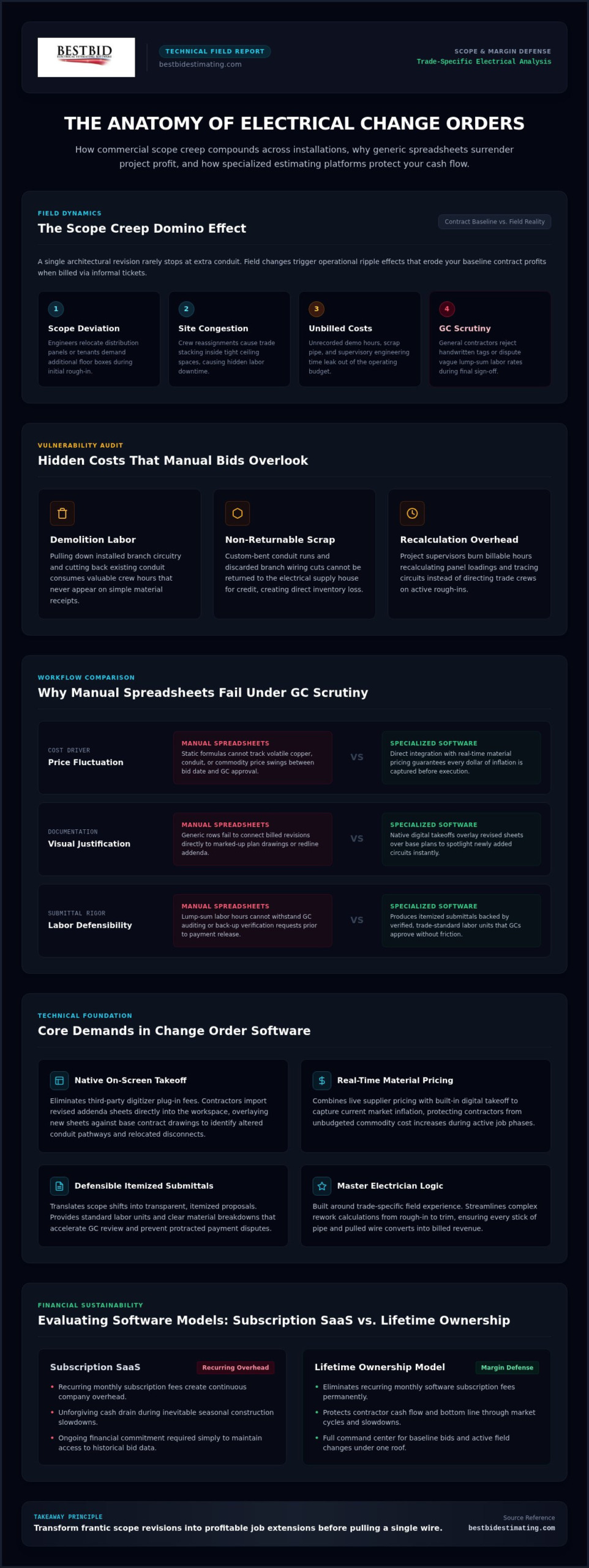
Every commercial jobsite experiences deviations from the original blueprints. In project management, a formal change order documents work that alters the original contract scope, modifying the baseline price, project schedule, or deliverables. When an engineer relocates a distribution panel or a tenant adds floor boxes during rough-in, the changes rarely stop at a couple of extra materials. Scope creep quickly triggers a ripple effect across the entire installation. Unscheduled crew reassignments and trade stacking in congested ceiling spaces inevitably create hidden downtime, eroding your project’s baseline profit before you even notice.
General contractors scrutinize electrical claims aggressively. If your field changes lack transparent documentation, general contractors will reject or heavily discount your tickets. Surviving these disputes requires moving beyond handwritten tags. Using specialized electrical estimating software allows you to track scope shifts from rough-in through trim, ensuring that added field labor converts directly into billed revenue.
To see how modern digital systems handle project variables, watch this quick workflow walkthrough:
The Hidden Costs of Unbilled Field Modifications
Field revisions consistently introduce costs that manual estimators miss. Uncaptured demolition labor is one of the most common drains; pulling down installed branch circuitry or cutting back existing conduit runs consumes valuable trade hours that never appear on a simple material receipt. Discarded branch wiring cuts and custom bent pipe cannot simply be returned to the supply house for credit. Your project supervisors also end up spending long hours recalculating panel loadings and tracing circuits instead of directing installation crews, quiet overhead that directly shrinks your net margins.
Why Manual Spreadsheets Fail Under GC Scrutiny
Standard spreadsheets lack the depth necessary to defend your claims against tough general contractors. Dedicated electrical change order estimating software solves this problem by connecting real-world components with standardized labor data:
- Price Fluctuation: Static formulas cannot track volatile copper, conduit, or commodity price swings between your initial proposal and GC approval.
- Visual Justification: Generic sheets do not link your billed revisions directly to marked-up plan drawings.
- Labor Defensibility: Spreadsheets cannot provide the verified, trade-standard labor unit back-up that general contractors require before releasing payment.
Core Features to Demand in Electrical Change Order Estimating Software
Field revisions move fast. If your estimating workflow relies on clunky workarounds or piecemeal tools, you’ll lose valuable hours trying to assemble an accurate bid. Dedicated electrical change order estimating software bridges the gap between field redlines and financial recovery. Rather than patching together external PDF viewers, standalone spreadsheets, and phone calls to distributors, your platform should serve as a complete command center for capturing every dollar of modified work.
Contractors seeking full control over active revisions often explore professional Best Bid electrical estimating software to handle both baseline bids and complex change orders under one unified roof.
Native On-Screen Takeoff for Plan Revisions
Paying for third-party digitizer plug-ins creates friction and drives up software overhead. Native digital takeoff allows you to import revised addenda sheets directly into your workspace. By overlaying revised sheets against original base contract drawings, you can immediately spot scope alterations.
Relocated disconnects, altered conduit pathways, and newly added lighting circuits become instantly visible. The software then calculates exact linear conduit and conductor variances automatically, slashing takeoff errors down to zero.
Assembly Morphing and Dynamic Labor Units
Rebuilding assemblies line by line when an engineer changes a specification wastes precious estimating time. Trade-focused electrical change order estimating software provides assembly morphing, letting you adapt existing configurations with a couple of clicks:
- Instant Material Swaps: Convert a standard dry-location EMT run into rigid metal conduit (RMC) or PVC-coated conduit without manually adjusting fittings, straps, and connectors.
- Labor Factor Adjustments: Apply specific difficulty multipliers for challenging field conditions like 20-foot ceiling deck work, occupied tenant spaces, or congested utility corridors.
- Defensible Labor Standards: Back up your labor installation units using proven, trade-recognized historical data that general contractors respect.
Real-Time Material Pricing Integration
Commodity volatility can quickly destroy the margin on a revision that sits on an owner’s desk for three weeks. Built-in integration with real-time supplier pricing services like NetPricer gives you current market costs for copper feeders, switchgear, and branch wiring. You won’t have to guess or rely on outdated catalog numbers. When you submit your proposal, you can attach transparent supplier price sheets straight from your system, establishing immediate credibility and locking down your jobsite profits.
Evaluating Software Models: Subscription SaaS vs. Lifetime Ownership
How much does your estimating tech really cost you over a five-year stretch? Many technology vendors have pushed the industry into a corner, converting essential estimating tools into perpetual rental agreements. Instead of giving you a reliable asset you own, they demand monthly per-user fees that never stop ticking. When you’re managing complex job modifications, electrical change order estimating software should act as a reliable profit safeguard, not an ongoing drain on your overhead.
Before locking your business into a recurring contract, take time to evaluate the true financial differences between rented software and permanent ownership. To see a detailed comparison of this approach, explore our Best Bid Next Generation guide.
The True Cost of Recurring Software Subscriptions
Subscription SaaS models look manageable on paper until you multiply those seats across your estimating staff and project managers over three to five years. Ongoing monthly expenses hit hardest during seasonal winter slowdowns or economic dips when revenue drops but software overhead remains fixed. In addition to base fees, SaaS providers frequently charge extra for essential features, mandatory maintenance contracts, and tiered customer support. If cash flow gets tight and you cancel a seat, you risk getting locked out of your historical project files, bid archives, and past change order documentation.
The Freedom of the "Buy It and Own It" Philosophy
Investing in lifetime ownership fundamentally changes the financial dynamic for electrical contractors. Instead of pouring cash into an endless monthly lease, a one-time purchase provides perpetual access to the platform:
- Zero Monthly Drain: Eliminate recurring software fees so your overhead stays lean during slow seasons.
- Total Database Control: Retain permanent possession of your project takeoffs, historical unit rates, and custom electrical assemblies right on your own machines.
- Included Long-Term Support: Secure a stable platform that offers software updates and responsive technical support without unexpected invoices or renewal fees.
Owning your tools outright provides permanent operational security. You gain professional takeoff precision and rapid change order generation without surrendering your hard-earned profit margins to endless recurring subscriptions.
Download as HTML
Step-by-Step: How to Price an Electrical Change Order for Fast Approval
Getting paid for added work starts with a standardized submittal process. When a site superintendent issues a verbal directive, pulling wire before securing written cost authorization is a gamble you don’t need to take. Following an orderly estimating progression ensures you capture every dollar while providing the clarity general contractors require to sign off promptly. Purpose-built electrical change order estimating software speeds up this five-step sequence, turning chaotic change requests into indisputable proposals within hours.
To upgrade your plan review routines across active jobs, explore our full suite of professional electrical estimating tools to eliminate takeoff bottlenecks.
Steps 1 to 2: Plan Markup and Variance Takeoff
Begin by importing the architect’s revised PDF drawings directly into your digital workspace. Rather than relying on memory, perform a clear delta takeoff:
- Isolate New Scope: Pinpoint added homeruns, moved disconnects, and altered equipment connections across the revised drawing layers.
- Calculate Variances: Quantify linear conduit footage and wire additions generated by rerouted electrical pathways.
- Factor Demolition Scope: Measure the labor hours required to de-energize, strip out, and dispose of work your team already installed during rough-in.
Steps 3 to 4: Applying Labor Difficulty and Material Quotes
Next, assemble your bill of materials and assign realistic labor values. Pull current vendor pricing through connected databases to guard against commodity spikes on wire and switchgear. Then, dial in labor multipliers based on actual jobsite constraints.
Working in fully furnished tenant areas, operating out of 30-foot scissor lifts, or navigating trade congestion around mechanical ductwork all reduce installation speed. Include specialty equipment rentals, disposal charges, and overtime premiums right in your direct costs.
Step 5: Generating Professional, Indisputable Submittals
Finally, export an itemized proposal package. General contractors push back on lump sums, but they readily approve clear documentation. Package your proposal with marked-up drawing excerpts alongside an itemized ledger showing labor rates, material quantities, equipment costs, and agreed overhead markups. Securing this digital sign-off protects your cash flow before your crew bends a single stick of pipe.
Ready to upgrade your workflow? Check our pricing page to choose your software package and start protecting your margins today.
Best Bid Next Generation: Field-Tested Estimating Built by Master Electricians
Most estimating platforms on the market feel like they were designed in a sterile office by software engineers who never wore work boots. Best Bid Next Generation breaks that mold entirely. Conceived and perfected by Master Electrician Steve Griffin, who brings over 50 years of hands-on electrical trade experience to the table, this platform thinks the way you think on a jobsite. Instead of getting bogged down in endless menus or multi-trade clutter, you get dedicated electrical change order estimating software fine-tuned to capture actual field realities.
For estimators looking to sharpen their workflow and build bulletproof proposals, exploring our contractor training guide offers practical strategies to master project takeoffs and price revisions accurately.
Practical Tools Designed for Trade Realities
Real-world job revisions demand tools that handle sudden scope shifts quickly. Best Bid Next Generation streamlines these revisions through specialized, trade-first features:
- Assembly-Driven Architecture: Morph entire circuit runs to reflect engineered revisions without manually searching for individual straps, couplings, or wire nuts.
- Integrated On-Screen Takeoff: Measure linear conduit pathways and drop counts right over imported PDF plans without licensing expensive external digitizer add-ons.
- Total Data Control: Protect your files through straightforward, one-click local backups that ensure your estimates and custom databases remain safely under your own command.
Empowering Electrical Contractors Nationwide
Adopting new technology shouldn’t grind your business to a halt. Best Bid Next Generation features a low learning curve, allowing field-seasoned estimators and new hires alike to produce professional, GC-ready proposals immediately. If you need a refresher or want to refine your team’s bidding skills, the Online School for Electrical Estimating provides structured training grounded in practical field methods rather than generic theory.
Contractors across the country trust this platform because it puts ownership and financial independence first. You get a reliable, fully featured estimating engine backed by free updates and personal technical support, with zero monthly recurring fees to eat away at your margins. Schedule a live Best Bid demo today to see how owning your estimating tools transforms project profitability.
Take Full Command of Your Jobsite Margins
Allowing unbilled rough-in changes and disputed labor units to chip away at your profits is an expensive habit. Defending your margins requires trade-specific precision, clear visual proof on revised plans, and the speed to deliver professional submittals before your crew commits costly hours in the field. Equipping your business with dedicated electrical change order estimating software ensures every added foot of conduit, demolition hour, and commodity material shift converts into paid work.
You don’t need to rent your technology or watch recurring monthly subscription fees chew up your revenue during seasonal slowdowns. Best Bid was founded by Steve Griffin, a Master Electrician with over 50 years of hands-on industry experience who built software around the practical realities of the trade. With integrated on-screen takeoff, direct NetPricer connectivity, and a permanent purchase model offering lifetime updates, you secure full ownership of your estimating future.
Stop leaving unrecorded changes on the table. Explore Best Bid Electrical Estimating Software Today and bid your next project with permanent confidence.
Frequently Asked Questions
What is electrical change order estimating software and why is it necessary?
Electrical change order estimating software is a trade-specific digital platform designed to price, document, and manage contract scope modifications on active jobs. It’s necessary because generic estimating methods frequently miss hidden rework variables like demolition labor, conduit rerouting, and site congestion. Dedicated software gives you defensible labor units, live material pricing, and visual markups that convince general contractors to approve your additional costs without friction.
Can I accurately calculate electrical change orders using standard Excel spreadsheets?
No, standard spreadsheets lack the trade intelligence needed to defend your margins under tough general contractor review. Excel formulas can’t track daily wholesale copper swings or connect your numbers directly to plan revisions. They also force you to build assemblies manually from scratch. One broken cell link or outdated material figure can leave you eating the cost of expensive field modifications entirely on your own dime.
How does dedicated change order software help get proposals approved faster by general contractors?
General contractors approve proposals faster when they receive transparent, itemized packages rather than questionable lump-sum totals. Purpose-built platforms instantly generate organized submittals showing exact material counts, defensible labor unit standards, equipment rental allowances, and highlighted PDF drawing overlays. This level of professional transparency eliminates lengthy back-and-forth arguments, allowing project managers to verify the added scope and sign off on your payment quickly.
What is the difference between subscription-based estimating software and lifetime license platforms?
Subscription software functions as an endless rental where you pay recurring monthly per-user fees to maintain software access. Lifetime license platforms follow a "buy it and own it" model, granting permanent ownership of your estimating engine after a single upfront purchase. Choosing lifetime software eliminates fixed monthly overhead during seasonal slowdowns while guaranteeing you always retain access to your bid archives and company databases without paying ongoing renewal fees.
How does real-time material pricing protect electrical contractors on change orders?
Real-time material integration protects your margins by linking your takeoff directly to live distributor pricing via services like NetPricer. Commodity materials like copper wire, steel conduit, and heavy distribution panels experience rapid cost fluctuations between your initial proposal and final owner approval. Live pricing ensures your change order estimates reflect true market acquisition costs today, preventing unexpected supplier invoices from wiping out your project profit.
Do I need separate digitizing software to perform on-screen takeoff for plan revisions?
You don’t need third-party digitizers if you choose modern platforms like Best Bid Next Generation that include native on-screen takeoff out of the box. Many legacy tools force contractors to purchase separate takeoff licenses or add-on modules just to measure plans. Native takeoff lets you import revised drawings, measure branch conduit runs, count revised devices, and transfer those quantities straight into your estimate without external programs.
How does assembly morphing speed up electrical change order estimates?
Assembly morphing allows you to change a base assembly into an entirely different specification with just a few clicks instead of searching through thousands of parts. For example, if a job revision requires switching half-inch EMT to three-quarter-inch rigid conduit, morphing swaps the pipe, straps, and fittings instantly. It recalculates your material costs and labor factors on the fly, reducing takeoff time from hours to minutes.
What happens to my historical project estimates if I choose software without monthly fees?
Your project files, custom assemblies, and bid histories stay completely safe and fully accessible on your local hardware. Subscription providers often restrict access to your archives if you cancel a seat, effectively locking away your past project records. With a permanent license model, you maintain total ownership of your files forever, backed by simple one-click backup tools that keep your intellectual property under your control.