Electrical Estimating Software with Labor Unit Calculations: A Contractor’s Guide
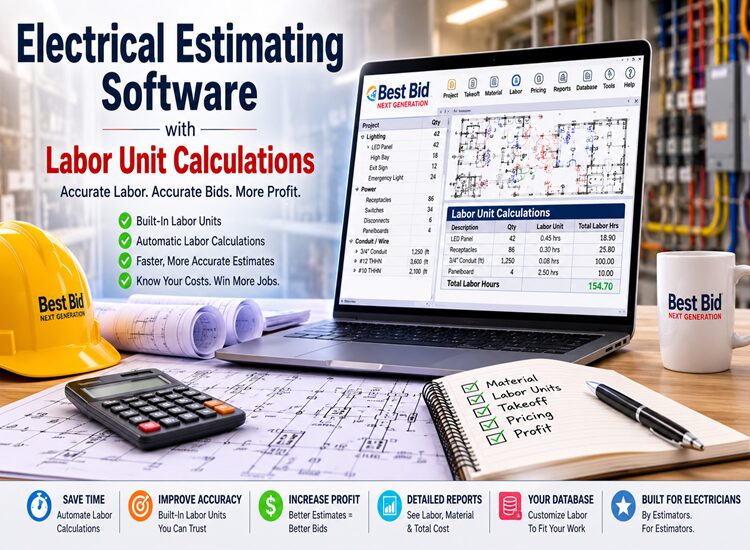
How many hours of your life have disappeared into the black hole of manual spreadsheets, only to leave you with a gut feeling that your labor numbers are still a shot in the dark? You aren’t alone in that frustration. Most contractors have felt the stress of hitting “send” on a bid while wondering if they just bought themselves a job instead of winning a profitable one. By leveraging electrical estimating software with labor unit calculations, you can finally stop the guesswork. This technology provides a consistent, field-tested foundation that ensures every estimate your team produces is both competitive and accurate.
We understand the daily grind of the trade and the pressure to turn around bids faster without sacrificing your margins. This guide will show you how to master automated labor calculations to eliminate bidding guesswork and protect your bottom line. We will walk through the transition from slow, manual methods to a streamlined workflow that yields professional, defensible results. Best of all, we’ll focus on how to achieve this through true software ownership, cutting out the recurring monthly fees that typically eat into your hard-earned profits.
Key Takeaways
- Learn how to distinguish between “man-hours” and “labor units” to build more defensible, professional bids.
- Discover how to use electrical estimating software with labor unit calculations to automate digital takeoffs and eliminate manual data entry errors.
- See how automated systems can increase your bidding speed by up to 10x while ensuring every estimator in your shop follows the same standards.
- Identify strategies for optimizing labor units across diverse project types, including specialized commercial improvements and high-stakes industrial environments.
- Explore the financial advantages of a one-time software purchase that provides total ownership without the burden of ongoing monthly subscription fees.
Table of Contents
- What Are Labor Units in Electrical Estimating?
- How to Calculate Labor Costs with Estimating Software
- Manual vs. Automated Labor Unit Calculations
- Optimizing Labor Units for Commercial and Industrial Projects
- Why Best Bid is the Best Value for Labor Unit Accuracy
What Are Labor Units in Electrical Estimating?
In simple terms, a labor unit is the amount of time it takes an electrician to install a specific component under normal conditions. If you’ve ever bid a job based on a “gut feeling” about how long a run of conduit should take, you’ve felt the risk of manual estimation. Labor units move you away from guesswork and toward a scientific approach.
While a “man-hour” is a broad measure of one person working for sixty minutes, a labor unit is granular. It accounts for the specific minute-by-minute reality of installing a 4-square box or pulling 500 MCM cable.
Relying on industry standards, like those found in the NECA Manual of Labor Units, gives your business a defensible baseline. However, these numbers aren’t static. They are the starting point for a profitable bid, and failing to account for them correctly is the fastest way to lose money on “bid day.” Using electrical estimating software with labor unit calculations allows you to apply these standards instantly across thousands of items without the risk of a simple math error sinking your entire project. It’s about moving from a reactive “I hope we covered it” mindset to a proactive, data-driven strategy.
Components of a Standard Labor Unit
A true labor unit isn’t just about the time the screwdriver is in the technician’s hand. To build an accurate estimate, you must look at the full picture of the workday. According to the Glossary of construction cost estimating, an effective labor rate must encompass all facets of the work environment. A standard unit typically breaks down into three core areas:
- Material handling: This covers the time spent receiving materials, unboxing them, and moving parts from the delivery truck to the actual point of installation.
- Installation time: This is the “tools-on” duration. It’s the physical act of mounting, connecting, and securing the component.
- Non-productive time: This is the reality of any job site. It includes essential setup, tool cleanup, and the inevitable breaks that occur during a shift.
Here is a great video:
Why Spreadsheets Fail at Labor Tracking
Many contractors start with spreadsheets because they feel “free,” but they often end up being the most expensive tool in the shop. The primary issue is formula propagation. One broken cell in a hidden row can carry a labor error through an entire multi-million dollar bid; you won’t catch it until the job is halfway done and the budget is gone. Updating global labor rates across hundreds of rows is a manual nightmare that invites disaster.
Modern electrical estimating software with labor unit calculations eliminates this vulnerability by integrating your labor database directly with your takeoff data. When you change a labor rate in a dedicated system, it updates everywhere instantly. This ensures your profit margins remain protected and your team stays consistent, regardless of who is performing the takeoff. It’s a level of precision that manual entry simply can’t match.
How to Calculate Labor Costs with Estimating Software
Calculating labor costs shouldn’t feel like a high-stakes gamble. In the past, contractors spent hours with highlighters and tally sheets, hoping their math held up under scrutiny. Modern electrical estimating software with labor unit calculations changes that dynamic by turning your takeoff into a live data stream. Instead of finishing a takeoff and then starting the labor math from scratch, the process happens simultaneously. When you quantify your materials, you are building your labor budget at the same time. It’s a faster, more reliable way to ensure your profit margins stay exactly where you planned them.
The real power lies in the transition from raw counts to actionable man-hours. Effective labor management requires following a standardized Cost Estimating Guide to ensure no hidden variables are missed. By using software that pre-loads these units, you eliminate the risk of forgetting the “incidental” labor that often erodes a project’s success. Once your materials are quantified, the software applies the labor units automatically, allowing you to focus your energy on high-level project strategy rather than basic arithmetic.
Step 1: Digital Takeoff Integration
The foundation of an accurate bid is a clean takeoff. Using built-in On-Screen Takeoff (OST) allows you to count fixtures, measure conduit runs, and identify assemblies directly on your PDF plans. The software doesn’t just record a quantity; it automatically links that quantity to a specific labor assembly. For example, counting a duplex receptacle doesn’t just add a device to your list; it adds the box, the plaster ring, the device, the plate, and the associated labor units for the entire install. This integration eliminates the common double-entry errors that occur when moving data from a takeoff tool to an estimate. If you’re looking to streamline this process, Best Bid Next Generation offers a built-in OST that handles these connections seamlessly.
Step 2: Applying Labor Factoring
Static labor units are a great starting point, but they don’t account for the reality of a difficult job site. This is where labor factoring becomes essential. You need the ability to adjust for specific conditions such as multi-story builds, restricted access, or hazardous environments.
If your crew is working off a 20-foot scissor lift, they aren’t going to be as fast as they would be on the ground. Software allows you to apply global labor factors to specific sections of your bid, adjusting the man-hours up or down based on the difficulty level. You can also adjust for your specific crew mix, such as a higher ratio of apprentices to journeymen, to see how it impacts the total cost.
These global adjustments save hours of manual data entry by updating every related labor unit across the entire estimate with a single click.
Finally, always review your labor-to-material ratio as a sanity check. If your historical data shows that labor usually represents 40% of your total cost on a specific project type, but your current bid shows 25%, you know something is wrong before you hit send. This final review ensures your bid is defensible, competitive, and, most importantly, profitable.
Manual vs. Automated Labor Unit Calculations
Is your estimating process still stuck in the era of manual entry and mental math? While some veterans take pride in their ability to “eye-ball” a project, the reality is that manual calculations are a bottleneck for growth. When you switch to electrical estimating software with labor unit calculations, your bidding speed can increase by up to 10x. This isn’t just about finishing faster; it’s about the ability to bid more work with higher precision. Instead of spending your weekend grinding through a single takeoff, you can process multiple bids and still have time for a life outside the office.
Consistency is the other side of the coin. In a shop with multiple estimators, everyone has their own “way” of doing things. This creates a nightmare for business owners who need to know why two bids for the same project look completely different.
Automated software ensures that every person in your company uses the same labor standards and the same field-tested database. It also allows you to use your own historical data to refine future bids. If you notice your field crews consistently beat the labor units on specific commercial tasks, you can adjust your standards to become even more competitive on the next job.
The Hidden Cost of ‘Free’ Spreadsheets
Many contractors hold onto spreadsheets because they don’t have a monthly fee, but they aren’t actually free. Calculate the hourly cost of your time. If you spend five hours manually entering labor data that a specialized tool could handle in thirty minutes, you’ve just spent hundreds of dollars in “lost” labor on a single bid. Keeping up with BLS construction cost data and shifting market trends is essential for staying competitive, but manual tracking makes it nearly impossible to react to market shifts in real time.
There is also the constant threat of the “fat-finger” mistake. One misplaced decimal point in a complex electrical formula can commit you to a project that will eventually bankrupt your company. You need a system that handles the heavy lifting of math so you can focus on the strategy of the bid. You can see how Best Bid Next Generation eliminates manual entry to keep your margins safe and your estimates professional.
Database Flexibility and Control
A major trap in the software world is the “locked” database. Some high-priced competitors give you a library of labor units but won’t let you change them, forcing you to bid their way instead of your way. We believe you must own your database to keep labor units realistic for your specific crew and local conditions. Our “morphed assembly” workflow allows you to adjust items on the fly, tailoring the labor to the exact needs of the project without breaking the underlying standards.
Steve Griffin, who has over 50 years of experience in the trade, always offers one piece of advice to contractors: never trust a database you can’t modify. If you can’t tweak the labor units to reflect the reality of your field performance, the software is a cage, not a tool. True electrical estimating software with labor unit calculations should empower your expertise, not replace it with a generic, one-size-fits-all number.
Optimizing Labor Units for Commercial and Industrial Projects
Not all projects are created equal. A high-rise office building requires a different labor mindset than a wastewater treatment plant. When using electrical estimating software with labor unit calculations, you need the ability to pivot between these environments instantly. Commercial work often involves high-volume, repetitive tasks where speed is king. However, specialized tenant improvements can throw a wrench in those numbers. Working around existing walls or active office staff increases the difficulty, requiring you to bump up your labor units to protect your profit.
Industrial projects take complexity to a different level. Here, you aren’t just installing parts; you’re navigating rigid conduit, explosion-proof fittings, and strict safety protocols. These factors aren’t optional.
If your estimate doesn’t account for the time spent on specialized tool setups or mandatory safety briefings, you’ll see your margins evaporate before the first wire is pulled. Residential work, by contrast, demands a balance of extreme speed and competitive per-device pricing. Best Bid Next Generation allows you to toggle between these project types, ensuring your labor standards match the reality of the site.
Adjusting for Height and Difficulty
Standard labor units assume you’re standing on the floor. The moment your crew steps onto a ladder or into a scissor lift, productivity drops. You must add labor premiums for “ladder time” or high-reach work to cover the time spent moving equipment and ensuring safety.
Hazardous locations or clean-room environments add even more overhead, often requiring specific PPE or decontamination procedures that can double the time required for simple tasks. Using historical job-costing data helps you verify these optimization strategies, ensuring your bids remain both competitive and realistic.
The Importance of Real-Time Pricing
Accuracy isn’t just about labor; it’s about how labor interacts with material. By linking your labor units to real-time material costs via NetPricer, you get a holistic view of the project’s financial health. Keep in mind that material lead times can directly impact labor productivity. If your crew is waiting on a backordered panelboard, your labor efficiency drops. For a deeper look at the landscape of the trade, check out our Electrical Estimating Tools: The Comprehensive Guide for Contractors in 2026.
If you’re tired of guessing how site conditions will impact your bottom line, explore how our software handles complex labor factoring to give you total control over every bid.
Why Best Bid is the Best Value for Labor Unit Accuracy
Why are you still paying monthly rent for the tools you use to build your business? Most software companies in this industry have moved to a model that traps you in a cycle of never-ending payments. Our “Buy it and Own it” philosophy is a direct challenge to that trend. Best Bid Next Generation is a professional-grade electrical estimating software with labor unit calculations that belongs to you the moment you purchase it. When you invest in your own tools, you’re building equity in your company, not just paying off someone else’s overhead month after month.
This system wasn’t designed in a corporate boardroom; it was built by Steve Griffin, an electrician with over 50 years of experience in the trenches. He understands that a multi-user license shouldn’t cost you the same as a new work truck. By offering 5-user licenses for a fraction of the $15,000 price tag charged by our competitors, we ensure that even single-location contractors have access to elite-level accuracy. Plus, with built-in On-Screen Takeoff (OST), you can stop paying for third-party takeoff subscriptions and keep those thousands of dollars in your own pocket.
The ‘No Subscription’ Advantage
Recurring fees are a slow drain on your profit margins. Every month that a subscription hits your credit card, it’s eating away at the hard-won gains from your last successful bid. We believe in transparency and long-term partnership, which is why our model includes lifetime updates and support without the hidden “maintenance fees” others use to pad their bottom line. Ownership is the ultimate business asset. It gives you the security of knowing your data and your tools are always available, even during a slow season. You can explore Best Bid pricing and ownership options to see exactly how we compare to the rest of the market.
Getting Started with the Online School
Adopting new technology shouldn’t feel like a second job. To help you hit the ground running, we offer the Online School for Electrical Estimating. This isn’t just a software tutorial; it’s a trade-specific training program designed to help you master labor management and bidding strategy. We bridge the gap between the software interface and the practical realities of the field, ensuring you know how to adjust your labor units for maximum profitability. If you’re ready to stop the guesswork and start winning more work, schedule a demo or start your training today!
Take Control of Your Bidding Future
Winning a bid is only half the battle; winning it profitably is what keeps your doors open. By moving away from manual spreadsheets and adopting electrical estimating software with labor unit calculations, you’re choosing precision over guesswork. You’ve seen how automated takeoffs and site-specific labor factoring can protect your margins. Now, it’s time to decide if you want to keep paying monthly rent for your tools or if you’re ready for the security of total ownership.
Best Bid is built on over 50 years of electrical field experience and is ranked as the #1 “Best Value” for contractors for a reason. We offer a one-time purchase model with lifetime support because we believe your software should be an asset, not a liability. Stop letting recurring fees drain your hard-earned profits and start bidding with the confidence of a seasoned pro. Your business deserves a system that works as hard as you do.
Stop Renting Your Software—Own Best Bid Next Generation Today!
We’re here to help you make this transition as smooth as possible. Whether you’re a one-man shop or a growing team, the right tools will empower you to reach the next level of success. Let’s get to work.
Frequently Asked Questions
Does electrical estimating software include standard labor units?
Yes, professional-grade systems include pre-loaded databases based on industry standards like the NECA Manual of Labor Units. These baselines give you a starting point for every item, from a simple junction box to complex switchgear. Having these units built-in ensures you don’t have to manually research installation times for every line item in your bid. It provides a level of consistency that is impossible to maintain with spreadsheets.
Can I adjust labor units for specific job site difficulties?
Yes, you can and should apply labor factoring to account for site-specific challenges like working in high-rises or hazardous locations. Our software allows you to apply global multipliers that adjust the base labor units for an entire section of a bid. If your crew is working off ladders or in a cramped crawlspace, you can bump the labor by a specific percentage to ensure your profit stays protected.
What is the difference between a labor unit and a labor rate?
A labor unit represents the time required to install a component, while a labor rate is the monetary cost you pay your crew per hour. Think of the labor unit as the “man-hours” and the labor rate as the “dollars.” When you multiply these two together, you get your total labor cost. Understanding this distinction is vital for creating bids that are both competitive and profitable in a shifting market.
How do I know if my labor unit calculations are accurate?
The best way to verify electrical estimating software with labor unit calculations is to compare your estimates against actual job-costing data from completed projects. If your field crews consistently take longer than your software predicts, you need to adjust your labor units upward. Professional software makes this easy by allowing you to tweak your database standards based on the real-world performance of your specific team and local conditions.
Is it possible to import my own labor units into the software?
Yes, flexible software allows you to import or modify labor units to reflect the specific productivity levels of your own field crews. You shouldn’t be locked into a generic database that doesn’t account for your team’s expertise. Whether you’re using our “morphed assembly” feature or importing a custom list, you have total control. This flexibility ensures your bids are based on your reality, not a software developer’s guess.
Does Best Bid software require a monthly subscription for labor updates?
No, Best Bid operates on a one-time purchase model that eliminates the burden of monthly subscription fees for labor updates or software access. We believe that once you buy your tools, you should own them for life. This approach saves you thousands of dollars over the lifespan of the software compared to “rent-forever” competitors. You get the full power of the system without a recurring hit to your credit card.
How does on-screen takeoff help with labor calculations?
On-screen takeoff automates the process by instantly linking material quantities from your digital plans to their corresponding labor assemblies. When you click to count a fixture or trace a conduit run, the software calculates the associated man-hours in real time. This eliminates the need for double-entry and drastically reduces the risk of human error. It’s the fastest way to move from a set of blueprints to a defensible bid.
Can I use the software for residential and industrial labor units?
Yes, the software is designed to handle the diverse requirements of residential, commercial, and industrial projects with sector-specific labor standards. Whether you’re bidding a high-volume housing development or a complex industrial facility with explosion-proof fittings, the system adapts. You can toggle between different labor databases or apply specific factors to ensure your electrical estimating software with labor unit calculations remains accurate across every niche your company serves.
Electrician • Estimator • Contractor • Author • Software Developer
From digging ditches in 1973 to creating one of the industry’s longest-running electrical estimating software systems, Steve Griffin has spent more than 50 years helping contractors win more work and make more money.





 Electrical contractor reviewing project costs after winning a construction bid