Streamlining Electrical Bid Workflow: Moving Beyond Spreadsheets in 2026

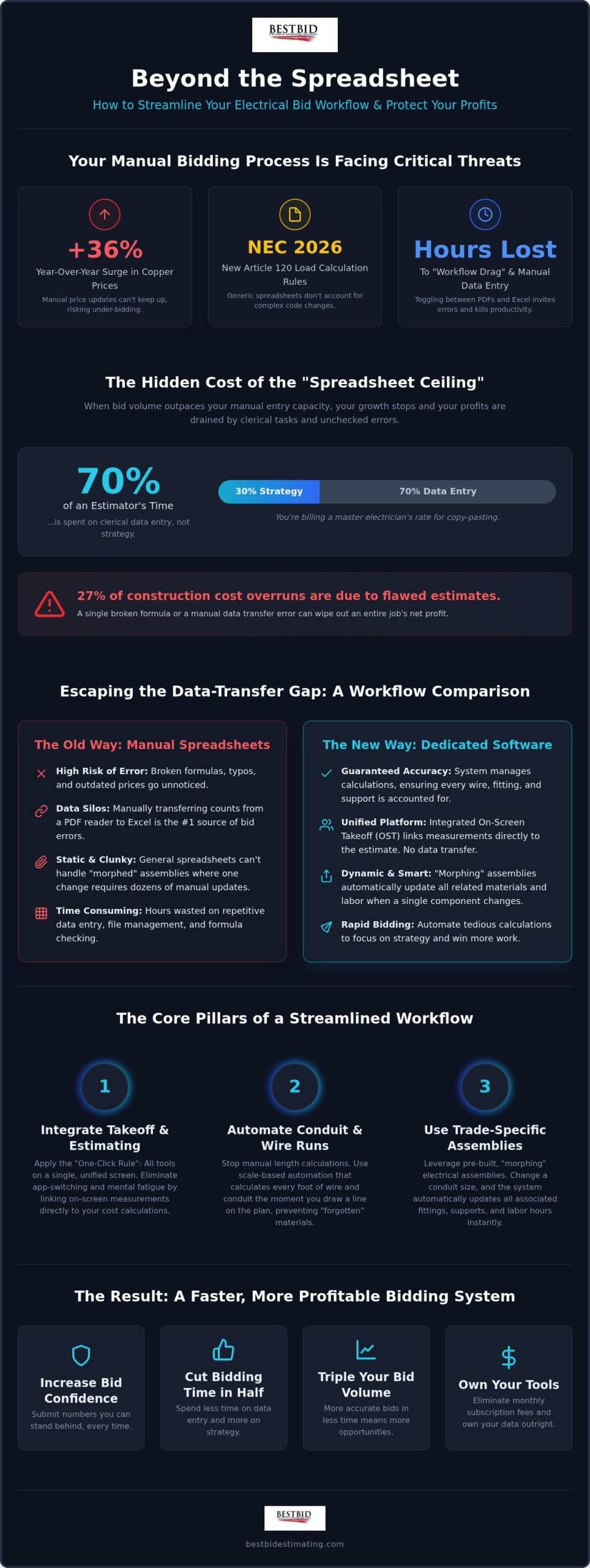
With copper prices surging up to 36% year-over-year and NEC 2026 rules shifting load calculations to a brand new Article 120, the margin for error in your bidding process has never been thinner. If you are still toggling between a PDF reader and a manual Excel sheet, you aren’t just working hard; you are risking your profit on a “workflow drag” that costs hours of billable time. Truly streamlining electrical bid workflow in 2026 requires moving past generic tools that don’t understand the nuances of the trade.
We know the frustration of finding a broken formula after a bid is submitted or realizing a material price update didn’t save. You deserve a system that provides total ownership without the burden of a monthly subscription eating your overhead. This guide will show you how to eliminate manual entry errors and cut your bidding time in half by using trade-specific automation.
We’ll explore how to build a repeatable system that accounts for every wire length and conduit run, giving you back your time and your confidence in every number you submit. It’s time to stop fighting your tools and start using a system built by people who have actually spent decades in the trenches.
Key Takeaways
- Identify the “Spreadsheet Ceiling” where manual entry errors and broken formulas begin to drain your profits as project complexity increases.
- Discover the core pillars of streamlining electrical bid workflow by bridging the gap between on-screen measurements and final cost calculations.
- Learn how trade-specific assembly workflows and built-in takeoff tools eliminate the need for tedious copy-pasting between separate programs.
- Understand the financial advantage of choosing a “no-subscription” platform that ensures you own your tools and data without monthly overhead.
- See how a faster, more accurate bidding system allows you to triple your bid volume and present professional, itemized proposals that win over general contractors.
The Spreadsheet Ceiling: Why Manual Entry is Killing Your Profit Margins
You’ve probably felt it. That moment when the stack of plans on your desk grows faster than your ability to type into Excel is what we call the Spreadsheet Ceiling. It’s the exact point where your bid volume outpaces your manual entry capacity, effectively capping your company’s growth. Effective streamlining electrical bid workflow requires recognizing the moment your manual systems begin to fail you. While the construction bidding process is fundamentally about competition and value, relying on unmanaged Excel files turns it into a high-stakes game of “find the broken link.”
The hidden cost of these spreadsheets isn’t just the time spent typing. It’s the risk. A single broken link or a formula error in a 50-tab workbook can go unnoticed for weeks. When you’re streamlining electrical bid workflow, you need to eliminate the “data-transfer gap” where most errors live. Manually moving counts from a PDF reader to a spreadsheet is the number one source of bid errors. It’s a clerical bottleneck that prevents you from actually analyzing the project’s risks and opportunities.
The Hidden Labor Cost of Manual Bidding
Estimators often spend 70% of their time on clerical data entry and only 30% on actual strategy. If you’re billing a master electrician’s rate for copy-pasting wire lengths, you’re losing money before the job even starts. Research from Compass International shows that 27% of construction cost overruns are due to flawed estimates. In a world where a 2% error in a spreadsheet formula can wipe out a job’s entire net profit, the stakes are too high for “good enough.” This creates a constant state of “bid anxiety,” where you’re never quite sure if your numbers are verified or just a lucky guess.
Why Electrical Bidding is Too Complex for General Tools
General construction spreadsheets fail because they treat electrical parts as flat data. They don’t account for “morphed” assemblies where one change in conduit size triggers a dozen changes in fittings, supports, and labor hours. Managing thousands of parts in a generic file is a recipe for disaster, especially with 2026 copper prices surging up to 36% year-over-year. Trade-specific databases are mandatory because they transform a list of parts into a dynamic, accurate reflection of real-world installation requirements. Using a dedicated tool like Best Bid Next Generation ensures that as material costs spike, your profit margins remain protected by real-time accuracy.
Core Pillars of a Streamlined Electrical Bidding Process
True efficiency isn’t about working faster; it’s about clicking less. The “One-Click Rule” is the foundation of streamlining electrical bid workflow. It suggests that every critical tool, from your digital takeoff to your final estimate summary, should be accessible from a single, unified screen. When you stop hunting through nested menus or switching between separate applications, you eliminate the mental fatigue that leads to costly mistakes. This unified approach transforms your computer from a digital filing cabinet into a high-performance engine for growth.
Integrating Takeoff and Estimating
Many contractors still treat takeoff and estimating as two separate jobs. They use generic measuring tools to mark up plans and then manually type those numbers into a different program. This creates a dangerous data silo.
By using built-in On-Screen Takeoff (OST), you eliminate the export and import steps entirely. Direct screen-based counting is easier to learn and far faster to execute. For those looking to optimize their plan markups and documentation, tools like Accura Cadd PDF Draw bridge the gap between initial design and the final bid, ensuring nothing is lost in translation.
Automating Conduit and Wire Calculations
Manual length calculations are a primary source of “click fatigue.” A streamlined workflow uses scale-based automation to calculate conduit and wire runs the moment you draw a line on the screen. Pre-built electrical assemblies take this further by allowing a single assembly to “morph” into any item you need. For example, changing a conduit size in the assembly should automatically update the fittings, supports, and labor hours associated with it. Automated takeoff ensures that every coupling, support, and foot of wire is accounted for, effectively preventing the “forgotten” materials that often bleed a project dry.
In 2026, market volatility makes real-time pricing a necessity rather than a luxury. With aluminum mill shapes up 49% year-over-year as of July 2026, relying on yesterday’s prices is a gamble. Connecting your bid directly to live market data via NetPricer ensures your margins are based on current costs, not outdated spreadsheets. If you want to see how these pillars work in a real-world environment, exploring Best Bid Next Generation is a great way to see how specialized software handles the complexities of the trade. This level of integration provides the financial clarity needed to bid with confidence in a shifting economy.
Spreadsheets vs. Dedicated Software: A Side-by-Side Comparison
Choosing between a manual spreadsheet and dedicated software isn’t just about picking a tool. It’s about deciding how much risk you’re willing to carry. While Excel is a versatile blank canvas, it lacks the hard-coded trade databases that prevent catastrophic errors. In a spreadsheet, a single accidental keystroke can delete a formula, leaving you with a bid that looks right but is mathematically impossible. Dedicated software replaces those fragile, user-created formulas with a locked, industry-standard database. This shift is the most effective way of streamlining electrical bid workflow because it removes the need for constant double-checking.
Speed is the next major differentiator. When you’re working in a spreadsheet, you’re likely stuck in a cycle of manual copy-pasting from PDF notes or scratchpads. Dedicated platforms offer 1-click transfers from takeoff to estimate.
This doesn’t just save minutes; it eliminates the clerical errors that happen when you’re tired and rushing to meet a midnight deadline. Beyond the internal mechanics, there’s the matter of how you appear to your customers. A professional, itemized proposal generated by software carries more weight with a General Contractor than a manually formatted document that looks like it was cobbled together in a home office.
The Total Cost of Ownership (TCO)
Many contractors view spreadsheets as “free,” but they are often the most expensive tool in the shop when you account for lost time and missed items. On the other hand, the modern software market is flooded with the “Subscription Trap,” where you’re forced into an endless cycle of monthly fees just to access your own data. For a true comparison, you need to look at the Total Cost of Ownership Electrical Estimating Software. Choosing a one-time purchase model allows you to protect your profit margins by turning a recurring expense into a permanent asset. You shouldn’t have to rent the tools you use to build your business. If you’re skeptical about whether affordable software can truly compete with premium platforms, our breakdown of the best electrical estimating software for small contractors debunks the most common myths holding small shops back from making the switch.
Database Control and Flexibility
True streamlining requires that you own and control your database. Cloud-only platforms might seem convenient, but they leave you vulnerable to internet outages or server downtime during critical bid days. If the server is down, your business is closed. A locally hosted system ensures you can work anywhere, anytime, without permission from a software provider. For smaller shops, Best Bid Next Generation provides a 5-star rated workflow that keeps you in the driver’s seat. You get the power of a professional database with the flexibility to adjust labor units and material prices on the fly, ensuring your bids reflect the reality of your specific market.
5 Steps to Transition Your Workflow Without Slowing Down
Moving away from a system you’ve used for years feels like changing tires while the truck is moving. However, sticking with a broken process is a guaranteed way to stall your business growth. To begin streamlining electrical bid workflow, you must first audit your current spreadsheet to find every point where you are manually copy-pasting data. These are your failure points. Once identified, look for a “No-Subscription” platform that lets you keep your hard-earned profits instead of paying a monthly software tax that never ends.
Your next move is to import or customize your core database to match your specific, field-tested labor units. No generic database knows your crew’s actual pace better than you do. After setting up your tools, run a “Shadow Bid.” Take a project you’ve already completed manually and re-estimate it using your new software. This side-by-side comparison provides the proof you need that your new system is both faster and more accurate, giving you the confidence to fully switch over without looking back.
Overcoming the Learning Curve
Trade-specific software is actually easier to master than complex Excel macros because it’s built to follow the logical flow of a job site. You don’t need to be a programmer; you just need to be an electrician. To bypass the initial struggle and gain immediate proficiency, utilize resources like the Online School for Electrical Estimating. Founder Steve Griffin often says, “Everybody has a first day,” and that philosophy drives the supportive environment of the Best Bid Academy, ensuring you have a patient hand helping you through the digital shift.
Cleaning Up Your Data
Standardizing your material lists is a cornerstone of streamlining electrical bid workflow because it allows for 1-click backups and faster pricing updates. You should also set up global labor adjustments to account for difficult site conditions or specialized projects like high-voltage work. If the transition feels overwhelming during a busy season, consider using freelance electrical estimating services to keep your bid volume up while you get your internal systems in order. This ensures your revenue doesn’t dip while you are upgrading your tools.
Ready to take the first step toward total ownership of your bidding process? Explore how Best Bid Next Generation can transform your workflow today.
Winning the Bid Day: Accuracy as Your Competitive Edge
Winning the bid day is about more than just submitting the lowest number. It’s about having the technical confidence to stand by your estimate when a General Contractor starts asking tough questions. By streamlining electrical bid workflow, you aren’t just saving time; you are building a competitive fortress. When your bidding process takes minutes instead of hours, you can realistically bid on 3x more projects without adding a single person to your payroll. This volume is what separates contractors who are surviving from those who are thriving.
There is a massive psychological advantage in the way you present your numbers. A GC who receives a professional, itemized proposal is far more likely to trust your expertise than one who gets a vague total on a generic letterhead. To further reinforce this trust, providing organized photographic evidence of site conditions via PHOTO iD can prove that your bid is based on a thorough and professional inspection. Before you hit send, use a “Shadow Takeoff” to verify your high-risk numbers. This final verification step ensures that your wire lengths and conduit runs are perfectly accounted for. It allows you to be more aggressive with your pricing because you know exactly where your break-even point lies. You don’t have to pad your bids for “unknowns” when your software has already accounted for them.
Scaling Your Business Without Adding Staff
A solo contractor using a unified system can perform the work of a three-person estimating team. You don’t need more office staff; you need better tools. By streamlining electrical bid workflow, you free up your schedule to focus on high-level strategy rather than clerical data entry. Beyond the bid, professional documentation remains critical for your brand. Utilizing a Panel Scheduler during project closeouts ensures that your reputation for quality follows you from the initial estimate to the final inspection. If you are looking for a complete roadmap to this transition, our guide on How to Streamline Electrical Bidding Process provides a deeper dive into the specific tools that make this scale possible.
The Best Bid Difference: Built by Electricians
Most software is built by programmers who have never stripped a wire or bent a piece of conduit. Best Bid is different. Every feature in our software is informed by Steve Griffin’s 50+ years of field experience as a Master Electrician. We understand the daily grind because we’ve lived it. This is why we maintain our “No Monthly Fees” promise. We believe in contractor profitability and total ownership. You shouldn’t have to pay a “SaaS tax” to access the data that runs your business. It’s time to move beyond outdated spreadsheets and own your future. Schedule a Walkthrough of Best Bid Next Generation today and see the difference that trade-specific expertise makes.
Take Total Control of Your Estimating Future
The transition from fragile spreadsheets to a robust, trade-specific system is the single most important step you can take for your business in 2026. By streamlining electrical bid workflow, you eliminate the data silos that lead to profit-killing errors and reclaim the hours spent on tedious manual entry. You’ve seen how bridging the gap between takeoff and estimating can triple your bid capacity while maintaining absolute precision in every conduit run and wire count.
We believe you should own the tools that build your legacy. That’s why we’re ranked #1 for Best Value among single-location contractors. With no monthly fees, ever, and lifetime updates and support included, you can bid with the confidence that your overhead is protected and your data is entirely yours. It’s time to stop fighting outdated tools and start using a system designed by people who understand the daily grind of the trade. Stop Renting Your Software, Own Best Bid Next Generation Today. You’ve put in the hard work in the field; now it’s time to let your technology work just as hard for you.
Frequently Asked Questions
Is it really faster to use software than my existing electrical bidding spreadsheet?
Yes, it is significantly faster because it automates the calculations that take hours in Excel. By streamlining electrical bid workflow with built-in tools, you can reduce bid preparation time for mid-complexity jobs from several hours to under 90 minutes. You stop fighting broken formulas and start focusing on the actual project scope, allowing you to submit more bids without working longer nights.
Can I import my current Excel database into Best Bid software?
Yes, you can customize the database to reflect your specific labor units and material preferences. While we provide a comprehensive industry database, we know every shop runs differently. You can import your field-tested data to ensure your new system speaks your language. This flexibility ensures that your transition doesn’t force you to abandon the years of practical knowledge built into your current spreadsheets.
Do I need to pay for separate on-screen takeoff (OST) software?
No, you don’t need separate takeoff software. Best Bid Next Generation and Hybrid Pro include built-in On-Screen Takeoff (OST) as a core feature. This eliminates the need for expensive third-party tools that require separate subscriptions. By having your measurements and calculations on one screen, you remove the data-transfer gap that often leads to manual entry errors during the streamlining electrical bid workflow.
What happens if I stop paying for software updates, will I lose access to my bids?
You will never lose access to your data or your bids. Unlike subscription-based models that lock your files if you stop paying, our “Buy it and Own it” philosophy means the software is yours forever. We provide updates and support to keep you current, but your ability to bid projects is never held hostage by a monthly fee. You maintain total ownership of your tools.
How long does it take for a beginner to learn electrical estimating software?
Most beginners can start bidding basic projects within a few days. Because the software is built by a Master Electrician, it follows the logical flow of a real-world job site rather than complex computer logic. We also provide specialized education through our Online School for Electrical Estimating to help you bypass the learning curve. You’ll find that trade-specific automation is much more intuitive than managing Excel macros.
Can Best Bid handle both residential and large-scale industrial electrical bids?
Yes, the software is designed to handle everything from simple residential service calls to massive industrial installations. The assembly-structure allows you to scale your estimates based on the complexity of the project. Whether you’re counting receptacles in a dwelling or calculating heavy switchgear and complex conduit runs for a data center, the system remains accurate and responsive to the specific needs of the trade.
Does the software include real-time material pricing for the US market?
Yes, our software integrates with NetPricer to provide real-time material pricing for the US market. This is critical in 2026, where copper and aluminum costs can shift significantly in a single week. You can pull live pricing directly from your preferred local distributors, ensuring your bid reflects the actual market conditions on bid day rather than outdated prices from a static, manual spreadsheet file.
What is the benefit of a one-time purchase over a monthly subscription for a small contractor?
The primary benefit is protecting your long-term profit margins. A one-time purchase eliminates the recurring monthly fees that eat into your overhead. For a small contractor, this means your tools become a permanent asset rather than a recurring liability. You gain the security of a modern, reliable system without the financial burden of an endless subscription, allowing you to keep more of what you earn. To understand exactly which features matter most for a smaller operation and which premium-priced options are simply unnecessary, see our full guide on the best electrical estimating software for small contractors and the five myths that may be costing you money.