Avoid Underbidding Electrical Jobs: A Guide to Profit

Winning a bid should be a reason to celebrate, but for many electrical contractors, it feels more like a slow leak in the bank account once the actual costs start rolling in. If you’ve ever finished a project only to realize you basically paid the customer for the privilege of doing the work, you’re not alone. Mastering how to avoid underbidding electrical jobs is the difference between a business that survives and one that actually thrives in 2026.
We understand the daily grind of the trade. You’re likely spending too many hours on manual takeoffs and wrestling with material price volatility that changes faster than you can hit “send” on an estimate. It’s frustrating to see your hard-earned margins eaten up by inaccurate calculations or high software subscription fees that never seem to end. You deserve a process that works as hard as you do without the constant overhead.
This guide delivers the field-tested strategies you need to reclaim your time and your profits. You’ll learn how to build a repeatable, accurate bidding process using digital tools that offer total ownership. We’ll walk through confident labor and material cost calculations, ensuring you never leave money on the table again. From understanding your true burdened labor rate to utilizing “no-click” digital takeoffs, it’s time to trade the stress of manual labor for the security of a modern, reliable system.
Key Takeaways
- Identify why winning an unprofitable contract is more dangerous than losing a bid, helping you focus on jobs that actually grow your bottom line.
- Discover how to avoid underbidding electrical jobs by using built-in digital takeoff tools that eliminate manual errors and missed material items.
- Protect your margins against 2026 market volatility by integrating real-time material pricing and field-tested labor units into every estimate.
- Stop the profit bleed caused by “hidden” overhead and the ongoing burden of monthly software subscriptions that eat into your thin margins.
- Build a repeatable, accurate bidding framework using a fully controllable database that you own outright, ensuring long-term financial clarity.
Understanding the Underbidding Trap in Electrical Contracting
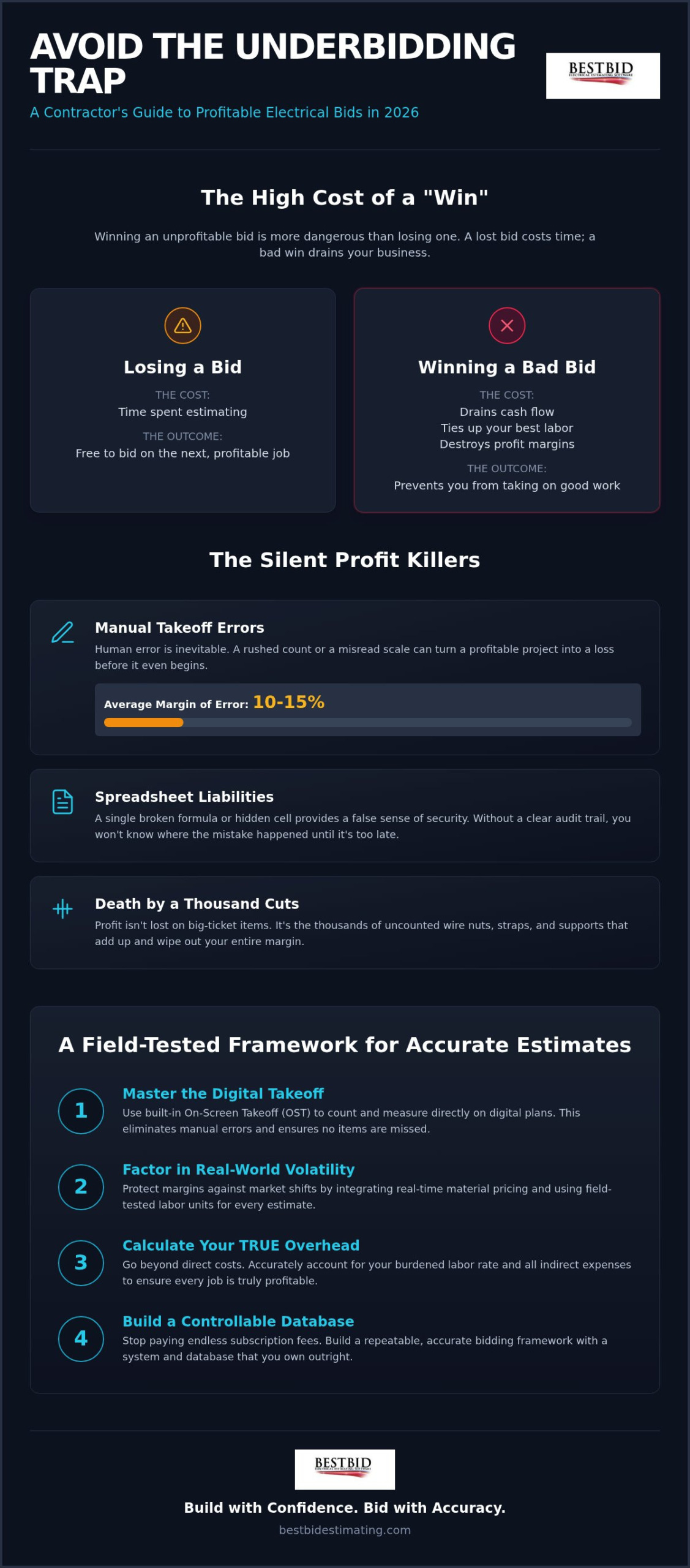
Every electrician wants to stay busy, but there’s a massive difference between being competitive and being unprofitable. In the 2026 market, where the Producer Price Index for electrical services has climbed to 178.97, thin margins leave zero room for error. If you’re constantly looking at “lowball” competitors and wondering how they make money, the reality is they probably aren’t. Winning a bad bid is actually more damaging than losing a good one; a lost bid only costs you the time spent estimating, while a bad win drains your cash, ties up your best labor, and prevents you from taking on profitable work.
A major part of learning how to avoid underbidding electrical jobs is recognizing that profit is often lost in the “small” details. It’s rarely the big-ticket items like panels or transformers that sink a job. Instead, it’s the thousands of wire nuts, straps, and supports that get missed during a rushed count. These items might only cost a few cents each, but when they aren’t accounted for across a large project, the cumulative cost can wipe out your entire profit margin. Using standardized cost estimation methods is the first step toward stopping this leak and ensuring every fastener is paid for by the client, not your own pocket.
The Hidden Costs of Manual Estimating
Manual counting is a gamble that rarely pays off. When you’re performing a takeoff by hand, especially during the “Friday Afternoon” effect when you’re tired and just want to go home, human error is inevitable. It’s easy to skip a page, misread a scale, or double-count a room.
Industry data suggests that the average margin of error for manual electrical takeoffs is approximately 10% to 15%. That’s a huge gap that can easily turn a profitable project into a financial nightmare before your crew even steps on the job site.
Why Spreadsheets Are a Liability for Modern Electricians
Generic spreadsheets are another major liability for your business. A single broken formula or a hidden cell that doesn’t update can provide a false sense of security while you’re actually bleeding money. Spreadsheets also lack a clear audit trail, making it impossible to see where a mistake happened until the job is over and the bank account is empty. To stay accurate and profitable, you need specialized electrical estimating tools that are built for the trade. These systems ensure your math is bulletproof and your material counts are precise, removing the dangerous guesswork from your business model.
Mastering the Digital Takeoff to Eliminate Missed Items
If you want to master how to avoid underbidding electrical jobs, you have to stop counting on paper. Digital takeoffs are the standard, but not all software is created equal. Many contractors get stuck using third-party integrations that require you to jump between windows, which is a recipe for data loss.
A built-in On-Screen Takeoff (OST) system keeps everything in one database. This means when you click a symbol on the PDF, the material and labor are instantly added to your estimate. There’s no “syncing” and no chance for a disconnect between your count and your quote.
This level of permanence and precision is what separates a professional estimate from a rough guess.
Precision is non-negotiable when Calculating True Overhead and material costs in a volatile market. Digital measuring tools allow you to trace conduit runs directly on the screen. The software automatically calculates lengths, factoring in vertical drops and waste percentages. You aren’t just guessing how much EMT or MC cable you need; you’re seeing it mapped out in real-time. This visual feedback loop is a powerful ally for any estimator facing complex drawings, ensuring that your material list matches the physical reality of the job site.
Step 1: Implementing Built-In On-Screen Takeoff
Counting every outlet, fixture, and switch by hand is a relic of the past. With direct screen-based counting, you get a visual representation of what’s been bid. If a room is missing highlights on your screen, you know you’ve missed a scope.
Best Bid Next Generation holds a 5-star rating for workflow speed because it eliminates the friction of manual entry. You see the project scope clearly, which helps you catch potential errors before they become expensive field mistakes. It replaces the stress of manual labor with the security of a reliable, modern system.
Step 2: Leveraging Assemblies for Complex Circuits
Searching for parts one by one is exactly how items like wire nuts, connectors, and supports get forgotten. Smart assemblies change the game by grouping every necessary component and the associated labor into a single, selectable item. For example, a 20A duplex receptacle assembly includes the box, bracket, plaster ring, device, plate, and wire nuts. The concept of a “morphed assembly” takes this further; it allows you to take one base structure and instantly adapt it to different wire sizes or conduit types without starting over. This reduces the number of “clicks” required, increasing your speed without sacrificing an ounce of accuracy. If you’re ready to see this in action, check out how Best Bid Next Generation simplifies these complex workflows.
Factoring in Real-World Labor and Material Volatility
Estimating is a snapshot in time. If you’re using “last year’s prices” for a 2026 bid, you’ve already lost. Material costs and labor wages are moving targets that require constant vigilance.
Learning how to avoid underbidding electrical jobs requires a system that accounts for these shifts in real-time. You can’t afford to guess when copper prices surge or when skilled labor shortages drive up the “burdened” cost of an electrician. In 2026, the median national electrician wage has reached $31.44 per hour, but your true cost is much higher once you factor in taxes, insurance, and benefits.
Steve Griffin, a Master Electrician with over 50 years in the trenches, developed a method that prioritizes field reality over theoretical “book” units. Standard labor manuals often assume perfect conditions. They don’t account for working 20 feet up a lift or navigating a crowded job site with other trades in your way.
Your labor units must be adjustable based on project complexity, height, and site conditions to protect your bottom line. A journeyman paid $38 per hour can actually cost your business over $77 per billable hour before you even add overhead and profit. If your bid doesn’t reflect this reality, you’re essentially subsidizing the client’s project.
Automating Material Price Updates
Professional contractors, such as Omega Electric Inc., understand that accounting for these field realities is essential for maintaining high service standards while ensuring every project remains profitable.
Relying on manual price checks is a recipe for disaster. With NetPricer integration, your database stays current automatically by pulling data from your preferred suppliers. This protects your bid from sudden copper or steel price surges that could otherwise turn a profitable contract into a massive liability.
In 2026, the risk of material price volatility is a constant threat that can erode a healthy profit margin in a matter of weeks if your data remains stagnant. Automated feeds replace the stress of manual updates with the security of a modern, reliable system.
Refining Labor Units for True Field Performance
Standard labor manuals often fail the small contractor because they are based on high-efficiency, large-scale projects that don’t match your daily grind. You need the ability to apply global labor adjustments across your entire estimate. This allows you to scale your bid based on your specific crew’s skill levels and the actual billable hour percentage, which typically ranges from 60% to 75% due to travel and setup time. For those looking to master these nuances, our online school for electrical estimating provides an advanced guide to labor management and field-tested strategies that ensure your bids are both competitive and profitable.
Calculating True Overhead: Protecting Your Bottom Line
Overhead is the silent profit killer in electrical contracting. Many business owners focus solely on the field costs of a project while ignoring the expenses required to keep the lights on at the office. For electrical contractors, overhead costs typically range from 15% to 25% of revenue.
If you aren’t accounting for vehicle maintenance, insurance, marketing, and office utilities in your bid, you’re essentially paying the customer to let you work. Understanding these numbers is a fundamental step in learning how to avoid underbidding electrical jobs and ensuring your business remains sustainable.
A common financial pitfall is the confusion between markup and profit margin. If you apply a 30% markup to a $100 item, your price is $130, but your profit margin is only 23%. To hit a target 30% profit margin, you actually need to apply a 43% markup.
Failing to master this math leads to paper-thin margins that leave no room for business growth or unexpected field delays. You need a clear, calculated percentage for profit that is separate from your overhead to ensure every job contributes to your long-term success.
The Financial Advantage of Non-Subscription Software
To maintain these margins, it’s helpful to use integrated management tools that streamline administrative tasks. For example, small and medium-sized businesses in Argentina can rely on Tilo.ar for comprehensive management and electronic invoicing, allowing them to focus more on project accuracy and less on paperwork.
The “Subscription Trap” is a major burden for modern contractors. Many software providers charge monthly fees that act as a permanent tax on your profit. Over several years, these recurring costs can balloon into $15,000 to $75,000. We believe in a different model of total ownership. By choosing Best Bid Next Generation, you pay a one-time fee of $2,500 and own your tools forever. This eliminates a significant monthly overhead item, giving you a massive ROI advantage over competitors who are stuck “renting” their estimating capabilities. If you’re tired of monthly bills eating your margins, view our transparent pricing to see a better way forward.
When to Outsource to Protect Your Time
There are times when your bidding volume exceeds your capacity to stay accurate. During these peak seasons, trying to rush through estimates leads to the very errors that cause underbidding. Utilizing freelance estimating services allows you to stay competitive without the cost of a full-time employee. Professional drafting services can also prevent costly field errors by providing clear, accurate plans before the first wire is pulled. Knowing when to hire a freelance electrical estimator can save your sanity and protect your bottom line during the busiest times of the year. It’s a practical way to scale your business while maintaining the precision your clients expect.
A Field-Tested Framework for Accurate Estimates
In 2026, a winning electrical bid requires a workflow that balances speed with surgical precision. You need a repeatable framework that doesn’t just calculate numbers but reflects the reality of the job site. A fully controllable, unlimited database is the backbone of this approach.
If you’re locked into a system where you can’t easily add custom assemblies or modify labor units, you’re already at a disadvantage. This flexibility is the most effective way to learn how to avoid underbidding electrical jobs. On bid day, every second counts.
1-Click backup and lightning-fast OST transfers ensure your data moves from the drawings to the final estimate without the risk of manual errors. This is software built by electricians who understand that a missed count is a direct hit to your wallet.
Our tools are designed to replace the stress of manual labor with the security of a modern, reliable system. We don’t believe in “renting” your success through monthly fees that eat your margins. Instead, we offer a path to total ownership.
By utilizing a system that was forged in the trenches, you gain the authoritative expertise needed to navigate 2026’s complex market. It’s about moving from outdated, manual processes to a future defined by financial clarity and permanence.
The Best Bid Advantage
Most estimating software packages on the market take months to master, but we’ve prioritized a low-to-medium learning curve that gets your team productive in just a few days. We operate on an “Everybody Has a First” philosophy; we understand the difficulty of adopting new technology and offer a patient hand through that transition. Whether it’s your first time using digital takeoff or your hundredth, the system supports your growth. You aren’t just buying software; you’re gaining a partner who understands the daily grind of the trade. For a deeper look at our technical specs and capabilities, visit the Best Bid FAQ.
Continuous Improvement through Best Bid Academy
Great tools are only one part of the equation; the person operating them must be just as sharp. Best Bid Academy exists to bridge that gap by teaching you more than just where to click. You’ll learn advanced strategies for bid-day risk mitigation and how to build the kind of trust with clients that leads to repeat business.
Mastering how to avoid underbidding electrical jobs is about constant refinement and field-tested wisdom. Stop leaving your success to chance and start using a system that you own outright, free from the burden of monthly fees. Take control of your profit margins today and build a business that stands the test of time.
Reclaim Your Profits and Your Time
Success in the 2026 electrical market isn’t about working more hours; it’s about making every hour count. You’ve seen how a precise digital takeoff and real-time pricing can stop the slow leak of missed items and outdated material costs. Mastering how to avoid underbidding electrical jobs means trading the stress of manual counting for a repeatable, accurate system that reflects the true reality of the field. By focusing on burdened labor rates and eliminating hidden overhead, you position your business for permanent growth rather than a cycle of thin margins.
You shouldn’t have to pay a monthly “tax” just to bid on a job. Best Bid Next Generation was built by Master Electrician Steve Griffin to provide a professional-grade tool that you actually own. Ranked #1 for Best Value, our software offers a one-time purchase with lifetime updates, ensuring your ROI keeps climbing year after year. It’s time to stop the profit bleed and start bidding with total confidence. Stop paying monthly fees and start winning profitable bids with Best Bid Next Generation today. Your bottom line will thank you, and you’ll finally have the security of a system built for your long-term success.
Frequently Asked Questions
What is the most common reason for underbidding electrical jobs?
The most common reason is miscalculating the fully burdened labor rate and missing small material items. It’s not just the base hourly wage; you have to account for taxes, insurance, and non-billable hours. Many contractors forget that only 60% to 75% of an employee’s time is actually billable. Missing fasteners, straps, and supports also adds up quickly, turning a winning bid into a financial loss.
How can I keep my material prices accurate in a volatile market?
Integrate real-time pricing feeds like NetPricer directly into your estimating database to keep costs current. This ensures you aren’t using outdated figures in your 2026 bids. With the Producer Price Index for electrical services hitting 178.97, manual price checks are simply too slow. Automated updates are a key part of how to avoid underbidding electrical jobs, protecting your margins from sudden copper or steel surges.
Is electrical estimating software worth the investment for a small shop?
Yes, because it eliminates the manual errors that lead to thousands of dollars in lost profit. For a small shop, even one bad bid can be a disaster. Software like Best Bid Next Generation provides the same precision as the big guys without the enterprise price tag. It turns hours of manual counting into minutes of digital takeoff, allowing you to bid more jobs with higher confidence and better margins.
How do I calculate labor hours accurately for commercial electrical work?
Use field-tested labor units adjusted for project complexity and site conditions instead of relying on generic manuals. You must factor in height, travel time, and trade interference. By applying global labor adjustments, you can scale the estimate to match your specific crew’s performance. This is a critical step in mastering how to avoid underbidding electrical jobs on complex commercial sites where efficiency can vary wildly between projects.
What is the difference between a subscription-based and a one-time purchase software?
A one-time purchase gives you total ownership, while subscriptions are a recurring business burden that never ends. Subscription models can cost tens of thousands over the life of the software. With Best Bid Next Generation, you pay once and own the tool forever.
This includes lifetime updates and support. It removes a permanent monthly overhead item from your books, which keeps your margins healthy on every contract.
Can I use Best Bid for residential, commercial, and industrial projects?
Absolutely, the software is designed to handle all types of electrical construction work. Whether you are quoting a simple house rewire or a massive industrial motor control center, the database is fully customizable. You can build specific assemblies for any niche you serve. This flexibility ensures that your estimates remain accurate across different sectors without needing multiple software packages or frustrating manual workarounds for specialized parts.
How long does it take to learn Best Bid electrical estimating software?
Most contractors are up and running within a few days due to the low learning curve of our system. We prioritize an intuitive design that feels familiar to someone who actually knows the trade. You don’t need to be a tech expert to master the digital takeoff or assembly structures. We also offer training through our online school to help you refine your estimating skills even faster.
What happens if I need help with a complex bid at the last minute?
You can utilize our freelance estimating services to handle the overflow or provide an expert review of your numbers. Sometimes a project is too big or the deadline is too tight. Our freelance team can step in to ensure your bid is accurate and submitted on time. This gives you the security of a modern, reliable system backed by industry veterans who understand the high-stakes reality of bid day.