The First Time I Won a Big Job — The Breakthrough Every Estimator Remembers

Electrical Estimating Philosophy · Series Part 7 of 56
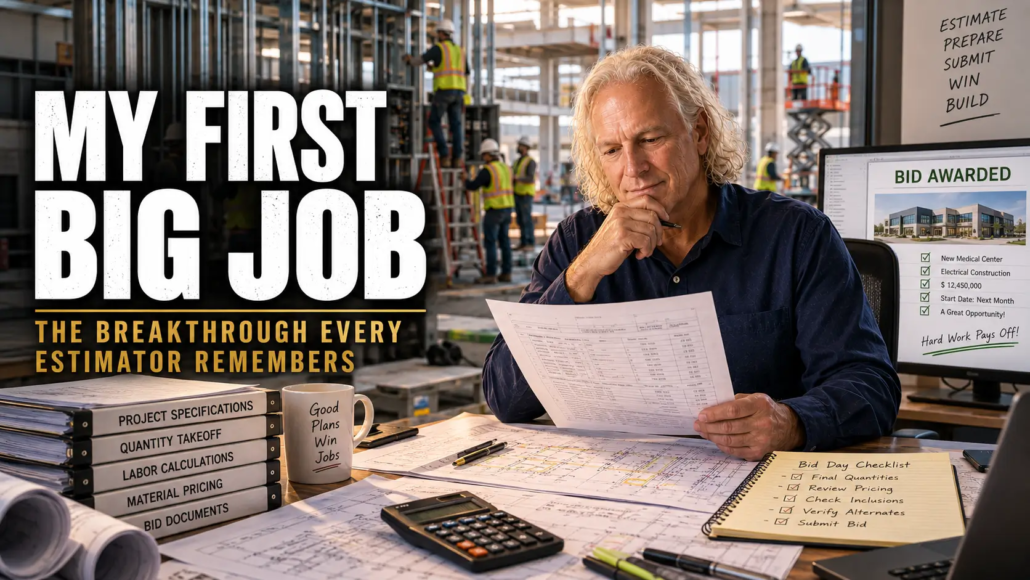
I remember sitting with my estimate in front of me and looking at the number one more time before Bid Day was over. I had already checked it, then checked it again. The drawings had been studied, quantities reviewed, labor considered, and materials worked through. At that point, there wasn’t much left to do except trust the work I had put into the estimate.
This wasn’t a small electrical project. It was the first big job where I really felt the weight of the number I was submitting. I knew that if I won, the estimate would eventually become a real project with real electricians, real materials, real labor, and real costs.
If I was wrong, I wasn’t going to discover that mistake on a piece of paper. I was going to discover it on the jobsite.
When I found out I had won, I was excited. But I also remember thinking, “Now I have to build it for that number.”
That thought probably taught me more about Electrical Estimating than the actual moment of winning.
A Big Job Changes the Pressure
Before that project, I had already estimated plenty of electrical work. I understood how to read drawings, count quantities, calculate material, estimate labor, and put together a bid. But a large project brings a different kind of pressure because every mistake gets bigger along with the job.
I took that estimate seriously. I went through the drawings carefully and tried to think beyond what I was seeing on the page. How difficult would the installation be?
How much labor would the work really require? Were there areas where access could slow the crew down? Were my material quantities realistic?
I’ve always believed an Electrical Estimator needs to understand where the numbers come from. A final total doesn’t mean much if you can’t explain how you arrived at it.
Bid Day Can Make You Second-Guess Yourself
Anyone who has worked on Bid Day knows the feeling. You’ve spent days working on an estimate, the deadline is getting close, and suddenly you start questioning everything.
Did I miss something? Is my labor too low? Did I carry enough wire? What if another contractor is lower?
I’ve felt that pressure many times.
The lesson I learned was that preparation gives you something to fall back on. Confidence doesn’t mean believing you’re never going to make a mistake. I’ve made plenty of them over more than 50 years in this business. Confidence means knowing you’ve done your homework and understanding why your number is what it is.
If I found a real error, I corrected it. But I didn’t want to change a sound estimate just because I was nervous.
Winning the Job Is Only the Beginning
The moment I learned I’d won that first big job was exciting, but the real test came afterward.
The estimate had to become a project.
The conduit had to be installed. The wire had to be pulled. Boxes, fixtures, panels, devices, and equipment had to be installed. The labor hours I had allowed had to be enough to get the work done.
That’s when you find out what your estimate is really worth.
My years working in the field helped me understand this. When you’ve actually installed electrical work, you look at drawings differently. You start thinking about access, material handling, installation difficulty, coordination, sequencing, and productivity.
Those details can make a major difference between an estimate that looks good on paper and one that works in the field.
I Learned From What Happened After the Bid
I’ve never believed that an estimator should simply submit a bid and move on.
A completed project gives you valuable information.
If the labor took longer than expected, I wanted to know why. If material usage was higher than I estimated, I wanted to understand what caused it. If something went exactly as planned, I wanted to remember that as well.
Every project became another lesson.
That’s how estimating judgment develops. You begin recognizing patterns and understanding which assumptions are reasonable and which ones deserve another look.
I’ve made mistakes throughout my career, but I’ve tried not to make the same mistake twice.
The Lowest Number Isn’t Always the Best Number
Winning a big job can make you feel successful, but I’ve learned that winning isn’t simply about being the lowest bidder.
A contractor can win a project and still lose money.
I’ve seen what happens when an estimate doesn’t properly account for labor, materials, or project risks. Getting the contract doesn’t help much if the number doesn’t give you a reasonable opportunity to make a profit.
That’s why I always ask myself two questions: Can I win this job, and can I build it profitably for the number I’m submitting?
Both questions matter.
Where Estimating Software Helps
When I started in the electrical industry in 1973, much of my estimating work was manual. I’ve watched technology completely change the way contractors prepare bids.
Today, Best Bid Electrical Estimating Software can help organize quantities, assemblies, labor, materials, and pricing while reducing repetitive work.
But I’ve never believed software replaces an experienced Electrical Estimator.
Software can help organize the information, but somebody still has to understand the project. You still need to recognize unusual conditions, question questionable quantities, and understand whether the labor makes sense.
That’s why I see technology as a tool that supports experience rather than replacing it.
The Lesson That Stayed With Me
That first big job changed the way I looked at myself.
Before I won it, I wondered whether I was ready for a project of that size. Afterward, I knew I could handle something bigger than I had handled before.
That didn’t mean I stopped learning. In fact, it made me realize how much more there was to learn.
That’s also part of the reason I wrote The Electrical Estimator’s Guide to Winning More Bids and Making More Money. I wanted to put practical lessons from my years as an electrician, estimator, and contractor into something other people in the industry could use.
I’ve learned that experience isn’t simply the number of years you’ve been doing something. It’s what you learn from those years.
What I Would Tell a New Estimator
If you’re a new Electrical Estimator and you’re waiting for your first big win, don’t worry about trying to feel completely confident before you submit the bid.
Instead, prepare.
Study the drawings. Check your quantities. Understand your labor.
Review your material. Think about how the work will actually happen on the jobsite. Question your assumptions, and learn from every project you complete.
Then, when you’ve done the work, trust your preparation.
My first big job taught me that confidence doesn’t come from guessing. It comes from knowing you’ve done everything you reasonably can to understand the project.
I’ve won many jobs since then, and I’ve lost plenty, too. That’s part of being an Electrical Contractor. But that first big win remains special because it was the moment I realized I could compete for bigger work and stand behind my estimate.
If you’d like to improve your Electrical Estimating process, prepare more confidently for Bid Day, or learn more about Best Bid, contact me at 800-941-7028. I’m always glad to hear from electrical contractors and estimators who are looking for practical ways to improve their estimating process and win more profitable work.

Frequently Asked Questionsre
1. What makes winning a first big electrical job so important?
For me, it was important because it proved that my preparation and estimating process could handle a larger project. It gave me confidence based on experience rather than simply hope.
2. How can an Electrical Estimator prepare for Bid Day?
I recommend carefully reviewing drawings, quantities, labor, materials, project conditions, and assumptions before the deadline. Good preparation makes it easier to trust your final number.
3. Should an Electrical Contractor always try to be the lowest bidder?
No. I believe the goal is to submit a competitive bid that can also be completed profitably. The lowest number isn’t necessarily the best business decision.
4. Why is jobsite experience valuable in Electrical Estimating?
Jobsite experience helps an estimator understand how drawings translate into actual work. Installation difficulty, access, productivity, coordination, and material handling can all affect project costs.
5. Can Estimating Software replace an Electrical Estimator?
I don’t believe it can. Software can organize information and reduce repetitive work, but an experienced estimator still needs to understand the project and make sound judgments.
6. How can estimators learn from completed projects?
I compare estimated labor and material with what actually happened. Understanding where the estimate differed from reality helps me make better decisions on future projects.
7. What is the biggest lesson from winning a first big job?
For me, the biggest lesson was that confidence comes from preparation. You don’t need to know everything, but you need to understand your estimate well enough to stand behind it.
My Final Takeaway
When I think about that first big job, I don’t just remember winning the contract. I remember the responsibility that came with it.
Winning gave me confidence, but building the project taught me even more.
After more than 50 years in this industry, I still believe the best estimators never stop learning. Every bid teaches you something. Every jobsite teaches you something. Every mistake can teach you something.
My advice is simple: do the work, know your numbers, learn from your projects, and trust your preparation.
That’s what turned my first big bid from a moment of uncertainty into one of the most important breakthroughs of my estimating career.
About Steve Griffin
Steve Griffin
Founder of Best Bid Electrical Estimating Software
Electrician • Estimator • Contractor • Author • Software Developer
From digging ditches in 1973 to creating one of the industry’s longest-running electrical estimating software systems, Steve Griffin has spent more than 50 years helping contractors win more work and make more money.