Creating Electrical Change Order Estimates and Cost Impacts

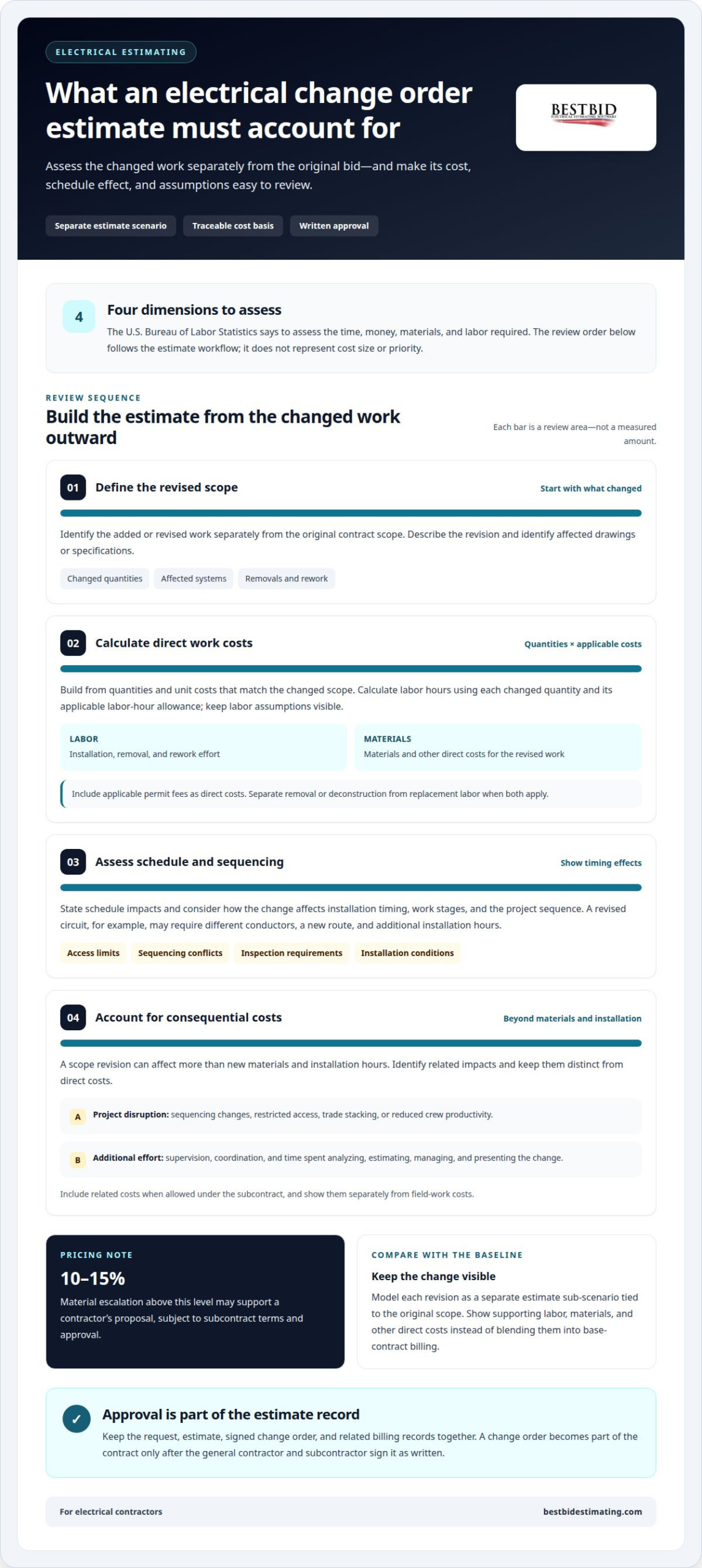
Treat each electrical change order as a separate estimate sub-scenario, tied to the original scope. When creating electrical change order estimates, account for the added or revised work, its schedule effect, and the related costs; according to the U.S. Bureau of Labor Statistics, that means assessing the time, money, materials, and labor required. A change order becomes part of the contract only after the general contractor and subcontractor sign it as written.
A scope change may look straightforward on a drawing but still add labor, disrupt sequencing, or require time to price and manage. A clear estimate separates these impacts from the original bid, making the change easier to review and its cost easier to explain.
This article explains how to document change orders, assess scope and timing impacts, and calculate overhead without obscuring direct costs. You’ll also learn how to model each change as a separate estimate scenario, compare it with the baseline, and base the price on the work required.
Key Takeaways
- Keep direct costs for added work distinct from consequential costs such as disrupted sequencing, reassigned crews, or extra supervision.
- Assess schedule effects alongside scope changes; a compressed work window can alter labor productivity and project costs.
- Look at change orders cumulatively, since several small revisions can affect project performance when considered together.
- Use the contract’s change-order terms for overhead and markup, and calculate company overhead from annual expenses and sales to understand your cost structure.
- Model each revision as a separate estimate sub-scenario so you can compare its cost and assumptions with the original bid.
How to Use Change Orders?
Use a change order to document revised electrical scope, price, and schedule effects. Creating electrical change order estimates starts with separating the requested work from the original contract scope.
Change Order Procedures
A change order documents an agreed adjustment to the construction contract, including scope, price, and schedule. Whether on commercial sites or residential remodel projects coordinated by general contractors like River City Construction Inc, clear records give both parties a shared basis for reviewing the work. Describe the revision, identify affected drawings or specifications, and state schedule impacts. The change order becomes part of the contract only after both parties sign it as written.
Move each request through estimating, review, and approval promptly. Faster processing can reduce the chance that a change disrupts project work. Material escalation above 10-15% may support a contractor’s proposal, subject to subcontract terms and approval. Before submission, field leaders can review the estimate for access limits, sequencing conflicts, or installation conditions missing from the drawings.
Electrical Estimating Steps
For creating electrical change order estimates, identify the revised work, then calculate its labor, materials, time, and money. The U.S. The U.S.
Bureau of Labor Statistics says electrical change order estimates require assessing the time, money, materials, and labor needed for the work. Separate new installations from removals or rework, and record quantities and labor assumptions for each affected system.
Next, assess schedule and pricing assumptions. A revised circuit, for example, may require different conductors, a new route, and additional installation hours. Include coordination and sequencing effects, not just added materials.
If local inspection requirements affect work stages, account for the resulting labor and timing. Include applicable permit fees as direct costs.
Billing should follow the subcontract’s change-order terms and approved scope. Show the change as a separate item, with supporting labor, materials, and other direct costs, instead of blending it into base-contract billing. This connects payment requests to written approval and gives reviewers a clear amount to assess. Keep the request, estimate, signed change order, and related billing records together.
Local electrical codes can affect the materials or installation steps required for revised work. Include applicable permit fees in the estimate, and account for how inspection requirements may influence labor sequencing and timing. Identify these impacts within the changed scope so reviewers can follow the basis for the estimate against project documents.
Owners are advised to do more up-front engineering because additions, design changes, and design errors are common reasons for change orders. Addressing these factors before work proceeds can help clarify the planned work and identify changes that need to be documented. The 2026 Electrical Change Order Costs Book includes change order procedures and considerations.
As work moves forward, contractors are advised to integrate changes into the workflow as efficiently as possible. Owners are advised to reduce change-order processing time to decrease the likelihood of project impact. Together, these recommendations emphasize early engineering and efficient handling of changes, while keeping each adjustment subject to the established process for documenting its scope, price, and schedule effect.
Consequential costs from timing and scope changes
A scope revision can affect more than new materials and installation hours. Estimate the added work alongside disruption to sequencing, supervision, access, and crew productivity.
Documenting and Supporting Costs
Cost documentation connects each requested amount to the changed work and its project impact. It lets the general contractor review the basis for each cost instead of assessing an unsupported total. Keep the revised drawing, quantity takeoff, labor assumptions, material records, and estimate together. Record time spent analyzing, discussing, estimating, managing, and presenting the change.
For rework, identify what must be removed and what must be installed again. Separate removal or deconstruction from replacement labor, then describe the affected area and work sequence. This helps distinguish change-related costs from work included in the original scope.
Unit Costs and Recoverable Direct Costs
Unit costs express the price of a defined quantity of electrical work, such as a length of conduit or an installed device. They help organize change pricing by system or installation type. Build the proposal from quantities and unit costs that match the revised scope, and show the calculation clearly.
Direct costs may include labor and materials for the changed work, plus time and expenses required to analyze, estimate, manage, and present it. Include these items when they relate to the change and are allowed under the subcontract. Show them separately so field work and administrative effort remain distinct.
Labor Hour Calculations
Calculate labor hours by multiplying each changed quantity by its applicable labor-hour allowance, then adding the work activities required to complete the scope. This creates a traceable estimate instead of an unsupported labor total. Separate installation, removal, and rework when each requires a different effort.
Compare estimated hours with actual hours from similar past jobs, while accounting for project conditions. Track installed quantities and actual earned work-hours in project software. If crews face restricted access or trade stacking, record those conditions separately. Otherwise, the estimate may miss lost productivity or misstate the production basis.
Timing, Scope, and Cost Risks
Consequential costs arise when a scope change disrupts the planned sequence or available work space. Trade stacking, reassigned manpower, diluted supervision, site access interference, and seasonal or weather conditions can affect productivity. Explain the specific project condition and how it relates to the added cost.
A common estimating risk is pricing visible materials while overlooking rework, management time, or schedule compression. For example, an activity originally scheduled for ten days may need to be completed in five after a delay. The shorter window can change crew loading and productivity assumptions, so document the revised plan and its cost basis.
Use past-job records to refine future unit costs and labor assumptions. The Online School for Electrical Estimating can support contractors building stronger estimating skills and more consistent cost documentation.
Cumulative change-order impacts
A single change order can be priced on its own, but repeated revisions may affect the project as a whole. The Construction Industry Institute developed two models: one identifies whether cumulative change has affected a construction project, and the other predicts the probable magnitude of that impact.
That distinction matters to electrical contractors. First ask whether a pattern of changes has disrupted performance, then assess the likely scale of the resulting impact. No single change-order value captures that relationship. Review the changes together, including their timing, size, processing time, and connection to project progress.
For example, several owner-initiated revisions may arrive while crews are working in a crowded area. Each may add only limited scope, yet repeated drawing updates and resequencing can interrupt work. Track the share of project time spent handling changes and the share initiated by the owner. These measures help describe the context for assessing cumulative impact.
Manpower relationships provide another useful perspective. Compare actual peak manpower with actual average manpower, then compare estimated peak manpower with actual peak manpower. Also compare actual and estimated manpower-loading curves. These comparisons can reveal whether repeated changes coincided with overmanning or shifting crew demands, rather than simply adding installation quantities.
Processing time matters, too. A change awaiting review can affect when electrical work is released, coordinated, or completed. Record when each change was submitted, reviewed, and incorporated into the workflow.
Then assess whether longer processing periods coincided with productivity problems, overtime, or staffing changes. Tie the timeline to specific revisions, not just general project notes.
To make this review useful, organize change records by date, origin, scope, and affected work area. Then compare project conditions before and after the accumulated changes. Consider:
- Percent change against the original project scope.
- Estimated and actual peak manpower, plus overmanning.
- Processing time and the share of changes initiated by the owner.
- Productivity tracking and overtime during affected periods.
These variables help assess whether cumulative change is associated with labor inefficiency; they don’t prove that every cost resulted from a change. Separate documented project conditions from assumptions, and connect each proposed impact to records and timing. This creates a coherent account of how revisions interacted, rather than a stack of unrelated change-order totals.
Overhead percentage calculations
Overhead covers business expenses that aren’t assigned directly to a single electrical project. For a change order, calculate the rate deliberately: it determines how much operating cost the estimate recovers, while profit remains a separate amount.
Start with annual business expenses that aren’t directly attributable to a project, then divide them by total annual company sales. This gives an overhead percentage based on the company’s own figures. Keep the periods consistent: compare annual expenses with annual sales, not project costs with annual revenue.
Next, distinguish an overhead percentage from a markup applied to direct costs. If overhead is 19% of total cost, direct costs make up 81%. To recover that overhead using a markup on direct costs, divide 19 by 81. The resulting markup is 23.5%, not 19%, because the markup applies to the smaller direct-cost base.
Electri International found that the average electrical contractor’s overhead is 19.16%. That figure offers industry context, not a substitute for calculating your own rate. Contract documents often predefine overhead and markup percentages for change orders, typically 5% to 10% for each. Use the contract’s stated basis and terms when pricing a specific change.
A common change-order approach applies 10% for overhead and 5% for markup, or 15% combined. Another commonly used approach applies 10% for overhead and 10% for markup, but it may not cover the contractor’s true costs. Before applying either approach, clarify what each percentage is calculated on:
- Overhead as a share of total company sales.
- Markup applied to direct costs to recover overhead.
- Profit added after costs and overhead are accounted for.
Profit also depends on its calculation basis. A 5% agreed profit requires a 5.3% markup on total costs to achieve that profit. The difference matters: adding a 5% markup to cost doesn’t produce a 5% profit margin on the final amount. Keep the desired profit distinct from overhead recovery in the estimate.
For each change order, show direct costs, overhead, and profit as separate calculation steps. For example, apply the contract’s overhead method to the eligible cost base, then calculate profit according to the agreed terms. This layout makes the estimate easier to review and exposes whether a familiar 10% or 15% allowance matches the intended calculation.
The 2026 Electrical Change Order Costs Book includes labor trade rates with overhead and profit.
Factors that may indicate change-related labor inefficiency include percent change, estimated and actual peak manpower, processing time, overmanning, and overtime.
Creating a change order as an estimate sub-scenario
Build the change as a separate version of the original estimate, not as an unexplained adjustment to its total. Creating electrical change order estimates as separate scenarios keeps the baseline intact and makes revised scope, assumptions, and cost differences visible.
Pricing Method Differences
Time-and-materials pricing tracks the labor and materials used, while lump-sum pricing sets a total for a defined scope. The contract’s pricing method determines how the estimate presents costs and supports billing.
For time-and-materials, show labor categories, estimated hours, material quantities, and applicable rates. For lump sum, price the defined change as a complete scope, then state one amount with its assumptions. Align the estimate with the subcontract’s pricing terms so the proposed amount follows the required method.
Preserve the original bid as the baseline, then create a separate scenario for the requested revision. For example, if revised drawings add a panel and feeders, include them only in the change scenario. Don’t overwrite the original quantities. This comparison makes additions, deletions, and unchanged work easier to distinguish.
Build the scenario from connected estimate components. Update affected takeoff quantities, labor assumptions, material requirements, and schedule conditions. Review related work that may also change, such as routing, terminations, or removal of superseded installations. Tie each changed item to the relevant drawing or written scope so the estimate remains traceable.
Required Estimate Information
A useful change estimate needs project information that defines the revision and supports its price. Clear inputs matter because missing scope details can distort quantities, labor, or comparison with the original bid.
Include the original estimate reference, change description, affected drawings or specifications, quantities, labor assumptions, material needs, schedule effects, and contract pricing method. State exclusions and assumptions directly. Creating electrical change order estimates with these details gives reviewers a clearer basis for evaluating each proposed adjustment.
Show the baseline, change scenario, and net difference as separate parts of the comparison. Keep unchanged quantities visible but distinct from additions, deletions, and replacements. If revised documents affect several systems, group the estimate by system or installation type. Before submission, check for duplicated quantities, omitted removals, and inconsistent labor assumptions.
Strengthen your estimate-sub-scenario workflow with electrical estimating tools and training.
Best Bid: Online School for Electrical Estimating
Best Bid’s Online School for Electrical Estimating helps electrical contractors strengthen their estimating skills. Apply what you’ve learned about separating a change from the base estimate to build clearer, better-supported change-order scenarios.
For a software-based estimating workflow, Best Bid Next Generation and Best Bid Hybrid Pro support electrical estimating, while Accura Cadd PDF Draw is another available tool. Choose the learning or estimating option that fits your next step, whether that’s improving your process or organizing project takeoffs.
Contact Best Bid to discuss the Online School for Electrical Estimating or its electrical estimating tools.
Make Your Next Change Estimate Stronger
Turn your change-order approach into a repeatable estimating practice. After each project, capture which assumptions held up, where field conditions shifted, and how the revised scope affected production. That feedback gives your team a practical reference for creating electrical change order estimates on future work, without treating every revision as a one-off exercise.
Set a clear internal standard for documenting estimate versions, recording approval status, and connecting changed scope to its source documents. Consistent records help estimators and field leaders work from the same information as project details evolve. They also make it easier to explain how a proposed change was priced, rather than relying on memory months later.
If you’re ready to strengthen your electrical estimating workflow, contact Best Bid about your estimating needs. Bring the estimating challenge you want to address, whether it involves refining your process or choosing tools for electrical contractors. A more consistent approach starts with one well-documented change and builds from there.
Frequently Asked Questions
How do you price electrical materials, equipment, and markup in a change order?
Price materials and equipment using current supplier quotes for the specified items, quantities, and delivery conditions. For example, distinguish a requested equipment substitution from the originally specified unit, including related accessories or connection changes. Show material and equipment costs separately from labor. Apply markup according to the subcontract’s terms, and state its calculation basis so the reviewer can follow how the proposed amount was assembled.
What are typical electrician labor rates and material markups in the U.S.?
There isn’t one rate or markup that fits every U.S. electrical change order. Labor pricing depends on work classification, project location, crew conditions, and applicable labor burden.
Material markup depends on the contract’s terms and pricing basis. For a defensible estimate, use the project’s applicable rates and documented material costs rather than treating a national figure as a universal benchmark.
How should electrical change order estimates account for overhead, profit, and taxes?
Show overhead, profit, and applicable taxes as separate estimate components, following the subcontract’s calculation terms. For taxes, identify the project jurisdiction and the items treated as taxable under the applicable rules; don’t assume labor, materials, and equipment share the same tax treatment. A clear taxable-cost base helps reviewers understand the tax calculation without confusing it with markup or overhead.
What is the step-by-step process for preparing and documenting an electrical change order?
Start by recording the request and identifying the affected contract documents. Define additions, deletions, and substitutions; calculate revised quantities and labor; then present the pricing basis and schedule effect. Attach supporting drawings, supplier quotes, and assumptions. Submit the proposal through the contract’s review process, retain written approval, and track the change separately in project records and billing so the approved scope remains traceable.