
Why Switch from PlanSwift for Electrical? 2026 Guide
Your estimating software should be a permanent asset you own, not a recurring tax on your hard work. For years, electrical contractors have settled…
This author has not written his bio yet.
But we are proud to say that Steve Griffin contributed 423 entries already.
Your estimating software should be a permanent asset you own, not a recurring tax on your hard work. For years, electrical contractors have settled…
Winning a bid should be a reason to celebrate, but for many electrical contractors, it feels more like a slow leak in the bank account once the…
The AI robotic arm demonstrates template matching and machine learning capabilities with gear analysis.
What if winning your biggest bid of the year was actually the worst thing that could happen to your business? It sounds backwards, but for many in…

Quick answer: Every electrical estimator eventually hits a wall where the workload, complexity, and pressure exceed what one person can manage. Recognizing that moment and choosing to ask for help—from teammates, specialists, or estimating tools—is the decision that separates estimators who burn out from those who build lasting careers.
I remember the day clearly. It was a Tuesday. I had three bids due that week, a stack of addendums I hadn’t fully read, and a supplier on hold waiting for material confirmation.
My phone wouldn’t stop ringing. My desk looked like a paper hurricane had hit it. And somewhere in the middle of all that chaos, I made a math error that cost us real money.
That was the day I realized I couldn’t do it all myself.
Steve Griffin
Founder of Best Bid Electrical Estimating Software
Electrician • Estimator • Contractor • Author • Software Developer
From digging ditches in 1973 to creating one of the industry’s longest-running electrical estimating software systems, Steve Griffin has spent more than 50 years helping contractors win more work and make more money.
It doesn’t announce itself. It creeps up on you slowly—more jobs in the pipeline, tighter deadlines, more complex drawings. You start staying later.
You skip lunch. You tell yourself you’ll catch up on the weekend. Then one day, the wheels come off.
For me, it wasn’t one catastrophic failure. It was a gradual erosion of accuracy and confidence. I was an experienced electrical estimator with years under my belt, but experience alone doesn’t protect you from overload. Nobody’s does.
There’s a myth in this trade that the best estimators are self-reliant. That asking for help signals weakness. I believed that for a long time. Looking back, I can see how much that belief cost me—in stress, in errors, and in missed opportunities to grow.
The reality is this: electrical estimating is too complex, too fast-moving, and too consequential for any one person to manage indefinitely without support. The projects get bigger. The specifications get thicker.
The bid schedules get tighter. Trying to absorb all of that alone isn’t strength—it’s stubbornness.
Burnout is the obvious answer, but the financial damage is what people underestimate. When I was stretched too thin, I started missing things. Small things at first—a footnote in the specs, a material substitution clause that should have raised a red flag.
Then bigger things. Labor unit errors. Scope gaps.
Numbers that were close but not close enough.
In electrical contracting, “close but not close enough” can mean losing a job you should have won—or worse, winning a job you should have walked away from.
Overworked estimators make costly mistakes. That’s not a judgment. It’s just physics. The brain has limits, and ignoring those limits doesn’t make them disappear.
The turning point for me came when I stopped viewing help as a crutch and started seeing it as a strategy. Here’s what actually worked:
Delegate what you can. Not every task in the estimating process requires your highest-level thinking. Takeoff verification, material pricing calls, drawing organization—these are areas where a capable team member can free up hours in your day.
Leverage the right tools. Best Bid Electrical Estimating Software was built specifically to reduce the mental load on electrical estimators. When your software does the heavy lifting on labor units, material costs, and bid organization, you have more bandwidth to focus on the judgment calls that actually require your experience.
Normalize asking for input. The strongest estimating teams I’ve seen operate with a culture where questions are welcomed. A second set of eyes on a complex bid has saved more jobs than I can count.
When I finally built a team approach around my estimating process, something unexpected happened: my accuracy improved. Not because I suddenly became smarter, but because I had fewer things competing for my attention.
A collaborative approach means errors get caught before they leave the office. It means someone else can handle the supplier calls while you focus on the specification review. It means bid day doesn’t feel like a one-man emergency.
I wrote about this kind of mindset shift extensively in my book, Everybody Has A First: “Lessons from a Lifetime in Electrical Contracting and Business”. The lesson I kept coming back to is simple—every success I experienced in this industry, I owed in part to someone who helped me get there.
Relief. That’s the first thing. Then clarity. Then growth.
When I stopped trying to carry everything alone, I could think more strategically. I could look at a bid package and see the full picture instead of just scrambling to get numbers on paper. My estimates got sharper.
My win rate improved. And for the first time in years, I wasn’t dreading Monday mornings.
The contractors and estimators who build long, successful careers in this industry aren’t the ones who work alone the hardest. They’re the ones who figure out how to work smart—with the right people, the right processes, and the right tools around them.
No electrical estimator succeeds alone. Not permanently. Not sustainably. The question isn’t whether you need help—it’s whether you’re willing to ask for it before the breaking point arrives.
Start small. Identify one task you can hand off this week. Explore whether your current electrical estimating software is doing everything it could be doing for your workflow. And give yourself permission to build a team, even if that team is just one other person who has your back on bid day.
Your breakthrough doesn’t come from doing more. It comes from doing smarter—together.
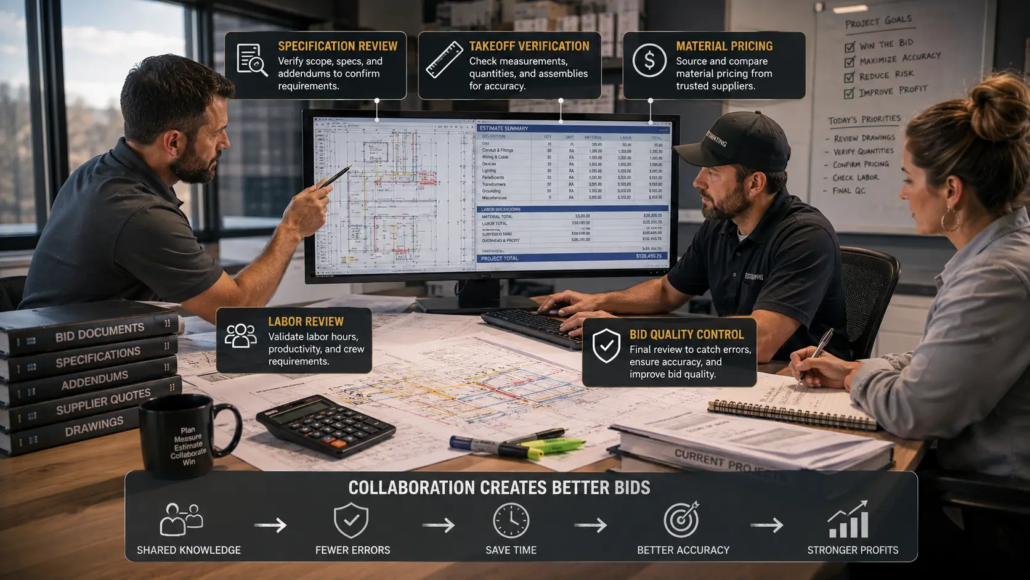
Many electrical estimators believe that self-reliance is a mark of competence. The culture of the trade often rewards independence, which makes it difficult to acknowledge limits. However, electrical estimating involves enough complexity—specifications, labor units, material pricing, addendums—that sustained solo performance without support typically leads to burnout or costly errors.
Overworked electrical estimators most commonly miss specification details, make labor unit errors, overlook addendums, and fail to catch scope gaps before submitting a bid. These mistakes are not a reflection of skill—they are a predictable result of cognitive overload.
Electrical estimating software like Best Bid Electrical Estimating Software automates time-consuming tasks such as labor unit calculations, material cost tracking, and bid organization. This reduces the mental workload on individual estimators and allows them to focus on the judgment-based aspects of the estimating process.
The right time is before a breaking point occurs. If bid deadlines are consistently stressful, if errors are increasing, or if an estimator is regularly working nights and weekends just to stay current, those are clear indicators that additional support—whether a team member or better tools—is overdue.
A team approach creates checkpoints in the estimating process where errors are more likely to be caught. Multiple people reviewing a bid, handling different components, or verifying takeoffs reduces the likelihood of a single point of failure. Collaboration also improves consistency across bids over time.
Ready to take the next step? I’d love to connect and talk through what’s working in your estimating process—and what isn’t.
 Call or reach out directly through the Best Bid Electrical Estimating Software website. Whether you’re a solo estimator just getting started or a contractor managing a full estimating department, I’m happy to share what I’ve learned over more than 50 years in this industry.
Did you know that the right estimating software can reduce your bid preparation time for a mid-complexity job from six hours down to under 90…

Speed and accuracy are not opposites in electrical estimating — they are partners. The fastest estimate and the most accurate estimate are rarely the same thing, but with the right tools and processes, electrical contractors can produce bids that are both competitive and profitable. Best Bid electrical estimating software is designed to help contractors find that balance.
By Steve Griffin — Founder, Best Bid Electrical Estimating Software | Electrician · Estimator · Contractor · Author · Software Developer
Every electrical contractor knows the feeling. The bid deadline is tomorrow morning. You have three jobs on your desk, the phone keeps ringing, and you’re staring at a set of drawings wondering whether to rush the estimate or take your time and risk losing the job to a faster competitor.
This is the central tension of electrical estimating. Submit too quickly, and you might miss something that costs you real money on the job. Spend too long perfecting every detail, and someone else walks away with the contract.
Neither extreme works. What you need is balance — and in 50+ years of working as an electrician, contractor, and estimator, I’ve learned exactly where that balance point lives.
This post breaks down the speed vs. accuracy problem, explains where most estimators go wrong, and shows you how Best Bid electrical estimating software is built to help you bid more jobs without bleeding margin.
Speed matters in estimating. That’s not in question. But speed without structure is where contractors lose money — sometimes on jobs they thought were straightforward.
When estimators rush, certain things get skipped. Labor productivity factors don’t get adjusted for job conditions. Material waste doesn’t get accounted for.
The conduit run that looks simple on paper turns out to cross three floors and two fire-rated walls. Those small misses compound. By the time the job is done, the number you bid doesn’t match the number it cost you to build.
Customers appreciate a fast turnaround — but not at the expense of your business. Winning a bid is only valuable if you make money on it. Speed without accuracy produces wins that hurt you.
The real problem is that many estimators confuse speed with shortcuts. Speed is not about cutting corners. Speed is about eliminating decisions that don’t affect the final number. When you stop spending time choosing the exact brand of a commodity box cover and start spending that time on expensive items that actually swing the bid, your workflow gets faster and your accuracy gets better at the same time.
On the other side of the equation, there’s the estimator who wants every detail to be perfect. Every connector counted. Every strap documented. Every inch of wire measured to the foot.
Here’s what I’ve seen happen with that approach: the bid takes three days. The contractor who was less precise submits in one day and wins the job. The over-detailed estimate never even gets looked at.
Detail is not accuracy. Detail is time. Accuracy is about producing a number that is trustworthy, competitive, and profitable — not a number that accounts for every screw.
There’s also a pricing problem. When you spend too long on an estimate, the process itself becomes expensive. Your overhead goes up.
Your capacity to bid other jobs goes down. And if the extra detail doesn’t improve the final number — which it usually doesn’t on commodity items — you’ve paid a cost with no return.
The goal of electrical estimating is a reliable number, not a perfect number. Reliable wins jobs. Reliable protects margins. Perfect just takes longer.
Not every line item in your estimate deserves the same attention. Expensive items — large gear, medium-voltage equipment, specialty materials — deserve careful review and supplier quotes. Commodity items like boxes, covers, connectors, and staples do not.
Having a few extra boxes on a job costs next to nothing. Making a supply house run because you were short costs real money.
The balance point is directing your manual thinking toward items that swing the number, and letting smart defaults handle everything else.
If you’re re-entering the same branch circuit assembly from scratch on every estimate, you’re losing time that you’ll never get back. Creating standardized templates for common installation types — standard receptacle circuits, lighting assemblies, panel feeders — means those decisions are made once and applied consistently across every job.
Consistency also protects accuracy. When an assembly is built once and tested against real job costs, you can trust it. When an assembly is built fresh every time, you’re introducing variation.
This is where Best Bid electrical estimating software earns its place. Best Bid is built around a simple philosophy: automate what the estimator already knows so they can focus on what requires judgment.
The built-in On-Screen Takeoff feature lets you import PDF drawings and measure conduit and wire lengths directly on screen — no paper, no manual calculation. Custom Assemblies let you build groups of frequently used products once and recall them on any future estimate. Advanced Substitutions let you swap materials across an entire estimate with a single click, so a specification change doesn’t mean starting over.
These aren’t gimmicks. They’re the direct result of 50+ years of estimating real electrical projects, watching where time gets wasted, and building tools to eliminate those bottlenecks.
Most electrical estimating software treats takeoff as a separate problem — you buy a third-party OST tool, export the data, import it somewhere else, and hope nothing gets lost in translation. Best Bid includes On-Screen Takeoff directly inside the estimating workflow. You count and measure from PDF drawings on your screen, and those quantities flow straight into your estimate.
No third-party tool. No re-entry. No gaps.
Specifications change. GCs issue addenda. Owners request alternates.
When that happens in the middle of an estimate, most estimators groan — because changes in other software mean re-doing hours of work. In Best Bid, the Advanced Substitutions feature lets you swap one material for another across the entire estimate with a single action. Change ½” EMT to ¾” EMT.
Swap copper conductors for aluminum. Update a raceway type across the board. The rest of the estimate adjusts automatically.
That speed means you can respond to changes the day they happen — not the day after the bid closes.
Some software charges per seat, per revision, or per support call. Best Bid is a one-time purchase with lifetime updates and free technical support. There’s no penalty for refining your estimate. You can revise as many times as needed, submit alternate bids, and adjust your number right up to the deadline — without worrying about what it’s costing you to run the software.
Subscription-based pricing creates a permanent overhead cost. Every month you pay, whether you’re busy or slow. Best Bid’s one-time fee model means you own the software outright.
Lifetime updates ensure the software stays current. That’s a significant advantage for smaller electrical contractors who need powerful tools without the ongoing expense.
The philosophy behind Best Bid isn’t accidental. It comes from a career that started in 1973, when I was digging ditches and pulling wire as a working electrician. Over the next five decades, I moved through every role in the industry — electrician, superintendent, project manager, contractor, and full-time estimator. I built Best Bid because I couldn’t find software that actually reflected how real estimators think.
Explore all 30 sections of The Art of Balance in Electrical Estimating Software by Steve Griffin, offering practical insights into the principles that support accurate, efficient, and confident electrical estimating.
That thinking has been documented in my book, Everybody Has A First, available on Amazon. The book covers 30 principles that together form a complete philosophy of electrical estimating — from the tension between cost and capability, to the psychology of estimating decisions, to why most software fails the people using it. It’s written for anyone who estimates electrical work, from contractors just getting started to veteran estimators looking for a framework to sharpen their process.
The book’s central argument is the same one that drives Best Bid: balance is not a feature you turn on. It is a discipline you apply to every decision — what to include, what to automate, what to spend time on, and what to trust to smart defaults.
You can find the book at amazon.com/dp/B0HBLZPXH3.
The contractors who consistently win jobs without losing money are not the fastest or the most detailed. They are the most efficient. They know which parts of an estimate require their attention and which parts don’t. They use tools that are built to reflect real-world installation — not theoretical precision. And they trust a workflow that’s been tested against real job costs.
The right estimate wins the job. The right software makes that possible.
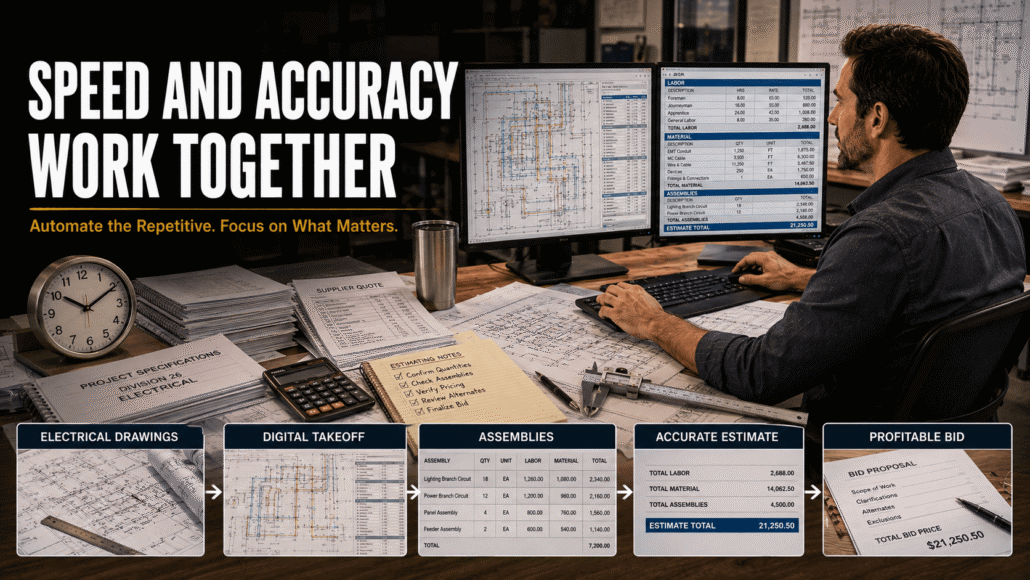
The balance comes from identifying which parts of an estimate require manual judgment and which can be handled by smart defaults and automation. Expensive gear, specialty materials, and site-specific labor factors need close attention. Commodity items like boxes, covers, and connectors do not. Speed built on well-calibrated assemblies and reliable defaults protects your margin — speed built on guessing introduces systematic error in both directions.
The biggest mistakes are skipping labor productivity adjustments for specific job conditions, failing to account for material waste, and not pricing large equipment with current supplier quotes. Rushing through those areas costs money on the job. Speed is safe on commodity items with proven assemblies — not on the variables that actually swing a bid.
Best Bid improves both. The built-in On-Screen Takeoff removes manual measurement errors. Custom Assemblies produce consistent quantities across every estimate.
Advanced Substitutions eliminate re-entry errors when specifications change. Accuracy comes from consistency — and consistent assemblies built on real job data are more accurate than manual entry that varies estimator to estimator.
The right benchmark depends on the project scope, not a fixed number of hours. A small commercial project should take a few hours with efficient software. A large industrial project may take several days. The question to ask is whether the time you’re spending is proportional to the opportunity — and whether the detail you’re adding is actually changing the final number.
Assemblies are the primary mechanism for achieving both goals at once. A single well-built assembly replaces dozens of individual line-item entries and applies a consistent labor and material standard every time it’s used. On a commercial project with hundreds of devices and circuits, assembly-based estimating can dramatically reduce takeoff time while improving consistency. That’s where bid time is won or lost.
Yes. Best Bid is specifically designed to be affordable and accessible for contractors of all sizes. The one-time purchase with lifetime updates means there’s no ongoing monthly fee, which matters when business is slow. The software is also built to minimize the learning curve — you don’t need to be a computer expert to use it effectively from the first week.
Best Bid electrical estimating software is built around that reality. If you’d like to see how it works before you commit, call us at 800-941-7028 or schedule a one-on-one walkthrough at bestbidestimating.com. There’s no sales pressure — just a live demonstration of how the software actually runs.
How much did your business pay in software “rent” last year just to keep your estimating department running? If you’re feeling the weight of…
As an electrical contractor in 2026, you’re likely facing more bid deadlines than ever before. When your team is stretched thin, the temptation to…
Improve commercial electrical estimating with connected takeoff, material pricing, labor detail, and job-cost review that helps protect bid profit today.