PlanSwift for Electrical: How to Choose the Right Alternative in 2026

The right takeoff software alternative for electrical contractors is not necessarily the tool with the longest feature list. It’s the one that supports your takeoff and estimating workflow without turning a software change into a bid-process rebuild.
Many general on-screen takeoff tools can be customized for counting and measuring. But quantities are only part of an electrical bid. Pricing, labor, assemblies, and repeatable estimating workflows matter too. A switch can also raise practical concerns about preserving established methods and data.
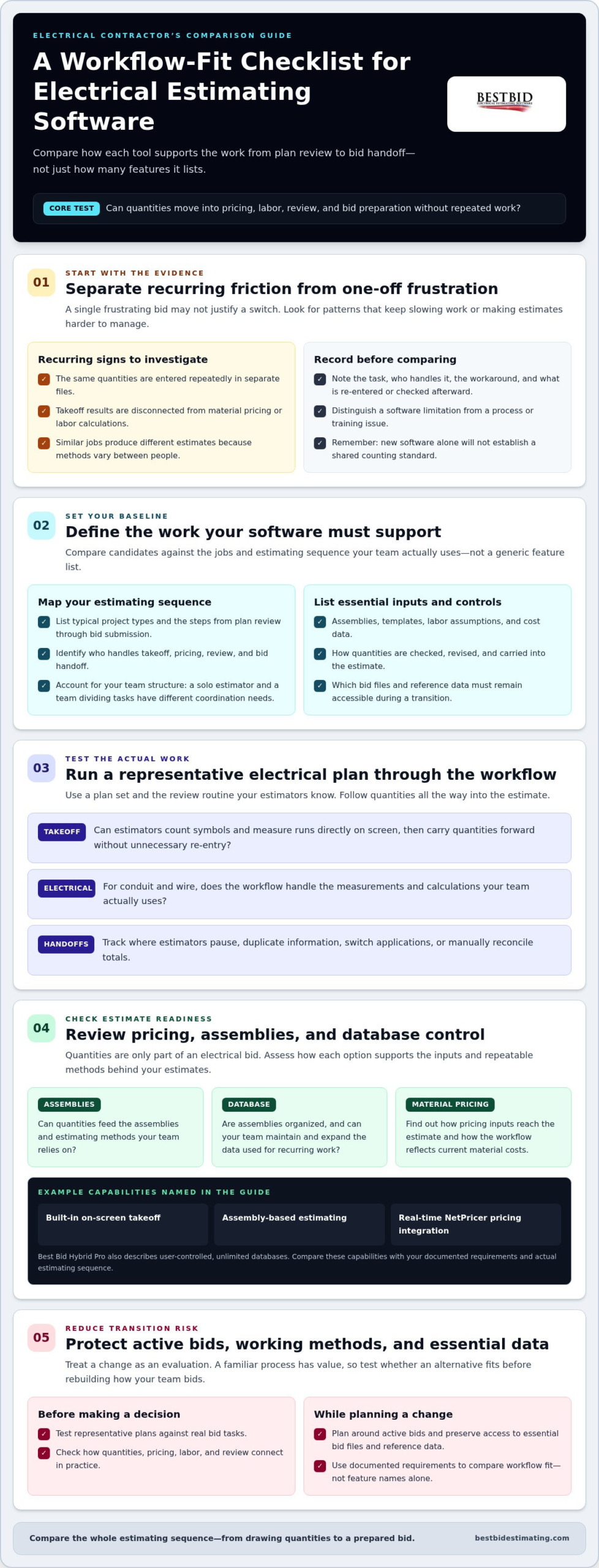
This guide gives you a framework for comparing alternatives by electrical workflow fit, not feature count alone. You’ll see what to assess in takeoff, pricing, databases, and bid preparation, along with ways to reduce transition risk. We’ll also look at Best Bid Hybrid Pro as an electrical-focused option with built-in takeoff and a one-time purchase model. Use the criteria to decide whether a different tool can support your work while protecting the processes that already work.
Key Takeaways
- Separate persistent workflow friction from one-off frustrations before deciding whether it’s time to switch.
- Use the PlanSwift for electrical alternative comparison to judge how each tool supports your estimating sequence, not just its feature list.
- Compare takeoff, pricing data, database control, and bid handoff with clear electrical-specific criteria.
- Reduce transition risk by testing representative plans and planning around active bids and essential data access.
- See how Best Bid Hybrid Pro’s electrical-focused workflow and built-in takeoff fit the priorities that matter to your team.
When should an electrical contractor consider a PlanSwift alternative?
Changing estimating software is a practical dilemma: keep a familiar process the team knows, or address recurring friction that costs time and makes bids harder to manage. Familiarity has real value, especially when estimators have developed repeatable takeoff habits. But it shouldn’t prevent you from examining persistent problems.
Treat this as an evaluation, not a verdict that PlanSwift is unsuitable. It can be configured for electrical takeoff. The question is whether its setup and your wider estimating process fit the work you do.
Start with the jobs your team bids and the steps between reading plans and submitting a number. A general construction estimating software overview can help put takeoff and estimating functions in context, but an electrical contractor’s decision should turn on actual bid tasks, team size, and existing processes.
For a broader view of how takeoff tools fit into estimating, watch this review:
Which signs suggest your current takeoff workflow needs review?
Look for recurring friction, not a single frustrating bid. Do estimators repeatedly enter the same quantities in separate files? Are takeoff results disconnected from material pricing or labor calculations?
Do similar jobs produce different estimates because people use different methods? These patterns may justify comparing tools. A one-time delay, a new employee’s learning curve, or a rarely used feature may not.
Record where work slows down and how often it happens. Note the task, who handles it, the workaround, and what gets checked or re-entered afterward. Then separate a software limitation from a process or training issue.
If the team lacks a shared counting standard, new software alone won’t create one. If a task remains awkward after the process is clear, that’s stronger evidence to evaluate alternatives.
What should an electrical contractor clarify before switching?
Define the work the software must support before comparing screens or feature names. List typical project types, the estimating steps involved, and the people responsible for takeoff, pricing, review, and bid handoff. A solo estimator has different coordination needs from a team that divides those tasks.
- Identify essential assemblies, templates, labor assumptions, and cost data.
- Record how quantities are checked, revised, and carried into the estimate.
- Note which bid files or reference data must remain accessible during a transition.
These details give you a fair baseline for a PlanSwift for electrical alternative: compare the new workflow against real bids, not a sales feature list. The electrical estimating software workflow at Best Bid includes built-in on-screen takeoff, assembly-based estimating, and real-time NetPricer pricing integration. Use your documented requirements to judge whether those capabilities align with your team’s current sequence before planning a change.
Which electrical estimating capabilities matter in a PlanSwift alternative?
A takeoff tool can tell you how many fixtures appear on a plan or how much conduit is measured. An electrical estimating system must also help turn those quantities into a bid, with the pricing, assemblies, and review steps your team relies on. Electrical estimating software connects plan quantities to material and labor inputs so an estimator can develop and prepare an electrical bid.
Judge each option by how well it follows your estimating sequence, from reviewing drawings through checking and handing off the estimate. Feature names can sound impressive, but the practical test is whether work moves cleanly between steps or leaves your team reconciling separate tools. That matters in any technology adoption in construction: the software has to fit the work and the people doing it.
How should you assess on-screen takeoff for electrical plans?
Use a representative plan set and follow your normal review routine. Check whether the tool lets the estimator count symbols and measure runs directly on screen, then carry those quantities into the estimate without unnecessary re-entry. For conduit and wire, assess how the workflow handles the measurements and calculations your team actually uses, rather than assuming a general takeoff feature covers every electrical need.
Also consider how much of the process depends on separate applications. Built-in takeoff can reduce the need to switch tools for counting and measuring, but its value depends on whether the resulting quantities fit your estimating method. Track where an estimator must pause, duplicate information, or manually reconcile totals. Those are useful comparison points.
Why do database control and current material pricing matter?
Estimate consistency depends on more than drawing quantities. Review how assemblies are organized, who controls the database, and whether your team can maintain and expand the data it uses for recurring work. The goal is a structure that supports your estimating practice, not a collection of disconnected entries that only one person understands.
Material pricing deserves its own check. Find out how pricing inputs reach an estimate and how the workflow reflects current material costs. Best Bid’s software includes real-time pricing integration through NetPricer, along with user-controlled, unlimited databases and assembly-based workflows. Its electrical estimating software overview describes these capabilities in the context of electrical estimating.
- Takeoff: Can estimators count and measure from plans in their normal sequence?
- Estimating: Can quantities feed the assemblies and estimate structure your bids require?
- Pricing: Is the material pricing workflow clear and suited to your estimating process?
- Data control: Can your team manage and grow its databases?
- Bid handoff: Can reviewers follow the estimate from takeoff through bid preparation?
Score each item against a real project, not a feature label. For a closer look at a trade-focused workflow, explore Best Bid’s electrical estimating approach.
PlanSwift vs. an electrical-focused alternative: how to compare fairly
A fair comparison follows the estimate from drawing review to bid preparation. PlanSwift is a customizable general on-screen takeoff tool that electrical contractors can use for measurements and counts. Best Bid Hybrid Pro is an electrical-focused option with built-in on-screen takeoff, assembly-based workflows, real-time NetPricer pricing integration, and user-controlled databases.
Neither a feature label nor a product category tells you by itself how well a tool fits your bid process. Test the work.
Use the table as a starting point, then compare each tool using the same project tasks and criteria.
| Comparison area | PlanSwift | Best Bid Hybrid Pro |
|---|---|---|
| Electrical fit | General takeoff tool, customizable for electrical work. | Electrical-focused estimating software. |
| Takeoff workflow | On-screen counting and measuring; current version 11 includes Takeoff BOOST tools for subscription users. | Built-in on-screen takeoff with direct screen-based counting and measuring. |
| Pricing data | Compare the pricing tools and integrations used in your PlanSwift setup. | Real-time pricing integration through NetPricer. |
| Database control | Electrical assemblies can be built; compare how your team organizes and manages its estimating data. | User-controlled, unlimited databases and assembly-based workflows. |
| License and learning curve | New customers use an annual subscription; learning curve depends on your setup and team. | One-time purchase with lifetime updates and support; assess learning curve in a workflow test. |
How do you compare takeoff and estimate workflows?
Choose one representative bid and perform the same tasks in each system: measure a plan area, count fixtures, organize quantities, and prepare the estimate for review. Record every manual handoff, repeated entry, and separate tool used. For PlanSwift functions, use the same version and setup as your team. This reveals workflow fit, not just takeoff speed.
How do ownership, flexibility, and learning curve affect fit?
Compare the license model and update terms alongside daily estimating needs. PlanSwift’s new-customer subscription model differs from Best Bid’s one-time purchase with lifetime updates and support. Then test how each tool handles your assemblies and database practices, and note how much guidance each role needs to complete a familiar bid. Trade-specific experience informs Best Bid’s approach, backed by more than 50 years of hands-on electrical trade experience.
For a useful PlanSwift for electrical alternative comparison, use the same plan set, assumptions, and bid tasks in both workflows. Keep a short scorecard: quantity accuracy, re-entry, pricing steps, database control, review handoff, and user comfort. A practical trial gives your team evidence to weigh against the effort of changing systems.
Download as HTML
How to plan a low-disruption switch from PlanSwift
A software change should protect the bidding work already in motion. Keep access to current estimates and essential reference data, and plan around active bid deadlines. Treat the transition as a controlled change in how work is done, not a rushed replacement. For any PlanSwift for electrical alternative, test the estimating workflow and make a deliberate plan for templates, assemblies, and other information your team relies on.
What should you test before moving active estimates?
Use a staged process. Start by documenting your current work, then test representative plans, train the users involved, and only then set a transition date. Keep active bids in the established workflow until your team has practiced the new one and knows how it handles the required tasks.
- Inventory current work. Record the types of electrical projects you estimate, the steps from takeoff to bid, and the files, templates, assemblies, and cost data used along the way. Note where essential information is stored and who needs access to it.
- Test representative drawings. Choose plans that reflect routine work as well as a less familiar project. Repeat common counts, measurements, quantity organization, and estimate preparation in the existing and prospective workflows. Compare outputs and steps, and ask each estimator to note where they felt confident or needed help.
- Plan data handling deliberately. Identify what must be recreated, retained for reference, or reviewed before use. Don’t assume PlanSwift files can be imported, converted, or migrated automatically. Map how each data type will be handled before relying on it, and preserve access to existing records during the transition.
- Set a transition point. Choose a start that doesn’t collide with deadline-critical bids. Establish which system will be used for each active estimate so the team doesn’t split work or lose track of the current bid record.
How can estimators reduce the learning curve?
Give users a defined practice workflow before they rely on new software for a live, deadline-sensitive bid. Have the team follow the same sample plan and document the steps for takeoff, quantity review, assemblies, pricing, and estimate checks. A shared routine makes it easier to spot where users need clarification and helps reduce inconsistent habits across the team.
Set aside time for practice and assign responsibility for maintaining the internal process. Best Bid’s lifetime support can help your team get oriented, while its Online School for Electrical Estimating offers training in estimating. Use these alongside hands-on practice; don’t assume any resource replaces the need to test the workflow on your own project types.
Best Bid Next Generation uses a one-time purchase model with lifetime updates and support. That ownership approach can be part of your transition evaluation. Keep it distinct from the practical work of organizing data, training users, and protecting active bids. For broader context, Best Bid’s electrical estimating software options provide a starting point as you assess the fit.
Why consider Best Bid Hybrid Pro as a PlanSwift alternative?
If your comparison points toward a trade-focused estimating workflow, Best Bid Hybrid Pro is an electrical estimating option to evaluate. The work doesn’t stop at counting symbols or measuring runs. The practical question is whether takeoff, estimate structure, material pricing, and control over your estimating data align with how your team builds bids.
What makes Best Bid’s workflow relevant to electrical estimators?
Best Bid software includes built-in on-screen takeoff, with direct screen-based counting and measuring. That lets estimators work with plan quantities as part of the estimating workflow. Assembly-based estimating supports organizing those quantities into the structures used to develop an electrical estimate, while user-controlled, unlimited databases give the business control over its estimating data as it grows.
Material pricing is another part of the workflow. Best Bid integrates real-time pricing through NetPricer, connecting pricing inputs to the estimating process. Together, these capabilities address several practical comparison points: working from plans, building estimates with assemblies, managing the database, and applying material pricing. Best Bid’s software approach is informed by more than 50 years of hands-on electrical trade experience, grounding its focus in the realities of electrical estimating rather than general takeoff alone.
As you assess a PlanSwift for electrical alternative, compare these functions against your documented bid process. Consider how your team counts and measures, organizes quantities, applies assemblies and material pricing, and maintains its database. A feature matters when it supports the next step your estimator needs to complete.
What is the next step for a contractor comparing options?
Bring your requirements list and a representative electrical plan to the evaluation. Mark which tasks the software supports directly, where users need manual steps, and how well the process fits your team’s bid preparation. This keeps the decision tied to your work, not just a product description. If license structure matters to your long-term planning, compare Best Bid’s one-time purchase model, lifetime updates, and support with your requirements.
Best Bid Hybrid Pro may be a strong fit if you’re looking for electrical-focused estimating with on-screen takeoff, assembly-based workflows, user-controlled databases, and integrated material pricing. It won’t remove the need to plan a transition carefully, but it gives you concrete capabilities to assess against your workflow. Compare the software with your own bid tasks, then decide based on fit.
Explore Best Bid Hybrid Pro and see how its electrical estimating workflow aligns with your requirements.
Make your next estimate the test case
You don’t have to decide on a software change in the abstract. Choose a representative upcoming project and use it to judge how well your current setup supports the work and what you’d want to improve. That gives your team a practical basis for deciding whether a PlanSwift for electrical alternative deserves a closer look, while keeping the decision tied to your estimating process.
If electrical-focused takeoff and estimating are priorities, make Best Bid Hybrid Pro part of that evaluation. Its built-in on-screen takeoff, one-time purchase model with lifetime updates and support, and software approach informed by more than 50 years of hands-on electrical trade experience offer specific points to compare against your requirements.
Start with your plans, your bid sequence, and the criteria that matter to your estimators. Explore Best Bid’s electrical estimating software and take the next step toward a workflow that fits your business.
Frequently Asked Questions
Is PlanSwift a good fit for electrical estimating?
It can be, depending on how your team turns drawings into a finished electrical bid. Try a representative project that includes the plan types and estimating steps you handle routinely, then note whether quantities, assemblies, pricing, and review work together as expected. For example, compare a fixture count and conduit measurement with the final estimate. If your process relies on separate worksheets or repeated entry, investigate whether that’s a tool issue or an established workflow choice.
What should I look for in a PlanSwift alternative for electrical work?
Look for a workflow that supports the way your estimators actually build bids, not just an appealing list of features. Evaluate a PlanSwift for electrical alternative with specific tasks, such as counting devices, measuring runs, organizing assemblies, and preparing estimate details for review. Include the people who use and check estimates in your evaluation. Their feedback can reveal whether the process is practical for the whole team, not only the primary estimator.
Can I transfer PlanSwift estimates directly into Best Bid?
Plan the handling of existing estimates as part of the transition rather than assuming they will transfer or convert automatically. Identify which records you need to retain, such as completed bid references or active estimate details. Keep access to the original records and map how your team will recreate or reference essential information in its new workflow.
Does Best Bid include on-screen takeoff for electrical estimates?
Yes. Best Bid electrical estimating software includes built-in on-screen takeoff, with direct screen-based counting and measuring. Takeoff information can move into estimates as part of the workflow.
To assess how that works for your team, use a drawing with familiar devices and measured runs, then follow the quantities through estimate preparation. This gives estimators a concrete way to see how plan review connects with their regular estimating tasks.
Is Best Bid sold with a monthly subscription?
No. Best Bid software uses a one-time purchase model, with lifetime updates and support. That structure may appeal to contractors who prefer a purchase rather than recurring software payments.
Consider how the ownership model fits your company’s software planning. The key distinction is the payment structure, not a promise about the results your estimates will produce.
How can I test a PlanSwift alternative without disrupting current bids?
Run a practice estimate using a completed or non-deadline-critical project before changing the process for active bids. Keep the existing estimate available as a reference, and compare quantities, estimate organization, and review steps side by side. Record questions as they arise so training can address real tasks. Maintain access to current bid information throughout the evaluation, and plan how each file or database item will be retained or recreated.
Is Best Bid Hybrid Pro intended for electrical contractors?
Yes. Best Bid Hybrid Pro is electrical estimating software for contractors evaluating electrical takeoff and estimating workflows. Compare it against the kinds of drawings, assemblies, and material-pricing tasks your team handles, rather than judging fit from a product label alone. Best Bid’s software approach draws on more than 50 years of hands-on electrical trade experience, bringing practical trade context to its estimating tools.