User Freedom in Electrical Estimating Software

Electrical estimator balancing user control and guided structure in electrical estimating software.
User Freedom vs. Guided Structure in Electrical Estimating Software | Steve Griffin

Estimating Philosophy  ·  Series Part 5 of 30

User Freedom vs. Guided Structure in Electrical Estimating Software

Too much freedom creates chaos. Too much structure creates rigidity. Steve Griffin explains the right balance between estimator control and software guidance.

By Steve Griffin  ·  Founder, Best Bid Electrical Estimating Software  ·  July 23, 2026  ·  8 min read

Part of the Complete Series This article is Series Part 5 of 30 in The Art of Balance in Electrical Estimating Software — the complete 30-section philosophy guide by Steve Griffin. Read all sections in one place.

Section 5: User Freedom vs. Guided Structure

How much freedom should the user have?

Too much freedom leads to:

  • Confusion
  • Inconsistency
  • Errors
  • Slow estimates

Too little freedom leads to:

  • Frustration
  • Restriction
  • Lack of flexibility

Balance is giving users the ability to change things when needed — while making smart choices for them by default.

Most contractors don’t want to think about every tiny detail. They want the software to:

  • Make good assumptions
  • Provide accurate quantities
  • Allow changes when necessary
  • Prevent mistakes
  • Speed up the process

Sometimes fewer options is better.

Freedom is not always helpful. Freedom can be overwhelming. Freedom can be confusing.

Freedom can be dangerous. Freedom can be inefficient.

Guided structure is not always restrictive. Guided structure can be helpful. Guided structure can be efficient.

Guided structure can be safe. Guided structure can be powerful.

Balance is choosing the right amount of freedom — not maximum freedom.

The best software makes smart decisions for the user. It chooses the right assemblies. It chooses the right quantities.

It chooses the right labor. It chooses the right structure. It chooses the right defaults.

And then — only when needed — it allows the user to override those decisions.

This is balance.

Freedom should be available — but not required. Guided structure should be present — but not oppressive.

The software should feel like a guide, not a dictator. It should feel like a partner, not a prison. It should feel like a tool, not a trap.

Balance is designing software that gives users freedom when they want it — and guidance when they need it.

Key Principle

This principle is one of 30 that together form a complete philosophy of electrical estimating built from 50 years of real-world experience. Every principle connects to every other. Read the full guide to see how they work together.
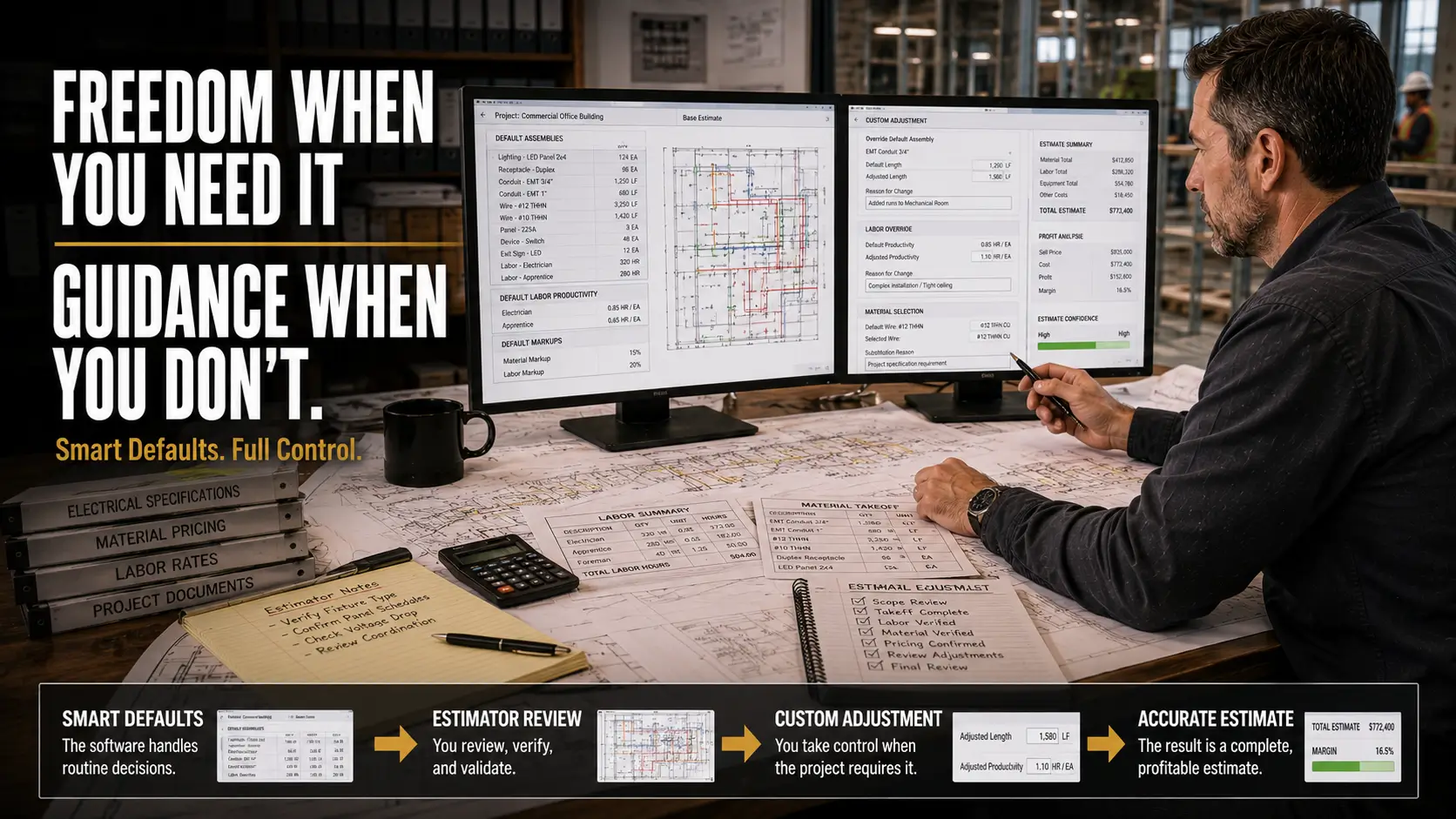
Electrical estimator balancing user control and guided structure in electrical estimating software.

Frequently Asked Questions

How much freedom should estimating software give an estimator?
Enough freedom to handle any real-world job condition, but enough structure to prevent inconsistency. The danger of too much freedom is that every estimate becomes a custom project with no standards, no baseline, and no way to compare performance across bids. The danger of too much structure is software that cannot handle the conditions that exist on actual jobs.
What happens when electrical estimating software is too rigid?
Rigid software forces estimators to work around it. They create external spreadsheets, add dummy line items, or build workarounds that undermine the integrity of the estimate. When a contractor cannot trust that their software reflects reality, they stop trusting the number — and that doubt costs real money in padded bids and lost opportunities.
What is guided structure in estimating software?
Guided structure is the set of defaults, workflows, and constraints that help estimators produce consistent, reliable output without restricting their judgment. It includes standard assemblies, default labor rates, required markup fields, and organized takeoff screens. Structure speeds up common work so that freedom can be reserved for unusual job conditions.
Should electrical estimating software allow custom entries?
Absolutely. Every job has conditions that do not fit a standard assembly. Software that cannot accommodate custom labor units, non-standard materials, or unique scope items forces the estimator to misrepresent reality. The best software makes custom entries easy without disrupting the structured workflow for standard work.
How do I know if my estimating software is too restrictive?
If you regularly complete portions of your estimate outside the software — in a spreadsheet, on paper, or in your head — the software is too restrictive. Those workarounds are a clear signal that the tool does not match your actual workflow. Every workaround is a place where accuracy and consistency are at risk.

Your Cart

Your Cart

Your Cart is Empty

Start Shopping
Continue Shopping
Payment Details
Sub Total $0.00