Electrical Estimating Tools: The Comprehensive Guide for Contractors in 2026
How much of your hard-earned profit is being siphoned away by software “rent” every single month? It’s a frustrating reality for many contractors who feel trapped by high monthly subscriptions just to keep their business running. You know the daily grind: working late to finish a bid, worried that a slow turnaround will cost you the job, or fearing that a manual counting error will turn a winning project into a financial drain. Using modern electrical estimating tools shouldn’t mean trading one headache for another.
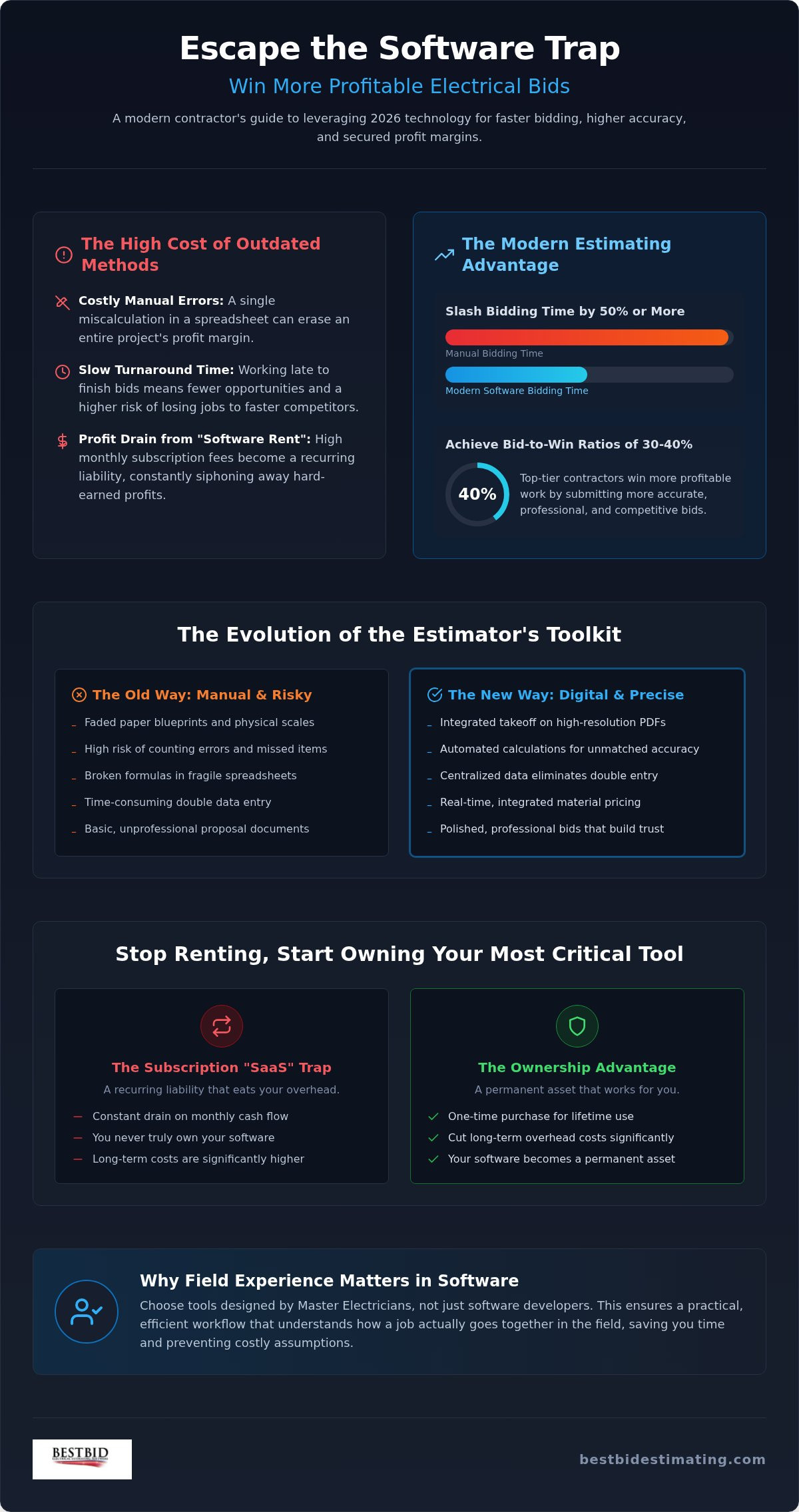
We believe your software should be a permanent asset that works for you, not a recurring liability that eats your overhead. This guide will show you how to master the 2026 technology landscape to slash your bidding time by 50% or more while securing your profit margins. We’ll look at how integrated takeoff and bidding systems are helping contractors achieve bid-to-win ratios of up to 40%. You’ll learn how to find a system that gives you total ownership and the precision you need to stop guessing and start winning more profitable work.
Key Takeaways
- Discover how transitioning from manual methods to digital systems can help you achieve the 30-40% bid-to-win ratios seen by top-tier contractors.
- Identify the essential features of modern electrical estimating tools, including why integrated on-screen takeoff is the key to eliminating double data entry.
- Learn how to break free from the “SaaS trap” by choosing software you own outright, cutting your long-term overhead costs significantly.
- Follow a simple, two-step process to move from error-prone spreadsheets to professional software without disrupting your current project flow.
- Understand why tools designed by Master Electricians provide a more practical and efficient workflow than those built by general software developers.
What Are Electrical Estimating Tools and Why Are They Essential?
In the electrical trade, precision is everything. You wouldn’t use a butter knife to strip wire, so why use a generic spreadsheet to calculate a $100,000 project? At their core, electrical estimating tools are specialized software and hardware systems designed to handle the heavy lifting of calculating material costs, labor units, and overhead. They replace the old-school architectural scale and yellow legal pad with a digital environment where every foot of conduit and every wire nut is accounted for. These systems are built to understand the specific nuances of our trade, from labor factoring to complex assemblies. If you want to see how these features come together in a professional package, you can explore Best Bid electrical estimating software to see the difference for yourself.
To better understand how these systems have changed the way contractors work in 2026, watch this helpful comparison:
For decades, the “Scale and Pencil” method was the industry standard. You’d roll out paper blueprints, grab your highlighters, and pray your physical scale didn’t slip. Today, that manual process is a major business liability. Modern Construction estimating software has moved the entire workflow to high-resolution PDF plans. This shift isn’t just about saving paper; it’s about eliminating the “bid day” errors that occur when you’re rushing to meet a deadline. Manual spreadsheets are often the primary cause of profit leaks because one broken formula or a missed cell can ruin your entire margin before the job even starts.
The Evolution of the Estimator’s Toolkit
The transition from paper to pixels has been a game-changer. Estimators no longer squint at faded blueprints; they use digital takeoff tools to click through high-resolution drawings, automatically calculating lengths. We’ve seen the industry move toward integrated pricing services that update in real-time.
This ensures your bid reflects today’s copper prices, not last year’s. These tools also use specialized databases to help ensure your counts align with National Electrical Code (NEC) requirements, keeping your projects safe and compliant from the start.
Key Benefits of Professional Grade Tools
- Increased Bid Frequency: Finishing a takeoff in half the time means you can bid on twice as many jobs. It’s a simple way to grow your backlog without working more hours.
- Unmatched Accuracy: Professional electrical estimating tools eliminate the “oops” factor. You won’t guess conduit runs or wire lengths; the software calculates them based on the actual digital scale of the plan.
- Polished Professionalism: First impressions matter. You’ll present clients with detailed, professional proposals that build trust, rather than basic spreadsheet printouts or handwritten notes.
Core Features to Look for in Electrical Estimating Software
Choosing the right electrical estimating tools isn’t just about picking the flashiest interface. It’s about finding a system that understands how a job actually goes together in the field. Professional Cost Estimators know that accuracy is the difference between a profitable year and a struggle to keep the lights on. You need a tool that eliminates the manual “grunt work” of counting and calculating so you can focus on the strategy of the bid. If the software doesn’t save you time, it’s just another expense on your ledger.
One of the biggest mistakes contractors make is paying for two separate programs: one for takeoff and one for estimating. This is a double expense and a double headache. Why pay “rent” on two subscriptions when you can have everything in one place? Integrated systems allow you to measure a run of conduit on your screen and have that data instantly populate your estimate. It’s fast. It’s clean. It works. This level of integration is exactly what we built into Best Bid Next Generation to help contractors move faster without the usual technical friction.
Then there is assembly-based estimating. Instead of clicking every single connector, strap, and foot of wire, you use “smart” groups. You select a 20A branch circuit assembly, and the software handles the parts list for you. This slashes your click counts and ensures you never forget the small materials that eat into your profit margins. When your electrical estimating tools include real-time pricing integration through services like NetPricer, you stop guessing about copper prices and start bidding with confidence.
The Power of Built-In Takeoff
When your takeoff is built directly into the software, you get a seamless 1-click transfer. There’s no exporting CSV files or worrying about data sync errors that often plague third-party integrations. You see exactly what you’ve counted on the PDF, and those numbers are already in your bid. This prevents the “lost in translation” errors that happen when moving data between different platforms. Producing accurate documentation alongside your estimates — including professional submittals — is just as critical, which is why pairing your estimating workflow with dedicated electrical panel schedule software can elevate the quality of your project documentation from bid to closeout.
Database Flexibility and Control
Don’t settle for a “black box” database that you can’t touch. You need to own and edit your material list. Look for “morphed assemblies” that adapt to different items in your list automatically. This flexibility allows you to make global labor adjustments. A commercial office build-out requires different labor units than a heavy industrial facility. Your software should let you adjust these variables based on your specific crew’s performance and the project environment, ensuring your labor hours reflect reality, not just theory. For contractors tackling large-scale plant work or complex manufacturing projects, purpose-built industrial electrical estimating software provides the specialized labor factoring and assembly databases needed to handle massive conduit runs and intricate system layouts with confidence.
Subscription vs. One-Time Purchase: The ROI of Software Ownership
Are you tired of paying “rent” on your own business processes? Many contractors get lured into the Software as a Service (SaaS) model by low entry costs, only to realize they’ve stepped into a financial trap. When you look at the five-year cost of electrical estimating tools, the math rarely favors the subscription model. You might start with a seemingly small monthly fee, but over half a decade, that recurring expense balloons into a $15,000 to $75,000 liability. That is money that should be in your pocket, not your software provider’s bank account. If you’re currently using a subscription-based platform and feeling the squeeze of annual price hikes, exploring the best non-subscription alternative to Stack can show you exactly how much you stand to save by switching to a one-time ownership model.
Ownership is about permanence and security. When you buy your software outright, you’re investing in a business asset that you control. You don’t have to worry about a sudden price hike or losing access to your project history because you missed a monthly payment.
We believe contractors deserve a model that provides lifetime value without the recurring bill. It’s simple. It’s fair.
It’s yours.
Calculating the True Cost of Estimating Software
The sticker price of a subscription is just the beginning. You have to factor in mandatory maintenance plans, support fees, and the cost of training your team on a system you don’t even own. There’s also a significant risk: if you stop paying that monthly rent, many providers hold your data hostage.
You lose the ability to look back at old bids or adjust active ones. From a tax perspective, purchasing a one-time software asset often provides better depreciation advantages than a recurring operational expense.
Why Best Bid Next Generation Leads in Value
While high-end enterprise tools like Accubid offer deep features, they often come with a price tag that is out of reach for single-location contractors. We’ve positioned our tools to deliver that same professional-grade power at a fraction of the total cost of ownership. When you compare a one-time fee of roughly $2,500 to the $15,000 or more you’d spend on enterprise subscriptions over the same period, the winner is clear. We offer what is widely considered the lowest 5-user licensing cost in the industry. You get the built-in takeoff, the real-time pricing, and the expert support without the five-figure enterprise burden. View our transparent pricing and ownership model to see how we compare.
Download as HTML
How to Transition from Spreadsheets to Professional Software
Moving away from a spreadsheet you’ve used for years feels like jumping without a net. We get it. You’ve built those formulas over time, and they’re familiar. But as your business grows, the limitations of Excel become clear. Manual entry is slow. Formulas break. Searching for current material prices takes hours. Transitioning to professional electrical estimating tools doesn’t have to be a nightmare if you follow a logical path. It’s about working smarter, not harder. For those looking to scale their operations with strategic guidance, you can visit consultingheads GmbH to access a network of professionals who help businesses improve their efficiency and management.
Start by auditing your current bidding process. Identify exactly where you lose the most time. Is it the manual counting?
The material pricing? Once you know where the leaks are, choose a tool with a low-to-medium learning curve. You have a business to run, so you can’t afford weeks of downtime.
Invest in field-tested training like the Best Bid Academy to shorten the gap. Finally, run a “parallel bid.” Take a project you’ve already completed and re-bid it in the new software. This verifies the accuracy of the new system against your old method without risking a real contract.
Overcoming the Learning Curve
Most contractors fail to adopt new software because the tools are built by programmers, not electricians. They’re often too complex for the daily grind. To succeed, you need “Estimator to Estimator” training. You don’t need a tech support person reading a manual; you need a peer who knows what a 3-phase panel schedule looks like. Leveraging pre-built databases can also help you get up and running in days. Learn more about the Best Bid Next Generation workflow to see how an intuitive design makes the switch easier.
Leveraging Professional Estimating Services
If you’re worried about falling behind during the transition, consider a hybrid approach. You can use Freelance Estimating services to keep your bids moving while you master your new software. If a massive commercial project lands on your desk, outsourced Freelance Drafting can handle the complex overflow. This ensures you never have to turn down work just because you’re upgrading your technology. Understanding when to hire a freelance electrical estimator can help you bridge the gap between your current workflow and a fully optimized bidding process. Ready to stop fighting with broken formulas and start winning? Upgrade to a professional electrical estimating system today.
Why Field Experience Matters in Software Development
Steve Griffin isn’t just a software founder; he’s a Master Electrician with over 50 years of dirt-under-the-fingernails experience. This matters because many electrical estimating tools on the market are built by people who have never stepped foot on a job site. They understand code, but they don’t understand the chaos of a last-minute bid change or the pressure of a looming deadline. When you use software designed by someone who has lived the trade, you notice the difference in every menu and every click. It’s built for the way you actually work, not how a developer thinks you should work.
This field-tested approach leads to features that solve your actual problems. Take our 1-Click backup, for instance. It’s a simple tool, but it’s a lifesaver when you’re working in the field and need to protect your data instantly.
We’ve also simplified PDF drawing tools so you can make quick adjustments on-site without needing a degree in CAD. These aren’t just “features” on a checklist. They’re practical solutions born from decades of real-world experience in the trenches.
We believe in a philosophy of “No Ultimatums, No Bullying.” You’re a professional, and your software support should treat you like one.
Real-World Solutions for Real-World Problems
We know what “Bid Day” feels like. The stress is real when you need to manipulate a database quickly to reflect a sudden material price spike or a change in project scope. Our software allows for fast, flexible adjustments because it was built to handle those high-pressure moments. We also operate on a philosophy that “Everybody Has a First.” Whether it’s your first time using professional electrical estimating tools or your first massive industrial bid, we’re here to help without the technical arrogance found elsewhere. Contractors who regularly take on plant expansions, manufacturing facilities, or utility-scale projects will find that dedicated industrial electrical estimating software is specifically engineered to handle the scale and complexity those environments demand. For those focusing on smaller projects, check out our guide on Residential Electrical Bidding Software: The 2026 Guide.
The Best Bid Ecosystem
Choosing the right software is just the first step. Our ecosystem includes expert training through the Best Bid Academy, freelance estimating support, and drafting resources to help your business scale. When bid volume spikes or a large project demands more bandwidth than your in-house team can handle, knowing when to hire a freelance electrical estimator ensures you never have to sacrifice accuracy or turn down profitable work. We don’t just sell you a license and disappear. We provide a community and a support system that understands your daily grind. Contractors stay with us because we treat them like partners, not just another subscription entry. Ready to see the full range of what we offer? Explore our full suite of electrical estimating software and find the right fit for your shop.
Take Control of Your Bidding Future
The landscape of 2026 doesn’t have to be defined by high monthly overhead and “renting” your success. By moving away from manual spreadsheets and adopting professional electrical estimating tools, you’re choosing accuracy over guesswork and profit over loss. We’ve seen how the right system integrates onscreen takeoff to save you 50% of your bidding time while protecting your margins from the “oops” factor of manual counts. Precision isn’t just a goal; it’s the foundation of your business.
You deserve a tool that reflects the reality of the trade. With over 50 years of field experience baked into every line of code, our software isn’t just a technical solution; it’s a partner in your growth. You get built-in OST and lifetime updates for a one-time fee, ensuring your data and your tools stay where they belong: in your hands. It’s time to stop paying for software you’ll never own and start investing in a permanent asset for your shop. You’ve done the hard work in the field. Let your software do the hard work in the office. For contractors who also need to produce clean, professional submittals alongside their bids, our guide to electrical panel schedule software covers how to eliminate the documentation headaches that slow down project closeouts.
Stop Renting and Start Owning Your Estimating Software Today!
Your more profitable future starts now. We’re here to help you make the transition smooth and successful.
Frequently Asked Questions
What is the best electrical estimating software for small contractors?
Best Bid Next Generation is widely considered the top choice for small to mid-sized contractors who need professional-grade power without enterprise complexity. It focuses on providing a field-tested workflow that matches how you actually work in the trenches. By prioritizing ease of use and total ownership, it allows smaller shops to compete with much larger outfits on bid accuracy and speed.
Can I find electrical estimating software with no monthly fees?
Yes, you can break free from the subscription cycle with our “Buy it and Own it” model. While many providers in 2026 have switched to recurring monthly “rent,” we believe your software should be a permanent business asset. You make a one-time purchase and own the tool outright. This eliminates the long-term financial burden of monthly fees that eat into your profit margins.
How much does professional electrical bidding software cost?
The cost varies significantly depending on the provider and the licensing model. High-end enterprise systems often cost between $2,000 and $5,000 per year, which can balloon to over $15,000 over five years. We offer the lowest 5-user licensing cost in the industry to ensure that professional electrical estimating tools remain accessible to single-location contractors who are focused on their bottom line.
Does Best Bid include built-in on-screen takeoff (OST)?
Yes, built-in onscreen takeoff is a standard feature in our software. This is a major advantage because it eliminates the need to buy, learn, and sync two separate programs. You measure and count directly on your digital plans, and those numbers flow instantly into your estimate. This seamless integration prevents the data sync errors common with third-party add-ons.
Is it worth switching from Excel to a dedicated estimating tool?
Absolutely, because the shift significantly improves your bid-to-win ratio. Contractors using dedicated electrical estimating tools often achieve win rates of 30% to 40%, compared to just 18% for those stuck with manual methods. Dedicated tools also slash your bid preparation time by 50% or more. You’ll stop worrying about broken formulas and start focusing on winning more profitable work.
How long does it take to learn Best Bid Next Generation?
Most contractors get up and running within just a few days. We designed the software with a low-to-medium learning curve because we know you don’t have weeks to spend in a classroom. To make the transition even easier, the Best Bid Academy provides field-tested training. You’ll learn from experts who understand the trade, not just tech support people reading from a script.
What is the difference between Best Bid and enterprise software like Accubid?
The primary difference lies in our philosophy of ownership and practicality. While high-end enterprise systems often target massive corporations with complex features and high subscription costs, we focus on the needs of the everyday contractor. Our tools are built by a Master Electrician for other electricians. We offer a more intuitive workflow and a transparent pricing model that avoids the “SaaS trap” of recurring bills.
Do I get free updates and support with a one-time purchase?
Yes, we provide lifetime updates and expert support with your purchase. We don’t believe in “bullying” our users with mandatory maintenance fees or charging for every minor software improvement. Our goal is to build a long-term partnership. When you invest in our software, you get a reliable system that stays current without the stress of unexpected recurring costs.
Electrician • Estimator • Contractor • Author • Software Developer
From digging ditches in 1973 to creating one of the industry’s longest-running electrical estimating software systems, Steve Griffin has spent more than 50 years helping contractors win more work and make more money.



 Electrical contractor reviewing project costs after winning a construction bid