Why Your Electrical Bids Are Losing and What May Be Behind It

A lost electrical bid isn’t always a pricing problem. The reason why your electrical bids are losing may be hidden in the estimate: scope gaps, mismatched labor hours, inaccurate material takeoffs, or assumptions that don’t match the plans. A low bid can also omit required work, so the final number alone doesn’t tell the whole story.
It’s frustrating to put careful work into a proposal and still lose the job, especially when you can’t see how competing bids compare. Common causes include incomplete scope, inaccurate quantities, unrealistic labor assumptions, and unclear pricing. Review each area before the next proposal goes out, and check for inconsistencies that could make your bid either uncompetitive or unprofitable.
Key Takeaways
- Compare your bid scope with the plans and specifications so omissions or extra work don’t distort the total.
- Review takeoff quantities and labor assumptions carefully; small estimating gaps can change the bid’s competitiveness.
- Check how labor burden, overhead, and margin shape your pricing, rather than adjusting the total without finding the cause.
- Use unusually high or low competing bids as a prompt to re-examine scope and assumptions, not as an automatic pricing target.
- Best Bid Next Generation supports electrical estimating with on-screen takeoff and automatic conduit and wire length calculations.
Why are my electrical bids losing
To diagnose why your electrical bids are losing, compare the scope, quantities, labor assumptions, and pricing method before changing your total. A lower competing number doesn’t prove your estimate is wrong. It may cover different work.
The project involved relocating a 400-amp, two-section panelboard, plus fire alarm and data work. That spread calls for a scope comparison, not an automatic price cut.
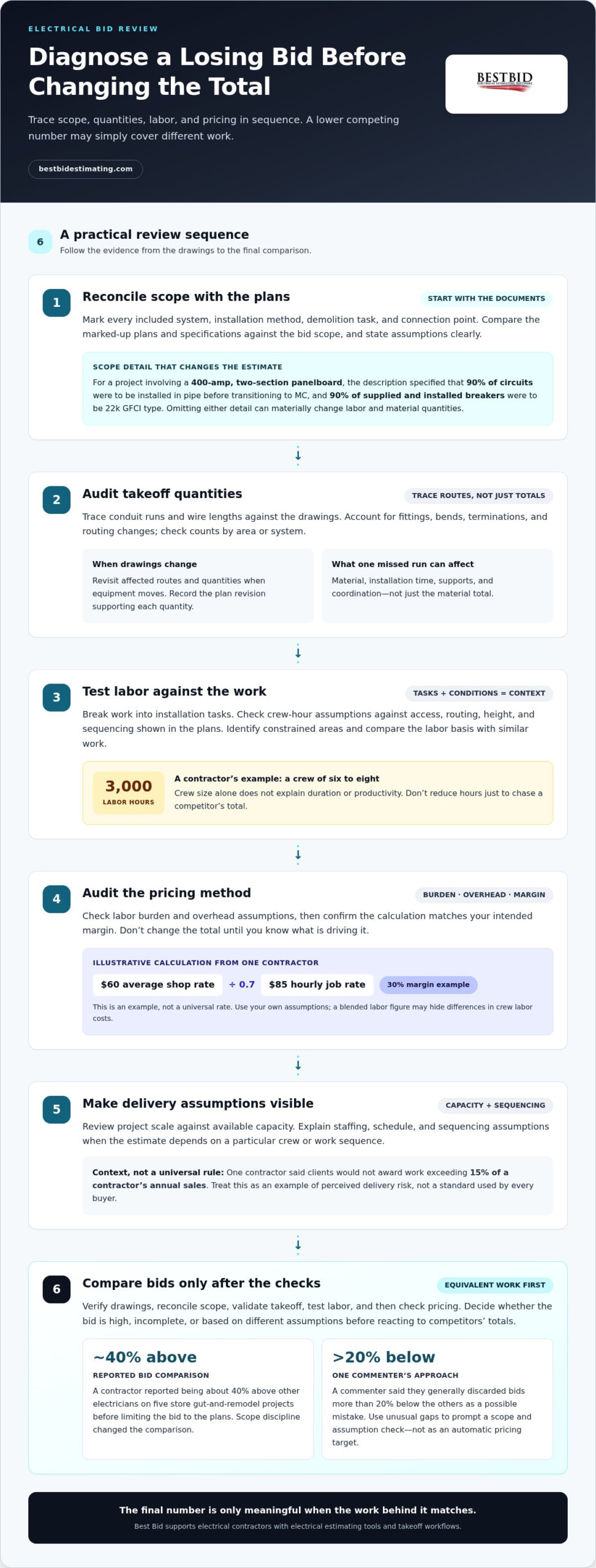
Start with the plans and specifications. Mark each included system, installation method, demolition task, and connection point. Then compare your marked-up documents with the bid scope.
In the panelboard example, the description called for 90% of circuits to be installed in pipe before transitioning to MC, and 90% of supplied and installed breakers to be 22k GFCI type. Leaving either detail out could materially change labor and material quantities. Listing assumptions clearly also helps distinguish a true scope difference from a missed item.
Next, audit the takeoff. Trace conduit runs and wire lengths against the drawings, accounting for fittings, bends, terminations, and routing changes. Check quantities by area or system instead of relying on a single project total.
If a drawing revision moves equipment, revisit the affected routes and quantities. A missed run can affect more than material costs: it may also add installation time, supports, and coordination. Record which plan revision supports each quantity so your estimate doesn’t combine measurements from different drawing sets.
Labor deserves the same line-by-line review. Separate installation tasks, then test each crew-hour assumption against access, routing, height, and sequencing shown in the plans. One contractor described a job estimated at 3,000 labor hours for a crew of six to eight.
That example shows why total hours need context: crew size alone doesn’t explain duration or productivity. Break the work into measurable tasks, identify constrained areas, and compare estimated hours with the labor basis used on similar work. Don’t reduce hours just to chase a competitor’s total.
Pricing can also miss because the estimate confuses markup with margin. One contractor described a 30% margin calculation by dividing a $60 average shop rate by 0.7, producing an $85 hourly job rate. That is an example, not a universal rate.
Use your own labor burden and overhead assumptions, then confirm the calculation matches your intended margin. A blended labor figure may obscure differences in the crew’s labor costs.
Review the bid against the project’s scale and your available capacity. One contractor said clients would not award work exceeding 15% of a contractor’s annual sales. Treat that as an example of how perceived delivery risk may influence a decision, not a standard used by every buyer.
A large bid may lose if the proposal doesn’t explain staffing, schedule assumptions, or project sequencing. Make those assumptions visible, especially when the estimate depends on a particular crew or work sequence.
- Match scope: Check every system and installation detail against the plans.
- Recheck quantities: Trace routes, lengths, counts, and drawing revisions.
- Test labor: Connect hours to specific tasks and working conditions.
- Audit pricing: Separate labor burden, overhead, markup, and margin.
- Clarify delivery: State the crew and sequencing assumptions behind the bid.
Finally, compare the bid with competing numbers only after confirming they cover equivalent work. A contractor reported a bid about 40% above other electricians’ bids for five 4,000-square-foot store gut-and-remodel projects, before limiting the bid to the plans. Scope discipline changed the comparison.
Use a review sequence: verify drawings, reconcile scope, validate takeoff, test labor, then check pricing. That process helps identify whether a bid is losing because it’s high, incomplete, or simply built on different assumptions.
Evaluate every pricing method against your own labor burden and overhead assumptions. Comments about panel-change pricing show why a low figure alone is not enough to diagnose a bid. A commenter also said they generally discarded bids more than 20% below the others because such bids suggested a possible mistake. Use those comparisons as prompts to verify scope and assumptions, not as a replacement for your own review with Best Bid.
Best Bid: Best Bid Next Generation
Best Bid Next Generation helps electrical contractors build detailed estimates with on-screen takeoff and automatic conduit and wire length calculations. It can help when manual takeoffs or scattered calculations make it difficult to keep quantities consistent across a bid.
A consistent takeoff workflow makes project details easier to organize and bids easier to prepare. Best Bid Hybrid Pro supports electrical estimating, while Accura Cadd PDF Draw provides PDF drawing tools for plan review and markup. If you want to strengthen your estimating skills, the Online School for Electrical Estimating offers focused training.
Choose the software or training that fits the part of your workflow you want to improve. Explore Best Bid’s electrical estimating tools and training, or contact Best Bid to discuss your estimating needs.
Build a Stronger Estimating Process
Understanding why your electrical bids keep losing can help you approach the next estimate more deliberately. Treat every submitted proposal as a chance to refine your process: note where assumptions differed, which scope details needed clarification, and what you would change before bidding similar work again. These observations can turn bid reviews into practical improvements rather than guesswork.
When you’re ready to discuss your bids and estimating workflow, contact Best Bid to discuss your bids. Bring the parts of your process you want to strengthen, whether that’s organizing takeoffs, reviewing labor assumptions, or preparing detailed estimates. A focused conversation can help you consider a useful next step for your electrical contracting business.
Refine your process with each estimate. Greater clarity starts with the next bid you build.