Labor burden calculation for electrical contractors: find your hourly cost

Your electrician’s wage is only the starting point. A labor burden calculation for electrical contractors adds employer payroll taxes, workers’ compensation, insurance, paid leave, and benefits to base wages; electrical contractors typically have a labor burden rate of 40-50%. The fully burdened hourly cost can vary by worker classification and the costs your company carries.
The gap between the wage on a time sheet and the true cost of labor matters when you build bids or compare the cost of a journeyman with an apprentice. If you leave out insurance, payroll taxes, or paid time off, your labor figure won’t reflect the full cost of putting a crew on a job.
This guide explains which costs belong in the calculation, how to express labor burden as a rate and an hourly cost, and how to compare fully burdened rates across classifications. You’ll also learn why paid hours and productive hours tell different stories, and which payroll, tax, insurance, and benefit records help your estimates reflect actual labor costs.
Key Takeaways
- Separate the costs your business pays for every worker from costs that vary by classification or benefit package.
- Compare each worker’s fully burdened cost against productive hours, not just the hourly wage on the payroll record.
- Use current payroll, tax, insurance, and benefit records to make labor estimates more representative of your actual costs.
- Apply consistent labor assumptions in bids and job costing so you can see where labor costs affect project performance.
- Treat industry benchmarks as a starting point, then account for your workforce structure, coverage, and location.
What Costs Are Included in Labor Burden?
An electrical contractor’s labor burden includes employment costs beyond an employee’s base wages. Adding those costs gives you the true labor cost to include in job costing.
Defining Employment Cost and Labor Burden
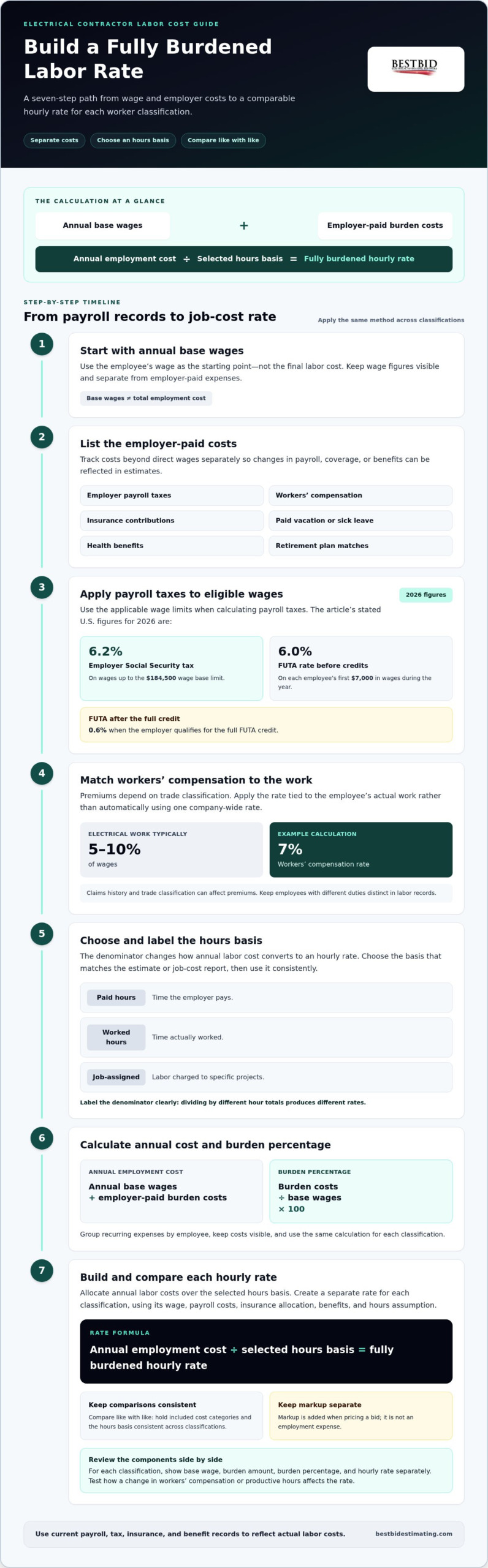
Labor burden is the cost of employing a worker beyond direct wages, including employer taxes, insurance, paid leave, and benefits. Total employment cost combines those expenses with the employee’s annual wages. The distinction matters when assigning labor to an electrical job: a wage-only figure leaves out real employer expenses. Track each component separately so changes in coverage or payroll costs are reflected in your estimates.
Benefits, Paid Leave, and Retirement Contributions
Benefits and paid time off are part of labor burden because the employer pays for them in addition to wages. Examples include employer health insurance contributions, paid vacation or sick leave, and retirement plan matches. Their annual cost depends on the benefits offered and each employee’s enrollment or eligibility. For job costing, allocate these expenses to the relevant workforce rather than treating them as part of the hourly wage.
Employer Payroll Taxes and Wage Limits
Employer payroll taxes add another layer to each employee’s annual cost. For 2026, the Social Security Administration sets the U.S. employer Social Security tax rate at 6.2% on wages up to the $184,500 wage base limit. For 2026, the Internal Revenue Service sets the federal unemployment tax rate before credits at 6.0% on each employee’s first $7,000 in wages during the year. After the full FUTA credit, the U.S. federal unemployment tax rate is 0.6% when the employer qualifies for that credit, according to the Internal Revenue Service.
Calculating Annual Cost and Burden Percentage
Annual employment cost equals annual base wages plus employer-paid burden costs. Divide burden costs by base wages, then multiply by 100 to find the burden percentage. Use the same calculation for each classification to make estimates comparable.
Labor burden covers costs beyond direct wages; labor cost is the resulting expense of employing the worker. Markup is separate: it is added to a cost when pricing a bid, not an employment expense. Keeping these figures distinct helps estimators check that job costs reflect payroll reality before markup is applied.
To calculate an accurate annual figure, group recurring expenses by employee and use the applicable wage limits for payroll taxes. Then assign the resulting labor cost to jobs using a consistent method. This keeps benefit expenses, paid leave, and taxes visible rather than burying them in the base wage.
Fully burdened hourly rates by worker classification
A fully burdened hourly rate combines a worker’s wage with employer-paid costs allocated across hours. For an electrical estimate, calculate a rate for each classification and use a consistent hours basis.
Payroll Tax and Workers’ Compensation Calculations
Payroll taxes and workers’ compensation add classification-dependent expenses to each worker’s wage. Calculate each cost separately, then allocate the totals over the hours used for estimating. Keeping the calculation visible makes it easier to update labor assumptions when payroll or coverage changes.
Separate percentage-based costs from fixed annual benefits before converting them to hourly amounts. Apply payroll tax rates to the wages subject to each tax, then apply the appropriate workers’ compensation rate to covered payroll. A spreadsheet or estimating software can keep wage, tax, insurance, and hours assumptions distinct, so you can update a rate without burying the change in one loaded figure.
Workers’ Compensation by Trade Classification
Workers’ compensation premiums depend on the work classification assigned to employees, so one company-wide rate may not accurately represent every crew. Electrical work typically carries a workers’ compensation rate of 5-10% of wages; an example calculation uses 7%.
Use the classification that reflects the employee’s actual work, then apply its rate to the related payroll. Claims history and trade classification can affect premiums, so separate employees with different duties in your labor records. For example, don’t automatically apply a field electrician’s rate to every worker simply because they’re on the same payroll.
Choosing an Hours Basis
Your choice of hours determines how annual labor costs convert into an hourly rate. Paid hours include time the employer pays; worked hours capture time actually worked; job-assigned hours track labor charged to specific projects. Choose the basis that matches the estimate or job-cost report, and apply it consistently across classifications.
Dividing by paid hours instead spreads that cost over a different total and produces a different rate. Label the denominator clearly in spreadsheets and reports to avoid misleading comparisons.
Comparing Rates Across Classifications
Build a separate fully burdened rate for each classification using its wage, payroll costs, insurance allocation, benefits, and selected hours basis. An apprentice and a journeyman may have different wages, while benefit eligibility, duties, and workers’ compensation classifications can also affect their total costs. Compare like with like by keeping the included cost categories and hours basis consistent.
For a practical review, put each classification’s base wage, burden amount, burden percentage, and hourly rate in separate columns. Then test how a change in workers’ compensation or productive hours affects the rate, using dedicated spreadsheets or free online calculators to quickly verify your math.
What is the difference between a base wage and a fully burdened labor rate?
Base wage is the employee’s direct pay; a fully burdened labor rate adds employment costs. In construction estimating and job costing, keep labor, overhead, and markup distinct.
Burdened Rates in Estimating and Job Costing
A burdened labor rate assigns employment costs to each labor hour, helping estimators price work beyond the paycheck. That loaded rate gives job costing a clearer labor figure, so recorded hours are valued consistently against the estimate.
Use the same labor categories in the estimate and job-cost report. If a project budgets electrician hours separately from apprentice hours, compare each category’s actual cost with its own estimate. This makes labor overruns easier to trace to hours, wage assumptions, or burden allocations instead of hiding the difference in one blended crew rate.
Typical Contractor Burden Rates
Electrical contractors typically have a labor burden rate of 40-50%, while construction labor burden rates typically range from 35% to 60%. These are benchmarks, not substitutes for calculating your company’s own payroll, insurance, and benefits. Union labor burden rates typically run 10-20 percentage points higher than non-union rates, reflecting differences in workforce structure and compensation.
Insurance classification matters because workers’ compensation premiums are based on payroll and assigned work classifications. Apply the rate that corresponds to the work, then keep that insurance cost separate from Social Security and other payroll expenses. A change in classification or claims history can alter the insurance allocation, so update the cost inputs used in estimating.
Separate direct labor burden from overhead. Construction overhead costs and equipment typically amount to 5-15% of wages, but they cover business expenses beyond an employee’s compensation. Allocating overhead across productive hours converts those expenses into an hourly amount.
A customer billing rate must cover labor burden and allocated overhead before profit. Keeping these figures separate helps prevent treating the burden percentage itself as markup.
Overtime and Burdened Labor Rates
Overtime changes direct wage costs and can affect the fully burdened rate for the hours worked. Under U.S. federal overtime requirements, covered nonexempt employees generally receive at least time-and-a-half their regular rate after working more than 40 hours in a workweek. Include overtime assumptions in estimates where extended schedules affect crew hours.
For job costing, record regular and overtime hours separately. Then apply the matching wage treatment and associated employment costs to each category. This keeps a project’s labor variance visible instead of making overtime look like a higher burden percentage. The Online School for Electrical Estimating can help sharpen your estimating knowledge, including how labor assumptions flow into project costs.
Gathering payroll, tax, insurance, and benefit records
Build the calculation from actual employee records, not one blended payroll percentage. Keep tax, insurance, and benefit documents separate so each annual cost has a clear basis.
Payroll Taxes Included in Labor Burden
FICA, FUTA, and SUTA are employer payroll taxes that add employment costs beyond wages. For 2026, the Internal Revenue Service sets the U.S. employer Medicare tax rate at 1.45%, with no wage base limit. An employer entitled to the full FUTA credit may receive a maximum credit of 5.4%, subject to eligibility conditions, according to the Internal Revenue Service.
Gather payroll registers, quarterly tax filings, and unemployment tax notices for the same annual period. Match taxable wages to each employee, then note which tax applies and its wage limit. Keep FUTA and SUTA separate: FUTA is federal unemployment tax, while SUTA is state unemployment tax. This makes the percentage traceable when actual payroll changes.
State-Specific Payroll Taxes
State payroll taxes can add costs beyond federal FICA and FUTA, and rates vary by state and employer experience. California state unemployment insurance rates range from 1.5-6.2% on the first $7,000 of wages; Texas rates range from 0.31-6.31% on the first $9,000 of wages. Use the state notice for the correct business and annual period.
Some states also assess payroll-related programs beyond unemployment insurance. California’s State Disability Insurance is listed at 1.1%, with an Employment Training Tax of 0.1%; Rhode Island Temporary Disability Insurance is listed at 1.3%. Keep these items distinct in the records. A combined tax percentage can hide which state charge changed and complicate job cost updates.
For a reliable labor file, organize documents by worker and cost category. Use the same annual period for payroll, insurance, and benefits, then record the calculation basis beside each amount. A practical record set includes:
- Payroll registers showing each employee’s wages and paid hours.
- Federal tax filings and payroll reports identifying FICA and FUTA wages.
- State unemployment notices showing the SUTA rate and taxable wage limit.
- Workers’ compensation and general liability statements with payroll classifications.
- Health plan invoices, paid-leave policies, and retirement match records.
Reconcile totals against payroll reports before allocating costs to labor hours. For example, compare the annual health insurance invoice with the employer contribution recorded for each enrolled employee. Keep the source document, calculation, and resulting hourly allocation together. That audit trail helps you update labor assumptions without mixing insurance or unemployment taxes into profit markup.
Electrical contractor labor burden benchmarks
Common mistakes include counting wages but missing paid leave, benefits, or insurance. Contractors can understate labor burden when their estimates do not reflect differences in worker costs or the hours available for billable work.
Electrical contractors typically have a 40-50% labor burden rate, or about 1.40 to 1.55 times base wage. Treat that range as a comparison point, not a substitute for your company’s actual payroll, benefits, and insurance costs. Your own hourly cost reflects the costs attached to each worker and the hours used to allocate them.
U.S. construction employees had annual wages of $74,630 and labor burden costs of $32,843 in December 2025 figures. Those burden costs were approximately 44% of base pay, with annual total compensation of $107,474. The benchmark shows why wage-only comparisons miss a substantial part of employment cost.
The breakdown helps explain what can drive the overall figure. Construction employees had annual paid leave costs of $5,491, or 7.4% of wages. Supplemental pay costs were $5,366, or 7.2%, while retirement and savings costs were $4,950, or 6.6%. Legally required benefits are one component of labor burden.
These figures describe U.S. construction employees overall, not a universal electrical contractor package. Compare your own costs with the benchmark categories, then investigate the reasons for differences.
Benefits, workforce structure, insurance classifications, and state payroll taxes can all change the burden rate. A gap from the typical range is a reason to review your inputs, not automatically a sign of an error.
For a useful comparison, track each worker classification separately. Keep base wage, burden amount, burden percentage, and hourly cost visible. Then review whether you used paid, worked, or job-assigned hours. For example, dividing annual employment costs by billable hours produces a different hourly figure than dividing by paid hours.
- Compare like classifications, such as journeymen with journeymen.
- Separate direct labor burden from overhead and markup.
- Update insurance and benefit inputs when their actual costs change.
This tracking helps pinpoint common sources of understatement: omitted benefits, outdated insurance assumptions, and inconsistent hour denominators. Review the underlying records before changing your estimating percentage. A clear cost breakdown also makes it easier to explain why apprentice and journeyman rates differ, even when both work on the same electrical project.
For a more consistent estimating process, use the Online School for Electrical Estimating to develop your estimating skills and apply labor assumptions more deliberately.
Best Bid: Best Bid Next Generation
Best Bid Next Generation gives electrical contractors specialized estimating software for turning project takeoffs into detailed bids. Once you’ve calculated labor costs by classification, use those figures alongside material quantities and project details to build a more complete estimate. On-screen takeoff and automatic conduit and wire length calculations support the estimating workflow. Keeping labor assumptions distinct also makes it easier to review what each bid includes.
Consider Best Bid when you’re ready to move from manual takeoff work to a dedicated electrical estimating process. Best Bid Hybrid Pro and Accura Cadd PDF Draw also support electrical estimating and drawing workflows. The Online School for Electrical Estimating can help build your estimating skills, while Freelance Estimating provides support when you need help with a project.
Explore Best Bid’s electrical estimating tools at bestbidestimating.com.
Make Your Next Estimate a Stronger Starting Point
Use your labor assumptions as a working business tool, not a figure that sits untouched after a bid goes out. A disciplined labor burden calculation for electrical contractors supports more consistent estimating decisions as crews, project demands, and operating costs shift. Build a repeatable review into your estimating routine, then use completed jobs to refine future assumptions.
The next step is applying that consistency across your estimating workflow. Keep labor inputs clear, compare estimates with job results, and adjust when actual project experience shows a difference. Over time, this feedback loop gives your team a sharper view of how labor assumptions shape bids and project decisions.
Best Bid offers electrical estimating tools for contractors looking to strengthen that workflow. Contact Best Bid to discuss your labor costs and take the next step toward more confident estimates.
Frequently Asked Questions
How do you calculate labor burden in construction?
Add employer-paid costs beyond wages, then compare that total with direct wages to find the burden percentage. For a useful construction estimate, organize expenses by employee classification and accounting period. Include payroll taxes, workers’ compensation, benefits, and paid leave, then allocate those amounts using the hours basis that matches your estimate. Keep overhead and profit separate so the burden figure represents employment costs, not the full customer billing rate.
Are subcontractors considered cost of labor?
Yes, subcontractor charges can be direct project labor-related costs, but they are not the same as employee labor burden. Record a subcontractor’s invoice under the appropriate subcontract or project cost category instead of applying employee payroll taxes and benefits to it. For example, track electrical installation work performed by a subcontractor separately from hours worked by payroll employees. This distinction helps you compare in-house labor with subcontracted work accurately.
How do I calculate the true cost of an employee?
Combine the employee’s wages with employer-paid costs tied to that worker, then choose an hours basis suited to the comparison. An employee-level record can show wages, insurance allocation, paid leave, and benefit contributions separately. For example, compare annual costs with job-assigned hours when reviewing project performance, or use productive hours for estimating. Label the denominator clearly so your team doesn’t mistake a project rate for a payroll-hour rate.
How does labor burden affect job pricing?
Labor burden raises the labor amount assigned to a project beyond employees’ base wages, affecting the job’s estimated direct cost. If an estimate counts only wage hours, the bid can miss employer-paid expenses associated with those hours. For example, a project with substantial field labor may carry more employee-related costs than one with limited labor, even if material quantities are similar. Calculate overhead and profit separately to see how each contributes to the final price.
What is labor burden for an electrical contractor?
Labor burden is the employer-paid cost of employing electrical workers beyond their direct wages. For an electrical contractor, it can include payroll taxes, workers’ compensation, paid leave, health benefits, and retirement contributions. A labor burden calculation for electrical contractors helps distinguish the wage rate from the broader cost of staffing a project. Separate classifications, such as apprentices and journeymen, when their wages, insurance treatment, or benefits differ.
How do you calculate labor burden per hour for an electrician?
Divide the electrician’s annual employment costs by the annual hours relevant to your purpose. Use paid hours to understand cost per compensated hour, or job-assigned hours to evaluate project labor. For example, when building an estimate, use the same productive-hours basis across comparable worker classifications. Keep wages and added employment costs visible in your worksheet so you can trace a rate change to its source.
Which payroll taxes and benefits are included in electrical labor burden?
Common employer payroll taxes include FICA, FUTA, and SUTA, while benefits can include health insurance, paid leave, and retirement contributions. Workers’ compensation is another employee-related cost, usually applied according to payroll classification. Keep each item in its own record category. That makes it easier to identify whether a change comes from unemployment taxes, insurance, or a benefit plan, rather than treating every added expense as one undifferentiated percentage.
What are typical labor burden percentages for electrical contractors in the United States?
A typical electrical contractor labor burden benchmark is 40-50% of base wages. Treat that range as a comparison point, not an automatic rate for every company or worker. Benefits, insurance classifications, union or non-union workforce structure, and paid leave affect the actual percentage.
Calculate your own rate from current employee costs, then compare classifications on a consistent hours basis. A benchmark is useful when it prompts investigation into differences, not when it replaces job-specific inputs.