Total Cost of Ownership Electrical Estimating Software: The 2026 Buyer’s Guide
What if the software you rely on to win bids is actually siphoning off your profit margins through a hidden subscription tax? You’ve likely felt the sting of recurring monthly fees that never seem to end, especially when you realize you’re paying extra just to access mandatory takeoff tools or your own historical bid data. Understanding the true total cost of ownership electrical estimating software is more critical now than ever, as the 2026 NEC updates and shifting material costs demand leaner, more efficient operations.
You deserve a tool that works as hard as you do without demanding a permanent seat at your table. It’s frustrating to feel like a guest in your own office, fearing that one missed payment could lock you out of years of bidding history. This guide promises to pull back the curtain on the real long-term costs of estimating tools, helping you spot the traps of low-entry subscriptions that balloon into massive overhead. We’ll provide a clear framework to compare software costs, show you how to maintain total ownership of your data, and explain how to streamline your workflow for the 2026 market without the weight of recurring fees.
Key Takeaways
- Learn how to calculate the total cost of ownership electrical estimating software over a five-year period to reveal the hidden fees buried in “affordable” monthly plans.
- Identify your financial break-even point by comparing the long-term cost of renting software versus the permanence of a one-time purchase.
- Protect your business from the “Data Hostage” problem and ensure you always have full access to your bidding history and project data.
- Use our 2026 evaluation checklist to confirm if essential tools like on-screen takeoff are built-in or just another recurring “tax” on your profits.
- Discover how to secure lifetime updates and support without ever receiving another monthly invoice for your estimating tools.
What is Total Cost of Ownership (TCO) for Electrical Estimating Software?
How much does your estimating software really cost? Most contractors look at the sticker price or the first month’s bill and stop there. That’s a mistake that can cost you thousands in lost profit over the next few years. To understand the true Total Cost of Ownership (TCO), you have to look past the initial download. It’s the sum of every dollar and every minute you spend on that tool over its entire lifespan. For an electrical contractor, the total cost of ownership electrical estimating software represents the full financial commitment of licensing, mandatory support, and the labor hours required to produce accurate bids over a five-year horizon.
There is a massive difference between treating software as a temporary expense versus a business asset. When you rent software through a subscription, you’re essentially paying a permanent tax on your ability to do business. The moment you stop paying, your tools and often your data simply vanish.
On the flip side, owning your software turns it into an asset. It’s a one-time investment that adds value to your company’s balance sheet and provides a permanent capability without a recurring liability. It’s the difference between leasing a service van forever and eventually owning the title.
Direct Costs vs. Indirect Costs
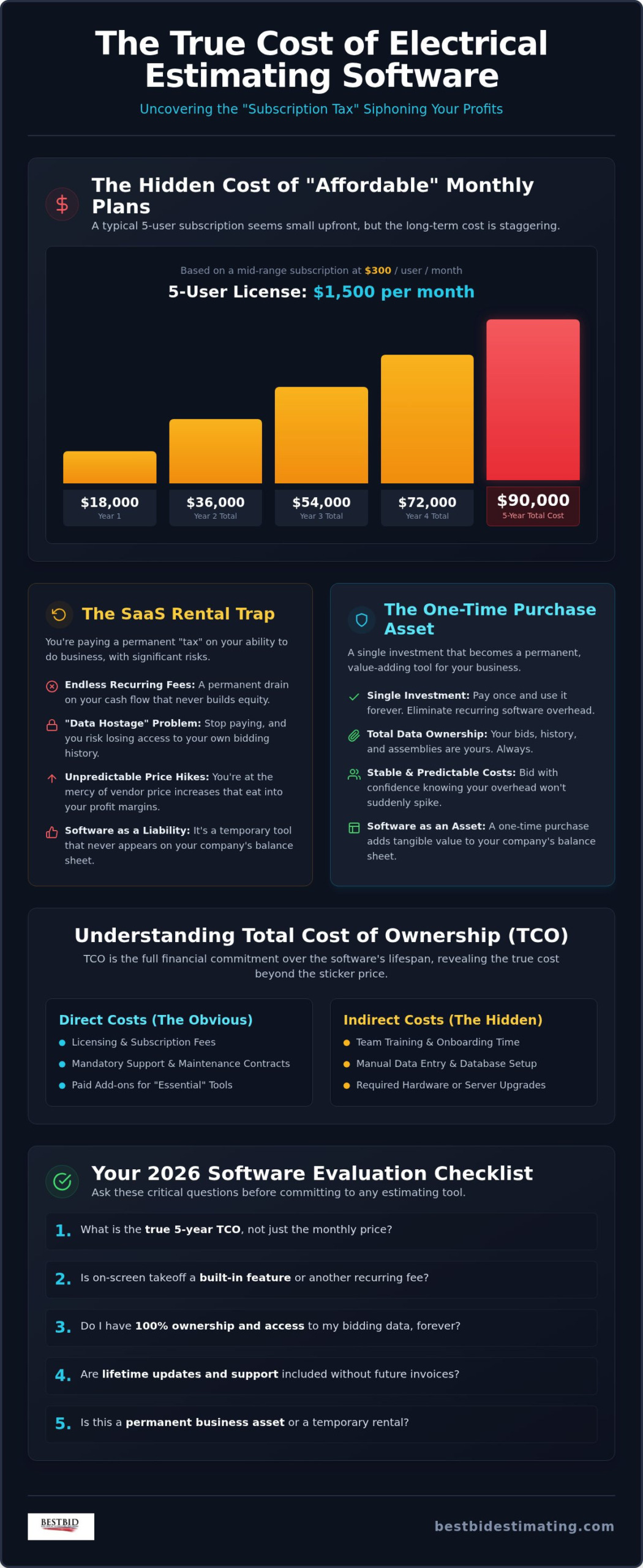
Direct costs are the obvious ones. These include your licensing fees, maintenance contracts, and those mandatory support packages that some vendors require just to keep the software functional. If you’re using a SaaS model, these direct costs never end. They’re a permanent line item on your overhead that grows every time the vendor decides to hike their rates.
Indirect costs are more subtle but often more expensive. Think about the time your team spends on database setup or training. If a tool is clunky or lacks trade-specific features, you’re paying for the “hidden” cost of manual data entry every time an estimator has to fat-finger a material list. You also need to consider hardware. Does the software require a high-end server, or can it run on a standard laptop? Every extra requirement adds to your total cost of ownership electrical estimating software.
Why TCO Matters for Your Profit Margins
Profit margins in the electrical trade are tight. With average net margins often landing between 5% and 10%, every dollar of overhead counts. When you’re paying a “subscription tax” every month, you’re essentially handing over the profit from one small project just to keep your bidding tools active. It’s a recurring drain on your cash flow that makes it harder to compete on price.
Calculating TCO also protects you from the volatility of the SaaS market. If you don’t own your tools, you’re at the mercy of a vendor who can raise your rates by 15% next year without warning. By understanding your long-term costs now, you can secure a stable overhead rate. This stability allows you to bid with confidence, knowing that your software costs won’t suddenly spike and eat the profit you worked so hard to secure.
The Hidden Costs of the “Subscription Tax” in Bidding Software
Many contractors fall into the trap of looking only at the monthly bill. It feels manageable at first. However, when you calculate the total cost of ownership electrical estimating software over a five-year period, the numbers become staggering. For a standard five-user license, a mid-range subscription costing $300 per month per user adds up to $18,000 a year. By year five, you’ve handed over $90,000. That’s money that could have gone toward new equipment, employee bonuses, or growing your fleet. Instead, it’s a “subscription tax” that never ends.
Then there’s the “Data Hostage” problem. This is the reality most SaaS providers don’t want to discuss. If you decide to switch software or simply hit a rough patch and stop paying, you lose access to your data.
Your past bids, assemblies, and project history are locked away. You’re forced to keep paying just to see your own work. It’s a restrictive cycle that treats your business data like a rental property rather than a permanent asset.
It’s vital to ensure you own your data outright, regardless of your current payment status.
The Escalation of SaaS Pricing
Don’t assume today’s price is what you’ll pay in 2027 or 2028. Historical trends in construction tech show that subscription prices rarely stay flat. Often, the “locked-in” rate you signed for only applies to the first twelve months. After that, you’re subject to annual increases that eat into your margins. Managing these recurring bills also creates an administrative burden. Keeping track of multiple seats, renewal dates, and price hikes takes time away from actual estimating. Understanding What Is Total Cost of Ownership (TCO)? means accounting for these inevitable price escalations before you sign the contract.
Third-Party Integration Fees
The “double-dip” is a common tactic where a vendor sells you the estimating tool but charges extra for essential features. If you have to pay for a separate On-Screen Takeoff (OST) subscription, your costs double instantly. Some platforms also charge “integration fees” just to let your software talk to a pricing service. These hidden layers make a cheap starting price irrelevant. To keep your overhead low, a built-in takeoff capability is a non-negotiable requirement. It eliminates the need for a second subscription and keeps your workflow in one place. If you’re tired of the monthly drain, it’s time to look at a pricing model that respects your bottom line and your long-term success.
One-Time Purchase vs. SaaS: A Long-Term Financial Comparison
When does renting stop making sense? For most electrical contractors, the “break-even” point between a one-time purchase and a subscription happens much sooner than the software sales reps want you to believe. While a SaaS model might look cheaper on day one, the cumulative total cost of ownership electrical estimating software usually crosses the ownership line within the first 12 to 18 months. After that point, every dollar you would have spent on a recurring subscription is pure profit back in your pocket. Choosing electrical estimating software with lifetime updates provides the highest ROI for single-location shops because it eliminates the uncertainty of future price hikes while ensuring your tools stay current with the latest 2026 NEC changes.
Ownership is about more than just the bottom line; it’s about the security of your business assets. When you own your software, you receive the value of lifetime updates and support without ever seeing another recurring invoice. You aren’t just renting access to a tool; you’re investing in a permanent capability.
This control extends to your database. When you can customize your assemblies and material lists without worrying about a vendor changing the interface or the pricing structure on a whim, your long-term estimator speed stays consistent and reliable.
The ROI of Software Ownership
Smart business owners look at software as a capital expenditure (CapEx) rather than a never-ending operating expense (OpEx). When you buy your tools, they become an asset on your balance sheet. This often opens up tax benefits, such as the ability to deduct the full purchase price in a single tax year under Section 179 or similar local regulations.
Beyond the tax man, the real ROI is found in your bidding history. You’re building a library of historical data that you actually own. You aren’t just renting a workspace; you’re building a fortress of project data that stays with your company forever, regardless of market fluctuations.
Workflow Speed and Labor Costs
Labor is your most expensive variable. If your software has a steep learning curve, your total cost of ownership electrical estimating software sky-rockets because of the hours wasted on onboarding. A tool designed by people who have actually been in the field ensures a low-to-medium learning curve, getting new estimators productive in days instead of weeks. Financial impact is also felt in the small details. Features like “1-Click” backups and fast, automated transfers from on-screen takeoff to the final estimate save precious minutes on every bid. By utilizing an assembly-structure workflow, you drastically reduce the labor hours required per bid, allowing your team to submit more quotes with higher accuracy and zero recurring overhead. If you want to go further, our complete guide on how to streamline electrical bidding process walks through the integrated digital workflows that top contractors are using to turn around quotes in half the time.
The 2026 Electrical Estimating Software Evaluation Checklist
Choosing the right tool requires looking at the total cost of ownership electrical estimating software over several years, not just the first thirty days. Most software demos focus on flashy interfaces while hiding the recurring costs that eat your profit. To avoid the subscription trap, you need a rigorous evaluation process. Don’t let a salesperson gloss over the long-term math. Use this checklist to verify if a software package is a genuine business asset or a permanent liability. With copper prices surging and NEC 2026 changes reshaping load calculations, streamlining electrical bid workflow by moving beyond manual spreadsheets is no longer optional—it’s a competitive necessity.
- One-Time Purchase Option: Does the vendor allow you to buy the software outright? If they only offer monthly “rent,” you’ll never stop paying for the right to bid.
- Built-in Takeoff: Is On-Screen Takeoff (OST) included in the core price? Paying for a separate takeoff subscription is a double-dip on your wallet that complicates your total cost of ownership electrical estimating software.
- Lifetime Support: Are technical support and updates included forever? Avoid “maintenance fees” that feel like a subscription under a different name.
- Database Control: Do you have 100% control over your assemblies and material pricing? You need real-time pricing integration without per-item “service fees.”
- Proven Training: Is there an Online School for Electrical Estimating available? Software is useless if your team can’t use it to win profitable work.
Technical and Database Requirements
Your database is the heart of your estimating speed. Verify that the software offers unlimited database capacity without hidden charges for adding new items or assemblies. In the 2026 market, your tools must be compatible with current operating systems and hardware to avoid forced, expensive upgrades.
Look for the ability to morph assemblies. This feature allows you to adjust components on the fly, which drastically reduces database search time and keeps your bids accurate. If the software can’t handle the complexities of the 2026 NEC reorganization, it’s already obsolete.
Training and Support Checklist
Software tutorials written by programmers are rarely helpful in the field. You need field-tested training from people who have actually run a job site. Check support response times and verify if “premium” help desks come with an extra price tag. It’s also wise to see if the vendor offers freelance estimating services. Having access to professional estimators for project overflow support is a massive advantage. It allows you to scale up for large bids without the TCO burden of hiring additional full-time staff. If you’re ready to secure a tool that belongs to you forever, see how Best Bid can transform your workflow.
Best Bid: Maximizing TCO Efficiency for Electrical Contractors
Best Bid isn’t just another tech company; it’s a tool forged from fifty years of field experience. When Steve Griffin founded Best Bid, he did so with a “from the trenches” philosophy that prioritizes the contractor’s bottom line over recurring corporate revenue. This mindset is exactly why Best Bid Next Generation is the ultimate solution for those looking to minimize the total cost of ownership electrical estimating software. By eliminating the subscription tax forever, we allow you to keep your profits where they belong: in your business.
The efficiency of our system comes from what we include, not what we charge extra for. While competitors might lure you in with a low base price and then hit you with fees for takeoff tools, we provide built-in OST. Combined with real-time NetPricer integration, you have everything you need to produce a professional bid in one package.
This integration is a major reason why Best Bid was ranked #1 for “Best Value” among single-location firms. You aren’t just saving on monthly fees; you’re saving on the labor hours typically wasted jumping between different programs.
Designed for the 99%
We focus on the needs of the 99% of contractors, the hardworking firms with fewer than ten estimators. These businesses don’t need bloated, overly complex systems designed for global corporations. They need speed and accuracy. Our licensing model is straightforward: buy it once, own it forever. We’ve meticulously designed the interface to reduce the “clicks per bid,” ensuring your estimators can work at peak capacity without being bogged down by unnecessary software hurdles. This focus on efficiency is a core component of reducing your total cost of ownership electrical estimating software.
Getting Started with a Permanent Solution
Moving away from a “pay-to-play” model is the smartest financial move you can make in 2026. Review the Best Bid pricing model to see how our 5-user license provides your team with the flexibility to grow without the fear of a ballooning monthly invoice. We understand the transition can feel daunting, especially if you’re worried about your historical data. We make it simple to move from a subscription model so you can maintain total ownership of your bids from day one. It’s time to stop renting your success and start owning it. Request a free consultation to see the TCO savings in action.
Take Control of Your Bidding Future
Choosing your next estimating platform is about more than just finding a tool. It’s about deciding whether you want to pay a permanent tax on your labor or invest in a business asset that you actually own. We’ve explored how the total cost of ownership electrical estimating software hinges on eliminating recurring fees and ensuring your data never goes hostage. By moving away from the rent-forever model, you secure your profit margins and gain the stability needed to navigate the 2026 market with confidence.
Best Bid was built by Steve Griffin, a Master Electrician with over 50 years of trade experience, to solve the exact frustrations you face daily. It’s why we’re ranked #1 for Best Value for single-location electrical contractors and carry a 5-Star rating for the fastest workflow and lowest learning curve in the industry. You don’t have to settle for clunky, expensive subscriptions that drain your cash flow. It’s time to put your hard-earned money back into your own pocket.
Stop Renting Your Success—Own Your Electrical Estimating Software Today
Build a stronger, more profitable business on a foundation of total ownership. We’re here to help you make the transition to a faster, more reliable future.
Frequently Asked Questions
Does any electrical estimating software offer a one-time purchase with no monthly fees?
Yes, Best Bid Next Generation is a leading example of software that offers a one-time purchase model with no monthly fees. This approach allows you to own your tools as a business asset rather than renting them as an ongoing expense. By avoiding recurring payments, you significantly lower the total cost of ownership electrical estimating software over the long term.
Is built-in on-screen takeoff (OST) better than using a general-purpose third-party tool?
Built-in on-screen takeoff is generally superior for TCO because it removes the need for a separate, recurring subscription to external takeoff software. When takeoff is integrated, you eliminate the risk of data transfer errors and the time wasted moving files between different programs. This streamlined workflow keeps your estimators focused on winning bids rather than managing software conflicts.
What are the typical hidden fees in electrical bidding software contracts?
Typical hidden fees include mandatory maintenance contracts, “premium” support packages, and per-user integration charges for pricing services. Some vendors also hide annual price escalations in the fine print of their SaaS agreements. These costs can quietly double your initial estimate of the software’s price over a five-year period if you aren’t careful.
How much does it cost to train an estimator on new software?
The cost of training depends entirely on the software’s complexity and the estimator’s experience level. A clunky, corporate-style system can require weeks of specialized instruction, which costs you thousands in lost productivity. In contrast, trade-specific tools designed by electricians minimize this burden, allowing new team members to become productive in just a few days.
Can I keep my data if I cancel an electrical estimating software subscription?
Most subscription-based providers will lock you out of your data if you stop paying your monthly bill. This “data hostage” scenario means you lose access to historical bids and project assemblies. To protect your business, you should prioritize software that allows you to maintain full ownership and access to your data regardless of your current payment status.
Does Best Bid software include real-time material pricing updates?
Yes, Best Bid software integrates with NetPricer to provide real-time material pricing updates directly within your estimates. This feature ensures your bids reflect current market volatility without the manual labor of updating database items one by one. It is a critical component for maintaining accurate profit margins in the 2026 electrical contracting market.
Is there a difference between “lifetime updates” and “lifetime support”?
Lifetime updates ensure your software remains compatible with new operating systems and the latest National Electrical Code (NEC) changes. Lifetime support refers to ongoing access to technical help and troubleshooting. Best Bid includes both in the initial purchase price, ensuring your total cost of ownership electrical estimating software stays predictable and low.
How does the learning curve of Best Bid compare to enterprise-level platforms?
Best Bid is designed with a much shallower learning curve than most enterprise-level platforms because it was built by a Master Electrician for the trade. While corporate systems often require extensive, high-cost training sessions, Best Bid uses an intuitive workflow that mirrors how an electrician actually thinks about a project. This practical design reduces implementation costs and gets your team bidding faster.