How to Create an Electrical Submittal Package: The 2026 Professional Guide

How much does a single rejected submittal actually cost your business when you factor in the wasted labor, delayed materials, and the hit to your reputation with the GC? It’s easy to view these documents as a simple formality, but in reality, your submittal package is the technical contract that shields your profit margins from expensive field errors. You’re likely tired of spending ten hours per project manually hunting down data sheets, only to have an engineer kick the whole pile back because of one minor technical non-compliance. It’s the kind of administrative grind that keeps you at the office long after the job site has gone quiet.
We understand the frustration of being a skilled professional buried in paperwork. This 2026 guide will teach you exactly how to create an electrical submittal package that looks professional and commands respect from general contractors. By mastering a repeatable workflow, you can stop the manual “busy work” and start using tools like AccuraCADD PDF Draw to organize markups with precision. We’ll walk through the essential components of a compliant package, from product data to shop drawings, so you can build a system that protects your business and your time.
Key Takeaways
- Learn why a submittal package is a technical contract that verifies your materials meet the engineer’s intent while protecting your bottom line.
- Master the nuances of Division 26 specifications to ensure every data sheet includes the specific model highlights required for first-time approval.
- Discover a repeatable 5-step workflow for how to create an electrical submittal package that slashes administrative time without sacrificing accuracy.
- Identify high-risk pitfalls like overlooked “or equal” clauses and material lead times that can derail project schedules and erode your profits.
- Explore how tools like AccuraCADD PDF Draw help you transition from manual PDF merging to a streamlined documentation process you actually own.
What is an Electrical Submittal Package?
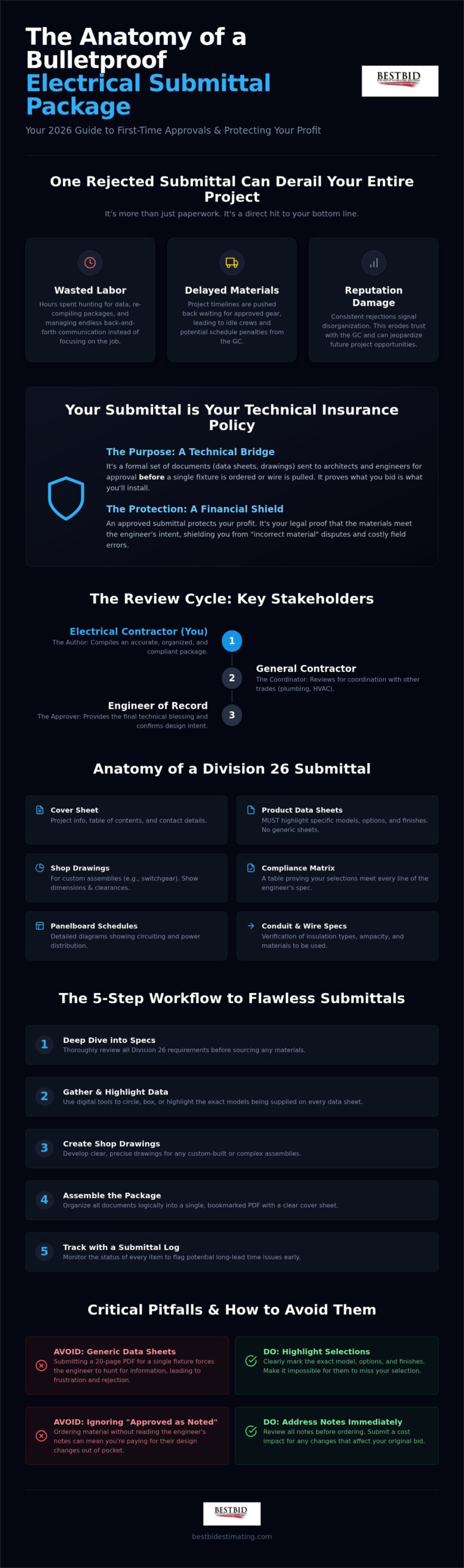
An electrical submittal package isn’t just a pile of paperwork; it’s the technical bridge between your bid and the actual installation. At its core, What is a Submittal? It’s a formal set of documents, including product data sheets and shop drawings, that you send to the architect or engineer for approval before a single wire is pulled or a fixture is ordered. While a single submittal might cover a specific occupancy sensor, a full package represents an entire system, like your switchgear or lighting controls. Learning how to create an electrical submittal package correctly ensures that every component meets the project’s Division 26 requirements. This process involves verifying technical details like voltage, phase, and UL listings that keep the job site safe and compliant.
Central to this process is the Submittal Log. This document acts as your project’s pulse, tracking every item from submission to final approval. It’s your early warning system for lead times, helping you spot a 40-week delay on a transformer before it halts your crew. Without a solid log, you’re just guessing when your materials will arrive.
The Legal and Financial Weight of Approval
Think of an approved submittal as your insurance policy. It protects you from “incorrect material” disputes, which can eat your profit alive. If you install what was approved, the financial burden of a change order often shifts away from your business.
However, you have to be careful with “Approved as Noted” stamps. If the engineer adds a requirement that wasn’t in your original bid estimate, your margin is at risk. You need to address those notes immediately before ordering materials to ensure you aren’t paying for the engineer’s design changes out of your own pocket.
Key Stakeholders in the Review Cycle
The review process is a collaborative cycle where everyone has a specific role. As the Electrical Contractor, you are the primary author. Knowing how to create an electrical submittal package that is organized and accurate is your first line of defense against delays.
The General Contractor then reviews the package to coordinate with other trades, ensuring your conduits don’t clash with plumbing or ductwork. Finally, the Engineer of Record provides the technical blessing. Their stamp confirms technical compliance with the design intent, giving you the green light to move from the office to the field with confidence.
Essential Components of a Division 26 Submittal
The Division 26 technical specifications are the roadmap for your entire package. They dictate the standards for every piece of gear you bring onto the site. When you’re learning how to create an electrical submittal package, the first rule is that generic data sheets won’t cut it.
You must highlight the specific models, options, and finishes you intend to use. If a manufacturer’s sheet lists ten different breaker sizes, circle or box the exact one you’re providing. It’s a simple step that prevents massive headaches during the review cycle.
Engineers hate hunting for information; make it impossible for them to miss your selection.
Standard manufacturer sheets often fall short for custom assemblies like switchgear lineups or complex lighting control systems. This is where shop drawings become vital. They provide a precise look at how components fit together in the real world, showing dimensions, connections, and clearances. For high-stakes or complex projects, utilizing professional electrical shop drawing services ensures your documentation is technically sound and visually clear. To truly stand out, include a compliance matrix. This table proves your selected gear meets every line of the engineer’s spec, which significantly reduces the chance of a rejection.
Electrical Specific Documentation
Your package needs to dive deep into trade-specific details that general construction guides often ignore. Include detailed panelboard schedules and circuiting diagrams to show exactly how power is distributed throughout the building. Lighting fixture schedules must be comprehensive, especially when integrated dimming controls or emergency battery backups are involved. Don’t forget conduit and wire specifications. You need to verify insulation types and ampacity to prove your installation will handle the intended load. Managing these details is much easier when you use professional electrical estimating software to track your material choices from the very start of the bid.
The Cover Sheet and Organization
A professional appearance builds immediate trust with the GC and the engineer. In the same way that high-quality PSD prop templates for film allow production designers to create realistic and professional-grade assets quickly, your submittal documents should reflect a high standard of technical clarity. Your cover sheet should include essential info like the project name, the specific spec section number, and your contractor contact information. Use a clear table of contents to help the reviewer navigate the package without frustration. For digital submissions, standardize your file naming conventions. Instead of a vague name like “DataSheet1.pdf”, use a structured format like “262416_Panelboards_ProjectName.pdf”. This level of organization shows you’re a seasoned pro who understands how to create an electrical submittal package that respects everyone’s time.
5 Steps to Creating a Professional Submittal Package
Building a package isn’t just about clicking “print” on a few PDFs. It’s a methodical process that separates the organized contractors from the ones constantly fighting for their profit. First, you must deep-dive into the project specifications and look specifically for “or equal” clauses.
These are your best friends in the office. They allow you to substitute equipment that meets the technical requirements but comes at a better price point, directly protecting your bottom line. If you skip this step, you’re potentially leaving thousands of dollars on the table.
Next, request updated data sheets from your vendors. Don’t rely on the old PDFs you downloaded six months ago during the bid phase. Manufacturers update their specifications and model numbers frequently.
If the sheet you submit doesn’t match the current production model, the engineer will flag it. Once you have the correct files, you need to mark up and annotate them. This is where you prove you’ve done the homework.
Cloud the specific model numbers and highlight the voltage and phase. This level of detail makes the engineer’s job easy, which is the fastest way to get your approval stamp. Finally, verify the compliance against the contract drawings and perform a final quality check before assembly.
Mastering how to create an electrical submittal package means catching errors in the office so they don’t become expensive field fixes. A single incorrect voltage selection can cost you days of downtime and thousands in restocking fees. It’s a simple workflow, but it requires discipline to execute project after project.
Annotating with Precision
Clouding and highlighting are non-negotiable if you want your package approved on the first pass. If you send a 50-page manufacturer catalog without markings, you’re basically asking the engineer to do your job for you. Use professional PDF drawing tools for electricians to ensure your annotations are legible and professional. Avoid hand-written notes or messy digital scribbles. When your documentation looks clean and precise, it builds an immediate sense of trust with the GC and the design team. They’ll assume your field work is just as organized as your paperwork.
The Internal Review Checklist
Before you hit send, run through a final mental checklist to ensure nothing was missed. It’s the small details that usually cause the biggest delays. Focus on these three areas:
- Technical Specs: Does the voltage and phase on the data sheet match the panelboard schedules exactly?
- Accessories: Are all required mounting kits, sensors, and specialized finishes included in the package?
- Lead Times: Have you clearly noted the lead times for long-cycle items like switchgear to help the GC manage the master schedule?
Common Pitfalls and How to Avoid Rejections
Why do so many packages get kicked back with a red stamp? Usually, it isn’t because the gear is wrong, but because the documentation is lazy. One of the most frequent mistakes is the “Wall of Text” error.
This happens when you provide a 50-page manufacturer data sheet but fail to highlight the specific model number or options you’re actually using. The engineer isn’t going to hunt through the fine print for you. They’ll just reject it and move to the next file on their desk.
Learning how to create an electrical submittal package that is clear and concise is the only way to avoid this cycle of frustration.
Ignoring lead times is another project killer. Getting technical approval for a transformer that won’t arrive for 40 weeks is a hollow victory if it shuts down your job site in month six. You must cross-reference your submittals with the master schedule.
Similarly, version control nightmares happen when you’re working off Rev 1 drawings while the project has already moved to Rev 4. If your submittal doesn’t reflect the most current design changes, it’s dead on arrival. Finally, avoid the “Substitution” trap.
Trying to swap a specified brand for a cheaper alternative without providing the required “or equal” documentation is a guaranteed way to lose the engineer’s trust.
Managing Revisions and “Resubmits”
Getting a “Revise and Resubmit” stamp feels like a setback, but it’s actually an opportunity to tighten your technical contract. Don’t take it personally; treat it as a checklist. When you resubmit, clearly track the changes between versions so the engineer can see exactly what you’ve corrected.
This speeds up their second look significantly. If a specification is vague or contradictory, don’t guess. Issue a clear RFI (Request for Information) during the submittal phase to get the answer in writing before you finalize your package.
Lessons from the Trenches
Steve Griffin often tells contractors that an approved submittal is your best defense against an expensive mistake. It is the final word on what is going into the building. You should never order material until the stamp is “Approved” or “Approved as Noted.” If you jump the gun to save time, you’re gambling with your own money. Submittal errors force field crews to stop work or redo installations, burning through your labor budget at an unsustainable rate. If you’re ready to stop the administrative busy work and take control of your process, explore the professional electrical estimating tools at Best Bid.
Streamlining Documentation with Professional Tools
Managing documentation shouldn’t feel like a second full-time job. If you’re still manually merging PDFs and using generic office software to mark up technical data, you’re losing hours of billable time every week. Transitioning to specialized electrical markup software isn’t just about speed; it’s about accuracy. When you understand how to create an electrical submittal package with tools built specifically for the trade, you eliminate the administrative “busy work” that leads to human error. Integrating these submittals directly with your electrical estimating workflow creates a seamless path from the initial bid to the final approval.
AccuraCADD PDF Draw is a prime example of a tool designed for the daily grind. It simplifies the markup of Division 26 submittals by allowing you to quickly cloud, highlight, and annotate sheets with professional precision. You aren’t just making the documents look better; you’re making them easier for the engineer to approve. This specialized focus ensures that your technical requirements, like voltage and phase, are front and center. It reduces the risk of a “Revise and Resubmit” stamp and keeps your project moving toward the installation phase, where platforms like GoBuid can then take over to manage your ongoing digital site documentation.
The “Buy it and Own it” Advantage
We believe you should own the tools you rely on to run your business. When you compare the lifetime cost of Best Bid tools against the never-ending cycle of monthly subscription models, the financial clarity is obvious. Most software companies keep your data hostage in a cloud you lose access to the moment you stop paying. With our model, your data stays with you. Check out the Best Bid pricing to see how a one-time license fee can replace years of recurring burdens. It is a transparent approach that respects your bottom line and your independence as a contractor.
Building a Repeatable Documentation System
Consistency is the secret to scaling your operations. By standardizing your submittal templates, you ensure that every package leaving your office meets the same high professional standard. You can train your team to follow this exact process through the Online School for Electrical Estimating, turning documentation into a repeatable system rather than a chaotic scramble. If you’re ready to see a more sophisticated future for your firm, explore Best Bid Next Generation to see how built-in tools speed up your entire bid-to-build process. Stop paying for software you’ll never own and start investing in tools that build your equity.
Take Control of Your Project Documentation
Mastering the technical workflow for your Division 26 requirements is the most effective way to protect your business from expensive field errors and administrative delays. By implementing a repeatable process for how to create an electrical submittal package, you move from the stress of manual paperwork to the security of a professional, streamlined system. Remember that your documentation is a technical contract; precision in your markups and a deep understanding of project specifications are what keep your profit margins intact project after project.
You shouldn’t have to pay a “monthly tax” just to access the tools you need to do your job. It’s time to transition to a model built on fairness and total ownership. With a 5-star rated workflow speed and built-in On-Screen Takeoff, you can finally eliminate the recurring burden of software subscriptions. Stop paying monthly for your tools—Own Best Bid Next Generation today and secure a permanent solution with no monthly fees ever. Your expertise deserves tools that work as hard as you do. Stay focused on the trade, and let your professional documentation build the trust your business earns every day.
Frequently Asked Questions
What is an electrical submittal package?
An electrical submittal package is a curated collection of technical documents, product data sheets, and shop drawings provided to the design team for approval before any materials are purchased. It acts as a verification step to ensure that the equipment you plan to install matches the engineer’s design intent. While a single submittal might cover one fixture, the package represents an entire system, such as your lighting or distribution gear.
How is a submittal different from an RFI?
A submittal is a formal request for approval of specific materials, while an RFI (Request for Information) is a tool used to clarify missing or conflicting information in the project documents. You use an RFI when the blueprints don’t make sense or a specification is unclear. Submittals are about proving compliance with the existing design rather than asking questions about the design itself.
What are the most common reasons for submittal rejection in electrical projects?
Most rejections happen because the contractor failed to highlight the specific model number or options on a multi-page data sheet. Engineers also frequently flag submittals for incorrect voltage or phase ratings that don’t match the panelboard schedules. If you don’t clearly demonstrate how a substituted product meets the “or equal” requirements, the reviewer will likely kick it back to protect the design integrity.
Do I need a shop drawing for every item in my submittal package?
You don’t need a shop drawing for every item, but they are essential for custom assemblies and complex systems. Simple components like conduit or standard breakers usually only require a highlighted product data sheet. However, equipment like switchgear lineups, lighting control systems, and custom fabricated supports require detailed drawings to show exactly how they fit and function within the building’s physical constraints.
Who is responsible for the final approval of an electrical submittal?
The Engineer of Record (EOR) holds the final authority for the technical approval of your submittal package. While the general contractor reviews the documents for coordination with other trades, only the engineer can verify that the materials meet the safety and performance standards of the design. Once they apply their “Approved” or “Approved as Noted” stamp, you have the legal green light to order materials.
How long does the submittal review process usually take?
The review process typically takes between 10 and 14 business days, though this can vary depending on the project’s specific Division 01 administrative requirements. You should always check the specifications for the “Review Cycle” duration to avoid scheduling conflicts. If you’re learning how to create an electrical submittal package, remember to account for this two week window in your procurement timeline to prevent material delays.
What is a submittal log and why do I need one?
A submittal log is a master tracking document that records the status, submission dates, and approval timelines for every item in your project. You need one to maintain a clear trail of documentation and to monitor material lead times that could impact your field labor. It prevents items from falling through the cracks and provides a reliable record if a dispute about material delays ever arises.
Can I use a manufacturer’s standard data sheet as a submittal?
You can use a standard data sheet, but it must be clearly annotated to show exactly which options and accessories you are providing. Sending an unedited manufacturer catalog is a fast way to get a rejection. Use digital tools to cloud the specific model numbers and highlight technical specs like UL listings. This ensures the engineer knows exactly what you’re buying without having to guess.