How to Calculate Electrical Bid Profit Margin: A Contractor’s Guide

A bid can look profitable on paper and still fall short of your target. The difference often comes down to which costs you counted and whether you used markup or profit margin to set the price. If you’re learning how to calculate electrical bid profit margin, start with the full cost of the work, not just materials and base labor.
It’s easy to miss labor burden, allocate overhead inconsistently, or overlook changes in material prices and quantities between estimating and installation. Those gaps can shrink your expected margin before the job is done. A clear calculation makes your bid easier to review and helps you spot where estimates are drifting.
This guide shows you how to build fully burdened labor, materials, and overhead into your job cost, calculate a bid price from your target margin, and distinguish margin from markup. You’ll also learn how to compare estimated costs with actual project performance so your next bid reflects what the last job really took.
Key Takeaways
- Learn how to calculate electrical bid profit margin using fully burdened job costs, not just direct materials and base labor.
- See how your target margin shapes the bid price, and why markup isn’t the same as margin.
- Set a defensible target using your own cost assumptions instead of relying on broad industry averages.
- Use a pre-submission review to catch gaps in quantities, labor hours, and scope before they affect your bid.
- Compare estimated costs with actual job performance to spot drift and strengthen future bids.
What Does Electrical Bid Profit Margin Tell You About a Job?
Electrical bid profit margin estimates how much of the bid price remains as profit after subtracting the costs included in the estimate. The basic calculation is profit divided by bid price, expressed as a percentage. If a bid is $12,500 and its estimated costs are $10,000, the projected profit is $2,500, or 20% of the bid price.
That percentage is only as useful as the cost estimate behind it. A bid that leaves out burdened labor or an overhead allocation can appear more profitable than it is. The broader Profit margin concept also includes measures such as gross, operating, and net margin, so define which costs your project calculation includes.
Profit margin versus markup: why the denominator changes the answer
Markup and margin both compare profit with another figure, but they use different denominators. Markup divides profit by cost; margin divides profit by the bid price. With an estimated cost of $10,000 and profit of $2,000, markup is 20%. The resulting $12,000 bid, however, has a margin of 16.7%, because $2,000 is 16.7% of $12,000.
The percentages aren’t interchangeable. Adding a 20% target margin directly to $10,000 produces a $12,000 bid, which falls short of a 20% margin. That’s why how to calculate electrical bid profit margin starts by identifying the denominator: profit must be measured against the selling price, not the job cost.
Which costs belong in an electrical bid?
Before judging a projected margin, list the costs your estimate is intended to cover. Depending on your accounting approach and the project scope, these categories may include:
- Direct materials: wire, conduit, devices, fixtures, and other specified items.
- Direct labor: estimated hours at the applicable labor cost, including the burdened components your company assigns to labor.
- Equipment: equipment costs assigned to the job.
- Subcontracted work: work performed by subcontractors and carried in the estimate.
- Allocated overhead: the portion of indirect business expenses assigned to the project under your accounting method.
Keep the estimate’s categories consistent with your accounting method. If overhead is already included in a labor rate, adding it again as a separate line can double-count it. If a cost is excluded from both, the projected margin can be overstated. Scope matters too: an omitted cost doesn’t disappear just because it isn’t in the estimate.
A project’s expected bid margin is not the same as your company’s eventual net margin. The bid figure is a projection based on estimated revenue and the costs included in that job estimate. The company’s net margin reflects actual revenue and expenses across the business, including costs that may not have been assigned to an individual job. Track both, but don’t treat one as a substitute for the other.
For the same reason, no single industry benchmark can set a defensible target for every electrical contractor. Service work, new construction, labor assumptions, overhead allocation, and estimating practices vary. Use your own cost records to understand what your bids need to support. A useful calculation starts with consistent inputs, not a percentage borrowed from another contractor.
How to Calculate an Electrical Bid Price From Your Target Margin
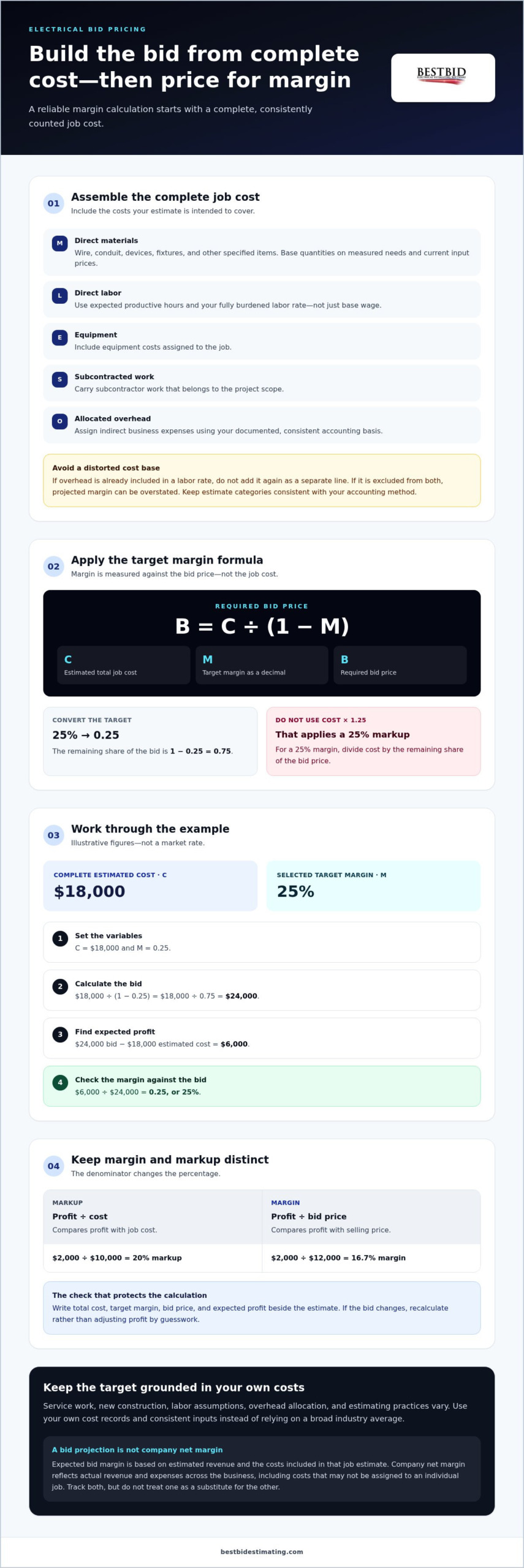
Once your cost categories are consistent, use a formula that keeps the target margin’s denominator clear. Let C equal estimated total job cost, M equal target margin as a decimal, P equal required profit, and B equal bid price. Then:
B = C ÷ (1 − M)
In plain language: Divide total estimated job cost by one minus the target margin to find the bid price. The margin’s denominator is the bid price.
Build a complete job cost before applying the margin
Complete the estimate before using the formula. Calculate direct labor from the productive hours expected for the work and your fully burdened labor rate, not just a base wage. Build material cost from measured quantities and current input prices.
Add equipment and subcontracted costs that belong to the scope, then allocate overhead using one documented, consistent basis. If overhead is already included in another rate, don’t add it again.
Apply the target margin and check the arithmetic
Convert the target percentage to a decimal before calculating. For example, 25% becomes 0.25, so the denominator is 1 − 0.25, or 0.75. A common mistake is to multiply cost by 1.25.
That applies a 25% markup, not a 25% margin. Divide by the remaining share of the bid price instead.
Hypothetical example: Suppose an electrical job’s complete estimated cost is $18,000 and the contractor selects a 25% target margin. These figures are for illustration only, not a market rate.
- Set C to $18,000 and M to 0.25.
- Calculate B as $18,000 ÷ (1 − 0.25), or $18,000 ÷ 0.75. The resulting bid price is $24,000.
- Calculate expected profit, P, by subtracting estimated cost from the bid: $24,000 − $18,000 = $6,000.
- Check the margin: $6,000 ÷ $24,000 = 0.25, or 25%.
The check matters. If you divide profit by cost instead, you get a markup of 33.3%, not the target margin. For how to calculate electrical bid profit margin accurately, keep the denominator tied to the bid price from start to finish.
Write the variables beside the estimate so another reviewer can trace the math: total cost, target margin, bid price, and expected profit. If the bid changes, recalculate instead of adjusting the profit figure by guesswork. The formula can’t fix incomplete quantities or unrealistic labor hours, but it makes your pricing logic easier to audit.
For a more repeatable estimating workflow, explore electrical estimating software with built-in onscreen takeoff and pricing integration.
How to Choose a Defensible Margin Without Relying on Industry Averages
A margin target should fit the work you’re pricing and the cost assumptions behind it. A benchmark can offer context, but it can’t account for your labor productivity, overhead, scope, schedule, or purchasing conditions. To make a defensible choice, compare a low, base, and higher scenario using the same estimating method, then document what changes between them.
Assess the project before choosing a target. Look for drawing conflicts, incomplete scope, access constraints, schedule dependencies, and materials exposed to price changes. Also consider how confident you are in the takeoff and labor hours.
These factors don’t automatically justify a higher margin. They help identify cost uncertainty and make the assumptions that affect your bid visible.
Match the bid target to project uncertainty
Write down what’s known, what remains uncertain, and how each assumption affects cost. For example, a hypothetical job with confirmed drawings and stable access may have fewer cost unknowns than one with unresolved access or procurement questions. Don’t treat a risk allowance as guaranteed profit. Include a justified allowance in the estimated cost, then apply the selected margin to that cost.
The table uses illustrative figures, not industry benchmarks or recommended targets. Each scenario pairs a different documented cost assumption with a contractor-selected margin. The bids show how those inputs change the result.
| Scenario and assumptions | Expected cost | Target margin | Illustrative bid |
|---|---|---|---|
| Low: confirmed scope, access, and schedule | $40,000 | 15% | $47,059 |
| Base: known scope plus a documented $2,000 allowance for identified procurement uncertainty | $42,000 | 20% | $52,500 |
| Higher: known scope plus a documented $5,000 allowance for greater access and schedule uncertainty | $45,000 | 25% | $60,000 |
These are separate scenarios, not a promise that the higher target will cover every risk. Review the assumptions with the estimator or project team, and revise them if new information changes the likely cost. That makes the logic behind how to calculate electrical bid profit margin easier to trace than choosing a percentage because it appears common elsewhere.
Keep contingency, overhead, and profit distinct
Contingency is a cost allowance for identified uncertainty, not a hidden profit amount. Direct job costs come from the project scope; overhead is the allocated share of indirect business expenses. Profit is what remains after those costs are covered. Keep each category separate in the estimate and state how the allowance and overhead allocation were determined.
Before approving a bid, record the scope assumptions, cost basis, contingency rationale, overhead method, and selected target. This gives reviewers a clear path from drawings and quantities to the final price. Benchmark figures can help frame a discussion, but they can’t replace your own cost records or business-specific financial review. A target is defensible when its inputs are clear, consistent, and tied to the actual job.
Protect Electrical Bid Margins from Estimate-to-Job Drift
A bid’s margin can change when field conditions differ from the estimate. The goal isn’t to make every job match the original forecast exactly. It’s to catch gaps before submission, then identify what changed and why when the work is complete.
An estimated margin is a forecast based on stated costs and assumptions, not a guarantee of the profit a completed job will deliver. Treat it as a starting point for review, then compare the estimate with actual project records to improve future bids.
Run a pre-bid margin audit
Before sending the bid, review the estimate against the drawings, scope, and pricing assumptions. A focused audit can catch errors that a margin formula won’t:
- Recheck takeoff quantities against the plans, including counts, lengths, and relevant assemblies.
- Review estimated labor hours and the assumptions behind them. Confirm the hours cover the tasks in the stated scope.
- Record when material prices were checked and note inputs that may change before purchasing.
- Confirm scope inclusions, exclusions, access assumptions, and dependencies are documented with the submitted estimate.
- Verify overhead allocation and contingency treatment, then check the bid arithmetic and confirm margin is calculated against bid price.
Keep the estimate version and its assumptions together. If scope or pricing changes before submission, update the relevant inputs and recalculate instead of relying on an older total.
Reconcile the bid against actual job performance
After closeout, compare estimated and actual labor hours, material quantities and costs, subcontracted work, and allocated overhead. Don’t stop at “over budget.” Sort each variance by its likely cause so you can correct the right part of the estimating process:
- Estimating error: The takeoff missed an item, or an estimate quantity or labor assumption was incorrect.
- Scope change: The work changed after the bid. Record whether the change was documented and billed.
- Productivity variance: Actual hours differed from estimated hours. Review what work or conditions drove the difference.
- Price movement: Material costs changed between pricing and purchase. Compare the estimate’s price basis with the actual purchase cost.
Look for patterns across completed jobs. A recurring labor overrun on a particular type of installation may point to labor units or assemblies that need review. Consistent material variances may call for a closer look at takeoff assumptions or pricing dates. Update those inputs when the job records support a change, rather than adjusting the target margin without evidence.
This review closes the loop on how to calculate electrical bid profit margin: estimate with clear assumptions, then test those assumptions against actual performance. Best Bid electrical estimating software supports a consistent workflow with built-in onscreen takeoff and NetPricer pricing integration.
How Electrical Estimating Software Supports a Repeatable Margin Workflow
A margin calculation is only as dependable as the estimate feeding it. If takeoff quantities live in one place, labor assumptions in another, and material prices in a separate worksheet, reviewers have to piece together how the bid was built. A consistent estimating workflow keeps those inputs organized, making it easier to trace costs, revisit assumptions, and compare the estimate with job results later.
Estimating software helps structure the work, while contractors remain responsible for labor rates, cost assumptions, overhead allocation, scope, and target margin. The tools make inputs easier to organize and review, but they don’t guarantee accurate assumptions, a particular margin, or a winning bid.
Use takeoff and pricing tools to improve estimate traceability
Best Bid software includes built-in onscreen takeoff for counting and measuring directly on screen as part of the estimating workflow. This helps keep quantities connected to the plans being reviewed, rather than relying entirely on separate manual counts and transfers. The estimator still needs to interpret the drawings, verify scope, and check that the takeoff reflects the work being priced.
Best Bid also includes NetPricer real-time pricing integration. Current pricing inputs help the estimator review material costs while preparing an estimate, but they don’t remove the need to confirm quantities, product selections, or project assumptions. A disciplined takeoff and organized cost data make it easier to see what informed the bid, even though field conditions may differ from the estimate.
Make the calculation a repeatable business process
Use the same estimate structure from bid to bid, with clear categories for labor, materials, equipment, subcontracted work, and allocated overhead. Keep assumptions and exclusions with the estimate, and record the target margin and final bid price. That way, another reviewer can follow the calculation without reconstructing it from scattered notes. It also gives you a clear reference when reviewing actual job costs after completion.
A practical workflow can follow a consistent sequence:
- Build the takeoff and organize quantities by scope or cost category.
- Apply documented labor, material, equipment, subcontract, and overhead assumptions.
- Review exclusions and unresolved scope questions before finalizing the estimate.
- Set the target margin, calculate the bid, and check the resulting margin against the bid price.
- Retain the estimate structure so actual labor and material use can be compared with the original assumptions.
This process gives you a reliable framework for how to calculate electrical bid profit margin while keeping the underlying inputs visible. Best Bid’s electrical estimating software helps organize and connect estimating work; your cost records and judgment determine whether the inputs fit the job. Explore Best Bid electrical estimating software to see its takeoff and pricing features.
Make Your Next Bid Easier to Review
Turn the margin calculation into a routine your team can repeat: keep assumptions visible, check them before submission, and use completed job records to refine future estimates. That way, how to calculate electrical bid profit margin becomes more than a formula. It becomes part of how you make informed bidding decisions.
Best Bid brings electrical estimating experience shaped by founder Steve Griffin’s more than 50 years in the trade. Its software includes built-in onscreen takeoff and NetPricer real-time pricing integration to support an organized estimating workflow. Best Bid software is sold as a one-time purchase with lifetime updates and support, with no recurring subscription fees.
Ready to make your estimates easier to build and review? Explore Best Bid’s electrical estimating workflow.
Frequently Asked Questions
Is there one target profit margin that works for every electrical contractor?
No single target fits every contractor or project. A service call, a tenant improvement, and a large new-build job can have different labor patterns, purchasing exposure, and overhead demands. Use your own completed-job records and business expenses to judge whether a target is sustainable. Review targets periodically as your work mix or operating costs change, rather than adopting a percentage simply because it’s common in the industry.
Can an electrical bid show a positive gross margin but still leave the business unprofitable?
Yes. A job can bring in more than its direct project costs while still contributing too little to cover company-wide expenses. For example, a bid may cover its materials and field labor but leave insufficient contribution for office payroll, insurance, estimating time, and other operating costs. Check how gross profit relates to overhead and net results across the business, not just whether one job’s direct-cost calculation is positive.
How should change orders affect an electrical project’s profit margin?
Include authorized changes in the project’s revised revenue and the added costs required to complete them. A change that adds devices, rerouting, or labor can increase revenue, but its margin depends on the price and the extra materials, hours, and subcontract work. Track each change separately, including its approval status and cost impact. Unpriced or undocumented extra work can consume labor without adding corresponding revenue to the job.
What happens to the calculated margin if a job finishes over budget?
The realized margin falls if final costs rise while collected or recognized project revenue stays the same. Recalculate using the job’s actual revenue and final costs, rather than the original estimate. If a project bid for $50,000 finishes with $45,000 in costs, its remaining profit is $5,000, or 10% of revenue. If costs reach $52,000 with no added revenue, the job has a $2,000 loss.
Can I calculate an electrical bid margin when some project costs are still uncertain?
Yes, but treat the result as provisional and make the unknowns visible. For how to calculate electrical bid profit margin with uncertain inputs, estimate a reasonable cost range, note the assumptions behind it, and show how different cost scenarios affect the bid. Separate a documented allowance for a specific risk from expected profit. As drawings, quantities, or supplier pricing become clearer, update the estimate and recalculate.
Do retainage and payment timing change an electrical project’s profit margin?
Not by themselves. Retainage delays access to part of the contract payment, and slow payment can create cash-flow pressure, but neither changes the basic margin calculation if total revenue and project costs remain unchanged. However, costs tied to financing or carrying receivables can affect profitability if your accounting assigns them to the project or business. Track payment timing separately from job margin so cash availability isn’t mistaken for project profit.