How Electrical Estimating Assemblies Changed My Approach | Steve Griffin
Everybody Has A First · Chapter 8
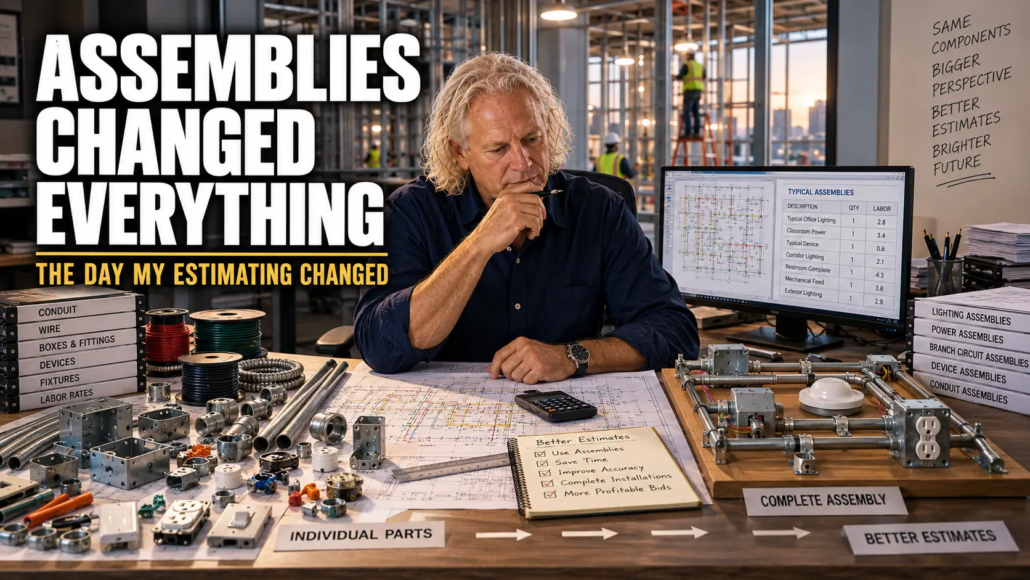
One of the biggest lessons I share in my book, Everybody Has A First is that some of the most important changes in my career started with something that seemed simple at the time. For me, assemblies were one of those turning points. Learning about assemblies was one thing. Learning how to actually use them was another.
When I first discovered assemblies, I thought I had simply found a faster way to put an estimate together. I didn’t realize I was about to change the way I looked at electrical work. Once I started using assemblies in my Electrical Estimating, I had to rethink the way I counted, organized estimates, and visualized a project before the first electrician ever stepped onto the jobsite.
For years, I had estimated from the bottom up. I looked at the drawings and worked through the project piece by piece. Conduit was conduit.
Wire was wire. Boxes were boxes. Fittings were fittings.
I counted what I could see and built the estimate from those individual components.
Assemblies made me step back and think about the installation itself.
From Parts to Complete Installations
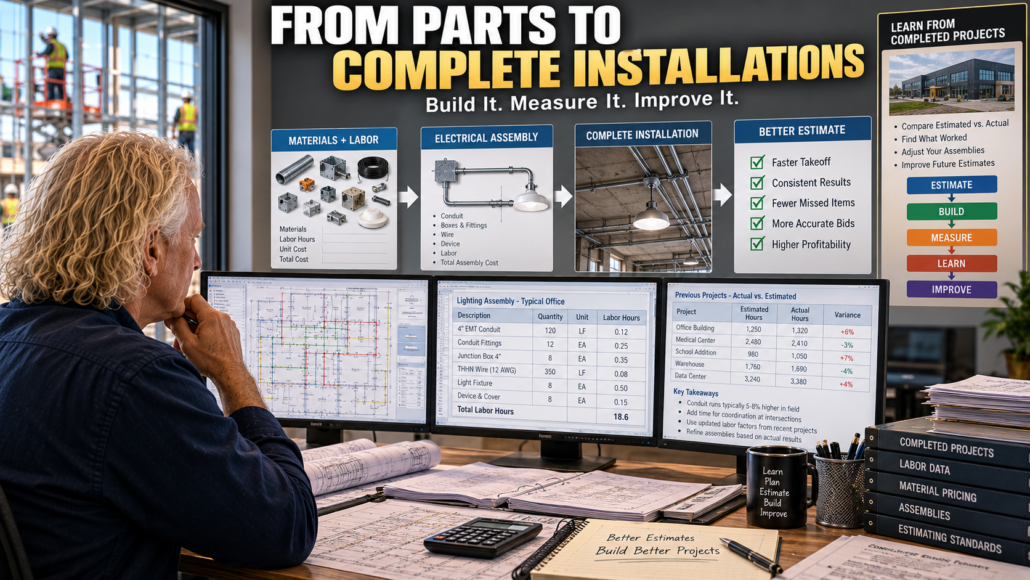
Once I understood the concept, I began creating my own assemblies. I would take a particular electrical installation and think through everything it actually required. What materials were involved?
How much labor would it take? What would an electrician actually have to do to complete the installation?
Then I tested those assemblies against real work.
I didn’t expect my first version to be perfect. If an assembly didn’t produce a realistic labor allowance, I changed it. If the material wasn’t right, I adjusted it. If something happened on the job that I hadn’t considered, I used that experience to improve the assembly.
Every completed project gave me another opportunity to test what I had created. A successful estimate gave me confidence that an assembly was working. A mistake gave me information about what needed to change.
I started realizing that an assembly wasn’t something I created once and forgot about. A good assembly should get better with experience.
Every Project Became Research
This was one of the biggest changes in my approach to Electrical Estimating. I started looking at completed electrical projects as a source of information.
Before that, it was easy to finish a job and move on to the next one. There was always another estimate waiting and another Bid Day coming. But I began asking myself what the last project could teach me.
If I estimated a certain amount of labor and the electricians needed more time, I wanted to know why. Maybe the installation was more difficult than I expected. Maybe access was a problem. Maybe the original labor allowance didn’t account for something I hadn’t considered.
If I consistently estimated too little of something, I wanted to understand why. If I was consistently carrying too much, that was worth knowing as well.
The more I paid attention to those differences, the more useful my estimating process became. I wasn’t simply preparing estimates anymore. I was building knowledge.
Memory Is Useful, But Data Is Better
I’ve relied on my memory for a lot of things throughout my career. After more than 50 years in the electrical industry, experience becomes part of how I look at a project.
But I’ve also learned that memory has limitations. I might remember that a particular installation took about a certain amount of time on an earlier job. But “about” isn’t the same as having actual production information.
Historical data gave me something much better. It gave me evidence.
If I could look back at completed projects and see what I had estimated compared with what actually happened, I could make better decisions on future estimates.
That doesn’t mean I blindly use an old number on a new project. Every electrical project is different. Conditions change, crews change, and installations can have different levels of difficulty.
But historical information gives me a starting point. It gives me something to compare against. It helps me recognize when a number looks unusual. Most importantly, it reduces the amount of guessing I have to do.
The Problem With Not Learning From Your Projects
I’ve seen contractors work on project after project and still make the same estimating mistakes. The information was there. The lessons were there.
The actual production results were there. But nobody captured them or studied them.
That’s a missed opportunity.
If I consistently underestimate a particular installation, I want to know about it. If a certain assembly repeatedly requires more labor than I originally allowed, I want to correct it.
The goal isn’t to prove that my original estimate was right. The goal is to make the next estimate better.
Assemblies Became More Than an Estimating Tool
As I continued working with assemblies, I realized the idea went beyond Electrical Estimating. It affected the way I thought about management, operations, training, and eventually software development.
I started seeing more of the business as a collection of processes that could be measured, reviewed, and improved.
The question became simple: How can I do this better the next time?
The Goal Isn’t Just to Estimate Faster
Speed is valuable in Electrical Estimating, especially when Bid Day is approaching. Nobody wants to spend unnecessary hours doing repetitive work.
But I don’t believe speed should be the only goal. The real goal is to estimate better.
A faster estimate isn’t necessarily a better estimate if important information has been missed.
That’s why I believe an estimator needs to balance efficiency with accuracy and practical judgment.
How Assemblies Influenced Best Bid
Years later, when I was developing Best Bid Electrical Estimating Software, those early lessons were still influencing my thinking.
I wanted the software to reflect the way an experienced estimator thinks about a project.
An Electrical Estimator needs to deal with quantities, labor, materials, assemblies, pricing, and reports. Those things need to work together rather than exist as disconnected pieces.
That’s why I’ve always viewed estimating software as a tool for the estimator rather than a replacement for the estimator.
The software can help organize information. It can reduce repetitive work. It can improve consistency. But the experience still has to come from the person preparing the estimate.
What Assemblies Taught Me
The biggest lesson assemblies taught me wasn’t actually about assemblies. It was about continuous improvement.
I learned that I don’t have to create a perfect system on the first attempt. I need to create something useful, use it, see what happens, and improve it.
That same philosophy works whether I’m building an assembly, reviewing an Electrical Estimating Report, training an estimator, or developing software.
Do the work. Measure the result. Learn from it.
Improve the process. Then do it again.
My Best Bid Rules
Build systems that can improve. Don’t create an estimating process that depends entirely on memory.
Track your results. Your completed projects contain information that can make future bids better.
Study historical data. Actual results are more useful than assumptions alone.
Learn from mistakes. A mistake becomes valuable when it changes what you do next time.
Don’t confuse speed with quality. The objective isn’t simply to finish the estimate faster. It’s to produce a better estimate efficiently.
Keep improving. Even a good estimating system can become better with better information.
For contractors and estimators who want to strengthen their fundamentals, I also believe education has an important place in the process. The Electrical Estimating Online School provides another resource for developing practical estimating knowledge and applying it to real work.
Frequently Asked Questions
What is an assembly in Electrical Estimating?
I use an assembly to represent a complete electrical installation by combining the materials and labor associated with that installation.
Why are assemblies useful to an Electrical Estimator?
Assemblies help me improve consistency and reduce repetitive estimating work while keeping the focus on how an installation will actually be performed.
How can historical data improve electrical estimates?
I can compare previous estimates with actual project results and use those lessons when preparing future bids.
Should I use old assembly information on every new project?
No. I use historical information as a starting point, not as an automatic answer. Every project has different conditions.
How can an Electrical Contractor learn from completed projects?
I recommend reviewing what was estimated against what actually happened. Labor, material usage, production, and unexpected conditions can all provide useful information.
Can Estimating Software help manage assemblies?
Yes. Estimating Software can help organize, reuse, and maintain assemblies along with their associated labor and material information.
What is the biggest lesson I learned from using assemblies?
For me, the biggest lesson is that Electrical Estimating should be a continuous improvement process. Every project gives me information that can help make the next estimate better.
My Final Reflection
When I first learned about assemblies, I thought I had discovered a better way to estimate. What I really discovered was a better way to learn.
Assemblies made me stop looking only at individual pieces and start thinking about complete installations. They encouraged me to capture information from completed projects instead of allowing those lessons to disappear. They showed me that historical data could strengthen experience and that mistakes could become useful feedback.
Those lessons eventually influenced much more than the way I prepared an estimate. They influenced how I thought about systems, management, training, operations, and software development.
After more than 50 years in the electrical industry, I still believe the best estimators are students of their own work. Don’t just finish a project and move on. Look at what happened.
Ask why it happened. Capture the lesson and use it.
The goal isn’t simply to estimate faster.
The goal is to estimate better.
That’s what assemblies taught me, and it’s a lesson I still use today.
If you’d like to discuss your Electrical Estimating process or learn how Best Bid can help you organize your estimating work, please call me at 800-941-7028. I’m always interested in hearing from electrical contractors, estimators, and project managers about the practical challenges they face when preparing bids.
You can also learn more about Steve Griffin and my experience in the electrical estimating industry.
About Steve Griffin
Steve Griffin
Founder of Best Bid Electrical Estimating Software
Electrician • Estimator • Contractor • Author • Software Developer
From digging ditches in 1973 to creating one of the industry’s longest-running electrical estimating software systems, Steve Griffin has spent more than 50 years helping contractors win more work and make more money.