Labor Units in Electrical Estimating | Steve Griffin
Labor Units in Electrical Estimating: The Most Critical Number in Your Bid
Labor units make or break an electrical bid. Steve Griffin explains how to select, calibrate, and trust labor units that protect your profit on every project.
Section 11: The Future of Electrical Estimating Software
Electrical estimating software is evolving faster than ever. The industry is changing, technology is changing, labor is changing, and expectations are changing. Contractors want more speed, more accuracy, more automation, more clarity, and more reliability — but they do not want more complexity.
They do not want more confusion. They do not want more training. They do not want more frustration.
The future of estimating software is not about adding more features. It is not about adding more buttons. It is not about adding more settings.
It is not about adding more complexity. The future is about refinement, clarity, automation, and balance.
The future belongs to software that understands the estimator’s workflow. Software that anticipates decisions. Software that reduces thinking.
Software that eliminates unnecessary steps. Software that guides without restricting. Software that simplifies without weakening.
Software that empowers without overwhelming.
The future belongs to software that feels natural — not software that feels technical.
The next generation of estimating software will focus on predictive intelligence. Not artificial intelligence in the marketing sense — but real intelligence built from real patterns. Software that recognizes common installations.
Software that understands typical labor. Software that knows typical quantities. Software that knows typical assemblies.
Software that knows typical field conditions.
Software that can say:
- “This is the most likely assembly.”
- “This is the most likely quantity.”
- “This is the most likely labor.”
- “This is the most likely material.”
- “This is the most likely workflow.”
And then allow the estimator to override it when needed.
The future belongs to software that makes smart decisions automatically — not software that forces the estimator to make every decision manually.
Another major shift in the future is workflow clarity. Estimators want software that is easy to navigate. Easy to understand.
Easy to learn. Easy to trust. They want software that feels like a tool — not a task.
They want software that feels like part of the job — not an obstacle to the job.
The future belongs to software that removes friction.
Friction is the enemy of productivity. Friction slows down estimates. Friction creates confusion.
Friction creates mistakes. Friction creates frustration. Friction creates inefficiency.
The future belongs to software that eliminates friction.
Another major shift is automation of repetitive tasks. Estimators spend too much time doing things that software should do automatically. Counting fixtures.
Assigning boxes. Assigning covers. Assigning connectors.
Assigning staples. Assigning straps. Assigning supports.
Assigning small materials.
The future belongs to software that handles these tasks automatically — without requiring the estimator to think about them.
Automation is not about replacing the estimator. Automation is about freeing the estimator. Automation is about reducing thinking.
Automation is about reducing decisions. Automation is about reducing mistakes. Automation is about reducing time.
The future belongs to software that automates the right things — not everything.
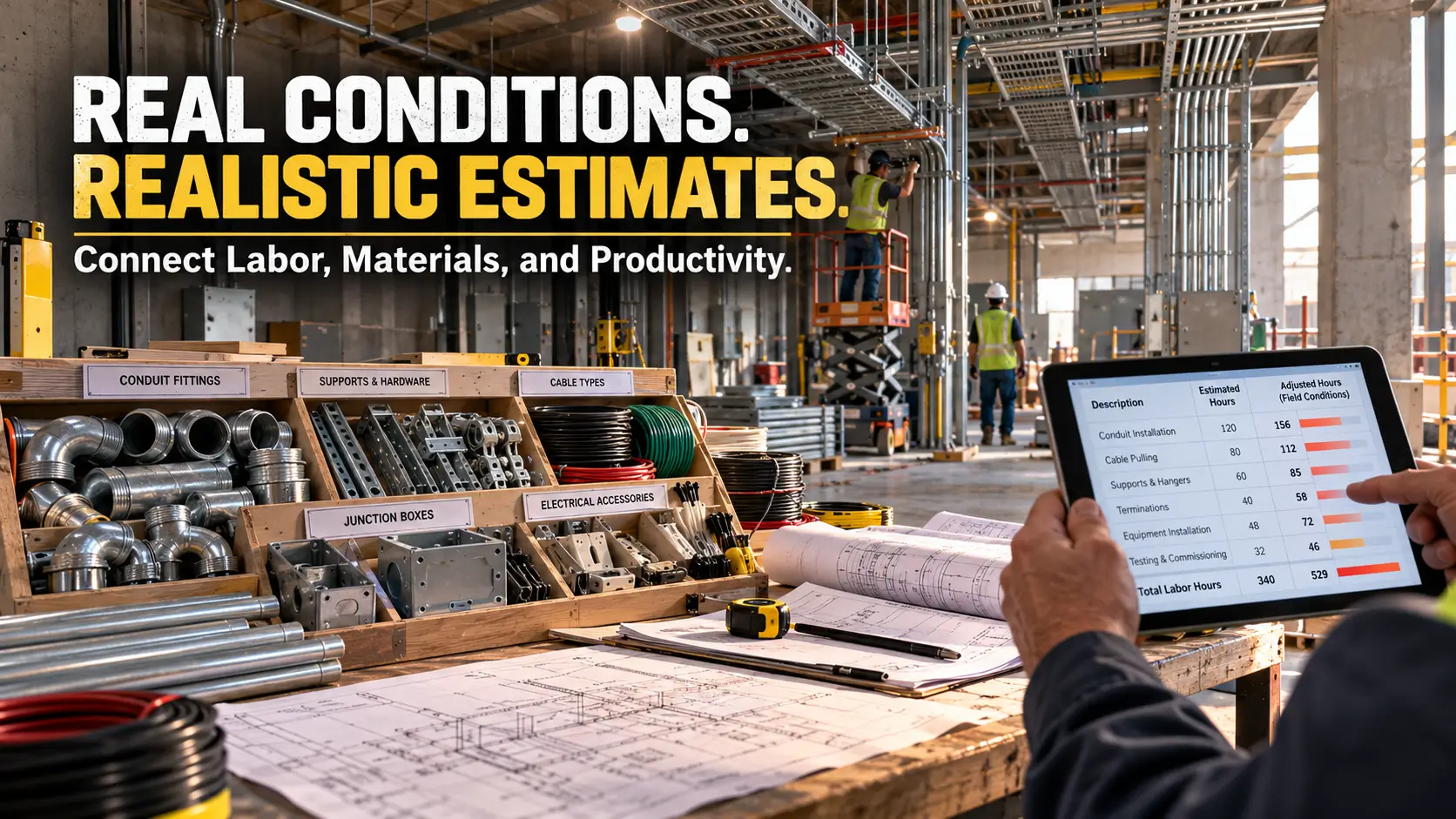
Another major shift is labor intelligence. Labor is the most expensive part of most electrical projects. Labor is the most variable part of most electrical projects. Labor is the most unpredictable part of most electrical projects.
The future belongs to software that understands labor deeply. Software that understands productivity. Software that understands conditions.
Software that understands limitations. Software that understands efficiency. Software that understands reality.
Software that can say:
- “This installation typically takes this long.”
- “This condition typically reduces productivity.”
- “This environment typically increases labor.”
- “This method typically saves time.”
The future belongs to software that reflects real labor — not ideal labor.
Another major shift is material intelligence. Materials fluctuate. Materials vary.
Materials change. Materials have lead times. Materials have availability issues.
Materials have substitutions. Materials have alternatives.
The future belongs to software that understands materials. Software that understands cost. Software that understands availability.
Software that understands risk. Software that understands opportunity.
Software that can say:
- “This material is typically used.”
- “This alternative is common.”
- “This substitution is acceptable.”
- “This option saves money.”
The future belongs to software that reflects real materials — not theoretical materials.
Another major shift is field awareness. The field is where the estimate becomes reality. The field is where labor meets materials.
The field is where drawings meet installation. The field is where assumptions become consequences.
The future belongs to software that understands the field. Software that understands conditions. Software that understands limitations.
Software that understands workflow. Software that understands challenges.
Software that can say:
- “This installation is typically done this way.”
- “This condition typically requires extra labor.”
- “This environment typically slows productivity.”
- “This method typically improves efficiency.”
The future belongs to software that reflects field reality — not office theory.
Another major shift is profit protection. Contractors estimate to win jobs — but they also estimate to make money. Profit is the goal.
Profit is the purpose. Profit is the reason contractors estimate.
The future belongs to software that protects profit. Software that understands margins. Software that understands risk.
Software that understands opportunity. Software that understands strategy.
Software that can say:
- “This decision increases profit.”
- “This decision reduces profit.”
- “This assumption is risky.”
- “This shortcut is safe.”
The future belongs to software that supports profit — not software that threatens it.
Another major shift is simplicity. Simplicity is powerful. Simplicity is efficient.
Simplicity is profitable. Simplicity is competitive.
The future belongs to software that simplifies — not software that complicates.
Simplicity is not weakness. Simplicity is strength.
Simplicity is clarity. Simplicity is efficiency. Simplicity is productivity. Simplicity is profitability.
The future belongs to software that is simple — but powerful.
Another major shift is balance. Balance is the foundation. Balance is the anchor.
Balance is the compass. Balance is the guide. Balance is the philosophy.
The future belongs to software that is balanced.
Balanced between speed and accuracy. Balanced between detail and simplicity. Balanced between freedom and structure.
Balanced between automation and control. Balanced between power and usability. Balanced between capability and cost.
Balance is everything.
The future of electrical estimating software is not about doing more — it is about doing better. It is about doing smarter. It is about doing faster.
It is about doing clearer. It is about doing simpler. It is about doing more accurately.
The future belongs to software that understands the estimator — and supports them.
Key Principle
The principle in this section is one of 30 that together form a complete philosophy of electrical estimating — built from 50 years of real-world experience bidding and winning electrical work. Every principle connects to every other. Master them together.
Frequently Asked Questions
Questions electrical contractors ask about electrical estimating labor units.
📚 Complete Series Navigation