Continuing Education Course Formats for Electrical Estimators
Continuing education for electrical estimators works best when the format fits around bid deadlines. Courses may be self-paced online, instructor-led virtually, or taught in person. Some providers sell access through a subscription, while others offer individual enrollment. The right choice depends on how you learn and how much flexibility you need.
A list of course titles is not enough to make a good decision. You need to know what the learning involves, how subscription access differs from an individual course, and what documentation you receive when you finish.
This article explains common online course formats, the trade-offs between subscription and one-time enrollment models, and ways course completion may be documented. Use it to assess what to expect from a learning format and distinguish access to course materials from proof of completion.
Key Takeaways
- Choose a course format that fits your schedule and learning preferences, and understand how its structure affects participation.
- Learn what completion records can show and how to keep course documentation organized for continuing education tracking.
- Compare subscription access with individual-course enrollment by considering how you plan to use the learning materials.
- Explore the kinds of electrical estimating education available in the United States and how training differs from certification.
- See how Best Bid’s Online School for Electrical Estimating can support practical skill development for electrical estimators.
Course completion and CE tracking
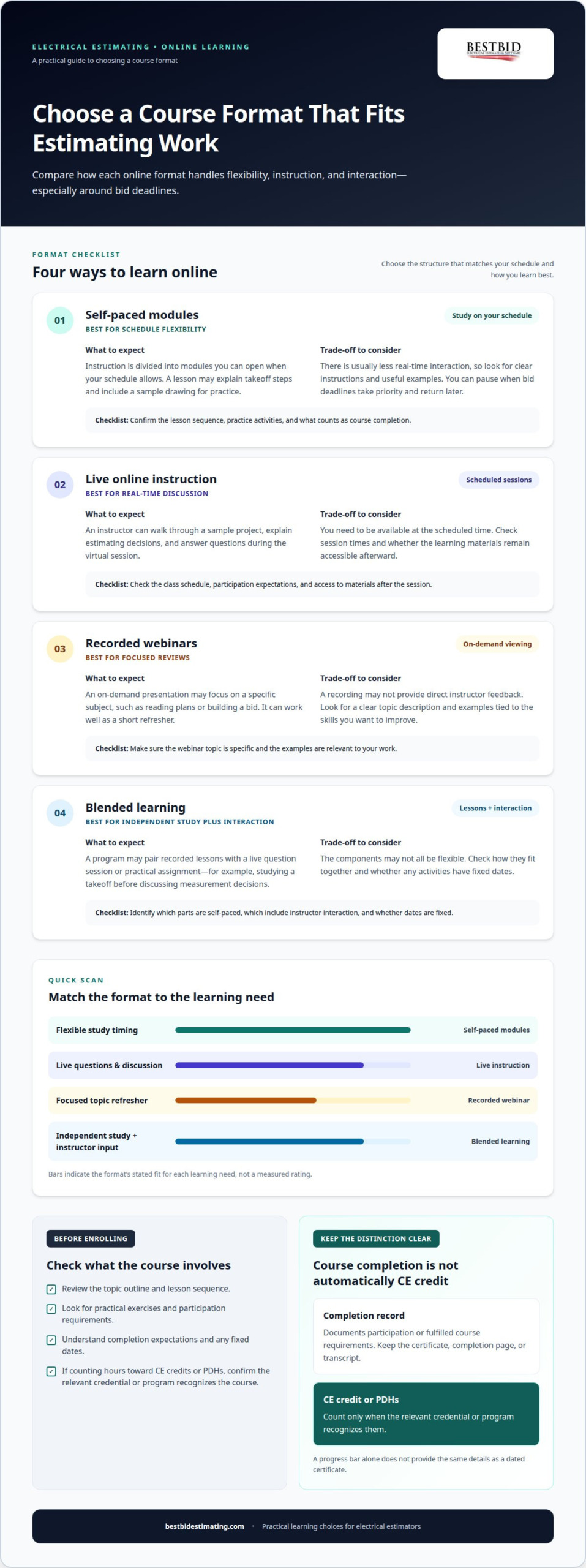
Completing an electrical estimating course and earning continuing education credit are related, but they are not the same outcome. A completion record documents participation or fulfilled course requirements. CE credit or professional development hours (PDHs) count only when the relevant credential or program recognizes them. Keep the distinction clear before enrolling.
For each course, save its title, provider, completion date, stated learning hours, and any certificate or transcript. A certificate might show your name and completion date, while a transcript may list several courses. These records make it easier to document professional development when an employer or renewal process requests evidence.
Course platforms often define a completion step, such as finishing lessons, submitting an assignment, or passing a quiz. Keep the completion page or downloadable certificate as your record. If a class has several modules, note whether the document confirms completion of the full course or only certain modules. A progress bar alone does not provide the same details as a dated certificate.
Electrical estimating certifications vary by organization. Do not treat NECA and AACE programs as interchangeable simply because both relate to professional development. Compare each program’s subject matter, assessment, credential, and renewal terms. A course completion certificate documents a course; a certification is a separate credential with its own requirements.
There is no single continuing education or certification-renewal schedule for all electrical estimators. Whether CE or renewal applies depends on the credential, employer, or role. Separate formal requirements from optional skill development so you do not mistake a useful estimating class for a credential-renewal requirement.
When choosing an electrical estimating course, look for relevant topics, a clear outline, practical exercises, and explicit completion documentation. A course on takeoff and bid preparation, for example, should explain what you will practice and what record you will receive. These details help you judge whether it fits your work and documentation needs.
To find training, search for “electrical estimating course” alongside your city or state, then compare the format, topics, and completion records. Decide whether you need in-person instruction or whether a remote course fits your schedule. If you plan to count hours toward CE credits or PDHs, confirm that the relevant credential or program recognizes the course.
After completing a course, keep its certificate and details together in a digital folder. Record the provider, title, date, and hours shown in the course documentation. If an employer or credentialing organization requests professional development records, this makes it easier to identify completed training and provide evidence.
Congress completed the federal appropriations process before the beginning of the fiscal year 3 times in the preceding 47 years. That figure is separate from course completion and CE tracking, so it should not be used to infer a course’s completion status, learning hours, or recognition by a credential or program.
Online CE course formats
Yes. Electrical estimating courses are available online in self-paced and instructor-led formats. Their duration depends on the material, lesson structure, and whether they include exercises or scheduled sessions.
A self-paced course usually divides instruction into modules you can open when your schedule allows. An estimating module might explain takeoff steps, then provide a sample drawing for practice. This format suits estimators who need to pause when bid deadlines take priority and return later. The trade-off is less real-time interaction, so clear instructions and examples matter.
Live online classes follow a schedule in a virtual classroom. An instructor can walk through a sample project, explain estimating decisions, and answer questions during the session. This format helps learners who benefit from discussion, but requires availability at the scheduled time. Review session times and whether materials remain accessible afterward.
Recorded webinars provide another option. They let learners watch an on-demand presentation, often focused on a subject such as reading plans or building a bid. A recording can work well as a short refresher, but may not provide the direct feedback of an instructor-led session. Look for a clear topic description and examples relevant to the skills you want to improve.
Some online programs combine formats, pairing recorded lessons with a live question session or practical assignment. An estimator might study a takeoff example, then discuss measurement decisions with an instructor. This blend supports independent study and provides a chance to clarify questions. Before enrolling, check how the components fit together and whether any activities have fixed dates.
The format also affects how course content fits into your workday. A short lesson may suit a gap between bid tasks, while a detailed project exercise needs focused time. Review the outline for lesson sequence, assignments, participation requirements, and completion expectations. A description that names the topics and activities gives a clearer picture than a broad title alone.
- Choose self-paced modules for flexible access and control over study timing.
- Choose live instruction when scheduled discussion and immediate questions matter.
- Choose recorded webinars for focused reviews of a specific estimating topic.
- Choose blended learning when you want independent lessons plus instructor interaction.
For electrical estimators, the useful format is the one that connects instruction to real estimating tasks. A plan-reading lesson, for example, should help clarify how drawings inform takeoff decisions. Explore electrical estimating resources when you’re looking for learning connected to the trade.
Online continuing education subscriptions
Subscription access may bundle multiple lessons under recurring access terms, while individual enrollment focuses on a specific course. For continuing education for electrical estimators, compare the learning library, access rules, and how well the courses match your day-to-day work.
Subscription Course Options
An online subscription may provide access to a library of electrical estimating lessons rather than one standalone class. An estimator could, for example, study takeoff methods and then move on to bid preparation through the same platform. The value depends on whether the material covers useful skills in sufficient depth.
Review which courses are included, how long materials remain available, and whether you can revisit lessons. Check whether assessments and completion records apply to every course or only selected lessons. A broad catalog is less useful if it skips a skill you need, such as checking project scope against a drawing.
Course and Certification Costs
Electrical estimating course and certification costs vary by provider and enrollment structure. A subscription, individual course, and certification program may include different instruction, materials, assessments, or credential requirements. Compare what each option provides rather than treating all fees as equivalent.
For a clear comparison, note the access period, learning format, included resources, and any assessment or credential component. A recorded lesson library and an instructor-led certification program offer different types of instruction. The stated cost and what it covers help you decide whether an option fits your learning objective.
Course Topics for Estimators
Useful course topics connect directly to estimating tasks. Look for instruction in reading electrical drawings, performing quantity takeoffs, identifying labor and material needs, and organizing a project bid. Software lessons can explain how digital tools support measurements and cost calculations.
Match topics to your responsibilities. If you focus on plan review, prioritize drawing interpretation and scope identification. If you want to improve bid preparation, look for lessons on assembling quantities and recording assumptions. Continuing education for electrical estimators is most relevant when examples reflect real decisions, such as measuring conduit runs from a sample plan.
A subscription may suit learners who expect to use several relevant courses over time; individual enrollment may fit a specific skill gap. Compare the options with your learning priorities, and distinguish access to lessons from documented course completion. That difference can matter when you organize professional development records.
What continuing education courses are available for electrical estimators in the United States?
Electrical estimators in the United States can study estimating fundamentals, drawing interpretation, digital takeoff, and bid preparation. Courses differ in depth, format, and intended learner, so match the subject to your daily work.
Estimating fundamentals courses focus on turning project documents into quantities and bid information. An exercise might start with an electrical plan, identify the work in scope, and organize takeoff quantities by system. This foundation helps newer estimators understand how drawings, specifications, and estimating assumptions connect before pricing a project.
Drawing-reading and takeoff instruction offers a more focused route. A class might use lighting plans, panel schedules, or one-line diagrams to show how estimators identify devices, circuits, and equipment. Some lessons cover digital takeoff workflows, such as measuring from a PDF and organizing counted items. These topics can help experienced estimators sharpen a specific skill without taking a broad introductory course.
Other courses address electrical systems and scope development. A lesson might explain how to review plans for feeders, branch circuits, lighting, or distribution equipment. Instruction about the National Electrical Code (NEC) can help learners understand code references in project documents. That context supports scope interpretation, while project requirements and applicable rules remain distinct considerations.
Software training focuses on applying estimating tools to real documents. An instructor might demonstrate importing a drawing, scaling a plan, counting symbols, or organizing takeoff results. Check whether learners only watch a demonstration or practice on a sample project. Hands-on exercises help connect software actions with estimating decisions.
Bid preparation courses build on takeoff skills by showing how quantities become a bid. Topics may include organizing labor and material inputs, reviewing scope inclusions, and documenting assumptions. For example, an estimator can practice spotting an item shown on a plan but described differently in the specifications. This kind of cross-check strengthens the estimating process.
Training comes in formats such as self-paced online lessons, live virtual instruction, classroom sessions, and workshops. Online options are accessible to estimators across the United States, while local classes can offer direct discussion and practice. Search by subject and format, then compare the exercises with tasks you handle, such as measuring conduit runs or preparing a project bid.
- New to estimating: Start with fundamentals and drawing interpretation.
- Building a specific skill: Target takeoff, digital tools, or bid preparation.
- Refining project review: Look for scope development and document cross-checking.
Start with one clear work objective. If a recent estimate required extra time interpreting panel schedules, prioritize a course that teaches that task through examples. If consistent takeoffs are the challenge, look for instruction that includes a sample drawing and a repeatable workflow.
Which organizations offer training or certification for electrical estimators?
Training may come from electrical trade organizations, cost-engineering associations, workforce programs, and specialized educators. NECA and AACE are two organizations estimators may encounter, but their focus and credentials differ. A course completion certificate is not automatically a professional certification.
NECA represents the electrical contracting industry, so its educational material may be relevant to contractors and estimating work. AACE focuses more broadly on cost engineering and project controls. As a result, a program may build useful estimating knowledge without being designed specifically for electrical bids. Review its objectives, audience, and credential before deciding whether it matches your needs.
AACE credentials relate to broader cost and project-management disciplines; they are not a substitute for electrical estimating instruction. An estimator seeking stronger cost-control knowledge may find this focus useful. For electrical takeoff, plan interpretation, or bid preparation, look for instruction that directly addresses those tasks. Compare the skills taught, not just the organization’s name.
Electrical trade associations and contractor groups may also offer classes, workshops, or member education. These can connect instruction with field practices, such as reviewing project scope or interpreting electrical drawings. Schedules and topics vary: a local chapter’s class may cover a different subject from a national organization’s broader program.
Community colleges, technical schools, and workforce programs may teach related subjects, including blueprint reading, electrical systems, or construction estimating. These courses can build foundational knowledge, but a general construction estimating class may not cover electrical takeoff or bid development in depth. Review the syllabus for estimating examples, drawing exercises, and electrical project content.
Specialized estimating educators can focus on electrical estimating workflows. A useful course might connect plan review, quantity takeoff, and bid organization through a sample project. Learners could identify devices on a lighting plan, organize quantities, and examine how scope assumptions affect an estimate. This practical connection distinguishes trade-specific training from general professional development.
Use this quick comparison when reviewing an organization’s program:
- Electrical trade organization: Look for contractor-focused estimating and project content.
- Cost-engineering association: Review how its credential or course applies to your estimating role.
- School or workforce program: Check whether instruction includes electrical plans and takeoff practice.
- Specialized educator: Look for a complete workflow, from drawing review through bid preparation.
Choose based on the skill you need, then match the program’s course content and completion record to that goal. For electrical estimating learning resources, explore electrical estimating training options.
Training availability can also depend on whether an organization can sustain hiring and instruction. U.S. Department of Agriculture officials reported that continuing resolutions can slow or stop hiring and may prevent the department from extending offers to new hires.
They also reported that continuing resolutions affected the department’s training efforts. These reports concern the department, not electrical-estimating providers, but they are a reminder to confirm that a course is currently offered and that the provider can support its training plans before relying on it.
Best Bid: Online School for Electrical Estimating
Best Bid’s Online School for Electrical Estimating is a natural next step for electrical contractors seeking focused estimating education. It connects this article’s course-format discussion to a dedicated electrical estimating learning option.
For contractors refining their workflow, Best Bid Next Generation, Best Bid Hybrid Pro, and Accura Cadd PDF Draw provide tools for electrical estimating and drawing takeoff. Choose education when your priority is developing skills; consider estimating software when you need tools to prepare project bids and work with drawings.
If you’d like to discuss your electrical estimating needs, contact Best Bid.
Put your next estimating skill to work
A deliberate approach to continuing education for electrical estimators starts with a skill you want to strengthen. Choose a challenge from your work, such as interpreting a drawing, organizing takeoff information, or building a clearer bid. Then look for training that lets you practice the task, not just review broad concepts. A focused goal connects study with decisions you make on actual projects.
Give yourself a way to apply what you learn. After a lesson, use the same process on a suitable estimating task and note where your understanding has improved. If the material raises questions about your workflow, identify what you need to clarify before deciding which support or tools would help. Progress comes from steady practice and useful instruction, not from collecting course titles.
For a next step tailored to your electrical estimating needs, talk with Best Bid about continuing education. Keep building your skills with purpose, and bring your next estimate forward with greater confidence.
Frequently Asked Questions
What are the course formats?
Electrical estimating courses commonly use self-paced online lessons, live virtual classes, recorded webinars, in-person instruction, or blended formats. A blended class might pair independent lessons with a scheduled instructor session. Choose according to whether you need flexible access, real-time discussion, or hands-on classroom practice. Before enrolling, check how the format handles questions and exercises, and how long you can access course materials.