I Was Too Dumb to Quit, Persistence Beats Talent in Estimating
Discover why persistence—not natural talent—is the key to becoming a successful electrical estimator. Lessons from Steve Griffin’s 50+ years.
This author has not written his bio yet.
But we are proud to say that Steve Griffin contributed 423 entries already.
Discover why persistence—not natural talent—is the key to becoming a successful electrical estimator. Lessons from Steve Griffin’s 50+ years.
Home › Blog › Why Complexity Kills Electrical Estimating Software — And What Usabili Estimating Philosophy · Series Part 3 of 30 Why Complexity Kills Electrical Estimating Software — And What Usability Really Means The most complex software is not the most powerful. Steve Griffin explains why usability beats features every time Read more about Electrical Estimating Software: How to Balance Cost vs. Capability
How much of your hard-earned profit is currently being swallowed by monthly subscription fees for software features you never even touch? For many…
Did you know that coordination errors and documentation gaps can eat up to 15% of your total construction costs? For an electrical contractor, that…
Why are you still paying monthly rent on the very tools you use to build your business? For many contractors, the "SaaS tax" has become an…
Why are you still paying a “monthly tax” to software companies just for the privilege of bidding on the projects you work 60 hours a week to win?…
Why are you still paying a monthly “tax” just to bid on jobs while your competitors are turning around quotes in half the time? With the 2026 NEC…

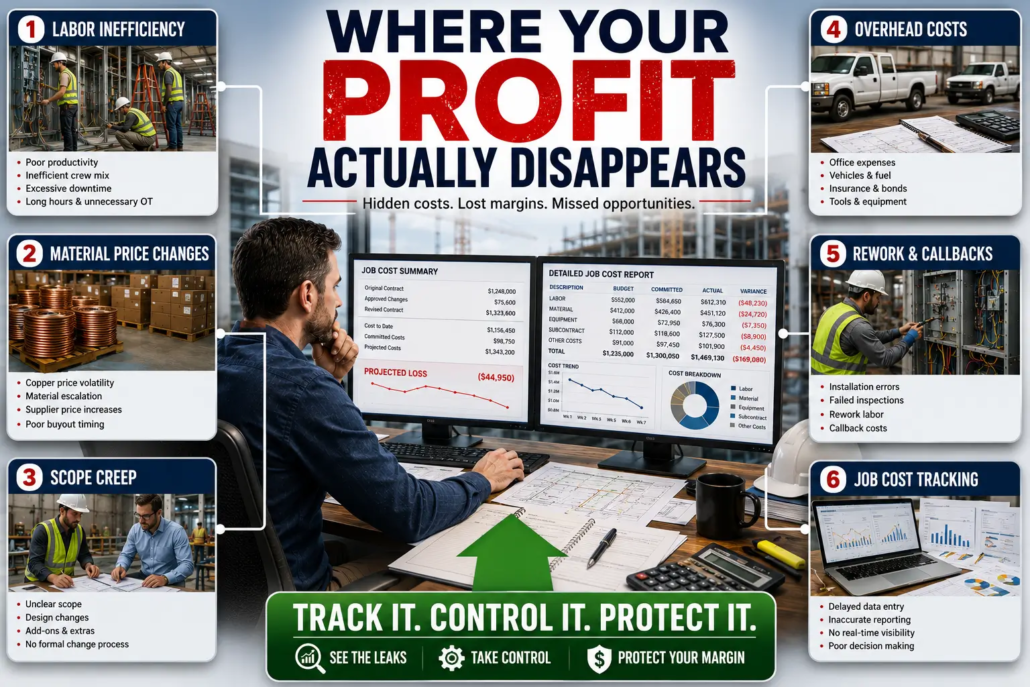
Accurate electrical estimates don’t guarantee profit. Labor inefficiencies, scope creep, material price swings, and untracked overhead can silently erode your margins—even when your numbers were right from the start. Here’s what I’ve learned after 50+ years in the trade about protecting what you earn.
I’ve seen it happen more times than I can count. A contractor puts together a solid estimate, wins the job, does the work—and still ends up in the hole. Not because the estimate was wrong. Because what happened on the job had nothing to do with what was on paper.
After more than five decades in this industry, I, Steve Griffin, starting as an electrician in 1973 and eventually building Best Bid Electrical Estimating Software—I’ve watched contractors make this mistake over and over. It’s one of the core themes I tackle in my book, Everybody Has A First. Estimating is a skill. But running a profitable job? That’s a different skill entirely.
Your estimate assumed a specific crew at a specific pace. What actually showed up? Maybe the wrong crew.
Maybe guys pulling overtime because the schedule slipped. Maybe temporary labor brought in at the last minute who didn’t know the job and slowed everyone else down.
Labor inefficiency is the number one reason I see tight estimates fall apart. One crew finishing another crew’s work—touching panels that were already half-wired, pulling wire through conduit someone else stubbed out wrong—eats time fast. Time you didn’t price for.
Track actual labor hours against your estimate on every single job. Not at the end. Weekly. That’s the only way to catch a problem before it becomes a loss.
You priced copper at one number. By the time the material hit the job, prices had moved. It happens constantly, especially in volatile markets. If you’re not monitoring material costs and adjusting your purchasing strategy accordingly, you’re gambling on every bid.
Build material escalation clauses into your contracts where you can. On longer jobs, this isn’t optional—it’s survival.
The owner asks for one extra circuit. Then another. The GC asks you to relocate a panel “real quick.” None of it gets documented.
None of it gets billed. And at the end of the job, you’ve given away hours of labor and hundreds in material with nothing to show for it.
Every change order—no matter how small—must be documented in writing and priced accordingly. This is non-negotiable. A verbal agreement on a jobsite is worth nothing when it’s time to invoice.
Trucks. Insurance. Office staff.
Software. If those costs aren’t factored into every job you bid, you’re subsidizing your customers’ projects with your own money. A lot of contractors I’ve worked with over the years were making money on paper and losing it in reality—because overhead was sitting in a general bucket instead of being allocated job by job.
One callback can wipe out the profit on an entire job. Poor supervision, rushing to finish, miscommunication between crews—these are the things that cause rework. And rework is pure cost with zero revenue attached to it.

The fix isn’t a better estimate. The estimate was already right. The fix is in how you run the job.
This is the discipline that separates contractors who grow from contractors who stay stuck.
The Estimate Gets You In the Door—Execution Pays the Bills
I wrote about this in Everybody Has A First—the idea that getting started is only half the battle. You can win a job with a great estimate and still lose everything if you don’t manage what comes next.
Profitable contracting is a loop: estimate accurately, execute efficiently, measure honestly, and adjust constantly. Break that loop anywhere, and the money leaks out.
If you’re ready to tighten up your estimating side of that loop, Best Bid Electrical Estimating Software was built for exactly that.
Accurate estimates lose money when real-world variables—labor inefficiencies, scope creep, material price changes, or unallocated overhead—aren’t managed during job execution. Estimating and job management are two separate disciplines.
Scope creep refers to additional work added to a job without formal documentation or additional billing. Even small undocumented changes accumulate into significant uncompensated labor and material costs.
A contingency of 5 to 10% is a common starting range, depending on job complexity, site conditions, and how well the scope is defined at the time of bidding.
Compare estimated labor hours against actual hours on a weekly basis during the job—not just at project completion. This allows you to identify and correct inefficiencies before they compound.
Best Bid is an electrical estimating software platform founded by Steve Griffin, designed to help electrical contractors build faster, more accurate estimates and improve overall job profitability.
Ready to estimate with confidence instead of compromise? Call 800-941-7028 today to schedule a live walkthrough and discover why Best Bid has helped electrical contractors build profitable estimates for over 50 years.
— POST 5 — There Is No Magic Pill in Electrical Estimating — Stop Looking for One I hear it constantly. A contractor calls Best Bid and the first question out of their mouth is some version of: “Does your software just do the estimate for me?” Not help them estimate. Do it for them.Completely. Read more about There Is No Magic Pill in Electrical Estimating — Stop Looking for One
Winning a bid shouldn’t feel like a gamble where the prize is a project that actually loses you money. If you’ve spent years in the trenches, you…