Advanced Electrical Estimating Techniques: The 2026 Contractor’s Guide

Why are you still paying a “monthly tax” to software companies just for the privilege of bidding on the projects you work 60 hours a week to win? It’s a common frustration for contractors who feel trapped by rising subscription costs and the constant pressure of shrinking margins. When you’re facing a massive industrial bid or accounting for the latest NEC 2026 updates, the fear of missing a single labor variable is real. You need advanced electrical estimating techniques that don’t just count parts, but actually protect your bottom line.
We understand that your time is better spent on the job site or growing your business than fighting with clunky, expensive tools. In this guide, you’ll learn how to implement high-level strategies and software workflows used by the industry’s top-tier estimators. We’ll show you how to achieve faster takeoff speeds and bulletproof labor factoring while moving toward total ownership of your estimating system. It’s time to eliminate the errors, cut the monthly overhead, and start winning the high-value commercial contracts your expertise deserves.
Key Takeaways
- Shift your focus from simple part counting to strategic risk management to transform from a basic takeoff person into a high-level estimator.
- Master advanced electrical estimating techniques using single-assembly workflows and integrated OST to drastically reduce clicks and eliminate data errors.
- Protect your profit margins by learning how to adjust “book labor” for real-world variables like site difficulty, height, and confined spaces.
- Prioritize estimating education grounded in decades of field experience rather than just basic software tutorials to ensure a real return on your training investment.
- Adopt a permanent ownership model for your software to eliminate monthly subscription fatigue and keep more of your project profits.
What Defines Advanced Electrical Estimating in 2026?
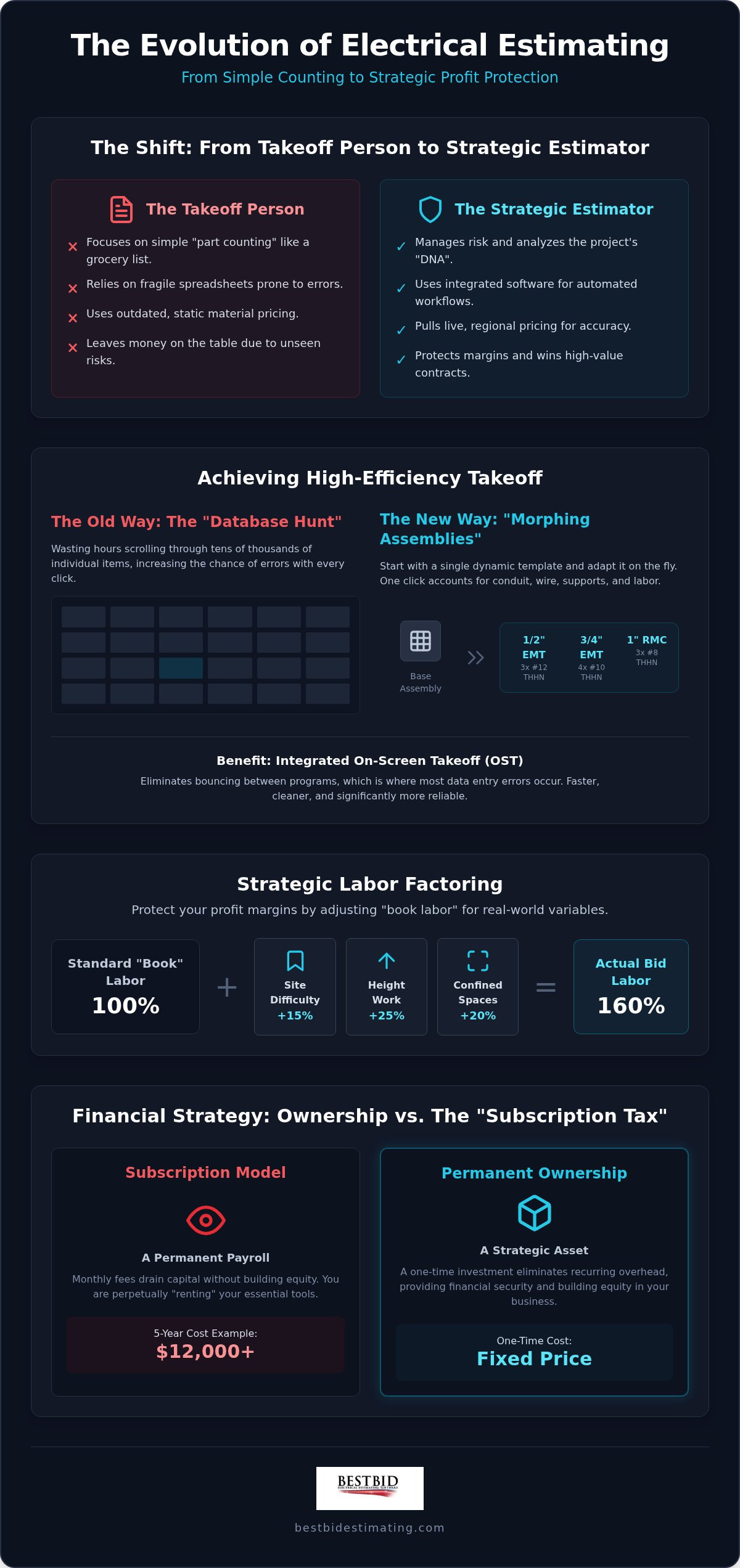
In the current market, advanced estimating has evolved far beyond the simple act of “counting parts.” It’s now a high-stakes game of strategic risk and labor management. If you’re still treating a bid like a grocery list, you’re leaving money on the table. A modern estimator doesn’t just look at quantities; they look at the project’s DNA.
They identify where labor might bleed out and where material volatility could gut a profit margin. This shift from a “Takeoff Person” to a “Strategic Estimator” is what separates the contractors who are barely scraping by from those winning high-value commercial contracts.
Understanding the nuances of estimating terminology is just the baseline. To truly excel, you must master advanced electrical estimating techniques that integrate real-time data. In 2026, material markets remain volatile. Relying on pricing from six months ago is a recipe for disaster. Using tools like NetPricer allows you to pull live, regional costs directly into your bid. This ensures your numbers are grounded in reality, not wishful thinking. It’s about precision and the confidence that your bid is both competitive and profitable. With copper tariffs and material price surges creating new challenges, learning how to improve electrical bidding accuracy in the face of volatile input costs is now a core competency for every serious estimator.
The Shift from Manual to Automated Workflows
Spreadsheets are the silent killers of accuracy. They’re prone to broken formulas and manual entry errors that can cost you thousands. Advanced workflows replace these fragile systems with integrated solutions. For instance, Best Bid Next Generation features built-in On-Screen Takeoff (OST). This eliminates the need to bounce between different programs, which is where most data entry errors occur. Instead of counting items, you’re “morphing” complex assemblies. This means one click can account for the conduit, wire, supports, and labor all at once. It’s faster, cleaner, and significantly more reliable.
Financial Strategy: Ownership vs. Subscription
We need to talk about the “Subscription Tax.” Most software companies want to keep you on a permanent payroll through monthly fees. Over five years, these subscriptions can cost you a small fortune without you ever actually owning the tools you rely on. A “Buy it and Own it” model is a strategic financial move for lean contractors.
It removes a recurring overhead burden and puts that capital back into your business. There’s a psychological advantage to knowing your tools are paid for. In a fluctuating economy, permanent ownership provides a level of security that a monthly bill never will.
It’s about building equity in your own operation rather than funding someone else’s recurring revenue model.
High-Efficiency Takeoff: Leveraging Assemblies and Integrated OST
Speed in the takeoff process isn’t just about how fast you can click a mouse. It’s about how many clicks you can eliminate entirely. Most estimators lose hours every week performing a “database hunt,” scrolling through tens of thousands of individual items to find one specific fitting or wire type. Implementing advanced electrical estimating techniques means moving away from this scavenger hunt. Instead, you should rely on a “Single Assembly” workflow that allows you to adapt to any project scenario on the fly. This momentum is what keeps your bids accurate and your schedule clear.
When you build assemblies that reflect your specific field crews, you’re accounting for more than just material. You’re accounting for the actual cost of doing business. Considering the median annual wage for electricians, even a small error in labor factoring across a large commercial floor plan can lead to a massive deficit. High-efficiency takeoff tools automate the heavy lifting, such as calculating conduit and wire lengths or accounting for vertical drops, without requiring third-party plugins that just add another layer of complexity to your day.
The Power of Morphing Assemblies
Morphing is the secret weapon of the strategic estimator. Rather than maintaining a separate assembly for every possible conduit size or wire combination, you use a dynamic template. You select a base assembly and “morph” the variables to match the prints.
This approach eliminates the need to manage a bloated database. It also ensures that your custom assemblies stay relevant to how your team actually installs in the field. You can adjust parts and labor units in seconds, ensuring your bid reflects the specific difficulty of the job at hand.
Integrated On-Screen Takeoff (OST) Best Practices
Using a separate program for your takeoff and your estimate is a recipe for data entry errors. Integrated OST, like what you’ll find in Best Bid Next Generation, creates a seamless bridge between the drawing and the final price. You count symbols or trace runs on the PDF, and the quantities flow directly into your estimate without a single manual transfer. This “1-Click” philosophy saves time and protects you from the simple typos that often lead to missed profit. For complex commercial plans, digital counting strategies allow you to auto-calculate branch wiring and circuitry with a level of precision that manual methods simply can’t touch. If you want to see how this workflow can tighten up your bidding process, it might be time to look at a system designed by people who’ve actually spent time in the field. Before diving into advanced workflows, make sure your foundation is solid by reviewing the electrical blueprint takeoff process to ensure you’re extracting accurate material counts and labor units from every set of plans.
Strategic Labor Factoring: Protecting Your Profit Margins
Labor is the single greatest variable in any electrical bid. It’s the factor that can either make you a hero or leave you underwater. Most software provides “book labor” units based on ideal conditions, but the job site is rarely ideal. Adopting advanced electrical estimating techniques requires you to bridge the gap between these theoretical numbers and field reality. You have to account for the actual environment where your crews will be working. Are they in a climate-controlled office or a congested industrial plant during a shutdown? The difference in productivity is massive, and failing to adjust for it is a gamble you can’t afford to take.
The National Electrical Contractors Association provides a foundation for understanding labor standards, but the “Chief Estimator” mindset involves knowing when to override those defaults. You aren’t just a data entry clerk; you’re a risk manager. On “Bid Day,” when the pressure is high and numbers are flying, you need the confidence to apply global labor adjustments. Whether it’s factoring in a 15% hit for working at heights over 20 feet or adjusting for site congestion in a tight urban build, these strategic overrides are what protect your profit margins from the chaos of the field.
Advanced Labor Variables
Precision estimating requires looking at the human element. You have to factor in “fatigue curves” if your project schedule demands heavy overtime. A crew working 60 hours a week isn’t as efficient in hour 58 as they were in hour 8.
You also need to account for non-productive time that “book labor” often ignores. Mobilization, daily safety meetings, and end-of-day clean-up can consume up to 20% of a technician’s day. If you don’t bake that into your labor factoring, you’re essentially donating those hours to the general contractor.
Risk Mitigation in Large Bids
Large-scale projects bring unique risks, particularly regarding long lead-time items like switchgear or specialized lighting. A delay in delivery can wreck your labor schedule and lead to costly stacking of trades. Advanced estimators use value engineering to mitigate this, offering alternative materials that meet the spec but are more readily available. This protects your margin while keeping the project on track. If the volume of large bids becomes overwhelming, knowing when to hire a freelance electrical estimator can provide the overflow protection you need to maintain accuracy without burning out your internal team. It’s about having the right strategy to win high-value work without sacrificing the quality of your numbers.
How to Choose Electrical Estimator Training Courses That Deliver ROI
How much does a single mistake cost your business? A simple slip-up in your labor factoring or a missed detail in the project specs can wipe out your profit for the entire quarter. Most contractors look for training that teaches them how to use a specific tool, but that’s like learning how to hold a hammer without knowing how to build a house. True ROI comes from investing in estimating education that focuses on advanced electrical estimating techniques and the practical realities of the trade. You need a curriculum that simulates the high-pressure environment of “Bid Day” and teaches you how to manage risk before it hits your bank account.
Training grounded in 50 plus years of field experience, like the insights provided by Steve Griffin, is vastly superior to academic theory. You aren’t just learning how to enter numbers; you’re learning the “why” behind every bid decision. When you compare the tuition for a professional course against the cost of even one missed commercial bid, the decision becomes clear.
It’s about buying back your time and avoiding the decades of unnecessary mistakes that others have already made. Professional training ensures that you aren’t just a “takeoff person” but a strategic asset to your company.
What to Look for in a Modern Curriculum
A modern program shouldn’t just be a tutorial on counting parts. It must cover labor management, relationship building, and strategic business growth. If you aren’t learning how to position your company as a leader in the market, you’re just learning how to be a faster clerk. Your education should empower you to implement advanced electrical estimating techniques that streamline your workflow and improve accuracy. Check out our Electrical Estimating: 2026 Contractor Training Guide to see what a comprehensive education should look like in today’s competitive environment.
The Best Bid Academy Difference
We focus on moving you from the trenches into a position of leadership through our Online School for Electrical Estimating. Our modules are designed for busy contractors who don’t have weeks to spend in a classroom. These field-tested practices allow you to customize your learning path, ensuring you master the specific challenges of your niche. Whether you’re looking to sharpen your own skills or train a new hire, you need a system that delivers results, not just a certificate. We believe in providing tools and knowledge that you can own and use to build a legacy. Elevate your estimating career with the right tools and training today.
Master the Trade with Best Bid Academy and Next Generation Software
Owning the right tools is only half the battle. To truly dominate your market, you need the knowledge to back those tools up. The synergy between Best Bid Next Generation software and the Academy training creates a powerhouse workflow. You aren’t just learning software; you’re mastering advanced electrical estimating techniques that have been refined over five decades in the field. This combination turns a standard contractor into a strategic business leader who knows exactly how to protect their bottom line.
In independent comparisons, our system consistently ranks as the best value for contractors. While other high-end platforms like Accubid and various subscription-heavy competitors demand thousands in recurring fees, we prioritize your long-term success through a permanent ownership model. You get the same precision and depth as the most expensive suites on the market without the ongoing financial burden. It’s about fairness and giving you the equity you deserve in your own business tools.
Why Best Bid Next Generation is the Professional Choice
We’ve designed our system to be the most accessible high-end tool on the market. With the lowest 5-user licensing cost in the industry at approximately $2,500, we make it possible for growing shops to use the same professional strategies as the giants. You get lifetime updates and support, which finally puts an end to the subscription fatigue that plagues so many modern contractors. For a deeper look at how this system transforms your workflow, read our Best Bid Next Generation Guide.
Your Path to Bidding Excellence
Implementing an advanced workflow in your shop doesn’t have to be a multi-month struggle. You can start today by evaluating your current overhead and seeing where the leaks are. If you’re tired of the pay-to-play model, your next steps are clear:
- Start by reviewing Best Bid Pricing to see exactly how much you’ll save by switching to an ownership model.
- Enroll in the Online School for Electrical Estimating to sharpen your edge and learn the field-tested strategies that software alone can’t teach.
- Join a growing community of successful contractors who have decided to buy their tools and own their future.
Stop settling for inconsistent margins and clunky workflows. Take ownership of your estimating process and start winning the contracts that will define the next decade of your business. We’re here to provide the tools, the training, and the support you need to succeed on your own terms.
Future-Proof Your Bidding Strategy
Transitioning to a high-level estimating workflow isn’t just about speed; it’s about the security that comes from precise labor factoring and strategic risk management. We’ve explored how moving beyond simple part counting to mastering advanced electrical estimating techniques can transform your profit margins. By leveraging integrated OST and morphing assemblies, you eliminate the manual errors that drain your bank account. You also regain control of your time and your overhead by choosing a system built for long-term success.
Why keep feeding a software subscription that never ends? We’ve built 50 plus years of field experience into every feature to ensure you have a tool that works as hard as you do. It’s why our system is ranked number one for “Best Value” in independent comparisons. You deserve a partner that respects your bottom line with zero monthly subscriptions and total lifetime ownership. Stop paying monthly fees; own the industry’s best electrical estimating software today. It’s time to bid with confidence and win the high-value projects your expertise deserves.
Frequently Asked Questions
What are the most common advanced electrical estimating techniques?
Modern techniques focus on strategic risk management and assembly automation rather than just counting individual parts. Key methods include morphing assemblies to fit specific field conditions and utilizing integrated on-screen takeoff to eliminate data transfer errors. These advanced electrical estimating techniques allow you to account for real-world labor variables like site congestion and height with much higher precision.
How do I choose between different electrical estimator training courses?
Prioritize courses that teach the “why” behind the numbers, not just which buttons to click in a program. Look for a curriculum developed by industry veterans with decades of field experience. A course that includes bid-day simulations and risk management will provide a much higher return on investment than a basic software tutorial that ignores the practical realities of the trade.
Is online electrical estimating training as effective as in-person classes?
Online training is often more effective for busy contractors because it allows you to learn at your own pace without leaving the job site. The Online School for Electrical Estimating provides modular lessons that you can revisit whenever you face a complex bidding scenario. This flexibility ensures you actually retain the information and can apply it immediately to your real-world projects.
What is the best electrical estimating software for small to mid-sized contractors?
The best software for this market is one that provides professional features without the burden of monthly subscription fees. Best Bid Next Generation is a top choice because it includes built-in OST and a “Buy it and Own it” model. This allows you to build equity in your own tools while maintaining the same precision as the massive electrical corporations.
How much does professional electrical estimator training typically cost?
Professional training costs vary depending on the depth of the curriculum and the experience level of the instructor. The real metric to consider is the cost of a missed bid or a labor calculation error. Investing in a comprehensive course is a strategic move to prevent mistakes that could cost your company thousands. Most contractors find the tuition pays for itself within the first few accurate bids they submit.
Do advanced estimating techniques really improve bid hit rates?
Yes, these techniques improve hit rates by giving you the confidence to submit the “lowest responsible bid” without fear. When your labor factoring and material pricing are bulletproof, you can tighten your margins safely. This precision makes your bids more competitive while ensuring that every project you win is actually profitable for your business. For a comprehensive breakdown of the systems and habits that drive consistent results, our guide on how to improve electrical bidding accuracy covers the specific steps contractors are using in 2026 to protect their margins against volatile material costs and shifting labor conditions.
Can I learn advanced estimating if I only have field experience?
Field experience is your greatest asset when learning advanced electrical estimating techniques. You already understand how long an installation actually takes, which is something a classroom-only estimator often struggles to grasp. You simply need to learn how to translate that field knowledge into the digital workflows and labor factoring strategies that modern bidding requires.
What is the difference between an estimator and a takeoff person?
A takeoff person is primarily responsible for quantifying materials and counting symbols on a drawing. An estimator takes that data and applies a profit strategy, manages risk, and adjusts for labor variables. Moving from a takeoff mindset to an estimator mindset is what allows a professional to win high-value commercial contracts and maintain consistent profit margins. If you’re still building your foundation, our guide to the electrical blueprint takeoff process walks you through a systematic method for extracting accurate material counts from complex 2026 plans.