Post-bid analysis for electrical contractors: Learn from each bid
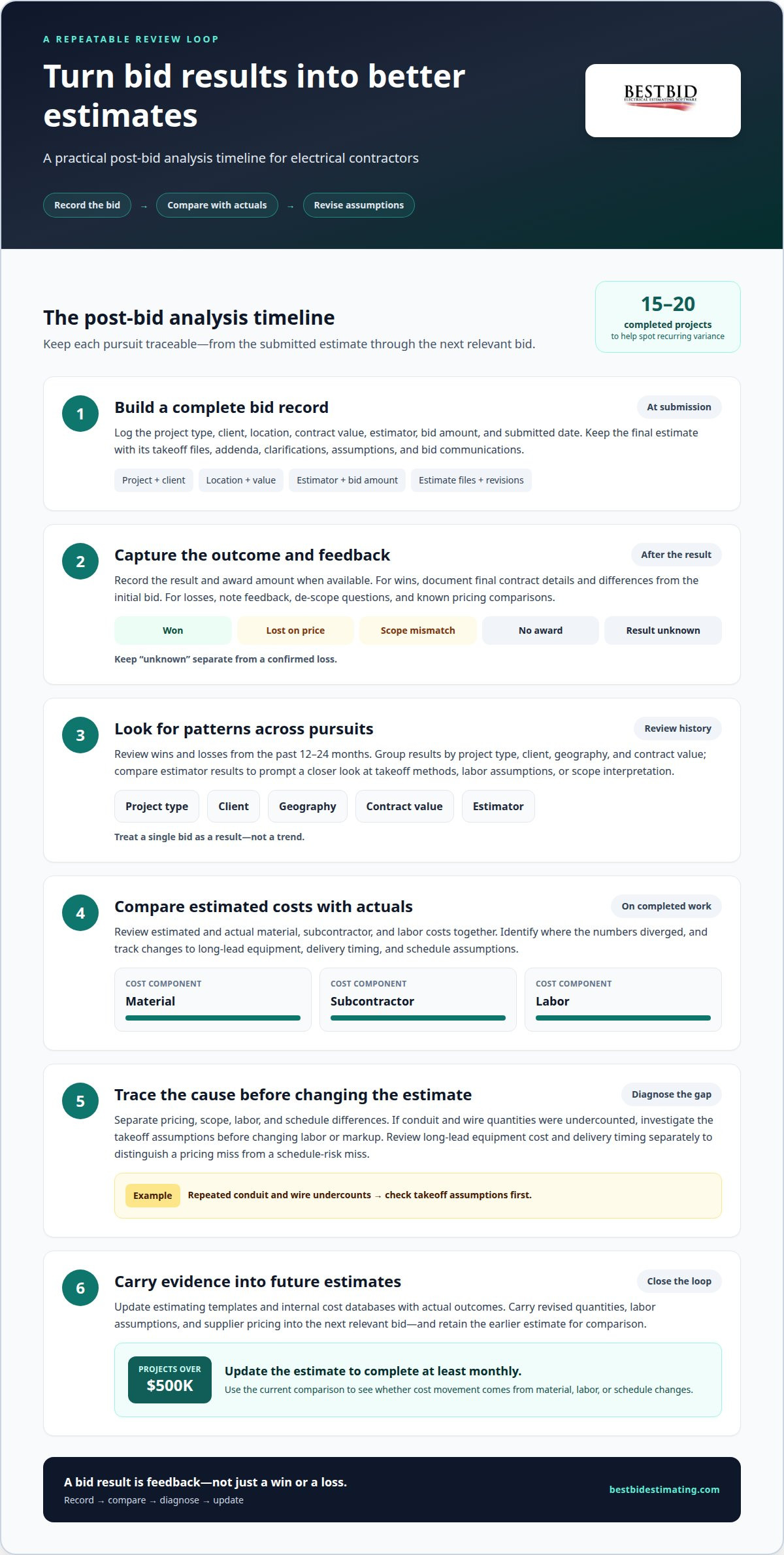
A bid result is feedback, not just a win or a loss. Post-bid analysis for electrical contractors means comparing the estimate with the project outcome, recording why the bid was won or missed, and using the pattern to improve future decisions. Reviewing estimating variance across 15-20 completed projects can help reveal where assumptions consistently differ from actual costs.
It’s easy to move straight to the next bid, especially when deadlines are tight. But a brief, consistent review can show whether the gap came from pricing, scope, labor assumptions, schedule, or how the proposal addressed the client’s needs. The aim isn’t to second-guess every estimate. It’s to make the next one better informed.
Learn how to record bid outcomes, follow up on losses, review project costs, and turn findings into better estimating records and pursuit decisions. Clear tracking also helps electrical contractors spot patterns across project types and clients, rather than relying on memory or a single result.
Key Takeaways
- Compare bid outcomes by project type, client, geography, and estimator to uncover patterns that a single win or loss can’t show.
- Close the loop by recording award results and following up to learn what influenced the decision.
- Use bid reviews to refine which opportunities to pursue and how you assess subcontractor proposals.
- Diagnose missed bids across price, scope, schedule, technical approach, and proposal requirements, then carry the findings into future estimates.
- Keep the final estimate, takeoff files, addenda, clarifications, assumptions, and bid communications together for a useful record of each pursuit.
1. How does post-bid analysis work?
After submitting a proposal, review its outcome, estimate assumptions, and project costs. Track win rates by project type, client, geography, and estimator to see where bids perform well. Compare the results with bid value, workload capacity, and profitability. These measures can show whether a pattern points to a competitive estimate or a pursuit strategy that needs improvement.
Record each opportunity’s project type, client, location, contract value, estimator, bid amount, result, and award amount when available. For won work, document the final contract details and differences from the initial bid. Keep estimated and actual material, subcontractor, and labor costs together. Note changes to long-lead equipment, delivery timing, or schedule assumptions, since they can affect both the estimate and the work plan.
Review wins and losses from the past 12-24 months, then group them by project type, client, geography, and contract value. Add estimator as another useful comparison: a difference between estimators can prompt a closer look at takeoff methods, labor assumptions, or scope interpretation. Avoid treating a single bid as a trend. Reviewing estimating variance across 15-20 completed projects can help reveal recurring estimating bias.
For completed work, compare estimated cost components with actual costs and identify why they diverged. If conduit and wire quantities were consistently undercounted, for example, investigate the takeoff assumptions before changing labor or markup. Update the estimate to complete as project costs develop; for projects over $500K, it should be updated at least monthly. A current comparison helps show whether cost movement comes from material, labor, or schedule changes.
Review long-lead equipment costs and scheduling separately. Compare the assumed equipment cost and delivery timing with project requirements, then record changes that affected procurement or installation sequencing. This helps distinguish a pricing miss from a schedule-risk miss.
After each review, update estimating templates and internal cost databases with actual project outcomes. Carry revised quantities, labor assumptions, and supplier pricing into the next relevant bid, while retaining the earlier estimate for comparison. This gives future decisions a traceable basis instead of relying on memory or adjusting figures without evidence.
Post-bid analysis for electrical contractors works best as a repeatable loop: record the bid, capture the result, compare estimates with actuals, and revise relevant assumptions. Retain bid and award amounts, scope, project category, location, client, estimator, estimated and actual costs, schedule changes, and the reason for a win or loss. Together, these records connect bidding performance with estimating accuracy and future pursuit decisions.
2. Closed-loop bid tracking and win-loss analysis
A bid log becomes valuable when it captures what happened after submission, not just the original price and deadline. Record each opportunity’s project identifier, bid date, submitted amount, project type, client, location, estimator, and final outcome. For wins, add the award amount and winning contractor when available.
For losses, note any feedback, de-scope questions, or known pricing comparisons. This creates a record you can use to test estimating assumptions instead of relying on memory.
Use consistent outcome categories, such as won, lost on price, scope mismatch, no award, or result unknown. Keep “unknown” separate from a confirmed loss; otherwise, missing feedback can distort the win rate. Calculate results across a defined period and segment them by project type, client, geography, and contract value.
A general contractor’s average bid-to-win ratio is 20-35%, but that broad benchmark doesn’t explain whether your own margins or pursuit choices are working. Your records need to show where wins and losses actually occur.
Review closed-loop bid data across 12-18 months before making portfolio-level decisions. Compare the number of bids submitted with awards won, then examine the bid-to-win ratio for each meaningful category. A low ratio in one market may reflect aggressive competition, a mismatch in scope, or too many bids pursued without a clear advantage.
Repeated wins at thin margins can also signal that pricing or supplier terms deserve review. Interpret the numbers alongside project fit, not in isolation.
Capture competitor and award pricing only when it’s available, and label its source and confidence. For U.S. public construction projects, bids are usually opened and read publicly, with bid tabulations showing bidders’ base bids, alternates, and unit prices.
In a sample of public electrical projects from 2010-2026, the median bidder count was 3; the reported gap between the winning bid and the second bid was 18.5% across 270 projects with complete rosters. Treat those figures as context, not a target for every private bid.
Keep drawing revisions and addenda in the same opportunity record. Save the revision identifier, issue date, affected sheets, and whether the estimate incorporated each change before submission. For example, if an addendum changes a lighting schedule, retain the applicable drawing version and related estimate notes. That trail helps distinguish a pricing gap from a proposal based on outdated documents.
Close the loop by updating the record when an award notice or general contractor follow-up arrives. Compare your submitted amount with the award and any available competitor pricing, then record the explanation for the result. Electrical estimating tools such as Best Bid’s electrical estimating software can support a more consistent estimating workflow, while the tracking fields keep bid outcomes and opportunities useful for future decisions.
3. Informing business development and subcontractor selection
Bid results can inform which general contractors you pursue and how you build working relationships. Review each opportunity’s invitation source, project fit, estimating effort, outcome, and follow-up. If a general contractor regularly invites your team but awards work elsewhere, examine the pattern before committing the same effort to every invitation. Consider your relationship with that contractor, experience with similar projects, current workload capacity, and any clear competitive advantage.
Use the records to focus business development. Group opportunities by general contractor, project type, geography, and award result. Then identify where your electrical scope, past performance, or schedule approach fits the work.
If a project’s drawings or requirements align with your team’s experience, pursuing it may make more sense than bidding outside that strength. Maintain a pipeline of suitable opportunities and track bid dates, so estimating effort supports a deliberate pursuit plan rather than a last-minute scramble.
General contractors use de-scope meetings to check whether electrical proposals cover comparable work before reviewing them. Treat a request for clarification or a call after de-scope as useful feedback: it indicates that the contractor is considering the proposal seriously. Respond clearly about included scope, exclusions, assumptions, and addenda.
If your proposal excludes cable installation, for example, state that directly. A complete, readable response helps the general contractor understand the price and compare proposals fairly.
Bid leveling helps reveal whether a low subcontractor proposal is genuinely competitive. Compare proposals against the same scope, drawing set, addenda, and schedule requirements. List each exclusion or missing item, then add its estimated cost to the bidder’s base price.
For example, if one proposal omits required testing while another includes it, account for testing before comparing the spread. This turns a headline price comparison into a scope-adjusted review. Keep written clarifications about ambiguous items with the proposal record.
After award, buyout turns the estimate into committed project costs through subcontracts and purchase orders. Compare each commitment with the corresponding estimate allowance and record the reason for any difference. If a supplier’s price changes or a subcontractor’s scope differs from the bid basis, document the impact before updating the job forecast. This comparison shows whether the estimate reflected market conditions and complete scope, or whether the team needs to refine supplier relationships and future bid assumptions.
Use these findings together. If a general contractor’s invitations repeatedly lead to poor-fit work, adjust pursuit priorities. If a subcontractor consistently submits complete proposals at competitive prices, factor that performance into selection decisions. Post-bid analysis can support both sides of the business: choosing better opportunities and building a more reliable subcontractor bench.
4. Diagnosing missed bids by price, scope, licensing, bonding, schedule, or paperwork
A lost construction bid needs a specific diagnosis, not an automatic price cut. Compare the submitted amount with available bid tabulations, award notices, and general contractor leveling questions. Then assess whether price, scope understanding, the technical proposal, schedule, or response to client requirements affected the result. For a public project, distinguish responsiveness, whether the bid conforms to the solicitation, from responsibility, whether the bidder can perform.
Start with price, but examine the estimate behind it. Compare the takeoff, labor assumptions, material quotes, and included alternates with available award information. If the bid was higher, identify whether quantities, product selections, or labor hours explain the difference.
A lower price alone doesn’t prove the estimate was inaccurate. If the result came from omitted work or an unsustainable assumption, reducing the next bid could weaken profitability without addressing the cause.
Next, test the scope against the drawings, notes, and specifications. Review every sheet and addendum used to prepare the proposal, then identify requirements that may sit outside the core electrical specifications. Testing, commissioning, warranty, and submittal requirements can carry material and labor costs without appearing on drawings.
For example, a proposal that excludes commissioning may look cheaper but fail to match the requested scope. Record each exclusion, accepted alternate, and clarification against the relevant document.
Review paperwork and qualification requirements separately. Compare the submitted package with the solicitation’s stated forms, requested information, licensing criteria, and bonding requirements. Record which documents were included and whether they were complete and consistent.
On a public project, a bid that fails to conform to the solicitation may be treated as nonresponsive. Keep that finding distinct from a decision about the bidder’s ability to perform, which relates to responsibility.
Schedule can also explain a missed opportunity. Compare the bid-phase schedule with the solicitation milestones, proposed durations, and long-lead equipment assumptions. If the proposal omitted a delivery constraint or showed an incompatible sequence, note the specific activity and document behind the gap. This gives the estimating team a practical correction: revise the schedule basis, identify procurement risks clearly, or reconsider pursuing similar work when capacity is limited.
Close each review with a documented cause and an estimating action. Mark whether the main issue was price, scope, qualification, schedule, or paperwork, and add supporting evidence from the bid record. If a drawing conflict drove the difference, retain its sheet and detail reference with the clarification log.
If an addendum was missed, improve the document-control step before the next submission. Consistent diagnoses turn individual losses into specific improvements to the takeoff, proposal review, and bid process.
5. Documenting bid materials and communications
A useful bid record lets an estimator reconstruct what the team knew when it priced the work. Keep one organized file for each opportunity, including the final estimate, takeoff files, leveling sheets, clarifications, addenda log, assumptions, accepted alternates, unit prices, and schedule of values. These records show which documents informed the submitted proposal and help explain differences between the bid basis and the eventual project.
Control drawing versions carefully. Save each drawing set and addendum with its issue date or revision identifier, then record which version the takeoff used. If a drawing conflict affects scope, capture a screenshot and note the sheet and detail numbers in a clarification log. For example, pairing a screenshot with a written question makes it easier to trace how an unresolved device location affected the estimate.
Keep subcontractor clarifications in writing with the bid file, especially statements about exclusions, assumptions, and ambiguous scope items. Attach each clarification to the proposal it supports, and retain the relevant email or written response. If a subcontractor excludes equipment connections, keep that exclusion visible during proposal review and later handoff. A clear record helps prevent an assumption from being mistaken for included work.
Communications need context, too. Record who provided each answer, which drawing or specification it addressed, and whether the estimate changed afterward. When the team receives revised material pricing, save the quote alongside the estimate version that used it. This gives future reviewers a trail from supplier information to the material allowance, rather than a bare number without explanation.
For awarded work, carry the same record into the project handoff. The final estimate, takeoff files, leveling sheets, clarifications, addenda log, assumptions, accepted alternates, unit prices, and schedule of values give the project team the bid basis. Keep updates distinct from the submitted version, so later changes don’t erase the original assumptions. This comparison supports a more accurate review of estimated and actual costs.
A tidy file structure makes retrieval practical: use the project identifier and document type in filenames, and keep superseded drawings separate from current bid documents. Link each clarification to its related sheet, detail, or addendum. A reviewer can then follow the chain from drawing revision to takeoff, estimate adjustment, and submitted proposal without relying on memory. These records make future estimating improvements evidence-based and strategic.
Build a more consistent electrical estimating workflow with tools for electrical estimating, and keep the supporting bid documents tied to each project record.
Best Bid: Online School for Electrical Estimating
When bid reviews reveal gaps in estimating knowledge or process, Best Bid’s Online School for Electrical Estimating offers practical training. Use those findings to focus your learning, whether the issue is recurring takeoff inconsistencies, unclear scope assumptions, or difficulty turning project outcomes into better estimates.
For electrical contractors looking to improve their estimating workflow, Best Bid Next Generation and Best Bid Hybrid Pro offer specialized electrical estimating software. Their on-screen takeoff and automatic conduit and wire length calculations can support consistent project estimating and detailed bids. Choose the learning or software option that addresses the issue your reviews have identified.
Contact Best Bid to discuss the estimating support that fits your needs.
Make your next bid a more informed decision
Choose one change to carry into your next pursuit. It might be clarifying scope more precisely, revisiting a labor assumption, or keeping a clearer record of drawing revisions. Apply that adjustment consistently, then track whether it improves estimating decisions across future opportunities. That’s how post-bid analysis for electrical contractors becomes part of the bidding process, not a review that gets filed away and forgotten.
When your findings point to a need for better estimating tools, Best Bid Next Generation, Best Bid Hybrid Pro, and Accura Cadd PDF Draw are options to explore. The right next step depends on the work your team wants to make more precise and manageable.
Contact Best Bid to discuss your bids and identify a practical next step for your estimating workflow. Keep learning from each pursuit, and make the next decision with greater clarity.
Frequently Asked Questions
How does post-bid analysis work?
Post-bid analysis connects the submitted estimate to the eventual result, then identifies what that result can teach you. Start with one bid, confirm the documents and assumptions used, and compare the outcome with available award information or project records. For example, if a bid was lost after a scope clarification, note whether the clarification changed the price or exposed a gap. Apply the finding to a specific estimating or pursuit decision.
What does post bid mean?
“Post bid” refers to the period after a contractor submits a bid or proposal. It can include the owner’s or general contractor’s review, bid comparisons, clarification requests, the award decision, and the contractor’s later review of the outcome. For an electrical contractor, this period can reveal whether the proposal was understood as intended and whether the estimating assumptions matched the project’s requirements.
What goes on a bid leveling sheet?
A bid leveling sheet places subcontractor proposals side by side against a consistent scope so reviewers can compare them fairly. Include each bidder’s base amount, included work, exclusions, clarifications, alternates, unit prices, and relevant schedule assumptions. Add the estimated value of omitted or excluded items when comparing adjusted totals. For example, if one proposal excludes testing and another includes it, show that difference rather than treating the base amounts as equivalent.
What is a bid tabulation?
A bid tabulation records the bids submitted for a project and is commonly used on U.S. public construction work. It typically shows each bidder’s base bid, alternates, and unit prices, making submitted amounts easier to compare. It can help an electrical contractor understand where a bid stands after opening, but it doesn’t explain every difference in scope, qualifications, or proposal assumptions.
What is post-bid analysis for electrical contractors?
Post-bid analysis for electrical contractors is a structured review of bid results and project cost information to improve future estimating and pursuit decisions. It looks beyond whether a proposal won or lost. The review can reveal whether scope interpretation, takeoff quantities, labor assumptions, or proposal requirements affected the outcome. For completed work, comparing estimated components with actual costs helps identify assumptions to carry forward or revise.
How do electrical contractors compare estimated labor hours with actual project costs?
Compare estimated labor hours with actual time records for the same work categories, such as feeders, devices, or equipment connections. Keep the scope basis consistent: separate added work or changed conditions from hours spent completing the original bid scope. Then investigate the reason for a variance, such as production assumptions, access constraints, or installation sequence. This shows whether the estimate needs a revised labor unit or a clearer project assumption.
How should contractors analyze material, equipment, and subcontractor cost variances?
Compare each estimated allowance with the corresponding actual purchase, commitment, or subcontract cost, using the same scope and quantity basis. Separate quantity changes from unit-price changes, and note whether substitutions, delivery timing, or revised requirements affected the result. For subcontractor costs, account for exclusions before comparing proposals with commitments. This breakdown helps identify whether the estimate, procurement choice, or project change drove the variance.
What are common reasons electrical contractors lose bids?
Common causes include a price that doesn’t match competing offers, incomplete scope coverage, outdated drawings or addenda, unclear exclusions, schedule concerns, and missing or incomplete proposal documents. A technical approach may also fail to address a client’s requirements. Diagnose each loss using available bid feedback, public tabulations, award notices, or general contractor questions. Don’t assume price was the cause unless the available evidence supports that conclusion.