How to Streamline Electrical Bidding Process: The 2026 Contractor’s Buying Guide

Why are you still paying a monthly “tax” just to bid on jobs while your competitors are turning around quotes in half the time? With the 2026 NEC overhaul shifting everything from load calculations to arc-flash labeling requirements, the old way of estimating isn’t just slow; it’s a liability. Learning how to streamline electrical bidding process is no longer about shaving off a few minutes. It’s about surviving a market where labor is scarce and code compliance is a moving target.
You’re likely tired of the subscription trap that eats your profits and the manual takeoff errors that lead to “buying” a job you can’t afford to finish. We understand that grind because we’ve been in the field too. This guide promises to help you master rapid, accurate bidding by eliminating software friction and mastering integrated digital workflows. We’ll explore how to automate material pricing, leverage built-in onscreen takeoff, and finally gain total ownership of your estimating data so you can win more profitable work without the recurring fees.
Key Takeaways
- Break the “double-entry trap” by eliminating the need to manually transfer takeoff data into spreadsheets, a common bottleneck that kills bidding speed.
- Discover how to streamline electrical bidding process by using integrated on-screen takeoff to measure and count directly on PDF plans with one-click estimate transfers.
- Evaluate the true total cost of ownership over five years to see why “buy-it-and-own-it” models outperform the recurring financial drain of monthly subscriptions.
- Apply a 5-step workflow framework using AccuraCADD PDF Draw to identify project scope early and capture quantities with digital precision.
- Future-proof your business with trench-tested tools like Best Bid Next Generation, designed by industry veterans to handle the specific complexities of the 2026 NEC.
Identifying Bottlenecks in the Traditional Electrical Bidding Lifecycle
The bidding process shouldn’t feel like a second full-time job. Many contractors struggle with how to streamline electrical bidding process because they’re stuck in a cycle of manual repetition. This isn’t just about working harder; it’s about identifying where your profit is leaking out before you even land the contract. If your workflow involves jumping between three different apps and a stack of paper plans, you aren’t bidding; you’re just managing chaos.
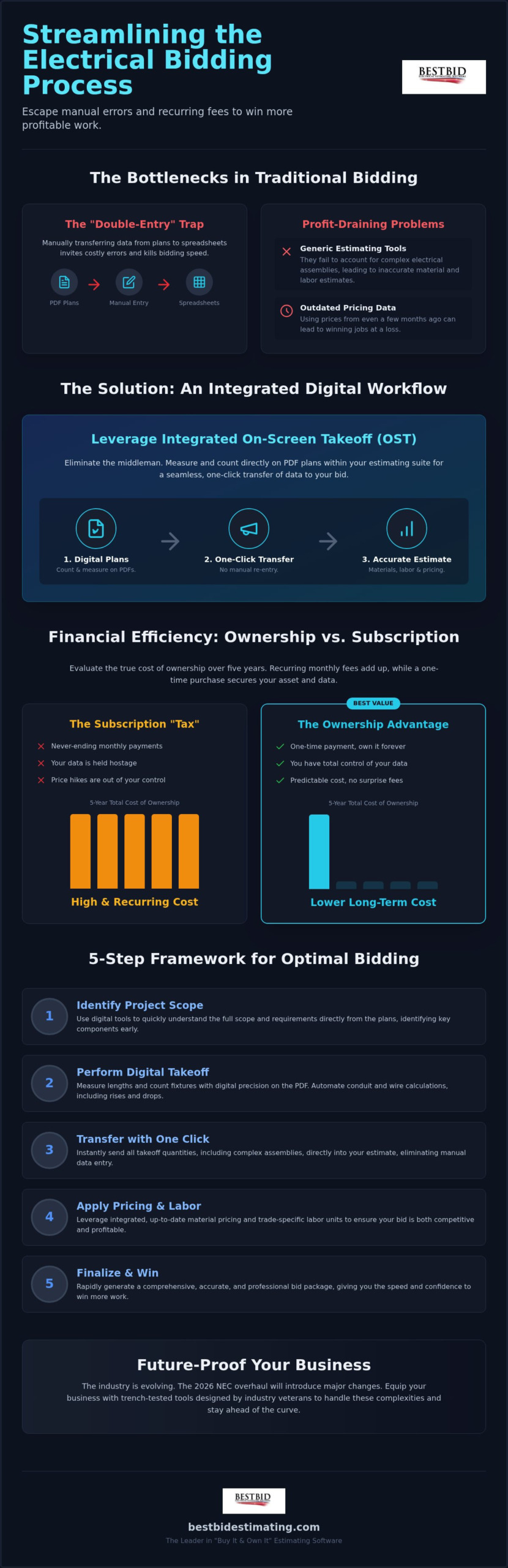
The “Double Entry” trap is the most common culprit. You count your fixtures or receptacles on a plan, write them down, and then type them into a spreadsheet. Every time your fingers hit the keyboard to re-enter data, you’re inviting human error.
This friction is compounded by outdated pricing data. In 2026, with the data center boom driving up the cost of switchgear and transformers, using prices from even three months ago is a recipe for disaster. You might win the job, but you’ll lose money on the materials before the first wire is pulled.
Communication silos also create a massive complexity barrier. When the estimator is disconnected from the field or the project manager, the bid rarely reflects the reality of the “boots on the ground” labor costs. This often leads to high-learning-curve software sitting unused on a shelf because it’s too complicated for the daily grind. True efficiency requires a system that everyone can actually use without a PhD in computer science.
The Hidden Cost of Manual Data Entry
Think about the hours spent re-keying counts. If an estimator spends five hours a week just moving data from paper to digital, that’s over 250 hours a year. At a professional wage, that’s thousands of dollars in lost productivity. Beyond the time, a single typo on a wire gauge or a missed zero on a conduit run can swing a bid by five figures. Spreadsheets are “good enough” until they aren’t. By then, the contract is signed and the loss is locked in. Moving to a modern estimating system eliminates this risk by connecting your takeoff directly to your final numbers.
Why Generic Estimating Tools Fail Electricians
Most generic estimating software treats an electrical job like a framing or plumbing project. It doesn’t account for the complexity of specialized electrical assemblies. A “receptacle” isn’t just a device; it’s the box, the mud ring, the wire nuts, the pigtails, and the labor to install it all. Generic tools force you to do manual math for conduit and wire lengths, which slows you down and increases the chance of missing 2026 NEC compliance requirements. High-quality systems use labor units specifically designed for different environments, whether it’s a high-rise commercial project or a hazardous industrial site. Without these trade-specific details, your bid is just an educated guess. If you’re still toggling between a PDF reader and a spreadsheet, our guide on streamlining electrical bid workflow beyond spreadsheets in 2026 breaks down exactly how to eliminate that workflow drag and cut your bidding time in half.
Leveraging Integrated On-Screen Takeoff (OST) for Maximum Speed
If you’re still using a separate takeoff tool and then manually importing those quantities into your estimating software, you’re working twice as hard as you need to. Integrated On-Screen Takeoff (OST) is the bridge between visual plans and mathematical costs. It allows you to measure and count directly on PDF plans within your actual estimating suite. This isn’t just a minor convenience. It’s a fundamental shift in how to streamline electrical bidding process efficiency.
Eliminating the “middle man” means you get 1-click transfers from the plan to the estimate. When you click a symbol on the screen, it doesn’t just show a mark; it adds the assembly, the labor, and the current material pricing to your bid instantly. This seamless connection saves hours on every bid by removing the export-import dance that often leads to corrupted files or lost data.
Visual verification ensures that every circuit and fixture is accounted for. If it’s highlighted on the plan, it’s in the bid. If you need to make real-time adjustments, changing a count on the plan updates your entire material list immediately.
You’ll never have to worry about a last-minute addendum throwing your manual spreadsheet into a tailspin again.
Automating Conduit and Wire Length Calculations
Manual wheeling or using generic measuring tools often ignores the three-dimensional reality of a job site. With digital path-finding, you can calculate exact run lengths automatically. Modern systems allow you to factor in vertical rises, such as drops to switches or ups to the ceiling, along with customizable waste factors. You don’t need a separate calculator for this. For large-scale commercial plans, using Best Bid Hybrid Pro simplifies this complex digital takeoff by handling massive file sizes and intricate runs with ease. It’s about precision that matches the 2026 NEC standards for circuit sizing and voltage drop.
Accuracy Through Visual Takeoff Markups
Organization is the enemy of error. By color-coding different systems, such as blue for power, yellow for lighting, and green for data, you create a clear visual roadmap of the project. This makes the plan review process much faster for project managers later on. Tools like DigiCount further automate the process by recognizing repetitive symbols across multiple pages. Instead of clicking 400 recessed lights one by one, the software does the heavy lifting for you. This level of automation is exactly what separates the top-performing contractors from those barely scraping by. If you want to see this in action, exploring the Best Bid Next Generation workflow can show you just how much time you’re currently leaving on the table.
Financial Efficiency: Comparing Subscription vs. One-Time Purchase Models
Many software companies want to keep you on a leash with monthly fees. They call it “Software as a Service,” but for an electrical contractor, it often feels like an endless tax on your ability to work. When you’re looking at how to streamline electrical bidding process, you have to consider the financial drag of your tools. A streamlined workflow shouldn’t come with a “forever” bill that eats into your 7.5% net profit margin.
The Total Cost of Ownership (TCO) over a five-year period for subscription software is often staggering. While a monthly fee might look small on a credit card statement, it compounds. If you’re paying for multiple users, you could easily spend tens of thousands of dollars for “rented” access to your own data. Small contractors are hit hardest by these recurring costs because they lack the massive overhead of national firms to absorb the hit. Ownership is a business asset. Software you own adds tangible value to your company’s bottom line, whereas a subscription is just a sunk expense that vanishes the moment you stop paying. If you’re running a smaller shop and wondering whether premium tools are truly worth the price, our breakdown of the best electrical estimating software for small contractors debunks five common myths that may be costing you money.
Choosing a “Buy-it-and-Own-it” model provides permanence and financial clarity. You get the security of a modern, reliable system without the stress of a recurring monthly burden. This transparency allows you to plan your business growth with confidence, knowing your estimating tools are paid for and protected.
The ROI of No-Subscription Software
The math is simple and transparent. A 5-user license for Best Bid Next Generation costs a fraction of the $15,000 or more that competitors often charge for initial licenses plus annual fees. By reallocating that “subscription” money into field training or marketing, you’re actually investing in the future of your trade. For a detailed breakdown of these savings, read our Total Cost of Ownership Electrical Estimating Software: The 2026 Buyer’s Guide. It’s about making your money work for you, not for a software developer’s recurring revenue targets.
Protecting Your Data and Independence
What happens to your bids if you hit a slow month and stop paying a subscription? In many cases, you face a data lockout. Your history, your custom assemblies, and your hard-earned estimating data become inaccessible.
Steve Griffin built Best Bid specifically as an alternative to this “rented” software trap. You deserve 1-click backups and total user control over your database. True independence means knowing that your business intelligence belongs to you, regardless of market fluctuations or software company policy changes.
A 5-Step Framework to Optimize Your Bidding Workflow
Learning how to streamline electrical bidding process isn’t just about speed; it’s about following a repeatable system that eliminates guesswork. When you use a system built by people who’ve actually worked in the trenches, you stop fighting your tools and start winning more jobs. This five-step framework is designed to take you from a messy stack of PDF plans to a professional, profitable proposal in record time.
- Step 1: Rapid Plan Review. Use Accura Cadd PDF Draw to identify the project scope early. This is where you spot the 2026 NEC changes, like the reorganization of load calculations into Article 120, before they bite you.
- Step 2: Execute Digital Takeoff. Leverage built-in OST to capture quantities instantly. Since the takeoff is part of the estimating suite, there’s no data transfer required.
- Step 3: Apply Real-Time Pricing. Connect to NetPricer to ensure your material costs reflect the 2026 market. With data center projects driving up switchgear costs, you can’t rely on last year’s pricing.
- Step 4: Review Labor Units. Adjust for site-specific conditions using Global Labor Adjustments. If the job requires working around a tight 2026 labor schedule, your bid needs to reflect that reality.
- Step 5: Generate a Professional Proposal. Produce a document that highlights your value and technical accuracy, not just a bottom-line number.
Mastering the ‘Assembly-Structure’ Workflow
Searching through a database of 50,000 individual parts is a waste of your talent. The most efficient way to bid is by using standardized assemblies that you can “morph” on the fly. If you have a standard 20-amp branch circuit assembly, you should be able to change the conduit type or wire gauge with one click without rebuilding the entire item.
This reduces the number of clicks required to build a complex bid and ensures consistency across your entire estimating team. It’s about working smarter, not clicking harder.
Professional Proposals that Win Jobs
A single-number bid tells a general contractor you’re just a commodity. A detailed, transparent proposal tells them you’re a professional who understands the project better than anyone else. Including your digital takeoff markups in the bid package proves your accuracy and builds immediate trust. If you want to dive deeper into these techniques, check out our Electrical Estimating: 2026 Contractor Training Guide. Providing this level of detail often justifies a higher price point because the client feels secure in your numbers.
Ready to stop the manual grind and take control of your data? See how Best Bid electrical estimating software can transform your workflow today.
Future-Proofing Your Business with Best Bid Next Generation
Speed is the lifeblood of a successful contracting business. When you look at how to streamline electrical bidding process, you aren’t just looking for a tool; you’re looking for a partner that won’t hold you back. Best Bid Next Generation is rated 5-star for workflow speed because it doesn’t force you through unnecessary hoops. It’s built for the way you actually work. Whether you’re a solo owner-operator or managing multiple crews, the system scales with you. It provides the same level of precision and efficiency regardless of your project’s size.
The “Trench-Tested” advantage isn’t just a marketing slogan. It means the software was built to handle the real-world complexities of the 2026 NEC reorganization and the shifting labor market. You get the security of a modern, reliable system that understands the daily grind of the trade. By choosing a platform that grows with your firm, you avoid the painful process of switching software every time you hire a new estimator or take on a larger commercial project.
Why 50 Years of Experience Matters in Software
Most construction software is built by coders who’ve never stripped a wire or stepped foot on a job site. They build “theory-only” tools that look good in a demo but fail when you’re facing a tight deadline. Steve Griffin’s background as a Master Electrician and estimator informs every feature in our suite.
He understands the daily grind because he’s lived it for five decades. This experience allows us to avoid the traps found in generalist software. We don’t give you ultimatums or force you into a box.
Our philosophy is rooted in a partnership that respects your trade and your bottom line.
Taking the Next Step Toward Bidding Excellence
Transitioning from manual spreadsheets doesn’t have to be a high-learning-curve nightmare. We’ve designed the interface to be intuitive for anyone who knows the electrical field. If you ever find yourself overwhelmed with a complex industrial bid or a sudden surge in work, we offer freelance estimating services to handle the overflow.
You also get access to the Best Bid Academy, ensuring your team’s skills stay sharp as industry regulations evolve. It’s time to stop renting your tools and start building real equity in your business. Moving to a professional system is the most significant step you can take toward long-term financial clarity.
Own your software and streamline your bids with Best Bid Next Generation and experience the security of a system built for your long-term success.
Take Control of Your Bidding Future
You’ve seen how the combination of integrated on-screen takeoff and real-time pricing can transform your workflow. Mastering how to streamline electrical bidding process isn’t just a luxury in 2026; it’s a necessity for survival in a market defined by labor shortages and complex NEC updates. By moving away from the “subscription trap” and manual data entry, you protect your profit margins and reclaim hours of your life. You’ve earned the right to own your data and your tools without a “forever” bill hanging over your head.
We’ve positioned our system as the #1 Best Value Ranking for single-location contractors because we believe in fairness and transparency. With built-in OST included at no extra cost and lifetime updates and support included, you can bid with the confidence of a seasoned veteran. It’s time to replace the stress of manual labor with a modern, reliable system that works as hard as you do.
You have the expertise to do the work. Now, give yourself the tools to win it on your own terms.
Stop Renting Your Software—Own Best Bid Next Generation Today
Frequently Asked Questions
What is the fastest way to streamline the electrical bidding process?
The most effective method is eliminating manual data entry by adopting an integrated digital workflow. By using software that combines takeoff and estimating, you remove the need to re-key counts from plans into spreadsheets. This single change prevents transcription errors and significantly reduces the hours spent on every bid.
Can I use electrical estimating software without paying monthly subscription fees?
Yes, you can choose a “Buy it and Own it” model instead of the common subscription trap. Best Bid offers professional tools with a one-time purchase, giving you total ownership of your software and data. This approach eliminates recurring monthly burdens and ensures you never lose access to your bids if you stop paying a fee.
How does integrated on-screen takeoff improve bidding accuracy?
Integrated on-screen takeoff provides a visual roadmap that ensures every circuit and fixture is accounted for. When you click a symbol on the plan, the software automatically adds the correct assembly and labor units to your bid. This direct connection removes the risk of missing items, which is common when using “good enough” manual methods.
Is it worth upgrading from spreadsheets to dedicated estimating software in 2026?
Upgrading is essential to stay competitive as the 2026 NEC overhaul changes how load calculations and safety requirements are handled. Specialized software includes built-in electrical assemblies and labor units that spreadsheets simply cannot replicate. Dedicated tools help you maintain your profit margins by catching complex requirements that manual math often misses. For a deeper look at why making this transition is critical right now, see our resource on streamlining electrical bid workflow and moving beyond spreadsheets in 2026.
How do I ensure my material pricing is accurate in a volatile market?
You should use real-time pricing integrations like NetPricer to stay ahead of market fluctuations. With the 2026 data center boom driving up the cost of switchgear and transformers, relying on old price lists is dangerous. Automated pricing ensures your quotes reflect the actual cost of materials at the moment you submit the bid.
What is the learning curve for Best Bid Next Generation software?
The software is designed by a Master Electrician, so the workflow mirrors the practical reality of the trade rather than abstract computer logic. Most contractors find the transition straightforward because the system uses industry-standard terminology and intuitive assembly structures. We also offer the Online School for Electrical Estimating to help your team get up to speed quickly.
Do I need separate software for PDF drawing and markup?
No, you can handle these tasks within your bidding suite using Accura Cadd PDF Draw. Integrating your drawing tools with your estimating software is a key part of how to streamline electrical bidding process efficiency. It keeps all your project markups and quantities in one secure location for easier project management later.
Can Best Bid software handle commercial, residential, and industrial electrical bids?
Our software is built to handle the full spectrum of electrical work, from residential service upgrades to massive industrial infrastructure. It includes specialized labor units and assemblies tailored to different environments. Whether you are bidding a high-rise commercial office or a complex data center, the system scales to meet the specific technical demands of the project.