Electrical Estimator Training Courses: The 2026 Guide to Professional Certification & Bidding Mastery

Why do seasoned electricians with decades of field experience struggle to win profitable jobs the moment they step behind an estimating desk? Knowing how to bend conduit and wire switchgear doesn’t automatically translate to building a bulletproof digital takeoff or navigating high-pressure bid-day deadlines. You’ve likely noticed that generic construction classes waste valuable time on outdated manual calculations that ignore actual job-site realities. If you’re ready to bridge the gap between the field and the front office, investing in practical electrical estimator training courses is the fastest way to take control of your numbers.
You shouldn’t have to risk your hard-earned profits on stressful guesswork or academic theory. In this guide, you’ll discover how to evaluate electrical estimator training courses to master plan reading, takeoff precision, and profitable bid management. We’ll break down leading certification paths, labor burden calculations, and modern digital workflows so you can assemble competitive bids with complete confidence from day one.
Key Takeaways
- Specialized electrical estimator training courses outperform generic construction classes by focusing strictly on trade realities like branch circuitry, conduit runs, and accurate labor units.
- Software-integrated learning connects digital blueprint takeoff directly to your pricing workflow, cutting bid prep time while eliminating costly manual errors.
- Assembly-based estimating groups conduit, fittings, wire, and supports into single items so you never leave critical installation hardware off your estimate.
- Professional training teaches high-stakes bid-day protocols, showing you how to vet eleventh-hour vendor quotes and draft airtight scope exclusions that prevent margin bleed.
- Learning from veteran trade professionals with decades of field experience helps you bypass years of expensive trial-and-error at the bidding table.
What to Look for in Professional Electrical Estimator Training Courses
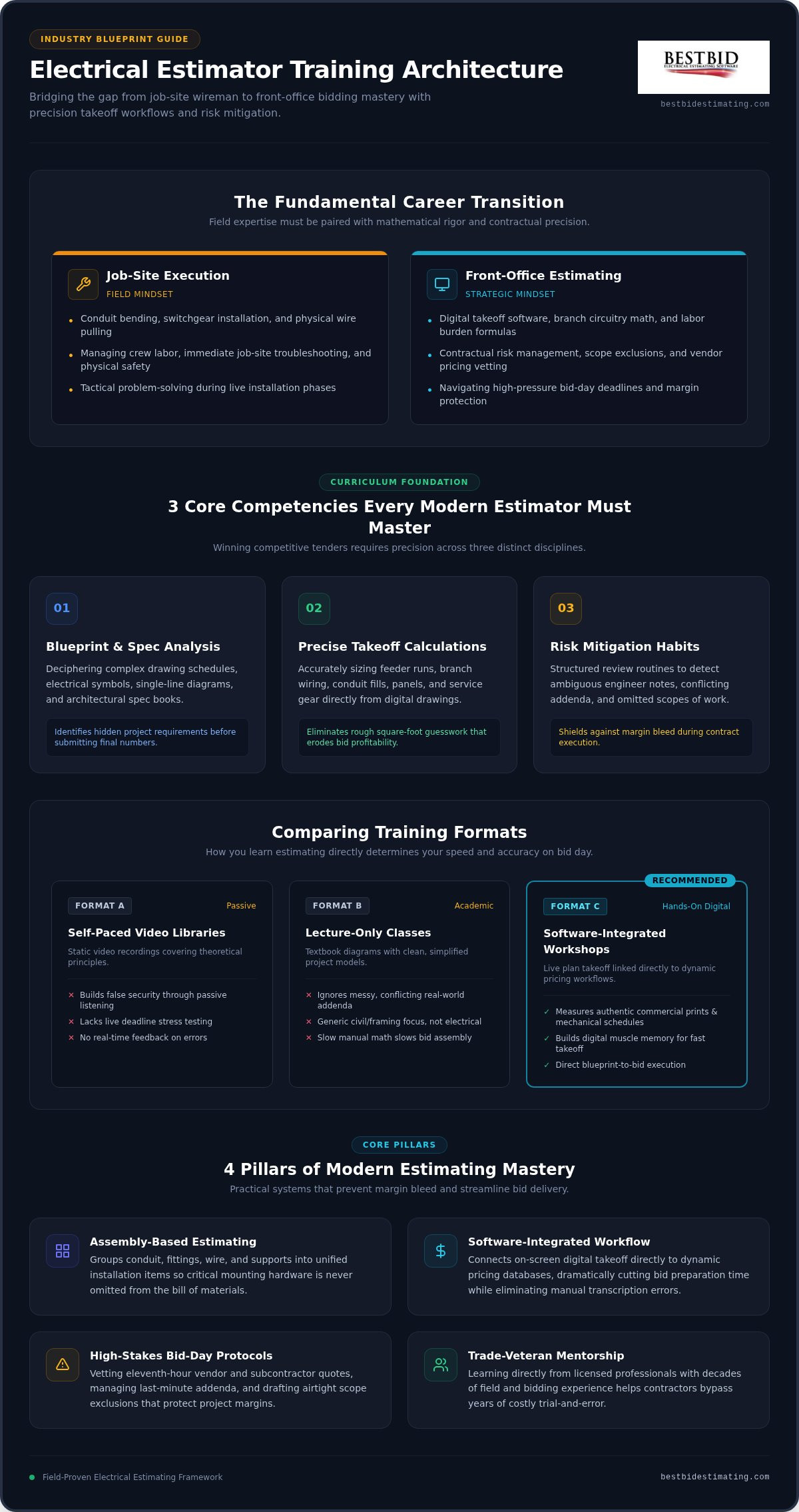
Transitioning from pulling wire on a commercial job site to pricing multi-million-dollar bids behind a desk is a massive career milestone. It requires an entirely different mindset. Running crews demands field grit; estimating demands mathematical rigor, contractual precision, and deep financial clarity. Professional electrical estimator training courses must bridge that gap directly. They shouldn’t treat electrical estimating like pouring concrete or framing walls. Electrical systems involve high-density complexities like branch circuitry, conduit fill capacities, and delicate switchgear packages. Missing small details leads to margin-crushing oversights on tender day. You need a program grounded in practical cost estimation principles that balances trade-specific math with fast, digital execution.
Academic Degrees vs Trade-Focused Industry Workshops
Do you really need to spend two years inside a college lecture hall studying generic construction management? For working tradespeople, spending years on theoretical coursework rarely makes financial sense. Academic tracks often cover broad civil engineering concepts while completely ignoring real-world bidding pressures. Practical, trade-focused workshops get straight to the point. They offer flexible, accelerated learning that lets you apply new skills to active bids immediately. Exploring a dedicated online school for electrical estimating helps contractors skip academic fluff, mastering live plan takeoffs and aggressive bidding strategies without pulling them away from daily operations.
The Core Competencies Every Modern Estimator Must Master
Winning bids consistently requires mastery across three foundational areas:
- Blueprint and Specification Analysis: Deciphering complex drawing schedules, electrical symbols, single-line diagrams, and architectural spec books to catch hidden requirements before submitting numbers.
- Precise Takeoff Calculations: Accurately sizing feeder runs, branch wiring, conduit fills, panels, and service gear rather than relying on rough square-foot guesses.
- Risk Mitigation Habits: Developing structured review routines to catch ambiguous engineer notes, conflicting addenda, and omitted scope items before the bid deadline strikes.
Mastering these fundamentals ensures your bids protect company profits instead of leaving money on the table.
Comparing Course Formats: Self-Paced, Instructor-Led, and Software-Integrated
How you learn estimating matters just as much as what you study. Sifting through electrical estimator training courses reveals three common formats: self-paced video libraries, scheduled classroom lectures, and software-integrated workshops. For electrical contracting businesses structuring internal employee development programs, platforms like WestNet LMS provide an organized framework for delivering modules. However, watching static video recordings alone builds a false sense of security. Estimating isn’t a spectator sport; without hands-on exercises, you quickly hit a wall when dealing with actual bid deadlines. The fastest path to bidding competency merges structured trade instruction directly with live digital takeoff tools, bridging the divide between theory and productive output.
Why Real Plan Takeoff Practice Outperforms Lecture-Only Classes
Textbook diagrams are clean, neat, and predictable. Real-world construction drawings are messy, crammed with addenda, and often contradictory. Effective training forces you to measure actual commercial prints where critical scope hides inside mechanical schedules, reflected ceiling plans, and architectural elevation notes. Working on authentic project files builds the digital muscle memory you need to trace linear conduit runs, count specialty gear, and spot missing information before submitting numbers. If you want to streamline your workflow, pairing targeted education with modern electrical estimating tools turns blueprint analysis into an automated, repeatable habit.
Evaluating Instructor Qualifications and Field Background
Who is actually teaching the material? Many courses rely on academic lecturers or software vendors who understand interface buttons but have never run conduit or faced a general contractor on bid day. Look for programs led by licensed trade veterans with decades of field and project management experience. Instructors who follow the professional standards set by organizations like the American Society of Professional Estimators (ASPE) teach you how to anticipate unseen labor risks, crew bottlenecks, and complex material logistics. That real-world perspective helps you protect your margins from costly trial-and-error.
Ready to see how modern tools simplify complex takeoffs? Test-drive an intuitive platform at bestbidestimating.com to experience how purpose-built software transforms your daily bidding accuracy.
Essential Curriculum: From On-Screen Takeoff to Labor Burden Calculations
High-caliber electrical estimator training courses must move well beyond rudimentary theory. To prepare you for commercial bidding, the curriculum should focus on real-world execution: setting up electronic drawings, generating assembly-based takeoffs, and factoring genuine labor units. Building a bid item by individual item takes too long and invites errors.
Elite programs teach you to group conduit, straps, fittings, wire, and mounting hardware into unified assemblies. One click calculates the entire system, speeding up your turnaround while capturing every washer and junction box.
Mastering On-Screen Takeoff and Plan Markup Workflows
Relying on physical architectural rulers and paper prints slows your bidding pace to a crawl. Modern workflows start by calibrating drawing scales electronically, isolating device layers, and auto-tracing branch circuits. Using dedicated takeoff applications like Accura Cadd PDF Draw allows you to overlay plan revisions, flag discrepancies, and tally symbols cleanly across dozens of pages. Digital takeoffs prevent duplicate counts and ensure your base quantities reflect actual project prints.
Calibrating Labor Units for Job-Site Realities
Published labor manuals provide useful starting baselines, but applying those numbers blindly will wreck your job margins. A 10-foot run of EMT installed on an open drywall ceiling requires vastly different labor than running conduit 25 feet high off a scissor lift in a live manufacturing facility. Comprehensive training teaches you how to adjust labor units based on:
- Elevation and Accessibility: Stepping up labor for staging, lifts, and working in confined mechanical rooms.
- Crew Composition: Blending master, journeyman, and apprentice hourly rates into an accurate composite labor burden.
- Productivity Loss: Factoring environmental fatigue, trade stacking, shift differentials, and non-productive material transport.
Managing Material Pricing Volatility and Vendor Quotes
Copper, steel conduit, and gear packages fluctuate constantly. Top-tier electrical estimator training courses teach you to move away from static supplier price books in favor of dynamic vendor pricing feeds. Learning how to structure quote comparisons ensures that eleventh-hour distributor numbers drop smoothly into your estimate without overwriting custom assembly markups. Covering overhead, bonding, general conditions, and clear profit margins ensures your bid isn’t just low enough to win, but built to safeguard the bottom line.
Beyond the Numbers: Bidding Strategy, Risk Management, and Bid Day Protocols
Anyone can punch numbers into a spreadsheet, but winning jobs profitably requires strategic savvy. The final hours before tender closing are notoriously chaotic. Phone calls fly in, suppliers revise pricing minutes before the deadline, and general contractors demand immediate voluntary alternates.
Academic curricula often skip these intense scenarios completely. Elite electrical estimator training courses must prepare you for the emotional pressure of bid day. You need reliable protocols to evaluate eleventh-hour distributor pricing, calculate risk exposure, and protect your enterprise from crippling scope gaps before turning in that final figure.
Structuring Proposals to Prevent Post-Award Disputes
A low price might win the contract, but an ambiguous proposal ruins your cash flow. If a specification note vaguely mentions “interlock wiring by electrical contractor,” who covers the engineering fees or extra control relays? Drafting definitive scope proposals removes that ambiguity. Clear proposals explicitly list:
- Specific Inclusions: Defining exact panel feeder sizes, fixture packages, and low-voltage raceways included in your base bid.
- Definitive Exclusions: Clarifying that trenching, backfill, concrete housekeeping pads, utility company fees, and temp power generators are excluded.
- Operational Qualifications: Stating lead-time dependencies, payment terms, and wage scale assumptions.
Aligning your estimate with clear documentation early on sets up a seamless handoff, especially when learning how to create an electrical submittal package that keeps general contractors and project engineers aligned.
Tactical Bid Day Management and Vendor Price Sealing
Mistakes on bid day usually happen during frantic cut-and-paste sessions ten minutes before tender close. You need a disciplined sorting system. Tabulate gear, lighting, and specialty systems into standardized quote sheets well ahead of time.
When that distributor calls at 1:45 PM with an updated switchboard quote for a 2:00 PM tender, you should simply slot the delta into a pre-linked summary tab rather than re-entering raw totals manually. Establish strict go/no-go boundaries. Don’t chase high-risk projects with unvetted general contractors who enforce severe liquidated damages or unreasonable retainage schedules.
Take charge of your bidding future by exploring professional training and purpose-built software options at bestbidestimating.com today.
How Best Bid Academy Delivers Field-Proven Estimating Mastery
Most commercial contractors cannot afford to lose hundreds of thousands of dollars learning how to bid through brutal trial and error. You need practical training that yields returns immediately, not abstract lectures about general construction concepts. Best Bid Academy cuts through academic noise by grounding every lesson in actual field realities. While generalist electrical estimator training courses often treat tradespeople like college undergraduates, our training treats you like a business owner whose livelihood depends on pinpoint mathematical accuracy and sustainable profitability.
The Steve Griffin Philosophy: Practical Lessons Learned in the Trenches
Who built your training program matters. Founder Steve Griffin entered the electrical trades back in 1973, bringing more than 50 years of hands-on installation and professional estimating experience directly to the curriculum. As an active member of the International Association of Electrical Inspectors (IAEI) and author of the industry book Everybody Has a First, Griffin created a learning path that directly addresses the real-world obstacles contractors face every day. You don’t just study raw formulas. You master labor productivity management, vendor negotiation tactics, and client communication strategies that protect your bottom line under pressure.
Accelerating Estimator Productivity with Specialized Digital Tools
Bypassing the bidding learning curve requires uniting trade wisdom with modern software execution. Best Bid Academy integrates real-world takeoff workflows directly with cutting-edge platforms like Best Bid Next Generation. Instead of fumbling with disconnected spreadsheets, you learn how to implement seamless assembly-driven workflows that track conduit, fittings, wire, and labor units under a unified system. Have questions about setting up your workspace? Review our comprehensive FAQ resources to see how contractor-focused support guides your development every step of the way.
Equipping your estimating department with specialized tools changes everything. When you explore our dedicated suite of electrical estimating software alongside expert instruction, you stop worrying about overlooked scope and start submitting bids built for long-term company growth.
Take Control of Your Bids and Protect Your Bottom Line
Winning profitable electrical contracts shouldn’t feel like rolling the dice on bid day. When you replace outdated manual formulas with modern digital workflows, you eliminate costly omissions and take complete ownership of your project margins. Choosing the right electrical estimator training courses equips you with the tactical plan analysis, assembly takeoff speed, and scope clarification skills needed to compete with anyone in the industry.
You don’t have to navigate this career transition through costly trial and error. Best Bid Academy brings you nationwide training programs tailored specifically for electrical contractors who want to master real-world bidding. Led by founder Steve Griffin, who brings over 50 years of electrical trade experience and practical lessons from his industry book Everybody Has a First, our hands-on coaching turns estimating uncertainty into long-term financial security. Stop letting guesswork cut into your profits. Connect with our team today and Master Accurate Bidding with Best Bid Academy so you can submit every commercial tender with total confidence.
Frequently Asked Questions
How long does it take to complete an electrical estimator training course?
Completion times vary depending on the course structure you choose. Self-paced on-demand programs usually take between two to six weeks, while live interactive workshops can deliver core concepts in several intensive sessions. Unlike multi-year academic degrees, trade-focused classes let working electricians learn practical takeoff methods in the evening and apply those skills directly to live commercial bids within days.
Can an electrician transition to estimating without a formal college degree?
Yes, practical installation experience often carries far more weight in an estimating department than an academic degree. Knowing how electrical systems assemble on a job site gives tradespeople an edge over theorists. For tradespeople who also want to formally certify their background, services like Right Pathway help convert hands-on trade experience into recognized qualifications. Targeted electrical estimator training courses then teach you the front-office fundamentals, such as digital plan takeoffs, labor burden formulas, and bid-closing protocols, enabling you to step into the estimator seat with confidence.
A solid foundational program must cover commercial blueprint reading, specification book analysis, and drawing schedule interpretation. You need to learn how to trace conduit runs digitally, group items into repeatable assemblies, calculate feeder fills, and structure quote requests for suppliers. Top courses also teach you how to draft airtight scope exclusions to protect your cash flow from unexpected job-site disputes.
Is on-screen takeoff software training included in professional estimating courses?
How do electrical estimating classes teach accurate labor rate calculations?
Professional courses teach you to build a true composite labor rate rather than guessing a single hourly wage. You will learn to factor blended crew costs balancing journeymen with apprentices. Training covers productivity adjustments for installation height, occupied spaces, and fatigue. You also discover how to account for non-productive hours like staging material, travel, safety meetings, and cleanup.
What is the difference between generic construction estimating and electrical-specific courses?
Generic construction courses rely heavily on square-foot cost models and general carpentry concepts that fail in the electrical trade. Dedicated electrical estimator training courses concentrate exclusively on trade-specific complexities like branch circuitry, motor control centers, switchgear, and conduit fill rules. They teach you to price thousands of individual fittings and specialty devices that general programs ignore completely.
Why is field experience valuable when learning electrical estimating?
Field experience gives you a realistic understanding of how fast crews actually work under challenging conditions. If you have bent rigid conduit or pulled wire through tight mechanical shafts, you know where unexpected labor bottlenecks occur. Quality training helps you harness that practical job-site knowledge, translating physical trade experience into structured digital assemblies that reflect real-world installation times.