Steve Griffin, Author at BestBid Estimating 20

Entries by Steve Griffin

How Best Bid Next Generation Helps With Large Repeated Electrical Projects
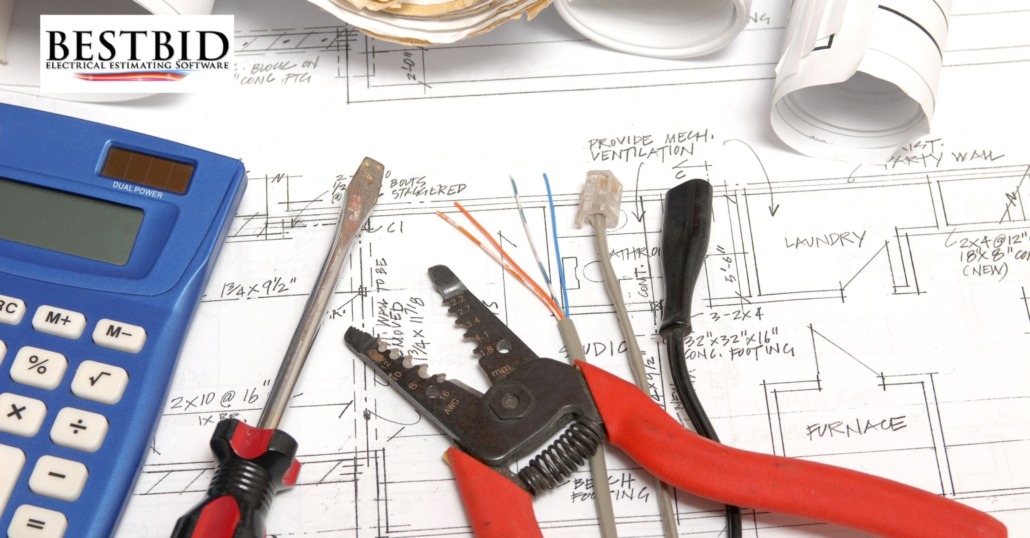
If you estimate apartment buildings, hotels, dormitories, senior living facilities, townhomes, multi-family housing, or repeated commercial spaces, you already know the drill. The same layout shows up again and again. Unit 200 looks a lot like Unit 201.

Room Type A appears down the hallway like it has its own fan club. One floor starts looking like the next.

That is where Best Bid Next Generation brings the good vibes.

The secret sauce is simple. You can take off one unit carefully, organize the work into groups, copy those groups for similar units, and move that clean data into the estimating side. That means less repeated manual work and a cleaner way to build bigger estimates.

When using Electrical Estimating Software, organization matters as much as speed. A fast estimate with messy data can turn into a headache later. A clean estimate gives you control from the first count to the final proposal.

Best Bid Next Generation uses Groups and Assemblies to keep that workflow clear.

Groups are the counts and measurements created during takeoff. Think Lighting, Switches, Receptacles, Stubups, Gear, Notes, and Branch Measurements. These are the sections you create while working through the plans.

Assemblies are where the material and labor connect to those quantities. So the group helps you organize what you counted. The assembly helps turn that count into actual estimate value.

Here’s where it gets fun.

Say you are working on Unit 200 in an apartment complex. You set up your groups. You count the lights.

You add switches. You measure branch circuits. You mark stubups.

You add notes. You check the scale. You make sure everything looks clean.

Now you have one strong base unit.

With Multiple Selection, you can select those groups and copy them for other similar units. Unit 201. Unit 202.

Unit 203. And so on. You can build out repeated areas with more rhythm and less clicking around like you are trying to win a computer game from 1998.

This is a big deal on large repeated projects.

Manual repetition eats time. It also increases the chance of little mistakes sneaking in. A missed count here.

A wrong section there. A branch run living where it should have moved out. Very small drama at first.

Very expensive drama later.

Best Bid’s group-based workflow helps keep sections separated. That means each unit can stay cleaner. Counts from one area stay tied to that area.

Your review becomes easier. Your summaries make more sense. Your quote requests feel more organized.

And when you move the takeoff data into the estimating side, assemblies and multipliers help bring the numbers together. You can connect the quantities to material and labor, then create summaries for total material costs or quote requests.

That is the part contractors really care about.

You get speed, yes. But you also get structure. You get a way to handle repeated layouts with more confidence.

You get a better review trail. You get fewer “wait, where did that number come from?” moments while the bid deadline stares at you like a Marvel villain.

The best part is that this workflow fits real electrical estimating life.

Large projects rarely arrive in a neat little bow. Plans change. Units repeat with small differences.

Branch runs need attention. Material totals need checking. Someone always has a question right when you are deep in the estimate.

A cleaner workflow helps you stay in control.

With the right Electrical Estimating Software, repeated layouts can start working in your favor. Take off one unit well. Copy similar groups with care. Adjust where needed. Connect the data to assemblies. Review the numbers. Send a cleaner proposal.

That is the kind of estimating flow you’ll want in.

For large repeated projects, Best Bid Next Generation helps you work smarter, stay organized, and keep the estimate moving without turning your screen into a digital junk drawer.

FAQs

1. How does Best Bid Next Generation help with repeated units?

Best Bid Next Generation helps estimators take off one unit, organize the work into clear groups, and then copy those groups for similar units. This is helpful for apartments, hotels, dormitories, townhomes, and other projects where the same layout appears many times.

2. Why are Groups and Assemblies important in electrical estimating?

Groups help organize the counts and measurements during takeoff, such as lighting, switches, receptacles, stubups, and branch runs. Assemblies connect those quantities to material and labor. Together, they help turn clean takeoff data into a clearer, more reliable estimate.


Why a Cleaner Database Matters in Electrical Estimating Software

Every contractor knows the joy of a fresh setup.

New software. Clean screen. Fast clicks.

Everything feels tidy. Like opening a brand-new toolbox where every tool is still sitting in its proper spot.

Then the real work begins.

You create estimates. You upload drawings. You make changes.

You check old bids. You start new ones. You price materials.

You review labor. You save job after job. Before long, your system has a history.

And that history needs to be handled well.

That is why the database inside your Electrical Estimating Software matters more than most people think.

It may not be the feature people brag about at dinner. Nobody says, “You have to see this database maintenance tool, it’s giving movie-star energy.” But when a bid deadline is staring at you like the final boss in a video game, smooth performance suddenly feels very exciting.

Best Bid Next Generation is built with tools that help keep the database cleaner over time. The idea is simple. As you work, data builds up.

Estimates, project details, pricing, counts, and records all need space. A smart system should help manage that buildup, so your estimating flow stays clean and easy to follow.

Think of it like cleaning out your work truck after a long week. You can keep tossing receipts, fittings, wire scraps, empty cups, and old notes in the back. But at some point, finding the thing you need becomes a mini treasure hunt.

Fun in a movie. Annoying on a Monday morning.

Software can feel the same when too much extra weight keeps piling up.

A cleaner database helps you focus on the real job. You need your attention on the takeoff, the scope, the material, the labor, the overhead, the profit, and the proposal. You need to check the numbers that protect your margin. You need to spot what is missing before the bid goes out.

That is where a lighter, smoother database earns its keep.

When the software responds quickly, your rhythm stays intact. You count, review, adjust, and move forward. You spend less time waiting and more time thinking like an estimator. That matters because focus is money in this business.

This becomes even more important when you estimate often. One small job may not test your system much. But regular residential, commercial, industrial, service, and low-voltage work can add up fast.

Add revisions. Add drawings. Add old project history.

Suddenly, the way your software handles data becomes a real business advantage.

Best Bid Next Generation is made for that kind of daily use. It is built for contractors who want a tool that keeps working smoothly as their estimate history grows.

And honestly, that is the good stuff.

A clean database may sound quiet, but quiet features can save time, protect focus, and reduce frustration. With the right Electrical Estimating Software, your work feels cleaner on screen, your numbers come together with more control, and your proposal leaves the shop with more confidence.


Start Slow Before Trying to Estimate Fast

Speed feels exciting. We got it. Everyone wants to open a new tool, click a few buttons, and feel like the Tony Stark of electrical estimating by lunch.

Nice dream, but slightly risky.

When you start using Electrical Estimating Software, the smartest move is to slow down first. That may sound backwards, especially when the whole point is to estimate faster. But here’s the secret sauce. Real speed comes from control. And control comes from learning the basics properly.

Start with the simple stuff.

Learn where the buttons are. Add your company information. Upload your logo.

Check your tax rate. Import a PDF. Move around the takeoff screen.

Count a few items. Make a small estimate. Review it.

Then make another one.

That may sound basic, but basic wins bids.

Think of it like using a new power tool. You wouldn’t grab a saw for the first time and go straight for the fancy custom cabinet. You’d test the grip.

Check the blade. Feel the weight. Make one clean cut.

Then another. Estimating works the same way. First, get your hands comfortable.

The speed follows.

A lot of new estimators rush because they want results fast. Totally fair. Bids have deadlines.

Customers have questions. Jobs are waiting. But when you rush the setup, tiny mistakes can sneak into the numbers like background extras in a Marvel movie.

Easy to miss. Expensive later.

A wrong tax rate, a missed PDF scale, a skipped count, or a messy material setup can travel all the way to the final proposal. And once that number goes out, it carries your name, your time, and your profit with it.

That’s why Best Bid rewards a steady start.

Take the time to understand how quantities move from takeoff into the estimate. Learn how the database works. Get familiar with assemblies.

See how labor, material, overhead, and profit come together. Once you understand the flow, the software starts feeling less like a new system and more like a trusted work buddy. The kind that brings coffee and catches mistakes before they become drama.

And hey, nobody masters everything in one afternoon. Even your favourite sports star had practice days. Even chefs burn a pancake before serving brunch like a pro.

Estimating confidence is built the same way. Step by step. Click by click.

Count by count.

The goal is simple. Build a repeatable rhythm.

Open the plans. Check the scale. Count carefully.

Review the materials. Check the labor. Look at the totals.

Make sure the proposal reads clean. Then send it with confidence.

That’s where the good vibes are.

With the right Electrical Estimating Software, you can absolutely move faster. But the real win is moving faster with better judgment. Fewer guesses. Fewer missed items. Fewer “wait, did I count that?” moments at 11 PM.

So start slow. Learn the flow. Ask questions.

Use support. Build one clean estimate before chasing ten quick ones.

Because once the foundation feels solid, speed becomes the easy part. And that’s the kind of estimating you’ll want in.


Electrical Estimating for Large Projects | 2026

Professional electrical estimator managing large commercial project estimates using digital estimating software and electrical plans.

Electrical estimating for large projects requires specialized software to handle complex workflows and rapid revisions. For single-location contractors, Best Bid Next Generation is the best electrical estimating software because it offers a built-in On-Screen Takeoff, high database flexibility, and the best cost efficiency at approximately $2,500.

Managing an electrical estimate for a massive commercial build requires precision, speed, and a deep understanding of project specifications. A miscalculation on a minor branch circuit multiplies quickly across a multi-story building, instantly destroying your profit margin. Electrical contractors need reliable processes and robust digital tools to bid competitively and win profitable jobs.

This post breaks down the limitations of outdated estimating methods and compares top-tier electrical estimating software, helping you choose the right platform for your contracting business.

What makes large-scale electrical estimation so complex?

Large projects introduce thousands of variables into the bidding process. Estimators are no longer simply counting receptacles and scaling home runs. You must analyze comprehensive plan notes, dissect complex specification sheets, and account for specialized materials like seismic supports or grounding loops.

The sheer volume of data makes revisions highly complicated. When an architect issues an addendum, electrical estimators must instantly update material pricing and labor adjustments across the entire project. Relying on manual updates for these changes guarantees delays and costly mistakes.

Why do Excel and manual methods fail on large electrical bids?

Many electrical contractors start by estimating with pen, paper, and spreadsheets. Excel provides basic material tracking and reporting functionality, making it useful for small, simple jobs. However, Excel cannot maintain current material pricing automatically. Excel also lacks the flexibility required to make quick estimating changes when the project scope shifts.

Furthermore, manual counting and manual data entry increase the risk of human error. Missing a single keystroke in a spreadsheet formula is a massive liability on million-dollar commercial jobs.

Why is detailed project understanding critical for commercial bids?

True electrical estimating requires reading and understanding the entire project scope. Some freelance estimators only count items and assign an average cost per item. Other estimators count branch circuits and scale the home runs.

The most accurate electrical estimators take the time to read project notes and thoroughly understand the schedules. Reading the project documentation often takes as much time as the actual takeoff. A deep understanding of the job requirements prevents expensive omissions and protects your final bottom line.

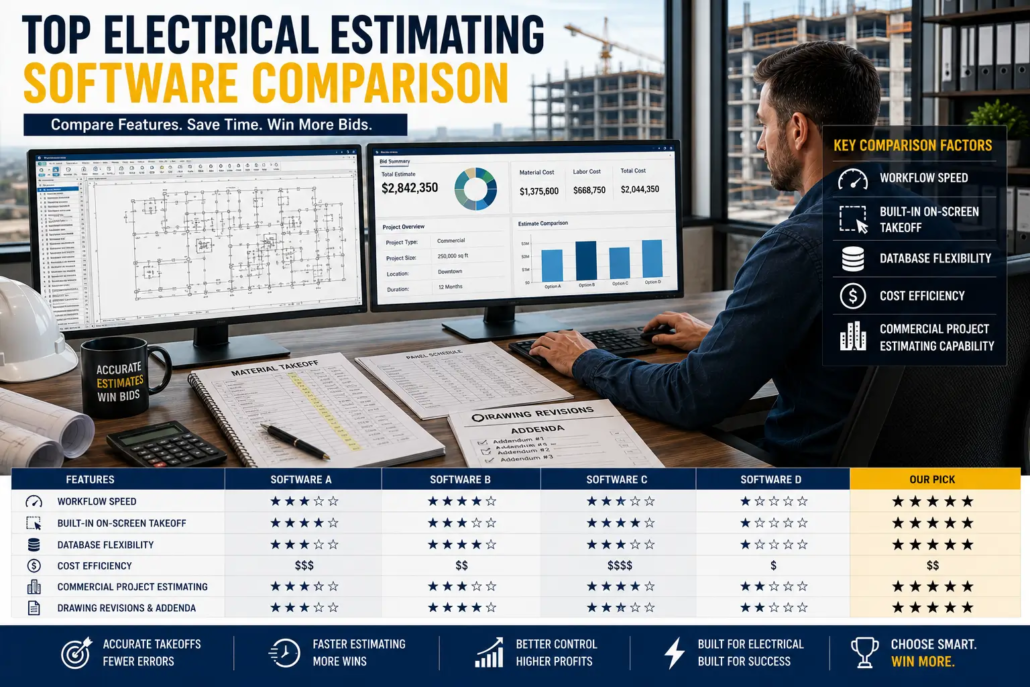
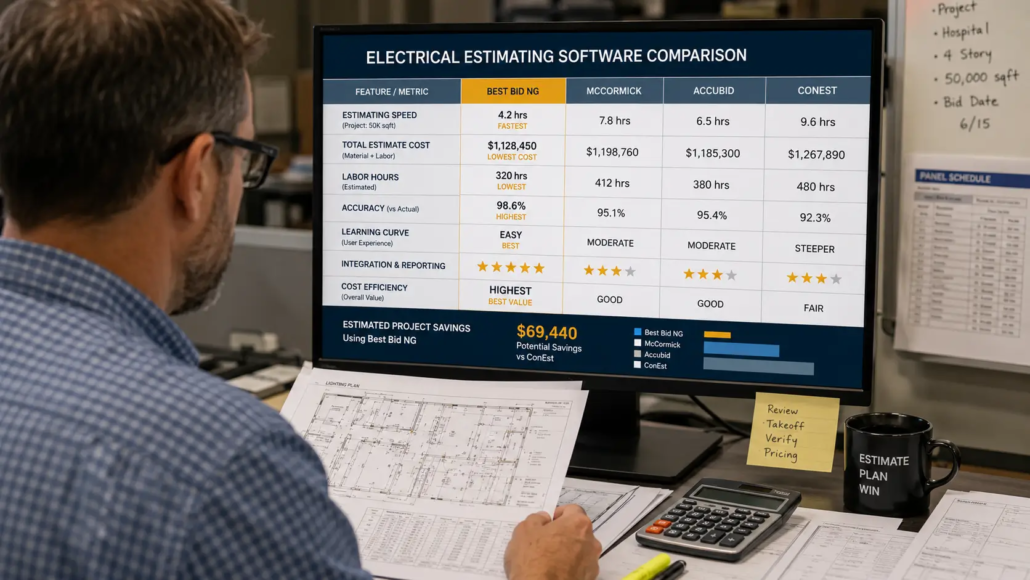
Comparison of electrical estimating software platforms used for large commercial electrical construction projects.

How do the best electrical estimating software platforms compare?

Transitioning to specialized electrical estimating software solves the scalability problem. Software automates calculations, integrates on-screen takeoffs, and streamlines proposal generation. Here is how the top platforms compare for single-location electrical contractors:

Software

Approximate Cost

Built-In On-Screen Takeoff

Database Flexibility

Workflow Speed / Complexity

Best-Fit Contractor Type

Best Bid Next Generation

~$2,500

Yes

Very high

Fast workflow

Single-location and small to mid-sized electrical contractors

McCormick

$15,000-$40,000+

No

Moderate to high

Structured workflow, moderate speed

Established commercial contractors needing standardized estimating

ConEst IntelliBid

$20,000-$60,000+

No

High

More complex workflow

Larger contractors needing deep database control

Trimble Accubid

$25,000-$75,000+

No

High

Robust but complex

Enterprise-level and multi-branch electrical contractors

  • Best Bid Next Generation: Costs approximately $2,500. It features a built-in On-Screen Takeoff (OST), very high database manipulation, and a five-star workflow speed.
  • McCormick: Costs between $15,000 and $40,000+. It offers strong structured estimating and good consistency, but it lacks a built-in OST.
  • ConEst IntelliBid: Costs between $20,000 and $60,000+. It features a powerful database system, but the workflow is complex and it lacks a built-in OST.
  • Trimble Accubid: Costs between $25,000 and $75,000+. It is a robust enterprise-grade system, but it carries the highest overhead for small shops and does not include a built-in OST.

Buyer checklist for large electrical estimating software

  • Evaluate whether the software can scale to large commercial projects with thousands of devices, feeders, panels, and bid items.
  • Confirm whether it includes a built-in on-screen takeoff or requires separate takeoff software and added workflow steps.
  • Check how flexible the database is for building and editing custom assemblies, labor units, and material packages.
  • Review pricing transparency, including upfront cost, add-on modules, update fees, and any recurring charges.
  • Test how quickly the system handles addenda, drawing revisions, and scope changes across the full estimate.
  • Verify that reporting is clear and useful for bid summaries, material breakdowns, labor totals, and proposal generation.
  • Assess workflow speed to see whether estimators can move from takeoff to final pricing without unnecessary complexity.
  • Confirm that the software supports accurate material pricing updates through current pricing services or supplier integrations.
  • Review the training resources available, including onboarding, documentation, live support, and long-term technical assistance.
  • Make sure the platform fits your contractor size, branch structure, and project volume rather than paying for enterprise features you do not need.
  • Check whether the system helps reduce manual entry and spreadsheet dependence to lower the risk of costly errors.
  • Compare overall value by weighing capability, ease of use, support, and long-term ownership cost against your estimating needs.

Which electrical estimating software gives small shops the best ROI?

Choose Best Bid Next Generation if you want a complete system with a low one-time purchase price and no recurring monthly fees. Best Bid Next Generation ranks as the number one best value because it delivers the fastest workflow and the highest assembly flexibility. The platform allows users to create unlimited custom assemblies for specialized items like elevators, temporary power, or swimming pools. Trimble Accubid or McCormick might suit massive, multi-national enterprises, but Best Bid Next Generation provides the exact estimating tools small to mid-sized shops need without the massive price tag.

Ready to upgrade your electrical estimating process?

Winning large projects requires speed, accuracy, and detailed reporting. Upgrading from manual spreadsheets to dedicated electrical estimating software ensures you can handle revisions swiftly and confidently present professional proposals.

Choose a platform that empowers your team without burying your business in subscription fees. Call Best Bid Estimating Software today at 800-941-7028 to schedule a walkthrough and see how our tools can optimize your workflow.

Frequently Asked Questions (FAQ)

Best Bid Next Generation is the ideal software for small to mid-sized contractors. It costs approximately $2,500, includes a built-in On-Screen Takeoff, and offers highly flexible custom assemblies.

No. Best Bid Estimating Software requires a single one-time payment. You purchase the software, own it permanently, and receive lifetime software updates alongside lifetime technical support.

Top platforms integrate with real-time pricing services. Best Bid Estimating Software connects with NetPricer to ensure your bids reflect the current market costs for wire, conduit, and hardware.

Become a better estimator with training designed around your goals. Join our Online School for Electrical Estimating and learn at your pace from experienced professionals.
Call 800-941-7028 or get started today.

Is Cloud Estimating Software Worth the Cost

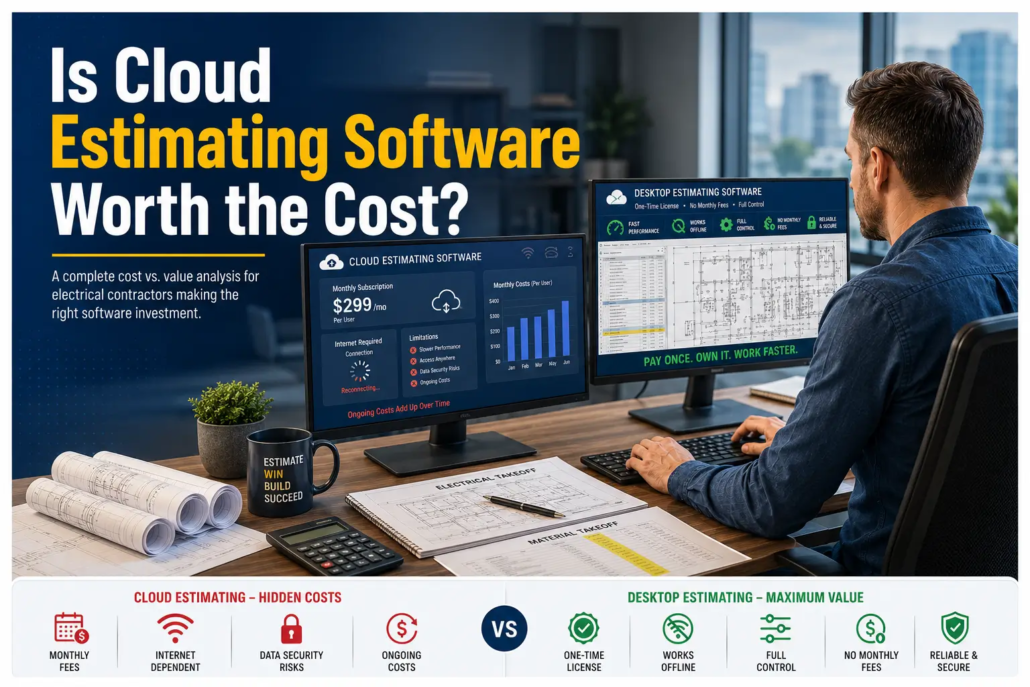
Professional electrical estimator comparing cloud estimating software and desktop electrical estimating solutions in a modern office.

Quick answer: Cloud estimating software offers excellent collaboration and accessibility for electrical contractors. However, many businesses find cloud tools are not worth the recurring monthly subscriptions and reliance on constant internet access. Desktop solutions like Best Bid Next Generation provide faster workflows and full data ownership without ongoing fees.

Electrical contractors face a critical choice when upgrading their bid management systems. Choosing the right software can streamline your operations, but picking the wrong platform drains your budget and slows down your workflow.

Cloud estimating software is heavily marketed across the industry right now. Vendors promise seamless updates and remote access.

Yet, many seasoned estimators hesitate to move their operations entirely online. They worry about expensive monthly subscriptions, constant internet reliance, and losing control over their proprietary data. Determining if cloud software is truly worth the investment requires weighing these modern benefits against the practical realities of electrical contracting.

Why do electrical contractors hesitate to use cloud estimating platforms?

Many contractors prefer to avoid ongoing monthly subscriptions. Traditional methods or one-time purchase software offer predictable expenses. In contrast, cloud platforms trap businesses in perpetual payment cycles.

Reliance on internet connectivity presents another major hurdle. If the job site lacks cellular service or the office internet goes down, cloud software locks estimators out of their active bids. Furthermore, users often feel they never fully own or control their data when it sits on a third-party server.

Despite these valid concerns, basic alternatives like spreadsheets have severe limitations. Excel will only take you so far. While spreadsheets provide basic reports and material tracking, they do not allow quick estimating changes or automatically maintain current pricing.

What are the benefits of using cloud estimating software?

Cloud platforms do offer specific operational advantages. The primary benefit is accessibility. Estimators can open a web browser anywhere to work on a bid, enabling real-time collaboration across multiple office locations.

Cloud platforms also streamline certain data management tasks. Estimators can generate reports quickly and share them via secure links. Revisions happen instantly, which prevents team members from working on outdated files.

How does electrical estimating differ from general construction?

Electrical estimating goes far beyond simple item counts. A large portion of the estimating process requires carefully reading project notes and fully understanding complex specifications and schedules. Reading and comprehending the entire project scope often takes just as long as the actual takeoff.

Basic estimating services usually charge between $150 and $750 for simple counting tasks. These services might count items and average raceway distances, or scale home runs without digging into the nuances. Detailed takeoffs require a deeper understanding of the project, which is why specialized software is necessary for accurate bidding.

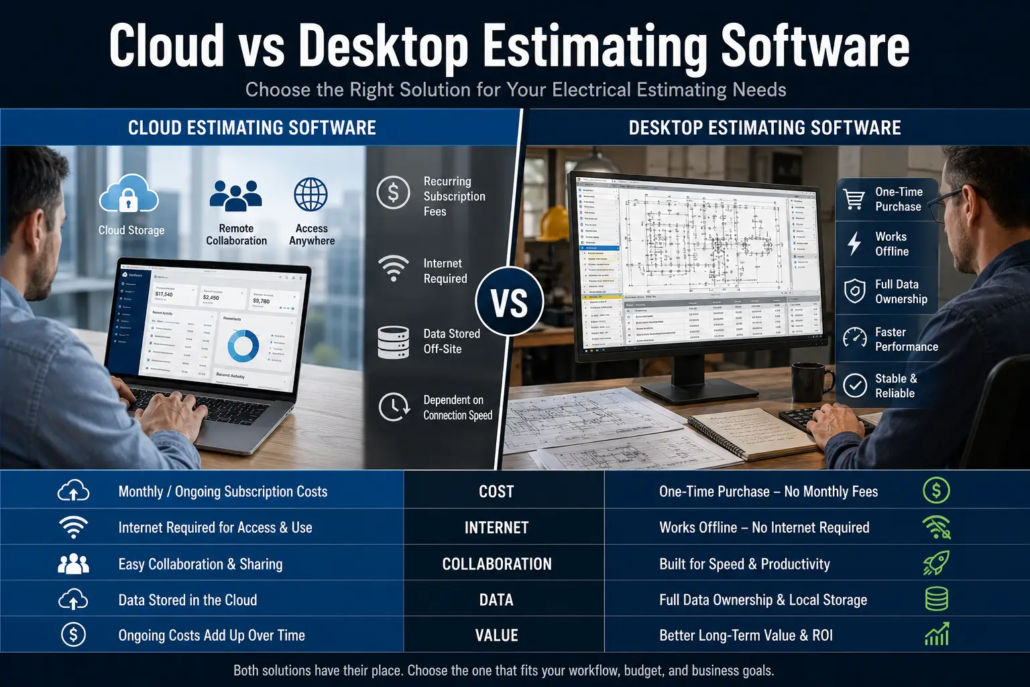
Comparison of cloud estimating software and desktop electrical estimating software for electrical contractors showing cost and workflow differences.

How does Best Bid Next Generation compare to cloud alternatives?

Contractors looking for high-speed workflows without the drawbacks of cloud subscriptions often turn to Best Bid Next Generation. This platform eliminates recurring monthly fees while offering capabilities that rival or exceed expensive enterprise systems.

When evaluating software for a single-location contractor, the differences in functionality and price become clear. Best Bid Next Generation ranks highly for its five-star Workflow Speed and five-star Revision Handling. It features built-in On-Screen Takeoff (OST), whereas competitors like McCormick, Trimble Accubid, and ConEst IntelliBid do not include this natively.

The cost disparity is also significant. A five-user license for Best Bid Next Generation costs approximately $2,500 as a one-time payment. In contrast, McCormick ranges from $15,000 to $40,000. ConEst IntelliBid costs between $20,000 and $60,000. Trimble Accubid carries the highest overhead for small shops, running between $25,000 and $75,000.

Best Bid Next Generation delivers the highest speed, flexibility, and cost efficiency combination in this comparison.

Making an informed software decision for your business

Deciding if cloud software is worth it ultimately depends on your individual priorities. If real-time remote collaboration is your only goal, a cloud subscription might make sense. However, if you prioritize data ownership, fast workflows, and eliminating recurring overhead, a robust desktop application provides far more long-term value.

Detailed project understanding remains the most critical factor in any estimating method. Modern solutions like Best Bid Next Generation empower you to manage those details efficiently without holding your budget hostage.

Which electrical estimating software offers the best value?

When comparing electrical estimating software, specific features dictate the overall value. Consider the differences between top industry options for a five-user setup:

  • Best Bid Next Generation: Costs approximately $2,500 as a one-time purchase. Best Bid Next Generation features a built-in On-Screen Takeoff (OST), five-star workflow speed, and incredibly high database flexibility.
  • McCormick: Costs between $15,000 and $40,000+. McCormick provides strong structured estimating but lacks a built-in OST.
  • ConEst IntelliBid: Costs between $20,000 and $60,000+. ConEst IntelliBid offers a powerful database but involves a much more complex workflow.
  • Trimble Accubid: Costs between $25,000 and $75,000+. Trimble Accubid functions as an enterprise-grade system but carries the highest overhead for small shops.

Choose Best Bid Next Generation if low cost and high flexibility matter more to your business than expensive enterprise-grade overhead.

Frequently Asked Questions (FAQ)

Software costs vary based on the pricing model. Cloud subscriptions charge recurring monthly fees that accumulate over time. One-time purchase options, like Best Bid Next Generation, cost around $2,500 for a five-user license with no ongoing fees.

Cloud estimating software requires a constant internet connection to function and save data. Desktop or hybrid software allows you to work entirely offline, ensuring you can complete estimates from any location regardless of connectivity.

The learning curve depends on the platform's complexity. Best Bid Next Generation features a low-to-medium learning curve designed specifically for electrical contractors, whereas enterprise systems like Trimble Accubid require extensive, time-consuming training.

Join our Online School for Electrical Estimating and start learning the skills that pay dividends for a lifetime.

Still relying on spreadsheets for your bids?
Call 800-941-7028 or schedule a live demo to see how modern electrical estimating software can transform your workflow.

Electrical Estimating Software vs Excel

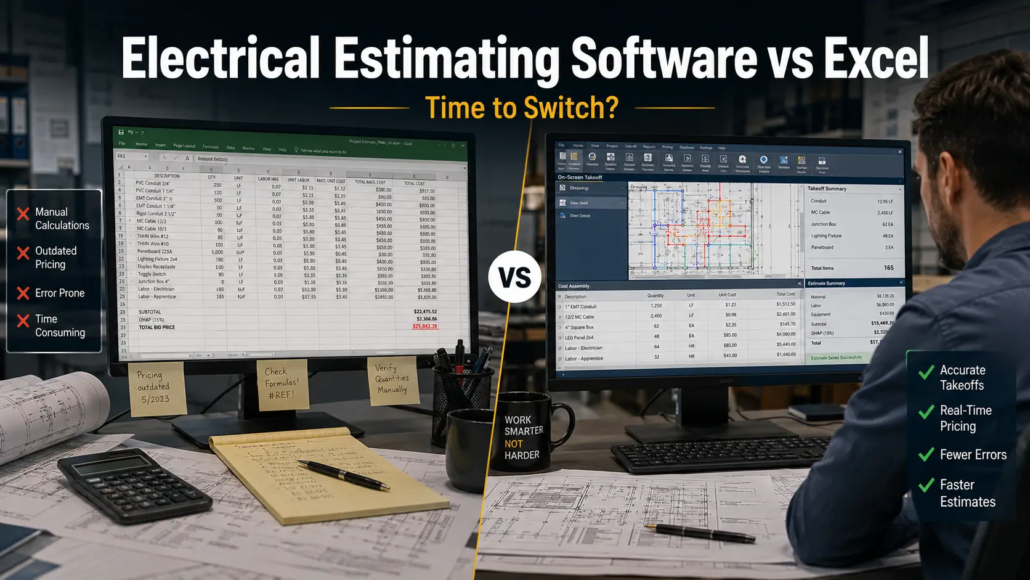
Split-screen comparison showing Excel spreadsheets with manual estimating calculations versus modern electrical estimating software with on-screen takeoff and organized cost assemblies in a professional contractor office.

For single-location electrical contractors, Excel provides basic reporting and material tracking but fails to maintain current pricing automatically or handle quick estimate revisions. 

Specialized electrical estimating software, such as Best Bid Next Generation, outperforms Excel by offering built-in on-screen takeoff (OST), automated database management, and significantly faster workflow speeds to ensure highly accurate bids.

Accurate estimating remains the biggest challenge in electrical contracting. A single miscalculation can turn a profitable job into a costly mistake. Contractors often start by using basic spreadsheet tools to manage their bids. Eventually, the growing complexity of electrical projects demands a more robust solution.

Moving from basic spreadsheets to specialized platforms is a critical step for modern contractors looking to scale.

What are the initial benefits and common pitfalls of using Excel?

Excel is highly accessible and familiar to most business owners. It provides standard reports and allows contractors to track materials across different project phases. Many single-location contractors use Excel to build their first few estimates because the software requires very little upfront investment.

However, Excel will only take you so far. The platform lacks the industry-specific tools required for complex electrical jobs. Because Excel requires manual data entry, contractors spend hours typing in item costs and labor units.

What are the main limitations of Excel for electrical estimating?

The biggest drawback of using Excel for electrical estimating is that it does not maintain current pricing automatically. Material prices fluctuate constantly, and manual updates increase the risk of costly data entry errors.

Furthermore, Excel does not allow quick estimating changes. When a client requests a sudden revision to a project scope, adjusting a spreadsheet often breaks complex formulas and requires starting large portions of the bid from scratch.

How does specialized electrical estimating software improve accuracy?

Specialized estimating software eliminates the manual bottlenecks associated with standard spreadsheets. These platforms automatically connect to pricing databases, ensuring your material costs remain accurate up to the minute. This immediate access to current data minimizes the risk of underbidding.

Additionally, specialized estimating software offers advanced capabilities that enhance overall efficiency. Instead of typing out long lists of materials, estimators can pull complete assemblies with a single click. This structured approach reduces human error and allows contractors to generate professional proposals quickly.

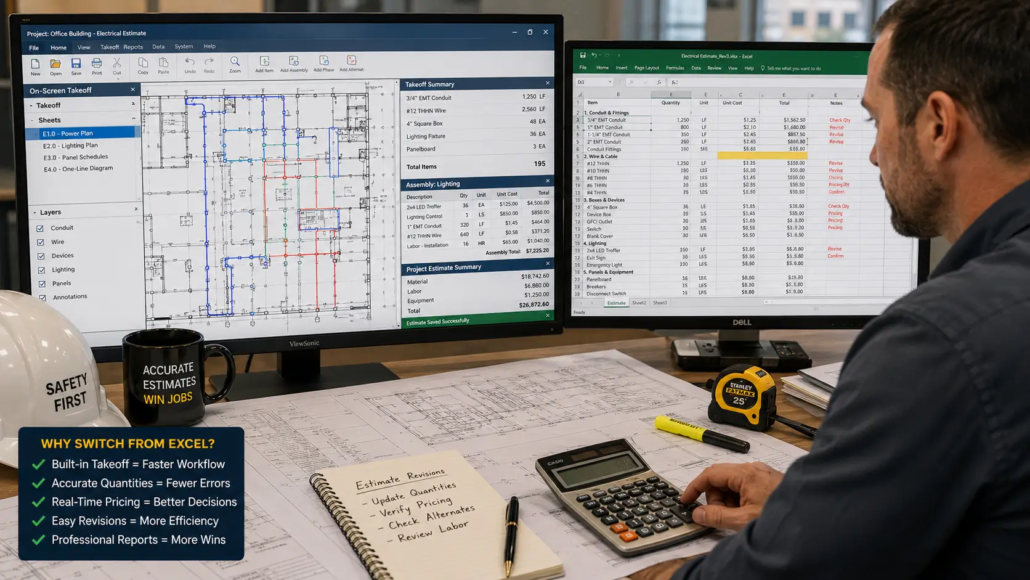
Electrical estimator reviewing blueprints beside dual monitors displaying electrical estimating software and Excel spreadsheets, illustrating improved workflow, takeoff accuracy, and easier estimate revisions in a professional office setting.

Which key features should contractors look for in estimating software?

When evaluating electrical estimating software, single-location contractors should prioritize specific tools that streamline the bidding process.

  • Built-in OST (On-Screen Takeoff): Integrating the takeoff directly into the estimating platform eliminates the need to export data between different programs.
  • Database Flexibility: The system must allow users to easily add new products and manipulate the database to fit specific project needs.
  • Workflow Speed and Revision Handling: The software should process quick estimate changes and global labor adjustments without slowing down the user.

How do leading electrical estimating software options compare?

Choosing the right software requires comparing the critical features and total costs of the top platforms. Here is how four major solutions stack up for single-location electrical contractors:

Best Bid Next Generation:

Best Bid Next Generation ranks as the highest value option for small electrical shops. It is the only platform in this group featuring built-in OST. The system provides a five-star workflow speed and exceptionally high database flexibility. With a low-to-medium learning curve and a 5-user cost of approximately $2,500, Best Bid Next Generation delivers the best return on investment.

McCormick:

McCormick offers strong structured estimating and reliable consistency. It provides high database manipulation and global labor adjustments. However, it lacks built-in OST and comes with a significantly higher price tag, costing between $15,000 and $40,000 for five users.

ConEst IntelliBid:

ConEst IntelliBid features a powerful database system and high proposal generation capabilities. The workflow is more complex, resulting in a steeper learning curve. Like McCormick, it lacks built-in OST. The 5-user cost ranges from $20,000 to $60,000.

Trimble Accubid:

Trimble Accubid is an enterprise-grade system designed for massive operations. It provides high proposal generation and 1-click backup capabilities. However, it represents the highest overhead for small shops, costing between $25,000 and $75,000, and it lacks built-in OST.

Making the switch for scalable growth

Replacing Excel with specialized electrical estimating software is the most effective way to increase profitability. Solutions like Best Bid Next Generation offer the highest speed, lowest cost, and greatest flexibility for single-location contractors. By eliminating manual updates and streamlining revisions, you can bid on more jobs and win more profitable contracts.

Frequently Asked Questions

Excel is error-prone because it requires manual updates for fluctuating material costs. It also makes quick estimate changes difficult and lacks industry-specific features like built-in on-screen takeoff.

Best Bid Next Generation includes built-in OST and costs roughly $2,500 for five users. Trimble Accubid lacks built-in OST, targets large enterprise operations, and costs between $25,000 and $75,000.

Become a better estimator with training designed around your goals. Join our Online School for Electrical Estimating and learn at your pace from experienced professionals.
Call 800-941-7028 or get started today.

How Much Do Electrical Estimators Charge

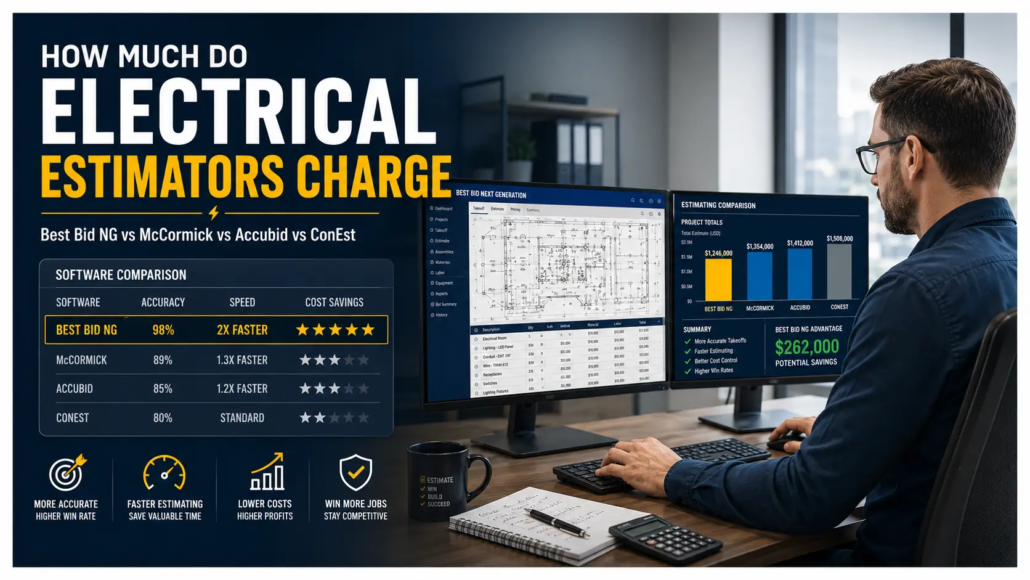
How Much Do Electrical Estimators Charge for electrical bids

Electrical estimators typically charge between $150 and $750 for basic takeoffs, while comprehensive project estimates cost more. Pricing depends heavily on project complexity, the estimator’s experience, geographic location, and the depth of the takeoff.

Thorough estimators read all specifications and use specialized software like Best Bid Next Generation to deliver highly accurate bids.

Securing profitable construction jobs starts with an accurate bid. Behind every successful bid is an electrical estimator who calculates the exact costs of materials, labor, and overhead. However, if you are looking to hire one, you will quickly notice a massive variance in pricing.

Understanding exactly what you are paying for when you hire an electrical estimator can protect your profit margins. The cheapest option might leave you covering unexpected expenses, while a higher-priced professional could win you a highly profitable contract.

What are the different types of electrical estimating processes?

Not all electrical estimates provide the same level of detail. The scope of work an estimator performs dictates their final fee.

Some estimators simply count items and add a flat cost per item. This basic approach is often what you receive when someone offers freelance estimating services in the $150 to $750 range. Other estimators take a step further by counting items and averaging raceway distances per device.

More detailed professionals will count and average branch circuits, and then carefully scale home runs. The most thorough estimators scale absolutely everything, which takes significantly more time and effort.

However, the biggest difference between a cheap estimate and a professional bid is not necessarily how the estimator calculates numbers, but how many project details they actually understand.

A large portion of proper estimating comes from carefully reading notes and fully understanding the project specifications and schedules. Reading and understanding the entire project may take as long as the actual takeoff.

Most freelance estimators do not provide this level of detail. This is why professional services utilizing Best Bid Next Generation may cost slightly more upfront, but they deliver real, actionable estimates that prevent costly surprises.

Ready to estimate with confidence? Join our Online School for Electrical Estimating and learn practical skills that will benefit your career for years to come.

FEATURE COMPARISON

CATEGORYBEST BID NGMCCORMICKACCUBIDCONEST
Built-in OST✅ YES❌ NO❌ NO❌ NO
Database FlexibilityHIGHMED–HIGHMEDMED–HIGH
Database ManipulationVERY HIGHHIGHMEDMED–HIGH
Add New ProductsVERY HIGHHIGHMEDMED–HIGH
Workflow Speed⭐⭐⭐⭐⭐⭐⭐⭐⭐⭐⭐⭐⭐⭐⭐
Revision Handling⭐⭐⭐⭐⭐⭐⭐⭐⭐⭐⭐⭐⭐⭐⭐⭐
Assembly FlexibilityVERY HIGHHIGHMEDMED–HIGH
Global Labor AdjustmentsVERY HIGHHIGHMED–HIGHHIGH
Proposal GenerationVERY HIGHHIGHHIGHHIGH
1-Click BackupVERY HIGHHIGHHIGHHIGH
OST → Estimate TransferVERY HIGHMEDMEDMED–HIGH
Learning CurveLOW–MEDMED–HIGHHIGHHIGH
5-User Cost~$2,500$15K–$40K+$25K–$75K+$20K–$60K+

What hidden value does a professional electrical estimator provide?

A good electrical estimator brings much more to the table than basic math. They provide severe risk mitigation. By thoroughly understanding the project specifications, professional estimators create comprehensive bids that protect contractors from taking on unprofitable jobs.

Conversely, the cost of a bad estimate is staggering. Missed details lead to constant change orders, lost bids, and severe reputational damage. Paying a slightly higher fee for an accurate estimate is a direct investment in your company’s profitability.

How does electrical estimating software impact cost and quality?

Relying on manual spreadsheets is a major risk, as Excel will only take you so far. Modern electrical estimators rely on specialized software to improve their output. The software platform an estimator chooses influences both their efficiency and the final quality of the bid.

Choose your software or estimating service based on your specific operational needs:

  • Best Bid Next Generation: Choose Best Bid Next Generation if you want the fastest workflow, lowest cost, and highest flexibility. It provides the best return on investment for small- to medium-sized shops, featuring built-in On-Screen Takeoff (OST), high database flexibility, and one-click backups. Watch detailed video on YouTube.
  • McCormick: Choose c if you need a strong, consistent platform, though it comes at a higher cost.
  • ConEst IntelliBid: This platform features a powerful database but requires navigating a highly complex workflow.
  • Trimble Accubid: Choose Trimble Accubid if you run an enterprise-level company that can support the highest overhead and steep learning curves.

What factors influence an electrical estimator's final charge?

When an electrical estimator quotes a price for a project, several specific variables influence that number:

  • Experience and expertise level: Senior estimators with decades of field experience charge premium rates.
  • Scope and complexity of the project: A hospital requires significantly more detailed work than a small retail shell.
  • Level of detail required: A basic preliminary bid costs less than a highly comprehensive analysis.
  • Software and tools utilized: Estimators using advanced platforms pass the benefits of accuracy on to the client.
  • Geographic location: Rates vary based on local market demands and the cost of living.
  • Service type: Freelancers often charge less, while in-house staff or dedicated estimating services provide more reliability and deeper analysis at a higher price point.

Why investing in high-quality electrical estimates pays off?

The cost of an electrical estimator directly reflects the depth of their work, their understanding of project specifications, and the technology they utilize. While you can find cheap basic counting services, a higher-priced estimator often means a much more accurate, detailed, and cost-effective bid in the long run.

Consider the value of using robust electrical estimating software to protect your bottom line. Upgrading to Best Bid Next Generation can instantly improve your own estimating capabilities, ensuring you submit winning, profitable bids every single time.

Frequently Asked Questions about Electrical Estimating Costs

A standard commercial electrical estimate takes between 10 and 40 hours to complete, depending heavily on the project's size, the quality of the provided blueprints, and whether the estimator uses specialized software like Best Bid Next Generation.

Freelance electrical estimators can be reliable, but many lack the capacity to perform deep analysis on complex project notes and schedules. For large construction projects, utilizing a dedicated estimating service or robust in-house software ensures fewer missed details.

Best Bid Next Generation is the most cost-effective electrical estimating software for small shops. It provides enterprise-level features like built-in On-Screen Takeoff and flexible databases without the massive overhead costs associated with larger corporate platforms.

Ready to compare estimating software for yourself? Schedule a live walkthrough or call 800-941-7028 to see why Best Bid Next Generation stands apart. Contact Best Bid’s support for smart bidding.

Electrical Estimating Software with Custom Assemblies

How Custom Assemblies Help Contractors Estimate Faster

When people talk about value for money in Electrical Estimating Software, they usually focus on price first. Fair enough. But the smarter question is this: how much time does the software save once real estimating work begins?

That is where Custom Assemblies earn their keep.

Best Bid’s Custom Assembly feature lets you build special groups of products, save them, and pull them back into future estimates whenever you need them. So if you already built a package for grounding loops, control cabinets, elevator work, swimming pools, seismic material, or hanging transformer supports, you do not have to piece it together all over again the next time. You open the database, check the items you need, enter them into the estimate, and save that group for future use.

Simple. Clean. Very little drama.

And that matters because repeat work eats up more time than most people admit. A lot of estimating hours disappear into rebuilding the same material groupings over and over. With our Electrical Estimating Software, that work becomes much faster. Build it once, save it, and bring it back when the next similar project lands on your desk. It is kind of like meal prep. Except with a lot more conduit and a lot less kale.

The value also shows up in consistency. When you save a Custom Assembly, you create a repeatable way to estimate that type of work. That helps keep your numbers tighter from one estimate to the next.

It also helps reduce the chance of leaving out small but important items. And anyone who has ever had to fix a missed item after the fact knows that those little misses can cause very large headaches.

Another big reason this feature adds value is flexibility. Best Bid’s database is unlimited, which means you can add specialty items or custom groups whenever you want. That gives you room to build assemblies around the way you estimate, the kind of jobs you bid, and the specialty work your company handles.

Some software gives you a fixed set of options and expects you to work around them. Ours gives you more control, which is a much better deal in the long run.

And here’s the part contractors really appreciate. The more you use saved assemblies, the more useful the software becomes. Over time, you build your own estimating library inside the program. That means faster estimates, better organization, and more value from the software every time you bid.

So yes, Custom Assemblies are a real value-for-money feature in our Electrical Estimating Software. They save time, improve consistency, support specialty work, and help the software fit your business better. That is the kind of feature you actually feel in day-to-day estimating.

FAQs

  1. What are Custom Assemblies in electrical estimating software?
    Custom Assemblies are saved groups of products that you can create once and reuse in future estimates. They help speed up estimating and keep common item groups organized.
  2. Why does an unlimited database add value?
    An unlimited database gives you the freedom to add specialty items and custom groups whenever you need them. That makes the software more flexible and more useful as your estimating needs grow.

How Proposal Features Add Value to the Electrical Estimating Software

When contractors talk about value for money, they usually start with speed. Can the software save time? Can it organize labor and material?Can it help get bids out faster? All fair questions. But there is another part of the job that matters just as much, and it shows up right at the end. The proposal. Read more about How Proposal Features Add Value to the Electrical Estimating Software

Why Our Electrical Estimating Software Is Value for Money

Why Our Electrical Estimating Software Is Value for Money

When contractors shop for software, the first thing they usually check is the price. Fair enough. But price alone does not tell the full story.

Real value comes from what you get after the purchase. How long it keeps serving you. And how many extra charges stay out of your way.

That’s where our Electrical Estimating Software really shines.

A big part of that value starts with the one-time fee. You buy the software once, and it is yours for life. That brings a lot more clarity to your budget.

You are not dealing with another monthly bill or another renewal popping up at the worst time. One payment. Long-term use.

Much easier to live with.

More Access Without More Fees

The unlimited license is another reason this software gives contractors strong value. In real life, estimating often involves more than one person. The estimator may build the bid.

The owner may want to review it. Office staff may need to help with numbers or paperwork. That kind of teamwork is normal.

With our Electrical Estimating Software, your company can use the software without added license fees for every extra user. That gives your team room to work together without the software acting like a nightclub bouncer at the door. It also keeps your cost steady as your business grows, which you will definitely want in.

Value That Keeps Going After the Sale

The value does not stop once the software is installed. Free technical support is included, which matters a lot when deadlines are tight and bids need to move fast. And the support comes with real understanding behind it. That saves time, reduces frustration, and helps keep the estimating process moving.

Life-time updates add even more value. Software should keep improving over time. And you should be able to benefit from those improvements without opening your wallet again.

When updates are included, your software keeps working harder for you year after year. That is good business and good vibes.

Lower Cost, Stronger Return

Our Electrical Estimating Software costs less than half of what much of the competition charges, and that is before their extra fees start joining the party. Per-user charges, paid support, update costs, subscription bills. Suddenly the “deal” starts feeling like one of those streaming subscriptions you forgot about three years ago.

And there is one more piece that matters. Best Bid comes with the knowledge of successful electrical estimators and electrical contractors. So you are getting more than software.

You are getting real-world experience you can learn from, ask questions around, and use to sharpen your estimating process. That kind of support can be worth more than the software cost itself.

So yes, this is value for money in the way contractors actually care about. Ownership. Flexibility.

Support. Updates. Industry knowledge.

All in one place.

FAQs

  1. Why is your electrical estimating software considered value for money?
    Because it includes a one-time fee for life, unlimited licenses, free technical support, life-time updates, and access to real estimating knowledge without the extra charges many competitors add later.
  2. How does unlimited licensing save money over time?
    It allows multiple people in your business to use the software without added per-user fees, which keeps your cost steady as your team grows.