
Industrial Electrical Estimating Software: The 2026 Professional Guide
Your estimating software should be a permanent asset, not a monthly liability. It’s time to stop paying “rent” on the tools that run your business….
This author has not written his bio yet.
But we are proud to say that Steve Griffin contributed 423 entries already.
Your estimating software should be a permanent asset, not a monthly liability. It’s time to stop paying “rent” on the tools that run your business….
How much of your hard-earned profit is being quietly siphoned off by software subscriptions that never actually end? If you’re currently using a…
How much of your hard-earned profit is siphoned away by a "subscription tax" every single month? It’s a question many contractors are…
How much money are you leaving on the table because of a single math error in your conduit lengths? It’s a painful reality for many electrical…
Did you know that only 31 percent of construction projects finish within 10 percent of their original budget? It is a staggering number that points…
Why are you still paying "rent" on the tools you use to build your own legacy? If you’re like most contractors, you’ve spent too many late…
How much of your hard-earned profit disappears into the "subscription tax" every single month? It’s a question more electrical contractors…

Most electrical contractors lose profit not because of bad estimates, but because of poor post-award execution. Weak material control, crew misalignment, unbilled change orders, and excessive overtime quietly erode margins between the day a bid is accepted and the day a job closes out.
Your estimate can be flawless. Every conduit run measured, every assembly priced, every labor hour accounted for. And yet, when the job closes, the profit you planned for simply isn’t there. So what happened?
The truth is uncomfortable but simple. The estimate was never the problem. The biggest threat to your profitability is what happens after the estimate is accepted. Poor execution control, sloppy material handling, and undisciplined billing create silent cost overruns, the kind that stay invisible in real time and only become painfully clear at closeout.
This post breaks down the most common gaps between a winning estimate and a healthy bank account, and shows how the right practices and tools can help you protect every dollar you bid.
Every profitable job starts with a strong estimate, but it doesn’t end there. The most successful contractors spend serious time “buying out” the project after award, aligning labor, materials, and subcontractor costs with real-world execution.
The principle is straightforward, control the small costs, and the larger financial outcome will follow. When small inefficiencies get ignored, they compound fast. A few mismatched material shipments here, a misassigned crew there, and suddenly a profitable bid turns into a break-even headache.
Profit leakage often begins at the receiving dock. It’s one of the most overlooked spots on the entire job site.
Failing to verify incoming shipments introduces unnecessary risk. Incorrect quantities, missing items, or mismatched materials can all slip through unnoticed, until they stall production weeks later. When material control becomes informal, costs become unpredictable. And unpredictable costs are the enemy of a tight margin.
A simple verification routine at delivery keeps your actual costs aligned with the numbers you bid.
One of the most common inefficiencies on electrical projects is improper crew assignment.
Sending underqualified or mismatched personnel to critical tasks slows production, increases rework, and drags down overall efficiency. Rotating crews mid-project makes it worse, disrupting workflow continuity and creating learning loss that rarely shows up anywhere in the original estimate.
Consistency in crew structure is a key driver of productivity stability. The same goes for field leadership, assigning a superintendent or lead without proper vetting, simply because everyone else is busy, can sink a project. Large electrical jobs need experienced leadership that can manage sequencing, labor flow, and coordination. Weak supervision leads to delayed decisions and reduced accountability across the site.
And when staffing isn’t balanced, overtime becomes the default fix. While overtime relieves short-term scheduling pressure, it usually lowers productivity per hour and inflates total labor cost. Chronic understaffing breeds fatigue, slower work, and faster budget overruns.
Want to uncover the hidden costs that quietly reduce project profits? Read our guide on the 7 invisible places electrical contractors lose 3–12% profit per job and learn how to identify and eliminate these costly inefficiencies.
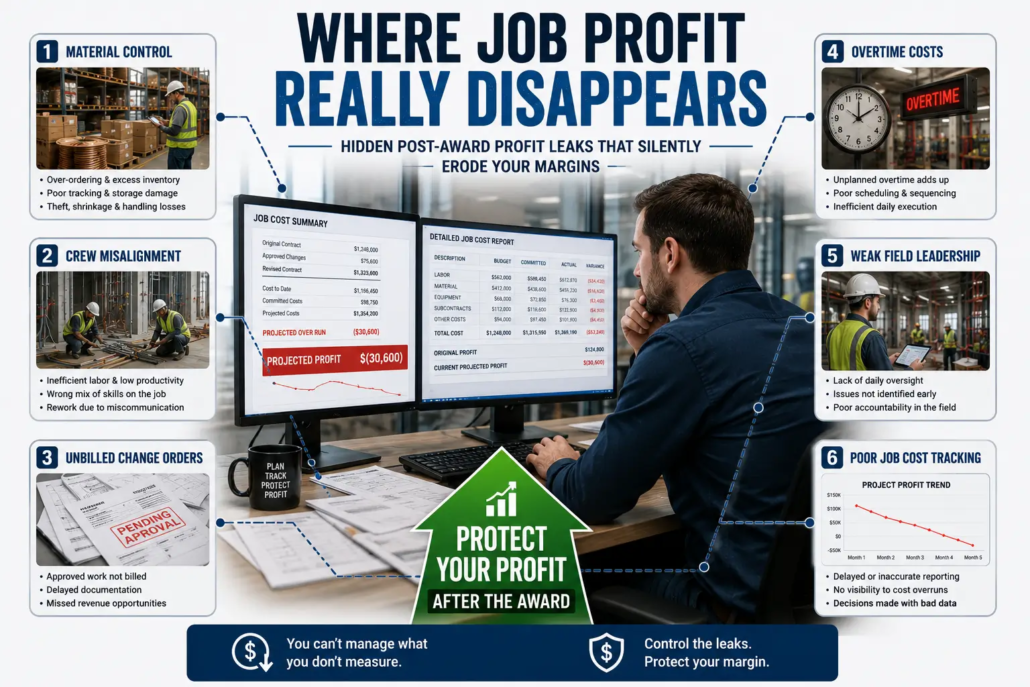
Change orders are one of the most misunderstood sources of lost profit in electrical contracting. The work is obvious in the field, but the cost impact behind it often goes underreported, or unbilled entirely.
Many contractors quietly absorb extra scope to keep relationships smooth or avoid conflict. Over time, that “silent generosity” becomes a steady drain on profitability. Here’s what should always be captured,
Failing to charge appropriately doesn’t build loyalty. In most cases, unpaid extras aren’t remembered as favors; they’re simply expected on the next project.
Closing the gap between estimate and execution comes down to discipline and visibility. Best Bid Electrical Estimating Software is built to support both, from the first measurement to job closeout.
Best Bid includes a built-in On-Screen Takeoff, so you can import PDF drawings and measure conduit and wire lengths directly from your computer screen. You can count items right on the plans, save those drawings inside the estimate, and review detailed labor and material breakdowns before you ever present a bid. That accuracy upfront sets a reliable baseline to measure execution against.
Because Best Bid was built by electrical contractors who estimate daily, it tracks the details that matter after the award too. Features like custom assemblies, advanced substitutions for value engineering, and dedicated fields for indirect costs, supervision, lost time, lifts, and more, help keep your real-world numbers tied to your bid.
Tools only work when your team knows how to use them. Best Bid backs its software with free technical support and an online estimating school, so estimators and project managers can sharpen their skills and apply them consistently across every job.
“The estimate gets you the job. Execution decides whether you keep the money.”
Material discipline, smart crew planning, vetted field leadership, and consistent change order billing are what separate contractors who hit their numbers from those who watch profit disappear by closeout. Pair those practices with accurate, contractor-built tools, and you give yourself the best shot at making your bank account match your estimate.
Ready to tighten the gap between your bids and your bottom line? Schedule a quick walkthrough of Best Bid Electrical Estimating Software or call 800-941-7028 to see how it works.

Electrical contractors rarely lose money on one big mistake. Profit erodes through small, untracked inefficiencies, material pricing drift, weak purchasing strategy, labor assumptions, and field disruptions, that compound across a job. Together, these “invisible leaks” can quietly drain 3–12% of total job profit before closeout.
Most electrical contractors do not lose profit in dramatic ways. There is no single blown estimate or runaway change order to point to. Instead, margin slips away in pieces, a few dollars on copper here, twenty minutes of travel time there, a supply run that should have been planned weeks earlier.
By the time, a job closes out, these scattered losses add up. Industry-experienced estimators estimate they can account for 3–12% of total job profit. The hard part? None of them show up as a single line item, so they are easy to miss and even easier to repeat.
This post breaks down seven of the most common, and most overlooked, places this happens, then shows how Best Bid’s electrical estimating software helps you catch them before they cost you.
One of the most common losses comes from failing to update material pricing between bid submission and actual purchase.
Most estimates are built on accurate numbers at the time of bid. However, the market rarely stands still. When material costs rise after award, especially on long-start projects, those increases often get absorbed instead of tracked.
Copper is the clearest example. With ongoing market volatility, contractors who treat conductor pricing as static are exposed the moment prices climb. A smarter approach is to monitor copper trends, forecast usage across upcoming projects, and lock in pricing when conditions are favorable. Successful contractors don’t leave conductor pricing to chance, they manage it like a commodity, buying based on projected poundage across multiple jobs to stabilize cost exposure over time.
Many contractors still buy materials job-by-job, which increases cost variability and weakens advantage with suppliers.
A strategic approach is to consolidate purchases across multiple projects, especially for rough-in materials. In some cases, a controlled inventory or small internal stock system can lower per-unit cost and improve availability.
Supply houses may also lock pricing on certain items, devices, boxes, disconnects, for extended periods. Contractors who use these arrangements gain far more predictable cost structures.
Weather and seasonal conditions are often left out of labor productivity estimates.
A job scheduled in winter may run slower due to cold weather, frozen ground, or slab delays. Summer can bring heat-related inefficiencies and tighter scheduling. When estimates ignore these environmental factors, labor assumptions become overly optimistic and fail to match real field conditions, a gap that shows up directly in your margin.
Not all general contractors are equally profitable to work with.
Over time, patterns emerge. Some GCs deliver smoother workflows, faster payments, and fewer disruptions. Others create constant delays, change orders, and coordination headaches that quietly erode margin.
Contractors who track job history and profitability by GC gain a real advantage. The most successful firms deliberately prioritize relationships with their most reliable, most profitable partners.
“Small interruptions in the workday add up fast.”
A scheduled 15-minute break that turns into a supply run, phone call, or extended downtime can easily stretch to 45–50 minutes of lost productivity per worker. Multiply that across a full crew, and it becomes a measurable labor overrun, one that rarely makes it into the estimating system.
Many estimates count only on-site labor, not the time it takes to get there or transition into productive work.
When time isn’t accounted for from arrival at the shop or the first job transition, contractors may lose 20–30 minutes per person per day. Spread across crews and the full duration of a project, that becomes a significant hidden cost that never appears in the original bid.
One of the most overlooked leaks is unstructured material handling in the field.
Frequent trips to supply houses for “small items” break workflow, extend labor hours, and introduce inefficiency. Even when each trip seems minor, the cumulative impact is substantial. In well-run operations, material flow is managed from the office. Field teams stay focused on installation, not procurement, which reduces downtime, improves accountability, and keeps materials tracked rather than improvised.

The common thread across all seven leaks is the same: weak tracking and slow, imprecise estimating. That’s exactly where Best Bid Electrical Estimating Software earns its keep.
Accurate, fast estimating. Best Bid is built to be the fastest electrical estimating software on the market, helping you produce detailed electrical estimates and accurately measure conduit and wire lengths. When your numbers are precise from the start, pricing drift and optimistic labor assumptions have far less room to hide.
Built-in On-Screen Takeoff. Best Bid is the only electrical estimating software with On-Screen Takeoff built in. You can import PDF drawings directly into your computer and count and measure right from your screen, no third-party tools, no time wasted switching between software.
Easy job tracking afterward. Best Bid helps you win bids and keep track of the job afterward, so material costs, labor, and change patterns stay visible instead of disappearing into closeout.
Made by people who do the work. Best Bid was meticulously crafted by a team of electrical contractors who estimate projects daily. Unlike software built by programmers with no field experience, it works the way electricians actually think.
Profit loss rarely comes from a single mistake. It comes from dozens of small, untracked inefficiencies that compound over time. Contractors who identify and control these seven areas don’t just estimate better, they build businesses that protect margin from job to job.
Don’t let hidden costs erode your profits. Discover how Best Bid can help you win more bids and maximize profitability. Visit bestbidestimating.com to explore the software and see its transparent, one-time pricing, or call 800-941-7028 to schedule a quick walkthrough.
Small, untracked inefficiencies, pricing drift, break drift, travel time, informal supply runs, and weak purchasing strategy, can quietly account for 3–12% of total job profit. Because none of them appear as a single line item, they’re easy to overlook and tend to repeat from job
Copper prices are volatile and can rise significantly between bid day and actual purchase, especially on long-start projects. Contractors who treat conductor pricing as static absorb those increases directly. Monitoring copper trends, forecasting usage across multiple jobs, and locking in favorable pricing helps stabilize cost exposure.
Break drift is when small interruptions stretch beyond their scheduled time, a 15-minute break that becomes 45–50 minutes after a supply run or phone call. Across a full crew, this turns into measurable labor overruns that rarely get captured in estimating systems.
Accurate, fast estimating software like Best Bid reduces guesswork in takeoffs, conduit and wire measurements, and labor assumptions. With built-in On-Screen Takeoff and tools to track the job afterward, contractors can spot and control the inefficiencies that erode margin before closeout.
Best Bid is built for electrical contractors and estimators of all sizes, from small shops to large firms handling multi-million-dollar projects. It’s especially useful for contractors moving from spreadsheets or pen-and-paper to computerized estimating, thanks to its one-time fee, free support, and lifetime updates.
Hidden costs don’t have to become lost profits. Call 800-941-7028 today to schedule a live walkthrough and discover how Best Bid Electrical Estimating Software helps protect your margins from estimate to project closeout.

Quick answer: The biggest mistake electrical estimators are making in 2026 is sticking with manual spreadsheets and pen-and-paper methods instead of adopting modern electrical estimating software. This habit leads to slow bids, costly errors, and lost projects in a market that rewards speed and accuracy.
Electrical estimators carry a heavy responsibility. Every bid you submit determines whether your company wins the job and whether that job turns a profit. Get the numbers right, and you grow. Get them wrong, and you either lose the bid or lose money completing it.
Yet many estimators are still working the same way they did decades ago. In 2026, that’s a problem. This post breaks down the single biggest mistake holding estimators back, what it costs your business, and how to fix it before your competitors leave you behind.
The biggest mistake is relying on outdated manual methods, homemade spreadsheets, paper takeoffs, and guesswork rather than modern electrical estimating software.
Spreadsheets felt cutting-edge twenty years ago. Today, they simply can’t keep pace with the speed, accuracy, and detail that complex electrical projects demand. A single typo in a formula or a missed line item can throw off an entire bid.
And when you’re measuring conduit and counting devices by hand, you’re spending hours on work that software can do in minutes.
The market has changed. Projects are more complicated, deadlines are tighter, and margins are thinner. Estimators who ignore this shift are bringing a calculator to a computer fight.
The consequences of manual estimating go far beyond a few wasted hours. Here’s what’s really at stake:
Picture two contractors bidding on the same $500,000 project. One can use software to import PDF drawings, count devices on-screen, and generate a detailed proposal in an afternoon. The other spends three days with a scale ruler and a spreadsheet. Who do you think submits a cleaner, more competitive bid?
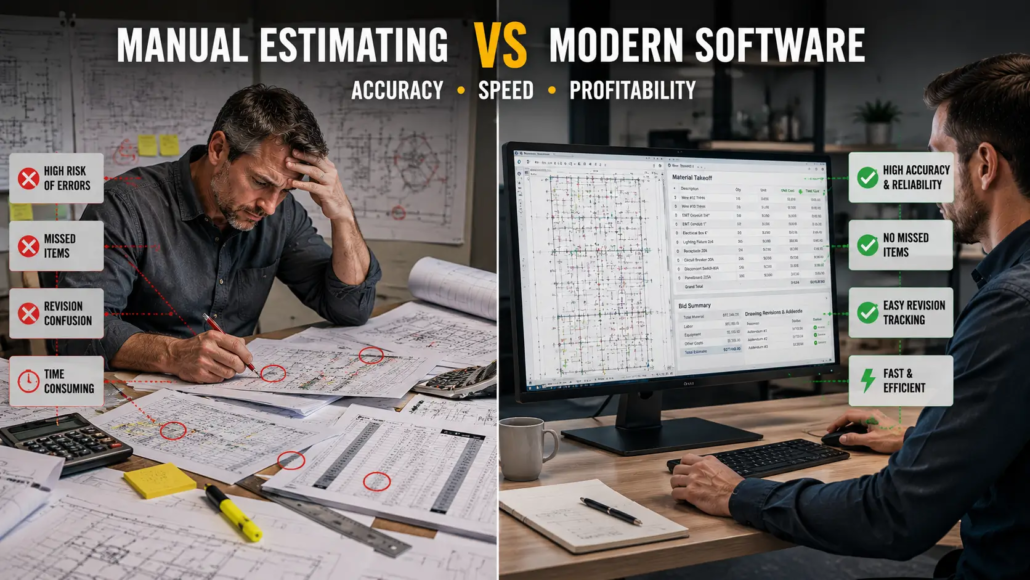
The fix is straightforward: replace manual methods with purpose-built electrical estimating software. Here’s how to make the switch work for you.
Adopt estimating software with built-in takeoff. Look for a tool that lets you import PDF drawings and perform counts and measurements directly from your screen. Best Bid Electrical Estimating Software, for example, includes on-screen takeoff built in—so you don’t need clunky third-party programs.
Use custom assemblies. Instead of sorting through endless pre-built assembly libraries, choose software that lets you create and save your own. This matches the way electricians actually think and work.
Keep material prices current. Manual price updates eat time and invite errors. Pricing services like NetPricer or real-time pricing keep your numbers accurate automatically.
Invest in training. Software is only as good as the person using it. Online estimating courses, like the one Best Bid offers, help estimators build confidence in their numbers and master the tools faster.
Estimating is moving toward speed, accuracy, and automation. On-screen takeoff, auto-count features, and instant pricing updates are becoming the baseline—not the exception.
The estimators who thrive in the coming years will be the ones who commit to continuous learning. Tools evolve. Pricing changes.
Project complexity grows. Staying competitive means staying curious and willing to adapt.
The good news? You don’t need to be a computer expert. The best electrical estimating software is built by electrical contractors who understand the business—not programmers who’ve never bid a job. That means it works the way you already think it does.
Your estimating software is the most important tool you own. Your success depends on your ability to estimate fast and accurately—and manual methods can’t deliver either anymore.
If you’re still wrestling with spreadsheets and paper takeoffs, now is the time to re-evaluate your process. Best Bid Electrical Estimating Software offers a one-time purchase with no recurring fees: an unlimited license, lifetime updates, lifetime support, and built-in on-screen takeoff. You buy it, and you own it.
Ready to leave outdated methods behind? Call Best Bid today at 800-941-7028 to schedule a no-pressure walkthrough, or download the free trial to see how it works for yourself.
The best electrical estimating software depends on your needs, but look for tools with built-in on-screen takeoff, custom assemblies, and transparent pricing. Best Bid offers two options—Best Bid Next Generation for advanced users and Best Bid Hybrid Pro for those transitioning from manual methods—both with a one-time fee and no recurring costs.
Pricing varies widely. Some providers charge per seat, plus license, support, and yearly update fees. Best Bid uses a one-time payment model: the Hybrid Pro is $1,995.95, and the Next Generation is $2,500.00, with no recurring charges and interest-free financing available.
No. Homemade spreadsheets can’t match the speed, accuracy, and detail that today’s electrical projects demand. They’re prone to formula errors, slow to update, and lack features like on-screen takeoff and labor reporting that protect your margins.
No. Quality electrical estimating software is designed for contractors, not computer experts. Best Bid, for instance, uses electrical terminology and an intuitive interface, and offers free lifetime support plus an online school to help you get up to speed.
The transition is faster than most estimators expect, especially with training and support. Best Bid offers an online school, free technical support to shorten the learning curve, and a free trial that lets you test the software before committing.
Stop estimating like it’s 2006. Call 800-941-7028 today to schedule a free walkthrough and see how Best Bid can transform your bidding process.