How to Create a Defensible Electrical Estimate: A Contractor’s Guide

What if the hardest part of an electrical bid isn’t choosing the number, but showing how you got there? Incomplete drawings, unclear scope, and undocumented assumptions can turn a reasonable estimate into a difficult one to review. Creating a defensible electrical estimate means making each scope decision, quantity, labor allowance, and material assumption traceable to its source.
If you’ve had to explain a bid after the takeoff was done, you know how quickly details can get lost. A count without a drawing reference, a labor figure without a stated basis, or an exclusion that never made it into the proposal can make review and revision harder than they need to be.
This guide shows you how to build a clear record you can explain, check, and update. You’ll learn how to document scope and quantities, identify questions and exclusions before submission, and make material, labor, and risk decisions easier to follow. We’ll walk through a practical estimating process that turns uncertain inputs into a more organized bid, without treating software or past estimates as a substitute for your judgment.
Key Takeaways
- Build a clear connection between each estimate item and the scope, quantity, labor basis, or pricing input behind it.
- When creating a defensible electrical estimate, document drawing references and clarifications alongside the related takeoff items.
- Make bid reviews more useful by keeping quantity references, labor notes, pricing dates, and estimate versions available for review.
- Before submitting, check scope coverage, calculations, source details, assumptions, and document versions, giving uncertain or high-impact items extra attention.
- Use estimating software to organize takeoff and estimate information, while keeping professional judgment at the center of each decision.
What Makes an Electrical Estimate Defensible to a Client or Reviewer?
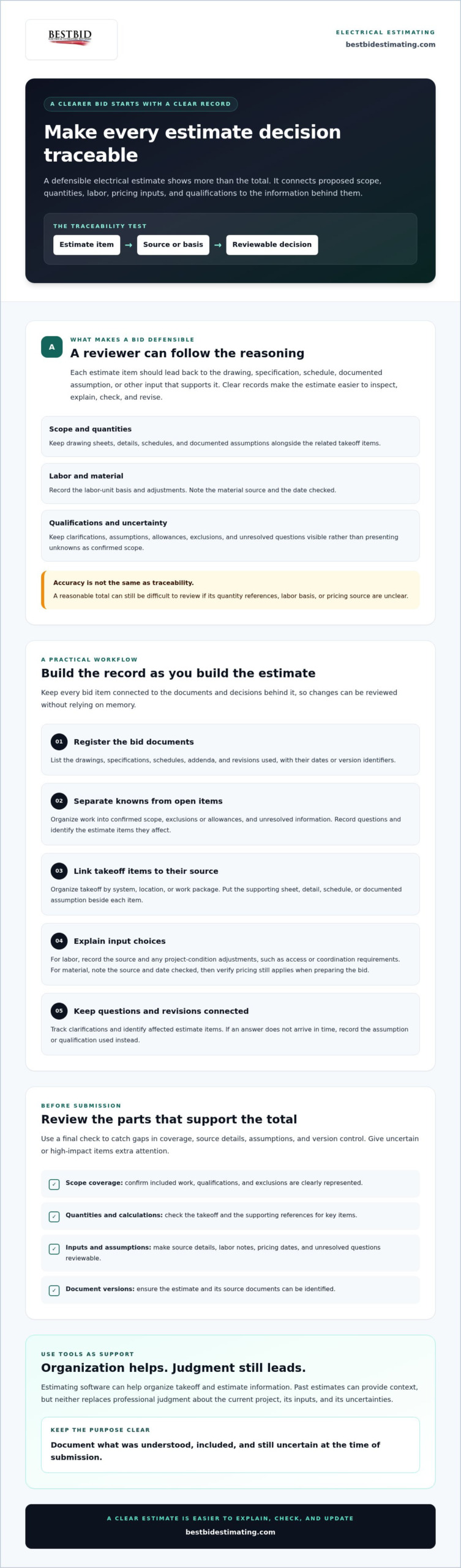
A defensible electrical estimate is a documented, reviewable account of the proposed scope, quantities, labor, pricing inputs, and qualifications, with enough source information for someone else to follow the reasoning. Creating a defensible electrical estimate means showing not only the total, but how you built it.
Accuracy and traceability are related, but they’re not the same. An estimate may land on a reasonable total and still leave a reviewer asking which drawing supports a device count, what labor basis was used, or whether pricing reflects current information. A clear cost estimate connects its inputs and assumptions to the decision the total represents.
For a practical walkthrough of estimating and takeoffs, watch this video:
What should a reviewer be able to trace?
A reviewer should be able to move from an estimate item back to the basis for it. For major quantities, record the drawing sheet and detail, specification, equipment schedule, or documented assumption used. For material and labor inputs, note how they were selected and reviewed, such as the applicable quote or labor basis, along with the relevant date or source.
Keep the estimate version and source documents identifiable. Record unresolved questions and clarifications, too. If a plan doesn’t establish a detail, mark it as an open item or stated assumption rather than letting it look like a confirmed quantity.
What defensibility does not mean
Documentation can make uncertainty visible, but it can’t complete an incomplete plan or make unknown field conditions disappear. A supportable bid is not a promise that the bid will be awarded, that the expected margin will be achieved, or that delivery will be risk-free. Its purpose is to make the basis for decisions easier to inspect and revise.
How to Build an Electrical Estimate With a Traceable Scope and Takeoff
Creating a defensible electrical estimate starts before the first count. Build a workflow that keeps each bid item connected to the documents, quantity, labor basis, and pricing input behind it. That way, if a drawing changes or a question is answered, you can identify what needs to be reviewed instead of rebuilding the estimate from memory.
Start with bid documents, scope, and open questions
First, create a document register. List the drawings, specifications, schedules, addenda, and revisions used, including their dates or version identifiers. Then sort the work into three clear groups: confirmed scope, exclusions or allowances, and unresolved information. Don’t let an unanswered question quietly become an assumed quantity.
Give each open item an owner and a bid-relevant due date. For example, note that the design team must clarify a panel schedule discrepancy before the bid deadline, and identify the affected panel and estimate items. If the response doesn’t arrive in time, record the assumption or qualification used in its place.
Connect takeoff, labor, and material inputs
Organize takeoff by system, location, or work package, then record the drawing reference beside each estimate item. A reviewer should be able to trace a quantity back to the sheet, detail, schedule, or documented assumption that supports it. Keep the link visible in the estimate record, not only in a separate set of notes.
For each labor input, record the labor-unit source and any adjustment made for project conditions, such as access or coordination requirements. Explain the reasoning rather than presenting an adjusted unit as a universal standard. For material, note the supplier or other source and the date checked. Verify that pricing still applies when you prepare the bid.
Review revisions and test the workflow
When an addendum or revised drawing arrives, log it and compare it with the documents already used. Identify affected systems and locations, then revisit the linked quantities, labor, and material inputs. Record what changed, what stayed the same, and which estimate version reflects the review. Finish by checking scope coverage, calculations, unresolved questions, and document versions.
Illustrative example: Suppose a lighting plan shows a fixture in a room, but a later schedule lists a different fixture type. Record the original sheet reference, the revised schedule reference, the quantity affected, and any related material or labor change. These are example inputs, not estimating standards.
A structured estimating workflow can help keep takeoff and estimate information connected. Explore Best Bid electrical estimating resources as one option for supporting that process.
Which Estimate Records Make Electrical Bid Decisions Easier to Defend?
A total by itself tells a reviewer what you bid, not how you arrived there. Compare two records for the same illustrative scope: 12 receptacles across three rooms. An undocumented estimate shows one combined amount.
An itemized record identifies the drawing and room references, how the count was made, the labor basis, the material source and date, and any open qualification. The scope hasn’t changed, but the second record gives someone a way to check the reasoning and spot what needs follow-up.
That traceability is the practical value of creating a defensible electrical estimate. It can also make revisions more controlled: if a drawing or clarification changes, you can find the affected estimate items instead of guessing which inputs need another look. For a compact record, capture these fields for each major item:
- Estimate item: System, location, or work package.
- Source: Drawing, specification, schedule, quote, or labor reference, with version or date where relevant.
- Assumption: The stated basis for any quantity, labor adjustment, or unresolved scope detail.
- Review status: Confirmed, pending clarification, or requiring recheck.
Document quantity, labor, and pricing inputs
For quantities, record the drawing reference, measurement method, and relevant system or location. For labor, note the basis and explain project-specific adjustments, such as access or coordination conditions, rather than leaving a standalone figure with no context. For pricing, retain the source and date checked. Flag vendor inputs that need confirmation before submission, since an older quote may no longer reflect available pricing.
These notes help a reviewer distinguish a measured quantity from an assumption and a current input from one that needs refreshing. They also give the estimator a clearer starting point when updating the bid.
Separate assumptions, exclusions, and revisions
Label confirmed scope, documented assumptions, allowances, and explicit exclusions separately. Then maintain a change log that records which addendum or clarification affected an item, what changed, and which estimate version includes the update. Keep coordinated project records together; related documentation may also include submittal information, as discussed in How to Create an Electrical Submittal Package.
For further guidance on organizing estimating tools and workflows, see this overview of electrical estimating software. Software can help keep records connected, but the estimator still needs to verify sources, assumptions, and revisions.
Download as HTML
How to Review an Electrical Estimate Before Submitting the Bid
A final review should do more than catch arithmetic errors. It should confirm that the estimate matches the bid documents, that important inputs can be traced, and that the total agrees with the scope and qualifications you intend to submit. Use the same sequence each time, then spend extra review effort where uncertainty or potential impact is greatest.
Run a scope and document completeness check
Start by confirming the estimate reflects the latest available drawings, specifications, schedules, and addenda. Check that revisions are identified and that no estimate items remain tied to superseded documents without review. Compare the known project scope against the estimate: each item should be included, explicitly excluded, or clearly marked for resolution.
Review schedules and panel-related documentation wherever they affect the work being priced. Then read the qualifications and exclusions alongside the estimate total. If the bid excludes work that a reviewer might reasonably expect to be included, make sure the exclusion is clear and consistent with the scope basis. A qualification should explain a boundary, not conceal a missing scope decision.
Test the estimate trail before bid day
Don’t give every line the same review treatment. Flag uncertain quantities, unusual labor adjustments, pricing that needs confirmation, and items affected by a recent document revision. Have a second reviewer check those first. Then select other quantities for spot checks against their source drawings and recorded takeoff references.
- Scope: Are known items accounted for, and are exclusions or unresolved questions visible?
- Calculations: Do quantities, extensions, and rollups reconcile to the estimate total?
- Inputs: Are pricing sources and dates, labor assumptions, and key adjustments recorded?
- Documents: Does the estimate identify the version being submitted and reflect applicable revisions?
Finally, compare the bid amount and proposal language with the estimate basis. Confirm that allowances, exclusions, and other qualifications are reflected consistently, and that the presented price covers the intended scope. Creating a defensible electrical estimate depends on this last connection between the working estimate and the bid the client actually receives.
If you want to strengthen your review habits through structured skills development, consider electrical estimating training such as Best Bid’s Online School for Electrical Estimating. To explore Best Bid’s estimating resources, visit Best Bid’s website.
How Electrical Estimating Software Can Support a Defensible Estimate
Estimating software can help keep takeoff, estimate items, labor inputs, and supporting notes organized in one workflow. That organization makes it easier to review how a number connects to its source. But software doesn’t decide whether the scope is complete or an assumption is appropriate. The estimator still owns the judgment behind every bid.
What to look for in an estimating workflow
Evaluate a workflow by asking whether you can move from a drawing reference to a takeoff quantity, then to its estimate item and supporting notes without losing context. Check whether labor inputs and pricing sources are reviewable alongside those items, and whether the system gives you control over estimate data. Consider backup options and how your team will update shared information before changing an established process.
Adoption takes more than moving data. Make sure estimators know how to use the workflow consistently, and consider whether structured training or support would help the team preserve its estimating practices during the change.
Where Best Bid fits, and what the estimator still owns
Best Bid’s confirmed workflow capabilities include built-in onscreen takeoff, direct screen-based counting and measuring, and estimate transfer. These functions can help maintain a connection between drawing-based quantities and bid items. Database controls can also support organized estimate information. Review the current product documentation to confirm feature details for the workflow you’re considering.
Best Bid’s NetPricer integration supports real-time pricing updates. Treat that as a pricing workflow capability, not proof that every input reflects current, project-specific vendor terms. Verify quotes and other sources for the bid at hand. The estimator remains responsible for checking scope, quantities, labor assumptions, pricing inputs, and final qualifications.
Best Bid Next Generation is one available estimating software option. Compare its workflow with your team’s documentation and review needs, rather than assuming any tool will resolve unclear plans or replace a disciplined estimate review. For more details, explore Best Bid electrical estimating software.
Creating a defensible electrical estimate depends on sound decisions and a record that makes those decisions understandable. If you’re considering a more connected estimating process, take a look at Best Bid’s estimating resources and see what may fit your current workflow.
Make Your Next Estimate Easier to Explain
A defensible bid is built from connected decisions: scope tied to project documents, quantities linked to takeoff references, and labor and pricing inputs supported by clear notes. Creating a defensible electrical estimate also means marking open questions and exclusions, then checking that the final proposal matches the estimate you reviewed.
Estimating software can help keep those records organized, but your team’s judgment remains central. Best Bid software includes built-in onscreen takeoff and direct screen-based counting and measuring. And with more than 50 years of electrical trade and estimating experience, founder Steve Griffin brings practical industry knowledge to the business.
Ready to explore tools and support for your estimating workflow? Explore electrical estimating tools and support.
Start with one improvement, such as recording a drawing reference beside each major quantity. Small, consistent steps can make the next bid clearer to review, easier to revise, and easier to explain.
Frequently Asked Questions
Is an electrical estimate defensible if the drawings are incomplete?
Yes, it can be documented responsibly, but documentation can’t remove uncertainty caused by missing information. Identify incomplete drawings or schedules, separate assumptions from confirmed scope, and record questions that could affect quantities or pricing. For example, flag a missing equipment detail rather than treating an assumed configuration as confirmed.
State relevant qualifications clearly and follow the project’s clarification process. The goal is to make uncertainty visible and reviewable, not to imply the estimate is complete.
What should be included in a defensible electrical estimate?
Include the defined scope, source documents and revision dates, traceable takeoff quantities, labor and material input bases, assumptions, exclusions, unresolved questions, and a record of revisions. The format can vary by contractor and project. What matters is that another qualified reviewer can follow how major items were developed and identify inputs that still need confirmation. Creating a defensible electrical estimate means making those connections clear, not relying on a total without supporting context.
How do you document electrical labor assumptions?
State the labor basis and its source, then explain any project-specific adjustments. If access, phasing, or coordination may affect productivity, connect that condition to the relevant estimate items and describe how you accounted for it. Avoid presenting a labor figure without context or treating a generic production rate as universally correct. Clear notes let a reviewer understand the reasoning, check whether it fits the project, and raise questions constructively.
Can electrical estimating software make an estimate defensible?
Software can support a defensible estimate by organizing takeoff, estimate items, source information, and revisions so they’re easier to review. It can’t independently confirm that scope is complete or that every assumption is appropriate. The estimator must review the project documents, validate quantities, assess labor and pricing inputs, and explain qualifications. Choose tools that help your team inspect, revise, and communicate estimate information while preserving the connection between bid items and their basis.
How should addenda be handled in an electrical estimate?
Record each addendum’s identifier or date, then review which estimate items it may affect. Update the related takeoff quantities or assumptions and keep a version history showing what changed and why. After the update, recheck calculations, totals, and qualifications against the intended bid scope. If the addendum leaves a material question unresolved, document the issue and follow the project’s clarification process rather than silently filling in the gap.
Does a defensible estimate guarantee that a contractor will win the bid?
No. A defensible estimate makes the scope, quantities, assumptions, and inputs easier to review and explain, but it can’t guarantee an award or a particular project outcome. Results may depend on project requirements, competition, timing, and other factors beyond the estimate itself.
Use documentation to support informed decisions and make uncertainty visible. It’s a sound estimating practice, not a promise that the bid will win work or eliminate project risk.