Disadvantages of Using Spreadsheets for Electrical Estimating in 2026

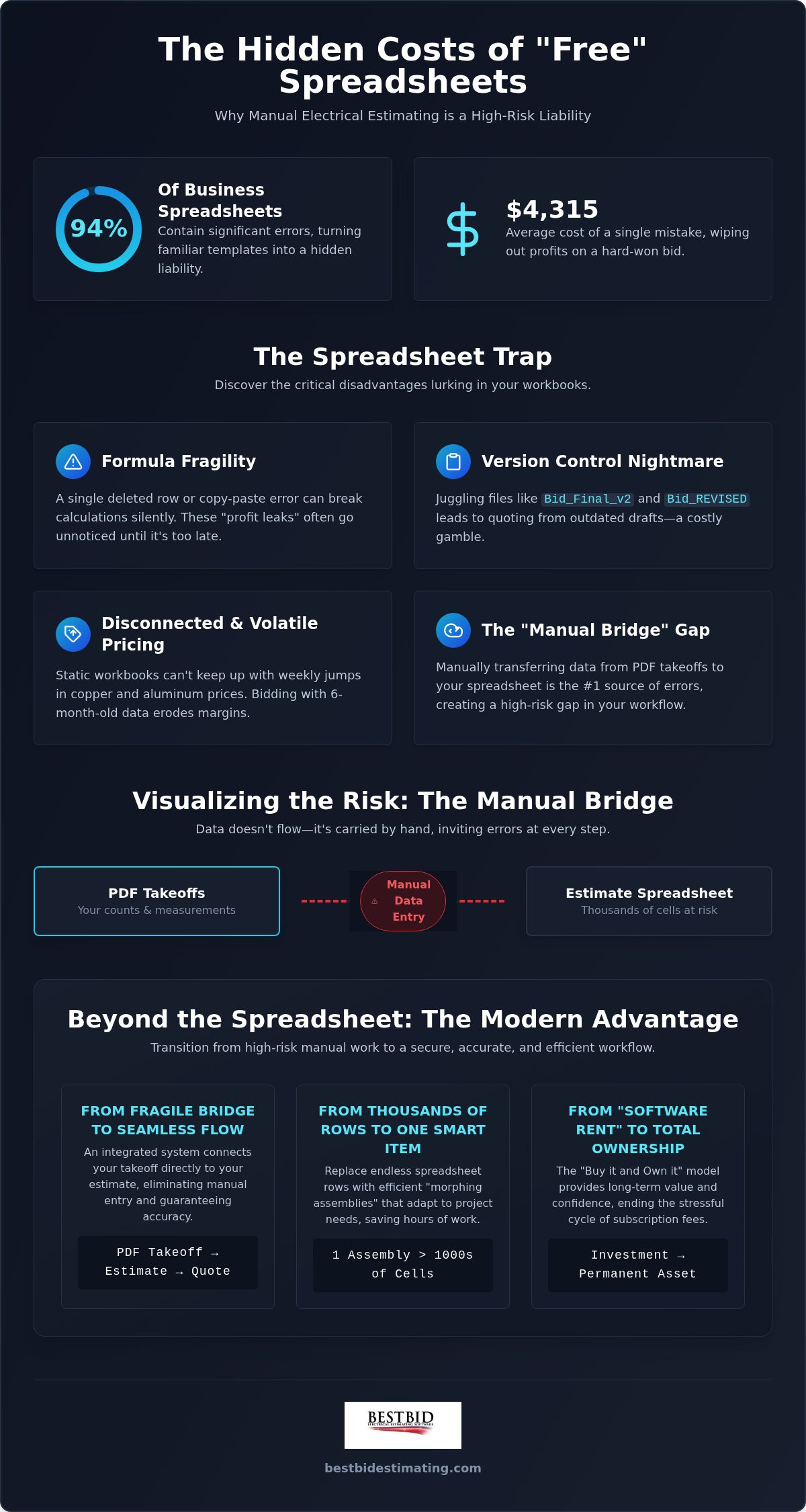
Did you know that 94% of business spreadsheets contain errors, with a single significant mistake costing a contractor an average of $4,315? It’s a staggering figure, but if you’ve ever felt that pit in your stomach after winning a bid only to find a broken formula in your workbook, you know it’s the reality of the trade. You’ve likely spent countless hours on manual data entry, fighting to keep up with copper and aluminum prices that seem to jump every week. It’s an exhausting cycle that turns estimating into a source of anxiety rather than a path to growth.
We understand that the “free” price tag of a spreadsheet is tempting, but the hidden disadvantages of using spreadsheets for electrical estimating are costing you far more in lost bids and eroded profits. This guide explains why manual systems are failing in 2026’s volatile market and how you can transition to a more secure, accurate workflow. We’ll show you how to move away from the stress of “software rent” and toward a system that provides total ownership and confidence in every quote you send out.
Key Takeaways
- Learn why relying on familiar templates creates a hidden estimating liability that risks your profit margins on every project.
- Understand the disadvantages of using spreadsheets for electrical estimating, specifically how silent formula errors and version control chaos can derail your bidding process.
- Discover the true cost of maintaining manual workbooks and how disconnected pricing fails to keep up with 2026’s material price volatility.
- Identify the “Manual Bridge” gap between your PDF takeoffs and your estimate, and how integrated systems eliminate high-risk data entry.
- Explore how transitioning to a “Buy it and Own it” model with Best Bid Next Generation replaces thousands of spreadsheet rows with efficient morphing assemblies.
The High Stakes of Manual Entry: Why Spreadsheets are Bidding Liabilities
In the electrical trade, familiarity often masquerades as safety. You’ve likely spent years refining your Excel templates, tweaking formulas, and building a system that feels like a trusted tool. But in 2026, relying on a generic grid for complex bids creates what we call an “estimating liability.” This isn’t just a file on your desktop; it’s a high-risk gamble that your bid is fundamentally flawed before you even pull the first wire. The false security of a familiar interface hides the fact that spreadsheets weren’t built for the specific, volatile needs of an electrical contractor.
The psychological toll of this manual process is heavy. You finish a bid late at night, but the anxiety keeps you awake. You’re second-guessing a manual cell entry or worrying that a price update didn’t carry through the entire workbook.
These “profit leaks” are often invisible until the project is well underway and the margins start to vanish. It’s a stressful way to run a business, and it’s one of the primary disadvantages of using spreadsheets for electrical estimating.
The ‘Silent Killer’ of Electrical Profit Margins
A single broken link in a commercial bid can wipe out your entire profit. Spreadsheets break silently. Unlike specialized software, Excel won’t alert you if a formula is missing a row or if a “hidden” column is skewing your totals. These aren’t just minor hiccups. History is full of high-profile spreadsheet errors that have cost companies millions of dollars. For a local electrical shop, a $5,000 error is just as devastating to the bottom line. Manual entry remains the number one source of estimating errors because it relies on perfect human execution in an imperfect, busy office environment. One accidental deletion in a sea of thousands of cells can turn a winning bid into a financial disaster.
Complexity Outpacing the Tool
As your business grows, your tools must keep up. A spreadsheet that worked for residential service calls will buckle under the weight of a 200-page specification document for a multi-panel industrial project. There is a clear tipping point where “fast and free” becomes slow and expensive. Consider these risks as your project complexity increases:
- Data Silos: Your takeoff data lives in one place while your pricing lives in another, requiring a manual bridge that invites error.
- Scaling Issues: Excel lacks the logic to handle complex electrical assemblies, forcing you to build every item from scratch.
- Review Friction: It’s nearly impossible for a second set of eyes to verify a complex spreadsheet without auditing every single cell.
When you’re chasing larger contracts, the disadvantages of using spreadsheets for electrical estimating become impossible to ignore. You need a system that supports your growth, not a file that breaks the moment you try to scale.
Formula Fragility and the Version Control Nightmare
It is 10:00 PM, and you are hunting through a server folder for the latest bid. You see “Main_Street_Electrical_Final,” “Main_Street_Electrical_Final_v2,” and “Main_Street_Electrical_REVISED_DO_NOT_USE.” Which one is actually the current version? This chaos is a daily reality for contractors stuck in the spreadsheet cycle.
Version control isn’t just an organizational headache; it’s a financial risk. When you’re juggling multiple revisions, it’s only a matter of time before you send a quote based on an outdated draft. This confusion is among the most dangerous disadvantages of using spreadsheets for electrical estimating, as it turns your bidding process into a game of chance rather than a calculated business move.
Relying on “last year’s template” is equally risky in 2026. While the layout might feel comfortable, the underlying data is likely a relic. Material prices for copper and aluminum are moving too fast for a static workbook to keep up.
If you’re bidding today’s high-stakes jobs using labor units or material costs from six months ago, you’re already behind. You need a system that offers permanence and precision, not a fragile file that grows more obsolete with every passing week.
The Domino Effect of Broken References
Spreadsheets are notoriously fragile because they rely on a rigid grid of cell references. One deleted row or an accidental “cut and paste” can shift named ranges and break calculations across dozens of tabs. These errors are often silent.
Excel won’t always give you a warning; it might just return an incorrect sum. Auditing a 50-tab workbook for these hidden breaks is a Herculean task that most busy estimators don’t have time for. You often don’t realize a formula has failed until the job is either lost to a more accurate competitor or won at a loss because a critical expense didn’t carry over to the final total.
Collaboration Conflicts in the Modern Office
Cloud-based tools like SharePoint and OneDrive offer the illusion of collaboration, but they aren’t built for the complexity of a multi-user electrical bid. When two people edit a complex workbook simultaneously, the auto-save feature can create “conflicted copies” or overwrite changes without warning. This creates a massive disconnect between the office and the field. Without a single source of truth for labor units and assemblies, your team is essentially guessing. To eliminate these manual headaches, many contractors are moving toward a permanent software solution that allows for secure, multi-user access without the risk of data corruption or file loss.
The Disconnect: Why Excel Fails the Takeoff and Pricing Test
The “Manual Bridge” is the invisible, error-prone gap between your PDF drawings and your estimate. You look at a plan, count your fixtures or measure a run, and then type that number into a cell. It sounds simple.
But when you do this hundreds of times for a single bid, your brain gets tired. One mistyped digit or a momentary distraction turns a profitable job into a financial liability. This fundamental disconnection is one of the primary disadvantages of using spreadsheets for electrical estimating.
You’re forced to act as a human data-transfer cable, and eventually, that cable is going to fray.
Manual conduit and wire length calculations are massive time-thieves. In a spreadsheet, you’re likely calculating these runs cell by cell, adding up elbows, couplings, and wire makeup by hand. It is a slow process that keeps you chained to your desk late into the night.
Modern systems replace those thousands of manual rows with intelligent logic that handles the heavy lifting for you. This allows you to focus on the strategy of the bid rather than the mechanics of the math.
The Pricing Gap: Manual vs. Real-Time
In 2026, material prices are moving faster than most contractors can type. With copper prices seeing increases of 32% and aluminum rising approximately 40% in recent market cycles, a static price list in Excel is a recipe for disaster. If you’re manually updating your spreadsheet even once a week, you’re still dealing with “pricing lag.” By the time you submit your bid and it gets accepted, the material costs might have already eclipsed your profit margin.
Automated pricing integration isn’t just a convenience anymore; it’s a survival strategy. You need a system that reflects the market as it is today, not as it was when you last had time to update your workbook.
Takeoff Isolation
Most spreadsheet users are doing double the work because their tools don’t talk to each other. You use one program for your on-screen takeoff and another for your estimate. This isolation creates the “forgotten item” syndrome. You see the conduit on the plans and you measure it, but it never makes it into the final spreadsheet total. Best Bid Next Generation eliminates this risk by building the takeoff directly into the software. Instead of manual counting and double entry, you get a seamless transfer that carries your measurements and assemblies straight into the bid. It ensures that every foot of wire you measure is a foot of wire you’re getting paid for.
Calculating the Real Cost: ‘Free’ Spreadsheets vs. Professional Software
Many contractors view Excel as a zero-cost tool. It’s already on your computer, so why pay for something else? This logic is one of the biggest traps in the industry.
When you look at the real math, the disadvantages of using spreadsheets for electrical estimating become a massive financial drain. You aren’t just losing precision; you’re losing the most expensive labor in your company: your own. Spreadsheets aren’t free; they are financed by the hours you’ll never get back.
The Labor Math of Manual Estimating
Let’s look at the “Hidden Labor Rate.” If you spend just five hours a week manually updating prices, fixing broken formulas, or double-checking takeoff entries, that adds up to 260 hours over a single year. If your time is worth $100 an hour, your “free” spreadsheet just cost you $26,000 in labor. This is the definition of opportunity cost: the profit you lose from other activities because you’re stuck doing manual data entry. When you calculate the hours spent on maintenance, the disadvantages of using spreadsheets for electrical estimating become even more apparent. If you could reduce your bid time by 50%, you’d effectively double your capacity to chase new projects without adding a single person to your payroll; to manage this increased business volume and your broader costs, you can visit Flowgres to explore ERP solutions for SMEs.
The modern software market has introduced a new disadvantage for the trade: the perpetual subscription. Most professional tools now require a monthly “rent” that never ends. If you stop paying, you lose access to your own data. We challenge this “Software as a Service” (SaaS) model because it puts the software company’s bottom line ahead of yours. Comparing the long-term cost of manual entry to Best Bid Pricing reveals a clear path to financial clarity. For a one-time fee of approximately $2,500 for a 5-user license, you gain a permanent asset for your business.
This “Buy it and Own it” philosophy is a hedge against inflation. With a one-time purchase, you get lifetime updates and support without the fear of a price hike next month. It’s a system built on 50+ years of field experience, designed to replace the stress of manual labor with the security of a modern, reliable system. It’s time to stop paying rent on your tools and start investing in your company’s future. You can view our electrical estimating software options to find the right fit for your team.
Beyond the Spreadsheet: The Best Bid Next Generation Advantage
Moving away from a manual system is a major step for any electrical contractor. You’ve seen how the disadvantages of using spreadsheets for electrical estimating can eat into your profits and steal your time. In 2026, the answer isn’t just “more software” or another monthly bill to pay.
It’s about moving to a system that provides permanence, precision, and total control. At Best Bid, we operate on a “Buy it and Own it” philosophy. We believe that once you pay for your tools, you should own them forever, without the burden of ongoing “rent” or subscriptions that hold your data hostage.
The real power of Best Bid Next Generation lies in its “Morphing” assemblies. In a traditional spreadsheet, you might have thousands of rows that you have to navigate and update manually. Our assemblies are intelligent; they adapt to your specific project needs with a few clicks, replacing hours of row-by-row data entry with a streamlined, automated process.
It’s a system built on 50 years of field experience, designed to think like an electrician, not a computer programmer. This transition allows you to move from the chaos of fragmented files to a unified database that actually works for your business.
Built for the Trenches, Not the Boardroom
Steve Griffin founded this company with over 50 years of experience as a master electrician and estimator. That experience is baked into every feature. We don’t build “theoretical” estimating tools based on what a corporate boardroom thinks you need.
We build tools that handle the practical realities of the job site, from complex panel schedules to volatile material pricing. The learning curve is designed for the traditional contractor, offering a low-to-medium barrier to entry that respects your time. Most importantly, owning your data on your own server provides a level of long-term business security that cloud-based spreadsheets simply cannot match.
Making the Switch: A Low-Friction Transition
We know that leaving your familiar Excel templates feels like a risk. That’s why we created the Online School for Electrical Estimating and the Best Bid Academy to support your move away from outdated methods. Our training ensures your team is up to speed quickly, turning a transition that could be a headache into a major competitive advantage. You get 1-Click backup capabilities and easy database control, giving you the confidence that your bids are safe and accurate. If you’re ready to leave the disadvantages of using spreadsheets for electrical estimating behind, schedule a free consultation today to see the difference a professional system makes for your bottom line.
Take Control of Your Bidding Future
The electrical industry is moving faster than ever, and your tools need to keep pace. We’ve explored how the disadvantages of using spreadsheets for electrical estimating include everything from silent formula errors to the massive hidden labor cost of manual data entry. You don’t have to stay stuck in a cycle of version control nightmares and pricing lag.
By choosing a system built on 50 years of field experience, you can eliminate the anxiety of winning a job that was under-quoted. It is time to move beyond the limitations of Excel and invest in a permanent asset for your company.
Best Bid Next Generation is ranked #1 for Best Value because we include built-in OST and never charge monthly fees. You get total ownership with a one-time purchase, ensuring your profit margins are protected for years to come. Stop Renting Your Software and Start Owning Your Profit: Get Best Bid Today. You’ve put in the work to build a successful business; now it’s time to use a system that works just as hard as you do.
Frequently Asked Questions
Is Excel good enough for small electrical residential jobs?
Excel might work for a basic service call, but even small residential projects face the same disadvantages of using spreadsheets for electrical estimating. As soon as you deal with copper price hikes or complex panel work, manual entry becomes a major risk. You’re better off using a system that scales with you, ensuring that a small mistake doesn’t turn a quick job into a financial loss.
What are the main advantages of electrical estimating software over spreadsheets?
The primary advantages include built-in onscreen takeoff (OST), real-time pricing via NetPricer, and morphing assemblies. Unlike static spreadsheets, professional software like Best Bid Next Generation connects your takeoff directly to your estimate. This eliminates double entry and ensures your material costs reflect today’s market. You get a centralized database that you control completely, rather than a collection of fragile files that can break without warning.
How do I know when it’s time to switch from Excel to specialized software?
It’s time to switch when you’re spending more than five hours a week on manual data entry or if you’ve recently lost money on a won bid due to formula errors. If the complexity of your projects is growing but your bidding speed is slowing down, your current tools are holding you back. Transitioning to a professional system replaces the stress of manual labor with the security of a reliable, field-tested workflow.
Can I import my existing Excel data into Best Bid software?
Yes, our software offers very high flexibility for database manipulation and product addition. You can move your custom items and labor units into the system to maintain your specific way of doing business. This ensures you don’t lose the years of knowledge you’ve built up in your spreadsheets. We provide the structure and speed, while you keep the data that makes your company unique.
What is the cost difference between Excel and professional estimating software?
While Excel seems free, the hidden labor cost of manual maintenance can exceed $26,000 annually. Best Bid Next Generation costs approximately $2,500 for a 5-user license. This one-time purchase is the lowest-cost option in its class compared to competitors charging between $15,000 and $75,000. When you calculate the hours spent on maintenance, the disadvantages of using spreadsheets for electrical estimating become even more apparent.
Does Best Bid require a monthly subscription like other software?
No, we never charge monthly subscription fees. We believe in a Buy it and Own it model that provides total ownership of your tools. Your one-time purchase includes lifetime updates and technical support at no additional cost. This approach eliminates the burden of recurring software rent and protects your business from the price hikes common in the subscription-based software market.
How much time can I save by switching from manual spreadsheets?
Most contractors report reducing their bid time by 50% or more after moving away from manual spreadsheets. Best Bid Next Generation is rated 5-star for workflow speed because it features 1-Click OST-to-estimate transfer and morphing assemblies. These tools eliminate the need to search through thousands of parts or manually measure conduit runs, allowing you to produce accurate, professional bids in minutes instead of hours.
Is there a steep learning curve when moving away from Excel?
We’ve designed our software with a low-to-medium learning curve specifically for electrical contractors. Because it was built by Steve Griffin, a master electrician with 50+ years of experience, the workflow follows the logic of the trade. If you need extra help, Best Bid Academy offers specialized courses to ensure your team is up to speed quickly. You’ll find it much more intuitive than managing complex, multi-tab workbooks.


 Electrical contractor reviewing project costs after winning a construction bid