Electrical Estimating Software: 2026 Small Business Guide

Why are you still paying “rent” on the tools you use to build your business? For a small electrical contractor, every dollar tied up in a recurring subscription is a dollar taken directly off your bottom line. You’ve likely spent too many late nights staring at blueprints, second-guessing your math, and wondering if a simple typo just cost you a profitable contract. It’s frustrating to feel like you need a degree in computer science just to get an accurate bid out the door.
This 2026 guide is designed to help you find the best electrical estimating software for small business, focusing on tools that you actually own rather than lease. You’ll learn how to eliminate those monthly fees while gaining access to built-in takeoff features and field-tested logic that levels the playing field against the big shops. We will break down the essential features your crew needs to win more work without the complexity or the subscription trap that slows you down. It is time to replace the stress of manual labor with the security of a modern, reliable system built by people who know the trade.
Key Takeaways
- Stop letting manual spreadsheets drain your profits; learn how trade-specific tools protect your margins against 2026’s volatile material costs.
- Discover how to choose the right electrical estimating software for small business by prioritizing a “buy it and own it” model over expensive monthly subscriptions.
- Identify must-have features for small shops, including built-in on-screen takeoff and customizable assembly workflows that significantly reduce bidding time.
- Follow a clear, five-step process to transition from slow manual methods to professional, automated bidding without a steep or frustrating learning curve.
- Learn why tools built by industry veterans provide the fastest workflow and most accurate field-tested logic for single-location electrical contractors.
Navigating Electrical Estimating Software for Small Contractors in 2026
What exactly is electrical estimating software? For a small shop, it’s the difference between a profitable year and a slow slide into debt. At its core, this is a specialized digital tool designed to calculate the exact cost of labor, materials, and overhead for electrical projects. While many contractors still rely on manual spreadsheets, these have become the primary profit killers of 2026. With material pricing swinging by the week, a single outdated cell in an Excel sheet can wipe out your entire margin. Modern construction estimating software provides the accuracy you need to stay competitive without the risk of human error. Choosing the right electrical estimating software for small business means finding a tool that understands your specific workflow.
To better understand how these tools streamline your bidding, watch this helpful overview:
The Evolution of Bidding: From Blueprints to Pixels
Paper blueprints are relics of the past. Today, bidding speed isn’t just a convenience; it’s a requirement to keep your crew busy. If you’re still doing manual takeoffs, you’re losing work to faster competitors before you even finish your first cup of coffee.
However, speed alone isn’t enough. You need to avoid theory-only software built by developers who have never pulled wire or mounted a panel. In 2026, you need a system that integrates real-time pricing to protect your project margins from inflation and supply chain shocks.
Speed without accuracy is just a fast way to go out of business.
Why Generalist Tools Fail the Electrical Trade
General construction tools often treat every trade the same. They don’t understand the complexity of electrical assemblies. An electrical bid isn’t just a list of parts; it’s a combination of conduit, wire, fittings, and specific labor units that change based on the environment. This is why electrical estimating software for small business must include a trade-specific database. You need a system like Best Bid Next Generation that knows exactly how many man-hours it takes to run 100 feet of EMT versus PVC. Relying on a generalist tool is like using a hammer when you need a multimeter. It might get the job done eventually, but it won’t be precise.
Small business owners are also waking up to the “software rent” trap. Many providers force you into monthly subscriptions that never end. We advocate for a model where you buy the tool and you own it.
You shouldn’t have to pay a recurring fee just to open a bid you wrote last year. Look for systems that offer 1-click backups and total data security without the monthly bill. This ownership model protects your margins and ensures your data stays in your hands, not on a server you’re renting.
Essential Features for Small Shop Bidding Success
Accuracy isn’t just about getting the numbers right; it’s about getting them right quickly. When you’re running a small crew, you don’t have forty hours a week to sit behind a desk building a material database from scratch. Many competitors force you to do exactly that, essentially making you the software developer.
You need a pre-built, unlimited database that you fully control from day one. This allows you to focus on the “Assembly-Structure Workflow,” a method that slashes your clicks by morphing individual items into complete parts. Instead of clicking ten times for a single run, you do it once.
It’s about working smarter, not harder.
Accuracy also depends on current market conditions. In 2026, material prices can shift overnight. Integrating real-time pricing services like NetPricer ensures your bids reflect the actual cost at the supply house.
This eliminates the “gut feeling” that often leads to underbidding. A low-to-medium learning curve is non-negotiable for a busy owner. If you can’t learn the basics in a single afternoon, the software will just become another expensive icon on your desktop that you never use.
The Efficiency of Built-In On-Screen Takeoff (OST)
Why pay for two different tools when one should do the job? A major gap in the market is the separation of takeoff and estimating. Many providers treat these as separate subscriptions, forcing you to pay “software rent” twice. Built-in OST enables a seamless transfer from counting fixtures on a digital plan to generating the final estimate. You can measure conduit runs and wire lengths directly on your screen, ensuring that every foot of copper is accounted for. This integrated approach is why electrical estimating software for small business should always include takeoff capabilities as a standard feature, not an expensive add-on.
Flexible Databases and Global Labor Adjustments
You must have 100% control over your database to stay competitive. Local markets differ, and so do your crews. A “one size fits all” labor unit doesn’t work when you’re dealing with a difficult site or a green apprentice. You need the ability to adjust labor units globally. This means you can tweak the difficulty level for an entire project with one click, protecting your profit when the job conditions are less than ideal. Professionalism also extends to your documentation. Using electrical panel schedule software allows you to provide the kind of clean, professional documentation that wins over general contractors and inspectors alike.
Finding a tool that balances these advanced features with a straightforward interface is the key to long-term success. If you’re ready to stop renting your tools and start owning your future, choosing the right system is the first step toward a more profitable business.
The Financial Reality: Software Ownership vs. Monthly Rent
How much are you really paying for the tools you use to build your business? In the electrical trade, we understand the value of owning our equipment. You wouldn’t rent your power tools or your service truck on a month-to-month basis, so why do it with your bidding system? Many providers have shifted to a Software as a Service (SaaS) model. While this looks like a low entry cost, it quickly turns into a permanent “software tax” on every project you bid. Choosing electrical estimating software for small business that follows a “Buy it and Own it” philosophy is a strategic move to protect your long-term margins.
The psychological benefit of ownership shouldn’t be overlooked. When cash flow gets tight or the market slows down, the last thing you need is a software company threatening to shut off your access. Owning your software provides a sense of security.
You know that your bidding platform is a permanent asset in your toolbox, ready to work whenever you are. This transparency is why “Best Value” rankings for small shops prioritize upfront clarity over complex monthly billing cycles that never end.
Total Cost of Ownership (TCO) for Small Businesses
If you analyze the five-year cost of a monthly subscription versus a single one-time purchase, the numbers are eye-opening. A typical subscription might seem affordable at first, but over sixty months, you could easily spend three to four times the cost of a permanent license. Competitors often charge tens of thousands of dollars over the life of their products.
In contrast, Best Bid Next Generation is built for the profit-focused contractor who wants to avoid recurring invoices. You get the security of a modern system without the burden of a monthly bill. Many companies claim to offer “free” updates, but those are actually paid for by your ongoing fees.
We provide lifetime updates and technical support because we believe in a partnership, not a subscription trap.
Escaping the Subscription Trap
What happens to your historical bid data if you stop paying your monthly “rent”? With many cloud-based systems, your data is essentially held hostage. If you cancel the subscription, you lose the ability to review past bids or adjust old estimates. This is a massive risk for a growing company. Ownership ensures your data stays on your hardware, under your control. You also gain the freedom of professional licensing from day one. Instead of paying for every additional “seat,” you can equip your team with the tools they need to win. You can check out the Best Bid pricing page to see how a transparent, one-time fee model compares to the endless cycle of software rent. It’s time to move toward a future where you own your tools and your data.
Download as HTML
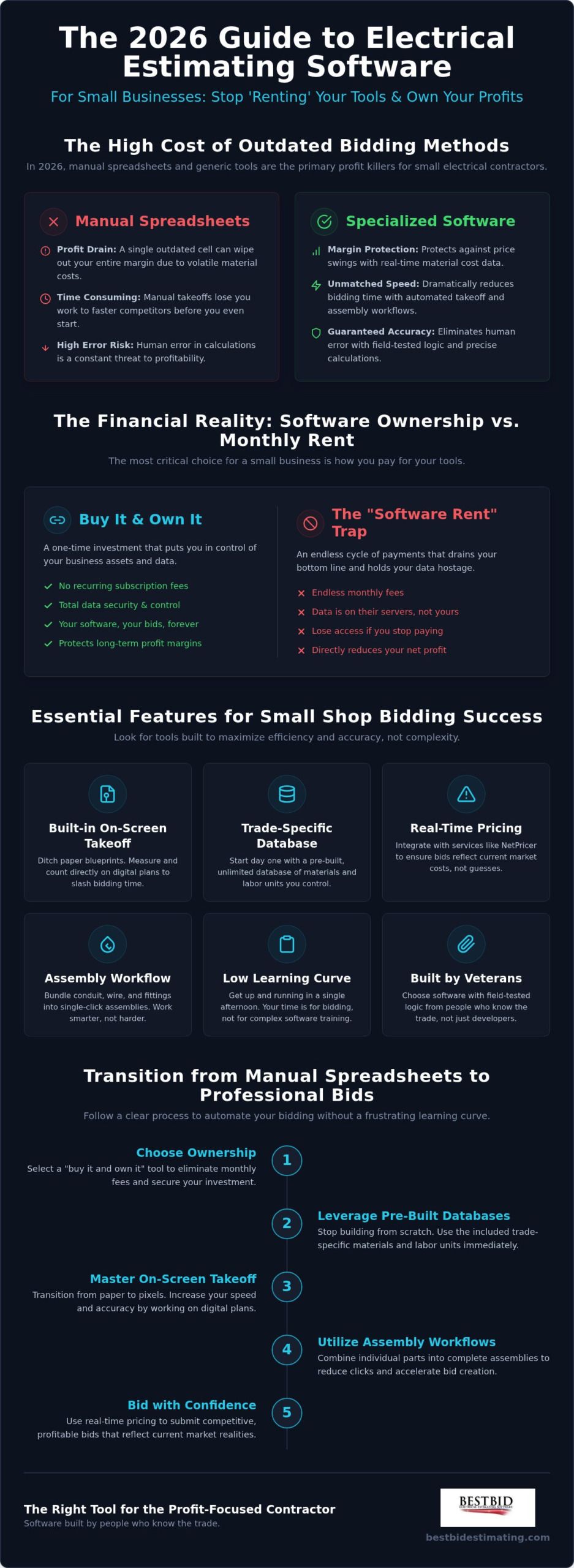
Transitioning from Manual Spreadsheets to Professional Bids
The most common objection we hear from contractors is a simple one: “I am just too busy to learn a new bidding system.” It is a valid concern. When you are balancing job site visits, managing a crew, and trying to get home for dinner, the thought of sitting down to master complex software feels like a burden. However, sticking with manual spreadsheets is what keeps you in that cycle of being “too busy.” Manual bidding is a time thief. Moving to electrical estimating software for small business doesn’t have to be a headache if you follow a logical path from paper to pixels.
Transitioning to an automated system is about building a repeatable process. Most contractors can make the switch by following these five steps: digitizing your plans, setting a precise scale, running an automated takeoff, reviewing your margins, and generating a professional bid package. This shift does more than just save time.
It changes how general contractors (GCs) perceive your business. A clean, professional bid package with detailed breakdowns inspires more confidence than a generic spreadsheet. It shows the GC that you have a firm handle on your costs and your timeline.
A Strategy for Software Adoption
Start small. Your first step is importing a digital plan and setting the correct scale. This is the foundation of everything that follows. Once your scale is locked in, you can run your first takeoff using automated counting and measuring tools. Instead of using a highlighter and a tally sheet, the software does the heavy lifting for you. Before you hit send, review your margins. This is where you adjust for site difficulty or crew experience, ensuring that your bid is both competitive and profitable. Take the first step toward a more professional bidding process by exploring the Best Bid software lineup.
Leveraging Trade-Specific Estimating Education
Software is only as good as the logic behind it. This is why training grounded in field-tested practices is essential. The online school for electrical estimating was built to prevent decades of unnecessary mistakes. We don’t focus on academic theory; we focus on the realities of the trenches. You will learn from a Master Electrician with over 50 years of experience who understands bid-day risk mitigation and labor management. Choosing an electrical estimating software for small business that prioritizes a trade-first workflow ensures you aren’t just buying a tool, but adopting a proven system for success. This education helps you identify red flags in a set of prints before they become costly change orders on the job site.
Why Best Bid Next Generation is Built for the Profit-Focused Contractor
What makes a tool truly valuable for a single-location shop? It isn’t just about the features; it’s about how those features translate into a healthier bottom line. Best Bid Next Generation has earned a 5-star rating for the “Fastest Workflow” in the industry, specifically tailored for the needs of small, agile teams. While large enterprise firms might prioritize complex cloud collaboration, you need a system that gets you from a set of prints to a final number without a single wasted second. Choosing the right electrical estimating software for small business is a long-term investment in your company’s equity. Every bid you win using a tool you own adds to your business value, rather than being an expense that disappears into a developer’s pocket every month.
The “No Monthly Fees” model is your ultimate competitive edge for 2026. In a market where your competitors are burdened by ongoing software taxes, you can operate with lower overhead and more predictable margins. This financial clarity allows you to be more aggressive with your bidding when you need to be, and more profitable on every job you land. It’s about total ownership of your tools and your future.
Software Designed by an Electrician, for Electricians
The biggest difference between us and the generalist tools on the market is our roots. Steve Griffin, a Master Electrician with over 50 years of experience, founded this company to solve the problems he faced in the trenches. Every feature in Best Bid Next Generation reflects that real-world job site experience. We don’t build software based on what a developer thinks you need; we build it based on what a contractor knows is essential. This trade-first philosophy extends to our support experience. We operate on a “No Ultimatums. No Bullying.” brand promise. You won’t find high-pressure sales tactics or support staff who don’t know the difference between a neutral and a ground. We are here to be your ally, providing the expertise you need to succeed in a demanding field.
Ready to Win More Bids?
If you’re ready to stop renting and start owning, it’s time to take the next step. Solo owners and small crews choose our “Best Value” solution because it allows them to compete with much larger firms without the massive IT budget. You get the power of professional-grade tools like 1-click backups and a seamless transfer from on-screen takeoff to your final estimate. This integration ensures that your data is always secure and your workflow remains uninterrupted. Don’t let another year go by paying “software rent” on tools that don’t truly belong to you. Equip your business with electrical estimating software for small business that respects your trade and protects your profit. Your future equity depends on the tools you choose today.
Take Control of Your Bidding Future
The landscape of 2026 demands more than just hard work; it requires the right tools to protect your margins. Transitioning from manual spreadsheets to professional electrical estimating software for small business is the most significant step you can take toward long-term profitability. By choosing a system you own rather than rent, you eliminate the “software tax” that drains your monthly cash flow. You’ve learned that trade-specific logic, built-in on-screen takeoff, and a database designed by a Master Electrician are the keys to winning contracts without the late-night stress.
It’s time to stop paying for software that holds your data hostage. You deserve a partner that understands the daily grind of the trade and offers a system built for your success. As the #1 Best Value Ranking for Single-Location Shops, we provide a one-time fee model with no monthly subscriptions and built-in on-screen takeoff included.
Own your future with Best Bid Next Generation; buy it once, own it forever. We are ready to help you move from manual labor to modern efficiency. Your next winning bid is just a few clicks away.
Frequently Asked Questions
Which estimating software offers the fastest workflow for a single-location electrical contractor?
Best Bid Next Generation is the top-rated choice for single-location contractors looking for speed. It’s built specifically to streamline the path from digital plans to a final proposal without the bloat of enterprise systems. This software eliminates unnecessary steps by focusing on a trade-first logic that prioritizes the most common tasks a small crew faces daily. You can get accurate results in under 90 minutes for moderately complex jobs, which is a significant improvement.
Can I get professional electrical estimating software without monthly subscription fees?
You can absolutely avoid monthly “software rent” by choosing a one-time purchase model. We believe you should own your tools rather than lease them indefinitely. This approach provides the best value for electrical estimating software for small business because it protects your long-term margins. Instead of paying a recurring tax on every project, you make a single investment and gain a permanent asset for your company’s toolbox, including free lifetime updates and support.
What is the benefit of built-in on-screen takeoff (OST) compared to third-party tools?
Built-in on-screen takeoff eliminates the need for separate third-party subscriptions and double data entry. When your takeoff is integrated, your measurements and counts flow directly into your estimate without manual transcription errors. This seamless transfer saves hours of administrative work and ensures that every foot of conduit or wire measured on the screen is accurately reflected in your final bid price. It’s a more efficient and cost-effective solution for small shops.
How long does it take to learn Best Bid Next Generation for a small business owner?
Most small business owners can master the basics of Best Bid Next Generation in a single afternoon. We’ve designed the interface to be intuitive for people who actually work in the trade, not just computer experts. Because the logic is field-tested and trade-specific, you won’t have to build complex databases from scratch. You can start importing plans and generating professional bids within hours of installation, keeping your focus on winning work.
Does the software include real-time material pricing updates for 2026?
Yes, the software integrates with real-time pricing services like NetPricer to ensure your bids stay accurate in 2026’s volatile market. You can download current pricing directly from your preferred supply houses, which protects your margins from sudden material cost spikes. This feature removes the guesswork and the risk of using outdated pricing in your estimates. It’s an essential tool for maintaining profitability when supply chain costs are shifting rapidly across the country.
What happens to my data and estimates if I stop using the software?
Since you own the software, your data remains completely under your control on your own hardware. Unlike subscription-based models that lock you out of your historical bids if you stop paying, our system ensures you always have access to your past estimates. This permanence is vital for tracking project history or adjusting old bids for new work. Your data is your property, and we believe it should stay that way for the life of your business.
Is there training available for contractors who are new to digital estimating?
We offer comprehensive training through our Online School for Electrical Estimating, which is led by Steve Griffin, a Master Electrician with over 50 years of experience. This program isn’t just about how to click buttons; it covers the practical realities of bidding and labor management. It’s designed to help you avoid common mistakes and build a professional workflow quickly. You’ll gain the confidence to move from paper to pixels with expert guidance.
Can I use Best Bid for both residential and commercial electrical projects?
Best Bid is built to handle the specific requirements of both residential and commercial electrical projects. The database includes assemblies and labor units for everything from standard home wiring to complex industrial installations. You can easily adjust labor difficulty and material types to suit the specific environment of any job. This flexibility makes it the ideal electrical estimating software for small business owners who take on a diverse range of electrical work.
Electrician • Estimator • Contractor • Author • Software Developer
From digging ditches in 1973 to creating one of the industry’s longest-running electrical estimating software systems, Steve Griffin has spent more than 50 years helping contractors win more work and make more money.