Total Cost of Ownership Electrical Estimating Software: The 2026 Contractor Guide

How much of your project margin is being siphoned off by software companies that never stop billing you? If you’re tired of “renting” your bidding tools, you aren’t alone. Most contractors are fed up with recurring monthly fees that eat into profits, coupled with the constant fear that a single missed payment could lock them out of years of critical bid data. It’s even more frustrating when you realize you’re paying a premium for mandatory add-ons like on-screen takeoff that should have been included from the start.
I’ve spent decades in the trade, and I know that every dollar matters to your bottom line. This guide will help you uncover hidden “subscription taxes” and calculate the true total cost of ownership electrical estimating software so you can finally stop overpaying. We’ll provide a clear five-year cost projection, compare the long-term ROI of ownership versus SaaS models, and show you how to ensure you own your data forever. It’s time to move past the stress of monthly bills and toward the security of a modern, reliable system that works for you, not the other way around.
Key Takeaways
- Identify why a low sticker price is often misleading and how to uncover the hidden indirect costs of your estimating lifecycle.
- Protect your project margins from the “Subscription Tax” by understanding the long-term impact of recurring payments on your bottom line.
- Calculate the true total cost of ownership electrical estimating software by factoring in training, implementation, and mandatory third-party add-ons.
- Use our 60-month ROI framework to compare the financial reality of renting your tools versus owning them outright.
- Secure your bid data and eliminate ongoing software burdens with a “Buy it and Own it” model designed by trade professionals.
What is Total Cost of Ownership (TCO) for Electrical Estimating Software?
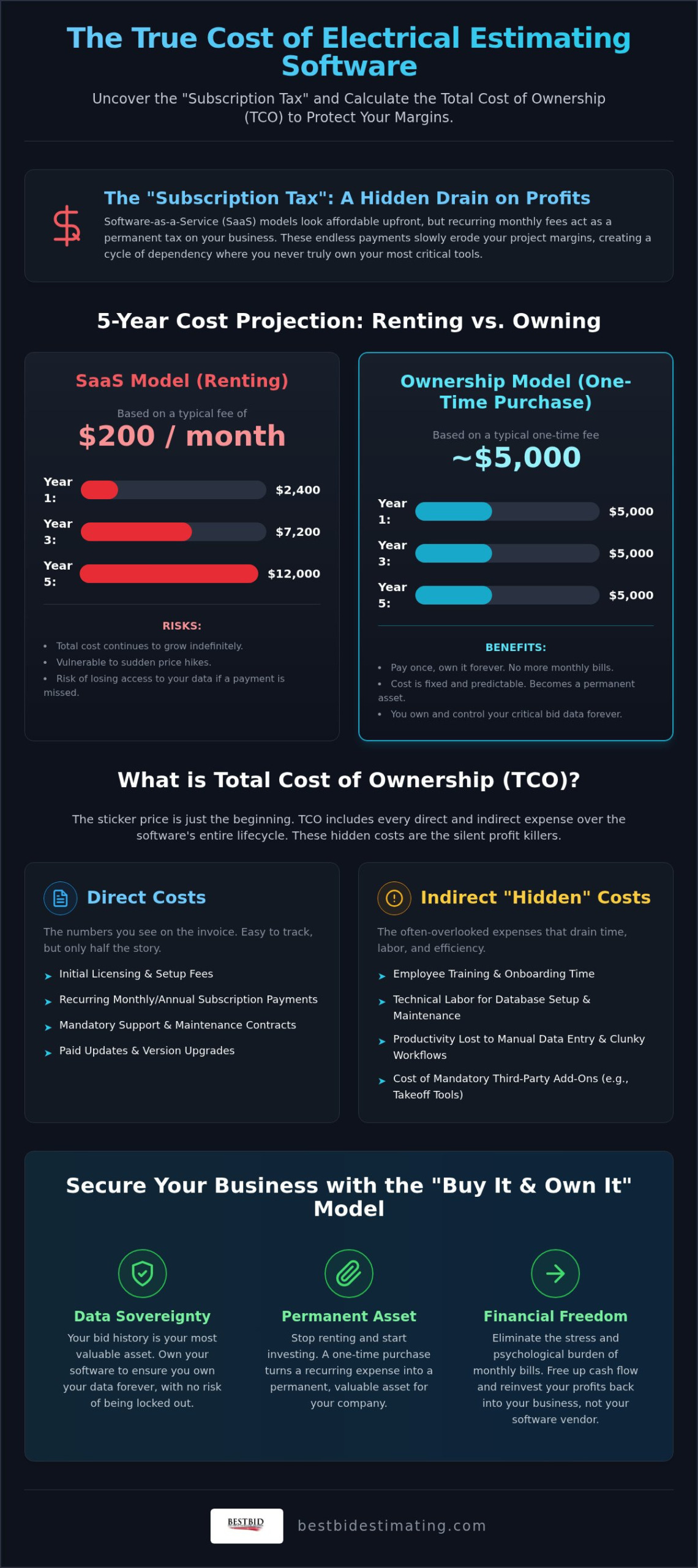
When you look at a new tool for your shop, you probably check the price tag first. However, the sticker price is often the most misleading part of an estimate. To truly understand your investment, you need to look at the total cost of ownership electrical estimating software. TCO is the complete sum of every direct and indirect expense you will incur over the software’s entire lifecycle, from the moment you sign the contract to the day you potentially replace it five years down the road.
In 2026, calculating TCO has become more critical than ever. We are dealing with rapid material cost fluctuations and frequent NEC updates that require your software to be agile and current. If your “cheap” software requires manual updates or expensive patches every time the code changes, your actual costs will skyrocket. A modern system should provide permanence and precision without hitting you with surprise bills every time the industry shifts.
To better understand how these costs aggregate over time, watch this helpful video:
Direct vs. Indirect Costs in Bidding
Direct costs are the numbers you see on an invoice. These include initial licensing fees, recurring subscription payments, and mandatory support contracts. While these are easy to track, they only tell half the story.
You must also account for indirect costs, which are often hidden. These include the hours your team spends on initial training, the technical labor required for database setup, and the ongoing time lost to manual data entries. Indirect costs are the silent profit killers in a 2026 electrical shop.
The 2026 ROI Factor: Why Speed Equals Savings
Your time is your most expensive asset. The efficiency of your workflow directly impacts the total cost of ownership electrical estimating software because labor is a massive variable. Think about the “cost of clicks.” If your software requires twenty steps to build a simple assembly while a competitor requires five, you are losing money on every bid. An assembly-structure workflow that minimizes steps can save your firm thousands of dollars in estimating labor annually. This focus on efficiency is exactly why the Best Bid Next Generation 5-star speed rating is a key metric for contractors who value their time as much as their profit margins.
The “Subscription Tax”: How SaaS Erodes Electrical Profit Margins
Many software vendors push Software as a Service (SaaS) as a budget friendly option. It looks like a small, manageable monthly expense at first glance. In reality, it acts as a permanent tax on your shop’s efficiency.
When you calculate the total cost of ownership electrical estimating software, these recurring fees quickly outpace the value they provide. You aren’t just paying for a tool; you’re entering a cycle where your profit margins are slowly eroded by a bill that never goes away.
The psychological burden of a permanent bill is heavy. Subscription models often market “free updates” as a major perk, but these are actually pre-paid through your monthly tax. You’re paying for tomorrow’s features with today’s hard earned project profit.
When you own your software, you eliminate that stress and gain a permanent asset for your business. It’s the difference between renting a shop and owning the land it stands on.
The Hidden Escalation of Recurring Fees
A $200 monthly fee might seem like a rounding error on a single commercial project. However, over five years, that same fee balloons into a $12,000 expense. That’s money straight out of your pocket that could have funded a new field truck or better equipment for your crew. You also face the significant risk of arbitrary price hikes. Contractors have zero control over SaaS vendor inflation; if the provider decides to raise the rent, you either pay the new rate or lose your workflow. You can compare these long term burdens against a more transparent model by reviewing Best Bid Pricing.
Data Sovereignty and Your Bidding History
What happens to your work if you decide to stop paying the monthly fee? For most SaaS users, the answer is the “Data Hostage” problem. If you miss a payment or cancel the service, you often lose access to your historical project data and custom databases.
True total cost of ownership electrical estimating software should include the peace of mind that you own your data forever, regardless of your current subscription status. We believe in 100% user control, which includes:
- Permanent access to all historical bids and project archives.
- Full authority over your material and labor databases.
- The ability to backup and move your data without vendor permission.
Best Bid founder Steve Griffin, a Master Electrician with over 50 years in the field, built this company on a “No Ultimatums” philosophy. You shouldn’t be threatened with losing your bid history just because you want to change how you manage your overhead. If you’re ready to stop renting your success, consider how a buy-it-and-own-it model can provide the security your business deserves.
Built-in OST vs. Third-Party Add-ons: Eliminating the “Takeoff Tax”
Why are you paying for two software licenses to do one job? Many contractors buy an estimating program only to realize they can’t actually see or count on their digital plans without buying a separate tool. We call this the “Takeoff Tax.” It’s a hidden, ongoing drain on your project funds that significantly inflates the total cost of ownership electrical estimating software. When your counting tool and your pricing tool are separate, you’re essentially paying a middleman to do work that should be automated.
Integrated systems change the game by allowing you to work within a single environment. When you count a receptacle on the screen, the material and labor costs should populate your bid instantly. If you’re forced to export data from an external counting tool and then import it into your estimating software, you’re wasting valuable time. This “transfer time” isn’t just a nuisance; it’s a labor expense that eats into your margins before you even submit the bid.
The True Cost of Third-Party Integrations
Licensing fees for external digital takeoff tools can add thousands of dollars to your annual overhead. Beyond the direct cash outlay, you face the labor cost of syncing databases between two different software companies. If the material descriptions in your takeoff tool don’t perfectly match your estimating database, you’ll spend hours on manual corrections. This friction is a major TCO burden. Best Bid Next Generation is uniquely positioned in the market because it includes built-in OST as a standard feature, not a costly add-on. This ensures your counts and your costs are always on the same page without the need for complex, fragile integrations.
Workflow Efficiency: From Screen to Estimate
Integrated software offers a 1-click backup and fast transfer advantage that separate tools simply can’t touch. By removing the middleman from the bidding process, you reduce the risk of repetitive counting errors. The software handles the heavy lifting, translating your visual takeoff into a detailed material list automatically.
This streamlined workflow does more than just save time; it reduces the learning curve for new estimators. You don’t have to teach them two different platforms or how to manage the “bridge” between them. You simply show them how to bid.
This simplicity is a core component of reducing the total cost of ownership electrical estimating software and keeping your shop lean and competitive.
Calculating Your 5-Year ROI: A Step-by-Step Framework
To find the true total cost of ownership electrical estimating software, you have to look past the first year. Most business equipment is depreciated over a five year period; your software should be evaluated the same way. By projecting costs over 60 months, the gap between renting your tools and owning them becomes an unbridgeable canyon. Use this framework to audit your current or prospective bidding platform and see where your money is actually going.
- Step 1: Licensing and Setup. Total all initial purchase prices, implementation fees, and data migration costs.
- Step 2: Recurring Payments. Multiply your monthly subscription or mandatory support fee by 60. Factor in a conservative annual price increase of 5 percent, which is standard for most SaaS vendors.
- Step 3: Takeoff Add-ons. If your software requires a third party tool for digital takeoff, add those licensing costs here.
- Step 4: Labor and Training. Estimate the cost of down time for your team to learn the system and set up your specific database.
- Step 5: The Comparison. Line up your totals. While the industry average for a 5-user setup often exceeds $25,000 over five years, the Best Bid model keeps your investment at approximately $2,500.
The Break-Even Point Analysis
Identifying the exact month where ownership becomes “free” compared to a subscription is a powerful exercise. For many contractors, the break-even point happens much sooner than they expect. Small shops, which represent the vast majority of the electrical trade, often reach this point within the first 12 to 18 months. Once you hit that mark, every dollar you would have spent on a subscription goes straight back into your project margins. You can read more about why small contractors choose no-subscription software to protect their long term cash flow.
Database Flexibility and Long-Term Value
A major component of total cost of ownership electrical estimating software is how the tool adapts as you grow. If you have to pay extra fees to add more items to your database or unlock advanced assemblies, your TCO will continue to climb. Ownership provides an unlimited database that stays under your total control. Features like global labor adjustments and assembly morphing save hours per bid by allowing you to update your entire pricing structure with a few clicks. This level of precision ensures you aren’t just saving money on the software itself, but also on the labor required to produce accurate bids. If you’re ready to secure the lowest 5-user licensing cost in the industry, view our Best Bid Next Generation options today.
Best Bid: Maximizing TCO Efficiency for Electrical Contractors
Choosing the right tool for your shop isn’t just about features. It’s about financial freedom. For contractors looking to protect their 2026 profit margins, the “Buy it and Own it” model is the only logical path forward.
When you compare an investment of approx. $2,500 for a 5-user license against the $15k to $75k price tags of competitors, the total cost of ownership electrical estimating software becomes the most important metric in your business. You aren’t just buying software; you’re investing in a permanent asset that works for you without asking for a monthly cut of your success.
We believe in transparency. That’s why we offer lifetime updates and support with our systems. You should never receive another monthly invoice just to keep your bidding tools operational.
This commitment to fairness is why independent comparisons consistently rank our suite as the #1 Best Value for single-location contractors. You get enterprise-level power without the enterprise-level debt, allowing you to lower the total cost of ownership electrical estimating software from day one.
Built from the Trenches, Not a Boardroom
Best Bid wasn’t dreamed up by a group of Silicon Valley developers who’ve never stepped foot on a jobsite. It was built by Steve Griffin, a Master Electrician with over 50 years of field experience. This real-world perspective drastically reduces the software learning curve because the workflow mirrors the way you actually think and work. Practical features like real-time NetPricer integration allow you to pull current material pricing instantly, ensuring your bids are as accurate as they are fast. If you want to see how these features stack up against the rest of the market, check out our Electrical Estimating Tools: The 2026 Guide.
Securing Your Bidding Future
Software is only as good as the person using it. We empower contractors through the Online School for Electrical Estimating, providing the specialized training you need to master the trade. This combination of world-class tools and expert education provides the ultimate peace of mind. When you own your software, you own your data, your history, and your future. There are no ultimatums and no “Subscription Taxes” to hold you back. It’s time to stop renting your bidding tools and start building a more profitable, secure business. Own your data and your future today.
Secure Your Profits and Own Your Bidding Future
Your project margins deserve better than a permanent tax on your productivity. By understanding the true total cost of ownership electrical estimating software, you can finally move away from the stress of recurring bills and toward the security of a modern, reliable system. You’ve seen the 5-year ROI numbers and the hidden costs of third-party add-ons. Now it’s time to make the choice that protects your shop’s future. Best Bid Next Generation provides a professional solution with lifetime updates and technical support included. We are ranked #1 for Best Value among single-location contractors because we offer a 5-user license for approximately $2,500; this is the lowest in its class.
Stop renting your success and start owning your tools. View Pricing and Own Your Software Today. You’ve worked hard to build your business. It’s time to equip your team with a system that respects your bottom line and guarantees your data sovereignty forever. We are here to help you make that transition with confidence and provide the specialized expertise your firm needs to thrive.
Frequently Asked Questions
What is the average total cost of ownership for electrical estimating software over 5 years?
Industry reports for 2026 suggest that high-end enterprise platforms can cost between $15,000 and $75,000 over a five year period when you factor in licenses, maintenance, and support. In contrast, our Best Bid Next Generation model keeps your total cost of ownership electrical estimating software at approximately $2,500 for a 5-user license. This massive difference allows you to protect your project margins and reinvest those savings into growing your field operations.
Does Best Bid really have no monthly fees or hidden costs?
Yes, we operate on a strict “Buy it and Own it” model with zero recurring payments. Your initial investment covers the software license, built-in digital takeoff, and ongoing support without a monthly “Subscription Tax.” We believe that once you pay for a tool, it should belong to you. This transparency eliminates the risk of unexpected price hikes that are common with SaaS vendors who control your access to the software.
Can I still get updates for non-subscription software in 2026?
You certainly can. While many vendors are moving toward subscription only models, we provide lifetime updates and technical support as part of your one-time purchase. This ensures your database stays current with 2026 NEC updates and material price shifts without requiring a new invoice every month. You get the benefits of modern technology while maintaining the security of a permanent asset that stays under your total control.
How does built-in on-screen takeoff reduce my total cost of ownership?
Built-in OST eliminates the need for a second software license, which can save you thousands of dollars in annual overhead. By removing the “Takeoff Tax,” you lower the total cost of ownership electrical estimating software because you aren’t paying for third-party integrations or separate training. A single, integrated environment allows your counts to flow directly into your bid, reducing the labor hours spent on manual data entry and error correction.
Is it difficult to switch from a subscription-based model to Best Bid?
Most contractors find the transition surprisingly simple because our software is designed by a Master Electrician with field experience. Unlike complex enterprise platforms, our workflow follows the natural logic of the trade. We provide the training resources and technical support needed to migrate your bidding process quickly. You can stop renting your tools and start owning them without the stress of a long, technical implementation period.
What happens to my historical bid data if I use a one-time purchase software?
You maintain 100% sovereignty over your data forever. When you own the software, you never have to worry about losing access to your project history or custom databases if you stop paying a monthly fee. We provide 1-click backup features that allow you to secure your bidding history on your own hardware. Your work is your property, and you should have the freedom to access it whenever you need it.
Does the one-time fee include technical support for my estimating team?
Technical support is fully included in your license fee. We don’t believe in charging you extra for the help you need to master your tools. Our support team understands the practical realities of the electrical trade and is available to assist with database setup or technical questions. This partnership ensures your estimating team stays productive without the burden of mandatory support contracts or per-call fees that inflate your overhead.
How does the learning curve of Best Bid compare to enterprise options like Accubid?
Our software is built from the trenches, which makes it much more intuitive for field-experienced professionals than corporate enterprise systems. While some platforms require weeks of intensive training, our assembly-structure workflow is designed to be mastered in a fraction of the time. You spend less time navigating complex menus and more time producing accurate, profitable bids. This efficiency is a core part of our commitment to helping contractors succeed.