How to Speed Up Electrical Estimating: The 2026 Efficiency Checklist

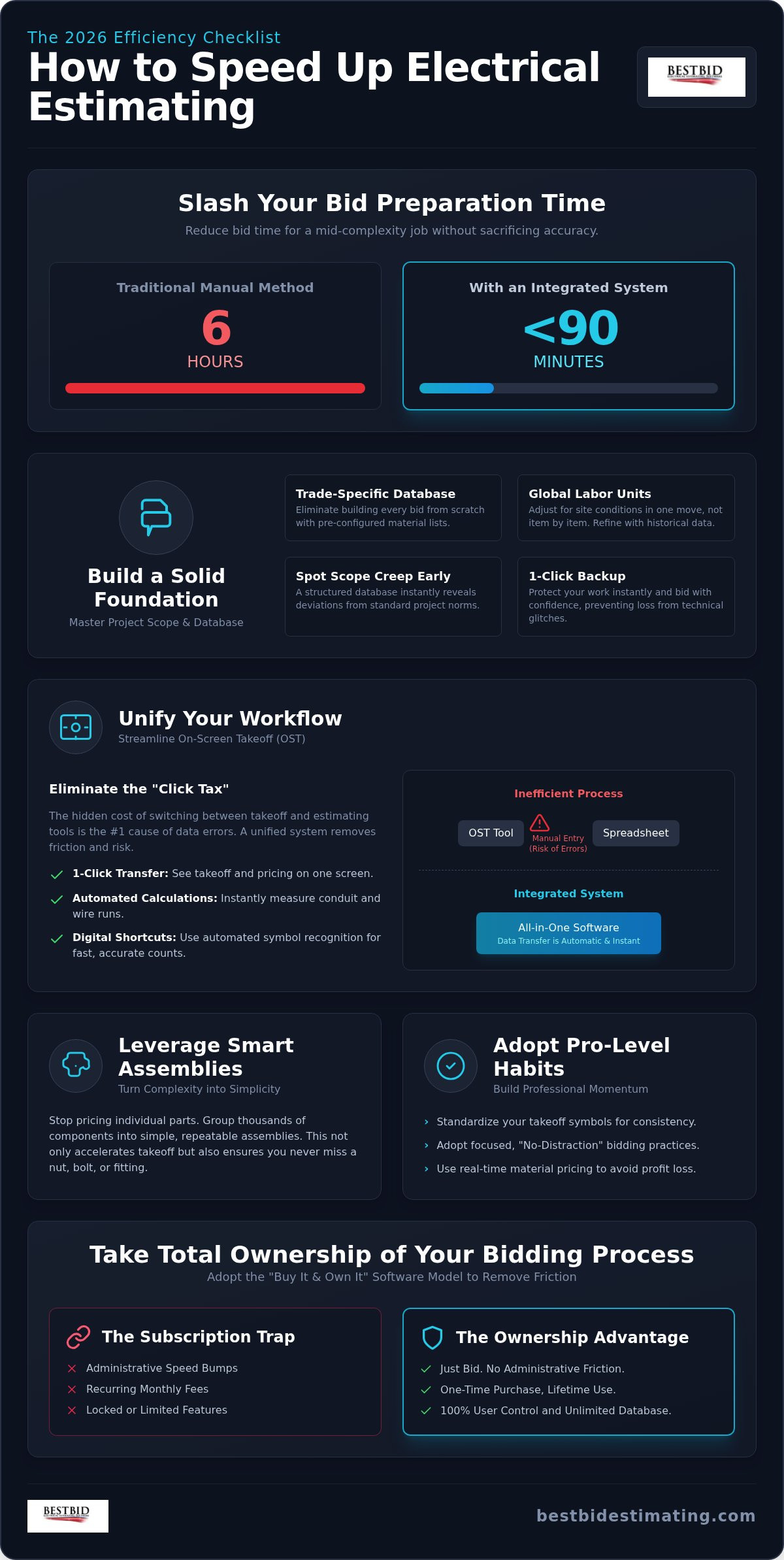
Did you know that the right estimating software can reduce your bid preparation time for a mid-complexity job from six hours down to under 90 minutes? If you are still grinding through manual takeoffs or fighting with software that feels like it was designed by a committee rather than a contractor, you are losing money. We know the daily grind because we have been in the trenches for over 50 years. You deserve to know how to speed up electrical estimating using a system that works as hard as you do, without the headache of monthly subscription fees or steep learning curves.
We agree that accuracy shouldn’t be the price you pay for speed. This guide provides the field-tested strategies and workflow shortcuts you need to slash bidding time without sacrificing a penny of profit. You will learn how to leverage built-in OST and real-time pricing to move from a pile of blueprints to a professional bid in minutes, not hours. We are laying out the 2026 efficiency checklist to help you take total ownership of your bidding process, ensuring you have the confidence to win more work while finally getting your evenings back.
Key Takeaways
- Learn how a pre-built, trade-specific database eliminates the need to build every bid from scratch while helping you spot scope creep before it ruins your profit.
- Eliminate the “Click Tax” by using integrated on-screen takeoff tools that stop you from wasting hours re-entering data between separate applications.
- Master the use of smart assembly structures and real-time material pricing to turn thousands of complex parts into simple, repeatable clicks.
- Discover how to speed up electrical estimating by adopting a “Buy it and Own it” software model that removes administrative friction and subscription traps.
- Build professional-level momentum by standardizing your takeoff symbols and adopting focused, “No-Distraction” bidding habits used by industry veterans.
Mastering the Project Scope and Database Foundation
Speed starts long before you open a set of drawings. If you’re spending the first hour of every bid setting up parts or hunting for pricing, you’ve already lost the race. True efficiency is built on a foundation of a ready-to-use database. Most contractors realize that how to speed up electrical estimating isn’t about typing faster; it’s about having the right information at your fingertips from the jump. When your database is pre-configured, you eliminate the “blank page” syndrome that stalls so many estimators.
Identifying scope creep early is another massive time-saver. When your database is structured properly, you’ll notice when a project’s requirements deviate from standard commercial or residential norms. This prevents those mid-estimate corrections that eat up your afternoon.
To keep your momentum, use a “1-Click Backup” system. High-speed bidding is intense. Nothing kills your pace like losing progress because of a technical glitch.
By protecting your work instantly, you can bid with the confidence of a seasoned pro.
Steve Griffin, a Master Electrician with over 50 years in the trade, built these workflows to remove the administrative friction that slows you down. When you own your software outright, you don’t deal with the “administrative speed bumps” of subscription renewals or locked features. You just bid. A streamlined foundation includes:
- A comprehensive, trade-specific material list.
- Pre-set labor units based on real-world field experience.
- Instant access to historical data for quick comparisons.
Pre-Configuring Your Material Database
You should never have to build an estimate from scratch for common projects. A robust, pre-configured database is your greatest asset. With tools like Best Bid Next Generation, you get 100% user control. This means you aren’t stuck searching for non-existent parts or fighting with a system that doesn’t understand the trade. An unlimited database allows you to handle complex commercial bids without hitting a wall, ensuring every part you need is already indexed and ready for takeoff.
Setting Global Labor Units
Your crew’s speed isn’t a fixed number. It changes based on site conditions like height, weather, and project complexity. Instead of adjusting labor for every single item, use global labor units to make these changes in one move.
This prevents you from over-estimating labor on simple residential tasks while ensuring you’re covered for difficult industrial installs. By using historical data from your past jobs, you can refine your speed over time. This creates a feedback loop where every bid you finish makes the next one faster and more accurate.
Streamlining On-Screen Takeoff (OST) Workflow
Have you ever calculated the “Click Tax”? It’s the hidden cost of switching between your takeoff tool and your estimating spreadsheet. Every time you copy a number from one screen to another, you risk a typo that could cost thousands. If you’re looking for how to speed up electrical estimating, the answer isn’t just a faster mouse; it’s a unified system. Built-in OST functionality removes the friction of data re-entry. It allows you to count devices and measure conduit runs while the software automatically populates your bid in real-time.
Automating conduit and wire length calculations directly from the plan saves hours of manual math. Instead of using highlighters and manual tallies, digital counting tools provide a permanent, accurate record. This transition from traditional methods to modern efficiency is what separates the shops winning the most profitable bids from those still stuck in the paperwork grind. By integrating these steps, you replace the stress of manual labor with the security of a reliable, modern system.
Eliminating the OST-to-Estimate Transfer
Why do people still use third-party takeoff tools? Often, it’s because they’ve been told precision takes time. We disagree.
Third-party tools are the top cause of data errors because they require you to be the manual bridge between two different databases. When you use a 1-click transfer method, you see your takeoff on the screen while you price it. This visual verification ensures you haven’t missed a room or double-counted a circuit.
It’s about replacing manual labor with the security of a system that doesn’t require a PhD in software to operate.
Digital Measuring and Counting Shortcuts
Measuring linear runs for conduit doesn’t have to be a chore. Modern digital tools handle the scaling for you instantly. Instead of manual tallies, automated symbol recognition can identify fixtures and devices across dozens of pages. This isn’t just about the bid; it’s about the project lifecycle. You can mark up PDF plans for your field crews while you estimate, ensuring the guys in the van know exactly what you bid. If you want to see this workflow in action, you can explore our integrated electrical estimating solutions to see how we eliminate the middleman and keep your workflow moving.
Leveraging Assemblies and Real-Time Material Pricing
Efficiency isn’t just about how many parts you can list; it’s about how few clicks it takes to get them onto the page. Searching through tens of thousands of items is the fastest way to kill your bidding momentum. If you want to know how to speed up electrical estimating, you must look at your assembly structure. A smart system doesn’t make you hunt for individual screws, connectors, and wire nuts. It groups them into intelligent packages that do the heavy lifting for you, reducing a complex task to a single action.
Beyond the parts themselves, the price you pay for those materials can make or break your company. We’ve seen contractors lose their shirts because they used pricing that was only three weeks out of date. Integrating real-time pricing isn’t just a luxury; it’s a necessity for survival in a volatile market. By connecting your workflow to live supplier feeds, you stop being a data entry clerk and start being a strategist.
The Power of Morphing Assemblies
Most software packages force you to manage a massive, clunky library of 50,000 fixed assemblies. This is actually slower because you spend all your time searching for the “perfect” match in a list that never ends. We believe 500 flexible, “morphing” assemblies are far more powerful than 50,000 rigid ones.
Imagine selecting a single assembly for a “standard office” and having it automatically adjust for ceiling height or wall type on the fly. This capability allows you to build a complete room estimate with one selection, customizing components without ever breaking your master database foundation.
Automating Material Cost Updates
Manual price checking is a profit killer. In a market where commodity prices fluctuate daily, relying on old spreadsheets is a gamble you don’t need to take. By integrating real-time pricing via NetPricer, your software stays connected to your actual supplier costs. This ensures “Bid Day” accuracy without the three-hour phone call to the supply house. When your material costs update automatically, you gain the freedom to focus on the strategy of the bid. This is how to speed up electrical estimating while maintaining the precision that keeps your business profitable and your stress levels low.
To scale this speed even further, use template bids for recurring project types like retail build-outs. Instead of starting from zero, you can pull a proven template, adjust your quantities through the integrated OST, and let the real-time pricing handle the rest. It’s a streamlined workflow that doesn’t require a PhD to master.
Advanced Workflow Habits for Faster Bidding
Speed isn’t just about the tools you use; it’s about the discipline you bring to the desk. If you’re constantly interrupted by phone calls or emails, your focus shatters. If you want to know how to speed up electrical estimating, you need to create a “No-Distraction” zone. Set a timer for 50 minutes of deep work. During this time, your only job is the takeoff. You’ll find that focused blocks of time allow you to finish bids in a fraction of the time it takes when you’re multitasking.
Maintain your rhythm through batch processing. Instead of jumping between counting devices and measuring conduit, do all your counting first. Then, switch to measuring linear runs.
This keeps your brain in one “mode” at a time, which is much faster than constant context switching. For residential service calls, don’t overthink it. Use “Easy Bid” modules designed for quick turnarounds.
These allow you to produce a professional quote for a panel swap or a car charger in minutes, keeping your high-end commercial workflows separate from your daily service work.
Standardizing the Takeoff Language
A messy takeoff is a slow takeoff. You should never have to guess what a specific mark on your screen means. Standardize your colors across your entire team.
Use Blue for power, Red for fire alarm, and Green for lighting. This creates a visual legend that makes the “second look” review incredibly fast. When you train junior estimators to follow a specific click-path and color code, you eliminate the confusion that leads to costly errors.
It turns your bidding process into a repeatable system rather than a guessing game.
Review and Refinement Shortcuts
The final review is where many estimators lose their nerve and their speed. Use specialized tools like our Panel Scheduler to verify circuit counts and load calculations instantly. This eliminates manual cross-checking between your takeoff and your panel schedules. Before you hit send, perform a 15-minute “Bid Day” review. Focus on the big-ticket items: total labor hours, major equipment costs, and your overhead margins. Finally, learn the most important speed habit of all: saying “No.” If a bid has poor drawings or an impossible deadline, walk away. Your time is better spent on projects where you can actually win and make a profit.
Scaling Speed with Professional Training and Software Ownership
Stop paying rent on the tools you use to build your business. If you want to know how to speed up electrical estimating, you have to look at the administrative friction caused by monthly subscriptions. When you have to worry about credit card expirations or seat licenses just to open a project, your workflow suffers. Our “Buy it and Own it” model removes those speed bumps. You get the security of a modern system with the permanence of a tool you actually own. This shift allows you to transition from a stressed estimator to a focused business owner who reclaimed their time.
Training is the second half of the speed equation. The Online School for Electrical Estimating exists to help you avoid decades of unnecessary mistakes. You don’t have to learn through trial and error when you can follow a field-tested path designed by Steve Griffin.
This professional training ensures that your team isn’t just fast, but consistently accurate. It’s about building expert speed through a shared history of what actually works in the field, replacing manual labor with the security of a modern, reliable system.
The Low-to-Medium Learning Curve Advantage
Too much complex software sits unused on a contractor’s shelf because it’s too hard to learn. You shouldn’t need a PhD to bid a warehouse. We designed our systems with a low-to-medium learning curve so you can get your first bid out in days, not weeks.
You get lifetime updates and support without recurring fees. This ensures your software evolves as the trade does. This ease of use is a competitive advantage that lets you respond to RFPs while your competitors are still reading the manual.
It’s a straightforward approach that respects your bottom line.
Leveraging Freelance Support for Overflow
Even the most efficient estimator hits a limit when the pipeline is full. This is when you should use freelance electrical estimating services to keep your business moving forward. Outsourcing the heavy lifting of a massive takeoff or complex drafting allows you to focus on relationship building and closing deals. It’s about working on your business instead of just in it. By using freelance drafting for your as-built process, you ensure your field documentation is as professional as your initial bid. This is the final piece of the puzzle for how to speed up electrical estimating while growing your bottom line.
Take Control of Your Bidding Future
Winning more work doesn’t have to mean working more hours. By integrating your takeoff with your estimate, leveraging flexible assemblies, and using real-time supplier pricing, you’ve already found the secret to how to speed up electrical estimating. These aren’t just software features; they’re the field-tested strategies needed to thrive in a competitive market. You’ve seen how removing the “Click Tax” and adopting standardized habits can turn a six-hour grind into a 90-minute win.
It’s time to stop renting your productivity and start owning it. Best Bid was built by Steve Griffin, a Master Electrician with over 50 years of field experience, specifically for shops that value speed and transparency. We are proud to be rated #1 for “Best Value” among single-location contractors because we don’t believe in hidden costs or administrative hurdles. Stop paying monthly fees and start bidding faster with Best Bid Next Generation today. You have the experience to do the job; now you finally have the tools to bid it with confidence. Your next big win is just a few clicks away.
Frequently Asked Questions
How can I speed up my electrical takeoff process?
You can speed up your electrical takeoff by eliminating the need to transfer data between separate PDF viewers and estimating software. Using a built-in on-screen takeoff (OST) tool allows you to count devices and measure conduit runs directly on the digital plans. This method removes the risk of manual entry errors and ensures that every quantity you mark on the drawing is instantly accounted for in your final bid total.
What is the fastest electrical estimating software for small contractors?
The fastest software for small contractors is a system that combines a low learning curve with trade-specific automation. Best Bid Next Generation is designed specifically for single-location shops to help them get bids out in minutes rather than hours. By avoiding complex, high-end software that requires weeks of training, you can start winning work immediately. Our system focuses on how to speed up electrical estimating by reducing the number of clicks required for every assembly.
Does electrical estimating software really save time compared to spreadsheets?
Yes, professional software saves hours per bid by replacing manual calculations with automated database lookups. While spreadsheets require you to manually update pricing and verify formulas, estimating software uses pre-built assemblies and real-time supplier feeds. Industry data shows that switching from manual spreadsheets to a dedicated estimating platform can reduce bid preparation time for mid-complexity jobs from six hours to under 90 minutes while significantly improving your final accuracy.
How do built-in takeoff tools differ from separate PDF software?
Built-in takeoff tools exist within the same environment as your pricing database, meaning there is no data transfer required. Separate PDF software forces you to perform a “second takeoff” where you manually type your counts into a different application. This separation creates a “click tax” that adds hours to your work week. Integrated tools like Accura Cadd PDF Draw ensure that what you see on the plan is exactly what appears in your bid.
Can I use real-time pricing to speed up my bids?
Absolutely. Integrating real-time pricing via services like NetPricer allows your software to pull current material costs directly from your suppliers. This eliminates the need for manual price checking or phone calls to the supply house. When you use live data, you gain the confidence to submit bids on “Bid Day” without worrying about commodity price fluctuations that occurred since your last database update. It is a critical component for anyone learning how to speed up electrical estimating.
Is there a way to automate conduit and wire length calculations?
You can automate these calculations by using digital measuring tools that track linear runs on your PDF plans. Once you set the scale for a drawing, the software automatically calculates the total conduit and wire required based on your path. It even accounts for vertical drops and waste percentages. This removes the need for manual scaling and complex math, allowing you to move through feeder and branch circuit takeoffs with incredible speed.
How long does it take to learn professional electrical estimating software?
Most contractors can learn to produce professional bids in just a few days if the software is designed with a low-to-medium learning curve. Unlike enterprise-level systems that require extensive training sessions, trade-specific tools like Best Bid are built to feel familiar to electricians. With support from the Online School for Electrical Estimating, you can master the core workflow and start recouping your investment through faster bidding within your first week of ownership.
What are the most common mistakes that slow down an electrical bid?
The most common mistakes include searching for individual parts in a massive, unorganized database and failing to use standardized takeoff colors. Estimators often lose time by re-entering data from third-party tools or allowing frequent interruptions to break their rhythm. You can avoid these pitfalls by using flexible assemblies that “morph” to fit different project types and by setting a timer for focused, distraction-free takeoff blocks during the workday.