How to Improve Electrical Bidding Accuracy: The 2026 Contractor’s Guide

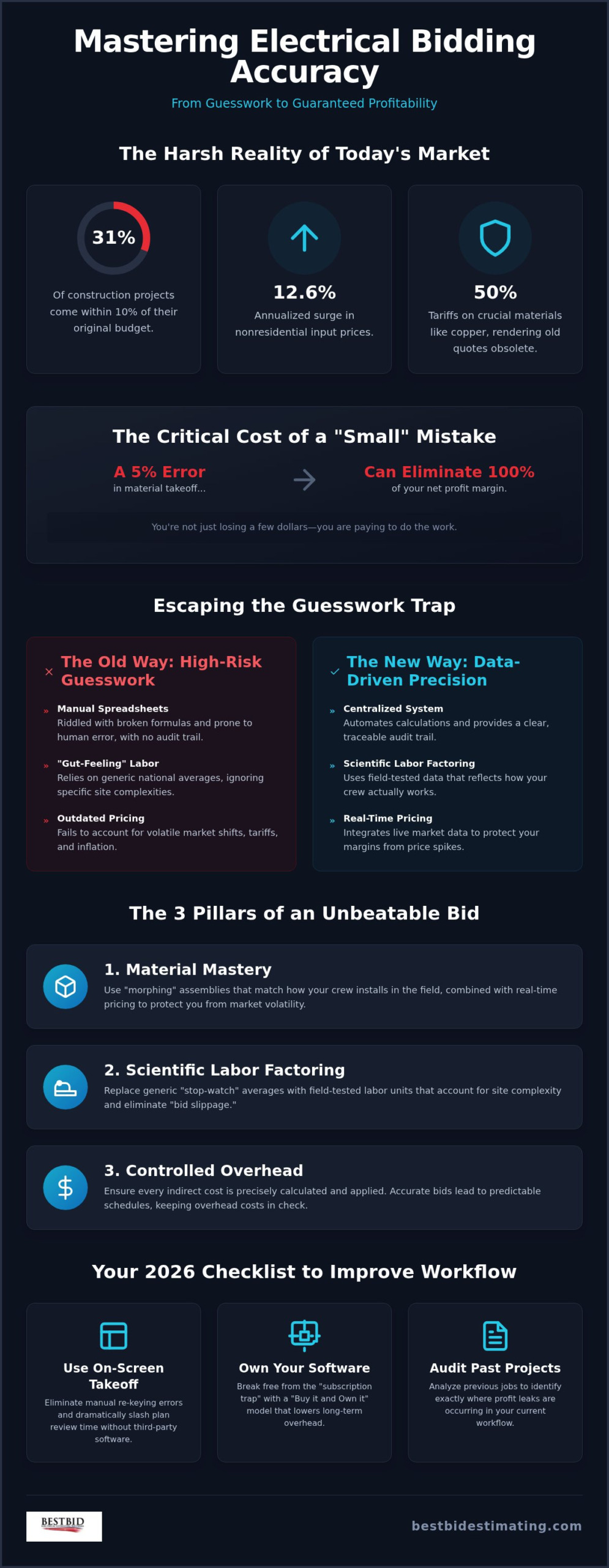
Did you know that only 31% of construction projects come within 10% of their original budget? In a market where nonresidential input prices are surging at an annualized rate of 12.6% and copper tariffs have hit 50%, a “close enough” estimate is a fast track to losing money. You didn’t spend decades in the field to have your profits eaten by volatile material spikes or labor units that don’t account for real-world conditions. To improve electrical bidding accuracy, you need a system that works as hard as you do, without the “subscription trap” of expensive software that drains your bank account every month.
We understand the frustration of missing a bid because of a simple takeoff error or, worse, winning a contract only to realize you underestimated the labor hours required for the new 2026 NEC arc flash labeling requirements. You deserve bids that reflect actual field conditions and a workflow that doesn’t sacrifice precision for speed. This guide will show you how to master field-tested strategies and digital tools designed to protect your margins. We will explore how to take total ownership of your estimating process, ensuring every bid you submit is precise, profitable, and professional.
Key Takeaways
- Learn how to improve electrical bidding accuracy by aligning your estimates with real-world site conditions and current 2026 material tariffs.
- Discover the “Scientific Labor Factoring” method to account for site complexity and avoid the common mistake of underestimating man-hours.
- See how integrated On-Screen Takeoff (OST) eliminates re-keying errors and slashes your plan review time without needing third-party software.
- Break free from the “subscription trap” by moving to a “Buy it and Own it” software model that lowers your long-term overhead and protects your bottom line.
- Audit your previous projects using our 2026 checklist to identify exactly where profit leaks are occurring in your current bidding workflow.
Why Your Bids Are Missing the Mark: The Real Cost of Inaccuracy
True accuracy in electrical bidding isn’t just about winning the job. It is the precise alignment between your initial Cost estimate and the actual expenditures recorded on the job site. When these numbers drift apart, your business suffers. To improve electrical bidding accuracy, you must first acknowledge that even small errors have massive consequences. For example, a mere 5% error in your material takeoff can completely wipe out your net profit margin on a typical commercial project. You aren’t just losing a few dollars; you are essentially paying the customer to let you work.
The psychological toll of bidding uncertainty is just as damaging. When you don’t trust your numbers, you’re forced into a corner. You might overprice the job to “be safe,” which leads to losing the contract to a more precise competitor.
Or, you might second-guess your totals and leave money on the table just to stay competitive. Neither path leads to a sustainable business. You need a system that replaces gut feelings with hard data.
The Mathematical Trap of Manual Spreadsheets
Many contractors still rely on legacy Excel files that have been passed down for years. These spreadsheets are often riddled with broken formulas and hidden cells that no one remembers how to fix. If you’re manually updating material prices across multiple tabs, you’re inviting human error into your bottom line. There is no audit trail when three different people touch the same file, making it impossible to see where a mistake started. Moving to a dedicated system like Best Bid Next Generation removes these risks by centralizing your data and automating the math.
Identifying the ‘Guesswork’ in Your Current Process
Are you still “guesstimating” labor based on a gut feeling? Relying on generic national averages is a recipe for disaster because they don’t account for your local labor market or specific site complexities. If you want to improve electrical bidding accuracy, you need to use field-tested labor units that reflect how your crew actually works.
Without this precision, you fall victim to bid slippage. Bid slippage is the gap between estimated and actual labor hours. When this gap widens, your project schedule collapses and your overhead costs skyrocket.
Precise labor factoring ensures you account for every wire pull and trim-out before the first van leaves the shop.
The 3 Pillars of Electrical Bidding Accuracy: Material, Labor, and Overhead
Precision in the electrical trade isn’t a luxury; it’s a requirement for survival. To improve electrical bidding accuracy, you must master the three pillars of every estimate: material, labor, and overhead. With nonresidential construction input prices surging at a 12.6% annualized rate in early 2026, your margin for error has evaporated.
You need a system that accounts for every length of conduit and every minute of labor with surgical precision. If you’re still relying on outdated pricing or “gut feelings,” you’re leaving your company’s future to chance.
One of the biggest advantages you can give your shop is real-time pricing. Because copper tariffs have reached 50% as of early 2026, a price quote from last month is already obsolete. By integrating real-time market pricing through NetPricer, you ensure your material costs reflect the current market rather than an outdated guess.
This protects you from inflation-driven losses that can sink a project before the first van even leaves the shop. Every wire nut and connector matters when you’re bidding on larger, high-stakes contracts.
Mastering Material Assemblies
Searching through a massive database for individual parts is a massive waste of your time. Instead, professional estimators use “morphing” assemblies. These allow you to quickly adjust a conduit run to include the correct hangers, couplings, and wire fill with just a few clicks.
When you have total ownership of your database, you can ensure your assemblies match the way your crew actually installs in the field. This level of detail is what separates a profitable contractor from one who is just staying busy without making a dime.
The Labor Factor: Beyond the Stop Watch
Labor is the most volatile variable in any electrical bid. “Theory-based” labor units found in generic software often fail because they don’t account for real-world conditions. Scientific labor factoring adjusts for height, weather, and site complexity.
If your team is working off 30-foot lifts instead of ladders, your labor units must reflect that increased difficulty. If you don’t account for these factors, you’re essentially underbidding the job by default.
Steve Griffin, a Master Electrician since 1973, built the Best Bid labor database on 50 years of field experience. This isn’t just data; it’s a legacy of knowing how long a task actually takes when the site is cramped or the conditions are grueling. For a deep-dive into managing these complex variables, see our resource on Advanced Electrical Estimating Techniques. If you’re tired of the guesswork, it’s time to see how Best Bid Electrical Estimating Software can anchor your bidding process in reality.
On-Screen Takeoff: Eliminating Manual Errors in Plan Review
To improve electrical bidding accuracy, you need to eliminate the gap between what you see on the plan and what you enter into your estimate. Traditional paper plans and highlighters are more than just slow; they’re a liability. When you’re juggling physical blueprints, it’s remarkably easy to double-count a fixture or, worse, miss an entire page of power requirements. On-Screen Takeoff (OST) changes the game by allowing you to view, mark, and measure digital PDF plans directly on your monitor.
The real magic happens with the “One-Click” transfer. In a manual workflow, you count the items, write them down, and then re-key those numbers into your spreadsheet. Every time you touch that data, you risk a typo that could cost you thousands. With the built-in OST in Best Bid Next Generation, quantities move directly from the drawing into your estimate. This streamlined digital workflow also reduces “click fatigue,” keeping your mind sharp and your focus on the nuances of the project rather than the repetitive motion of data entry.
Manual vs. Digital Takeoff: A Comparison
If you’re still on the fence about ditching the paper, consider how the two methods stack up in a high-stakes bidding environment. Digital markers provide a permanent visual record of exactly what was bid, which is invaluable during project handoffs or when defending your numbers to a GC.
- Accuracy: Manual is high-risk for missed counts; Digital provides visual verification of every item.
- Speed: Manual is slow and repetitive; Digital is up to 50% faster for complex counts.
- Auditability: Manual has no clear trail; Digital offers a “color-coded” record of the takeoff.
- Cost: Manual involves printing fees; Digital is included in your one-time software purchase.
Optimizing the Takeoff Workflow
Efficiency in the takeoff phase isn’t just about counting faster. It’s about using the right tools for markups and revisions. By using AccuraCADD PDF Draw, you can quickly highlight changes in addendums and calculate automated conduit and wire lengths with precision. This eliminates the “fudge factor” often added to wire runs, ensuring your material list is lean and competitive. For a deeper look at the mechanics of this transition, check out our Electrical Blueprint Takeoff guide. Most shops find that by integrating these tools, they can improve electrical bidding accuracy while simultaneously cutting their takeoff time in half.
Best of all, having these tools built directly into your estimating system saves you from the “software tax” of paying thousands in annual third-party fees. You shouldn’t have to pay a subscription just to read a PDF or measure a line. We believe in total ownership, providing you with the professional-grade tools you need to win work without the ongoing financial burden.
Your 2026 Checklist: Steps to Improve Your Electrical Bidding Workflow
Transitioning from manual methods to a digital system requires a clear roadmap. To improve electrical bidding accuracy, you need a repeatable process that eliminates the “gut feeling” and replaces it with verifiable data. This five-step checklist for 2026 will help you tighten your workflow and protect your profits.
- Step 1: Audit your last three completed jobs. Find exactly where the “estimate vs. actual” gap was widest.
- Step 2: Ditch the subscription trap. Move to a “Buy it and Own it” software model to lower your fixed overhead and regain control of your tools.
- Step 3: Implement a standardized labor unit system. Ensure it accounts for non-productive time like safety meetings, material handling, and tool maintenance.
- Step 4: Leverage built-in OST. Account for every device and every foot of cable without the risk of re-keying data into a separate spreadsheet.
- Step 5: Use a “Bid Day” checklist. A simple peer review or final verification step can catch mathematical oversights before you hit submit.
Conducting a Post-Job Audit
True accuracy is built on a feedback loop. Start by comparing your actual material invoices against your original estimate. If you find you’re consistently short on small parts like connectors or supports, your assemblies need adjustment.
Analyze your labor reports to identify specific tasks that exceeded the budget. Did the rough-in take longer because of unforeseen site conditions? Use these findings to tweak your database in Best Bid Next Generation.
This turns every past mistake into a future profit by refining your numbers for the next bid.
Beyond analyzing hard data, the most successful contractors also tap into the collective knowledge of their field crews to find process improvements. To discover how a structured platform can help you capture and implement these internal ideas, visit Ideawake.
The Role of Estimating Education
Software is a powerful tool, but it isn’t a silver bullet. You need the underlying skills to use it effectively. We developed the Online School for Electrical Estimating because we know that professional skill development is the only way to truly improve electrical bidding accuracy. Training helps you master risk management and material purchasing strategies that protect your bid integrity from the start. When you understand how to factor for labor difficulty and market volatility, you stop guessing and start winning.
Stop paying monthly “rent” for tools you’ll never own. Get a demo of Best Bid Next Generation and see how a field-tested system can transform your bidding process.
The Best Bid Advantage: Field-Tested Accuracy Without Subscription Fees
To improve electrical bidding accuracy, you need more than just a digital tool. You need a system that understands the grit and reality of the job site. Best Bid Next Generation is engineered specifically for small-to-medium electrical shops that can’t afford the “subscription tax” or the bloated complexity of generalist software.
While your competitors are stuck re-learning their tools every time a monthly update changes the interface, you can focus on what matters: turning out precise bids that win profitable work. Our workflow is designed to be the fastest in the industry because it was built by people who have actually pulled wire and managed crews.
The power of our system lies in a 100% user-controllable database. You aren’t locked into “factory settings” or theoretical labor units that don’t apply to your local market. You own your data, your assemblies, and your labor units.
This level of customization is the only way to improve electrical bidding accuracy across diverse project types. Whether you are bidding a simple commercial fit-out or a complex industrial facility, your software should adapt to your expertise, not the other way around.
Software Built by Electricians, for Electricians
Steve Griffin, a Master Electrician since 1973, founded Best Bid with a “Trenches-to-Tech” philosophy. Every feature in the software exists to solve a real-world problem he encountered during his 50 years in the trade. We know you don’t have weeks to spend in a classroom learning how to navigate a clunky interface. That’s why we prioritize a low-to-medium learning curve, allowing busy contractors to get up and running quickly. You get the sophistication of a high-end estimating suite with the intuitive feel of a tool that belongs in your truck. If you are ready to see the difference that field-rooted expertise makes, you can View Best Bid Pricing and Software Options today.
Total Ownership: The Ultimate Competitive Edge
Owning your tools is the first step toward a more profitable 2026. Most of our competitors will charge you between $20,000 and $75,000 when you factor in their heavy subscription fees and setup costs. We find that model exploitative and unnecessary for the 99% of electrical shops that just need to get the job done right.
A Best Bid 5-user license is a one-time fee of $2,500. This single investment eliminates the $300 or more that typically drains out of your business every month in software “rent.”
Transparency is at the core of our partnership. When you buy Best Bid, you get free lifetime updates and technical support. There are no hidden fees, no “premium” tiers for basic features, and no surprises.
By choosing a “Buy it and Own it” model, you lower your fixed overhead and gain a permanent asset for your company. This financial clarity allows you to bid more aggressively on tight margins because you aren’t constantly worried about covering your software overhead. It is time to stop being a tenant of your own technology and start being an owner.
Secure Your Profits for 2026 and Beyond
Bidding shouldn’t feel like a high-stakes gamble. By shifting from manual spreadsheets to a system rooted in 50 years of field experience, you can finally eliminate the guesswork that eats into your margins. You’ve seen how precision material takeoffs and scientific labor factoring can transform your workflow. Now, it’s about taking that final step to improve electrical bidding accuracy by owning your tools and your data.
You don’t need another monthly bill to run a successful shop. You need a reliable system that understands the daily grind of the trade. With built-in on-screen takeoff included and no monthly fees, ever, you can focus on winning work that actually pays. It’s time to stop paying for software rent and start building a permanent asset for your business.
Your expertise in the field is your greatest asset. It’s time your estimating software reflected that same level of professionalism and grit.
Frequently Asked Questions
How can I improve my electrical estimating speed without losing accuracy?
You can increase your estimating speed without sacrificing precision by automating the takeoff process. By using software that transfers quantities directly from your digital plans to your estimate, you eliminate the risk of re-keying errors. This allows you to focus on analyzing job site complexities rather than counting individual components. Streamlining this workflow is the most effective way to improve electrical bidding accuracy while meeting tight deadlines.
What is the most common mistake in electrical bidding?
The most common mistake is underestimating labor hours by failing to account for non-productive time. Many contractors only estimate the “wrench time” and forget to include safety meetings, material handling, and tool setup. If your labor units don’t reflect these real-world activities, your project will likely exceed its budget. Consistently auditing your past jobs helps you identify where these labor gaps occur and allows for more precise future bids.
Is there electrical bidding software that doesn’t require a monthly subscription?
Yes, Best Bid Next Generation is a professional-grade estimating tool that uses a one-time purchase model instead of monthly fees. This approach allows you to own your software permanently without the ongoing financial burden of a subscription. You get all the essential features, including on-screen takeoff and a comprehensive database, while keeping your overhead low. It’s a transparent alternative to the “subscription trap” common in the industry today.
How do I calculate labor units for complex electrical projects?
To calculate labor units for complex projects, you must apply factoring to your base labor rates. This involves adjusting your hours based on specific site conditions such as working from high lifts, extreme temperatures, or restricted access areas. Using a database built on field experience ensures your labor units are grounded in reality rather than theoretical averages. This level of detail protects your margins on high-stakes contracts where every hour counts.
What is the difference between Best Bid Next Generation and traditional estimating software?
Best Bid Next Generation differs from traditional software by offering total ownership and a field-rooted design. While many platforms are built by generalist programmers, our software was developed by a Master Electrician to solve trade-specific problems. We prioritize a fast, intuitive workflow that fits the needs of small-to-medium shops. Unlike many competitors, we don’t charge for updates or technical support, making it a more cost-effective long-term solution for your business.
Can I use on-screen takeoff for residential electrical bids?
You can absolutely use on-screen takeoff for residential bids, especially for custom homes or multi-family projects with complex floor plans. Using digital tools allows you to quickly count devices and measure wire runs with much higher precision than manual scaling. This speed gives you a competitive advantage when bidding on high-end residential work where accuracy is critical for maintaining profitability. It ensures every recessed light and outlet is accounted for in your final total.
How often should I update my material pricing database?
You should update your material pricing database as frequently as the market changes, which is often daily in volatile conditions. Because items like copper and conduit are subject to significant price swings and tariffs, relying on month-old data is risky. Integrating a tool like NetPricer allows you to pull real-time pricing directly from your suppliers. This ensures your bids reflect current market realities and helps you improve electrical bidding accuracy across every submission.
Is it worth hiring a freelance electrical estimator for large bids?
Hiring a freelance electrical estimator is a smart strategy when you’re pursuing a project that exceeds your internal capacity or expertise. It allows you to bid on larger, more complex work without the overhead of a full-time hire. A professional freelance estimator brings specialized knowledge and an outside perspective to your takeoff. This can be a vital step in scaling your business while ensuring your bids remain competitive, accurate, and profitable.