Risks of Using Spreadsheets for Electrical Bidding, and How to Reduce Them
What if the number that costs you a bid isn’t a missed fixture, but a formula you trusted? Spreadsheets are familiar, flexible tools, and they can…

What if the number that costs you a bid isn’t a missed fixture, but a formula you trusted? Spreadsheets are familiar, flexible tools, and they can…
Learning electrical estimating online is worth it if you want a repeatable way to structure an estimate and price a job accurately, taught by people who estimate electrical work themselves. The Best Bid Online School for Electrical Estimating teaches exactly those two skills. It has open enrollment, and each course is shaped around what the Read more about Learn Electrical Estimating Online: Is It Worth It?
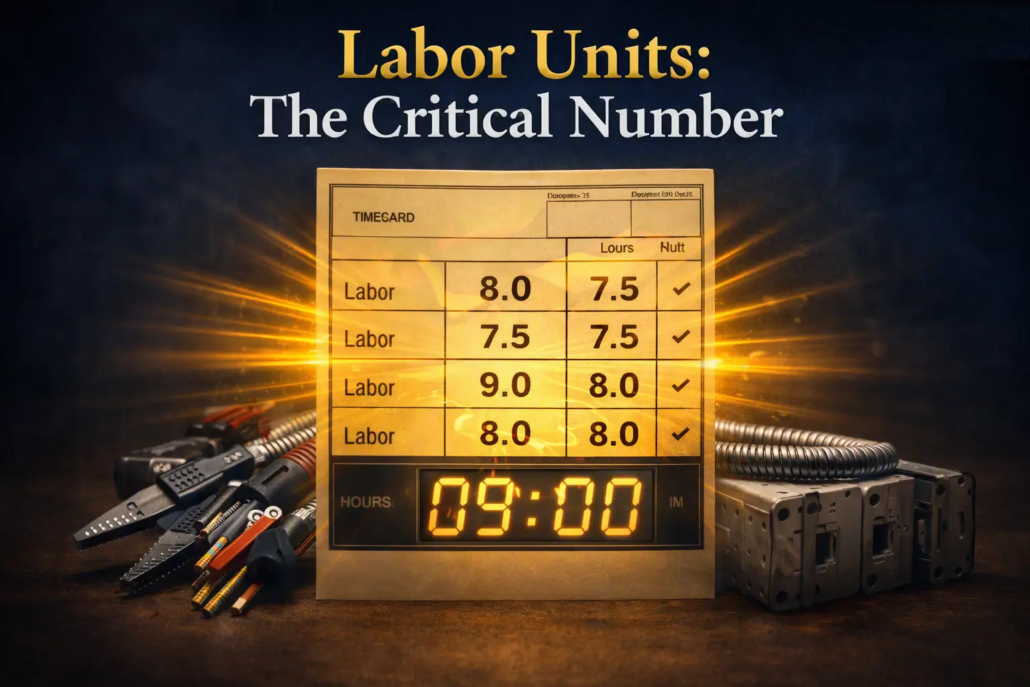
Labor units make or break an electrical bid. Steve Griffin explains how to select, calibrate,
and trust labor units that protect your profit on every project.
Electrical estimating software is evolving faster than ever. The industry is changing, technology is changing,
labor is changing, and expectations are changing. Contractors want more speed, more accuracy, more automation,
more clarity, and more reliability — but they do not want more complexity.
They do not want more confusion. They
do not want more training. They do not want more frustration.
The future of estimating software is not about adding more features. It is not about adding more buttons. It is
not about adding more settings.
It is not about adding more complexity. The future is about refinement, clarity,
automation, and balance.
The future belongs to software that understands the estimator’s workflow. Software that anticipates decisions. Software that reduces thinking.
Software that eliminates unnecessary steps. Software that guides without
restricting. Software that simplifies without weakening.
Software that empowers without overwhelming.
The future belongs to software that feels natural — not software that feels technical.
The next generation of estimating software will focus on predictive intelligence. Not artificial intelligence
in the marketing sense — but real intelligence built from real patterns. Software that recognizes common
installations.
Software that understands typical labor. Software that knows typical quantities. Software that
knows typical assemblies.
Software that knows typical field conditions.
Software that can say:
And then allow the estimator to override it when needed.
The future belongs to software that makes smart decisions automatically — not software that forces the
estimator to make every decision manually.
Another major shift in the future is workflow clarity. Estimators want software that is easy to navigate. Easy
to understand.
Easy to learn. Easy to trust. They want software that feels like a tool — not a task.
They want
software that feels like part of the job — not an obstacle to the job.
The future belongs to software that removes friction.
Friction is the enemy of productivity. Friction slows down estimates. Friction creates confusion.
Friction
creates mistakes. Friction creates frustration. Friction creates inefficiency.
The future belongs to software that eliminates friction.
Another major shift is automation of repetitive tasks. Estimators spend too much time doing things that
software should do automatically. Counting fixtures.
Assigning boxes. Assigning covers. Assigning connectors.
Assigning staples. Assigning straps. Assigning supports.
Assigning small materials.
The future belongs to software that handles these tasks automatically — without requiring the estimator to
think about them.
Automation is not about replacing the estimator. Automation is about freeing the estimator. Automation is about
reducing thinking.
Automation is about reducing decisions. Automation is about reducing mistakes. Automation is
about reducing time.
The future belongs to software that automates the right things — not everything.
Another major shift is labor intelligence. Labor is the most expensive part of most electrical projects. Labor
is the most variable part of most electrical projects. Labor is the most unpredictable part of most electrical
projects.
The future belongs to software that understands labor deeply. Software that understands productivity. Software
that understands conditions.
Software that understands limitations. Software that understands efficiency. Software that understands reality.
Software that can say:
The future belongs to software that reflects real labor — not ideal labor.
Another major shift is material intelligence. Materials fluctuate. Materials vary.
Materials change. Materials
have lead times. Materials have availability issues.
Materials have substitutions. Materials have alternatives.
The future belongs to software that understands materials. Software that understands cost. Software that
understands availability.
Software that understands risk. Software that understands opportunity.
Software that can say:
The future belongs to software that reflects real materials — not theoretical materials.
Another major shift is field awareness. The field is where the estimate becomes reality. The field is where
labor meets materials.
The field is where drawings meet installation. The field is where assumptions become
consequences.
The future belongs to software that understands the field. Software that understands conditions. Software that
understands limitations.
Software that understands workflow. Software that understands challenges.
Software that can say:
The future belongs to software that reflects field reality — not office theory.
Another major shift is profit protection. Contractors estimate to win jobs — but they also estimate to make
money. Profit is the goal.
Profit is the purpose. Profit is the reason contractors estimate.
The future belongs to software that protects profit. Software that understands margins. Software that
understands risk.
Software that understands opportunity. Software that understands strategy.
Software that can say:
The future belongs to software that supports profit — not software that threatens it.
Another major shift is simplicity. Simplicity is powerful. Simplicity is efficient.
Simplicity is profitable. Simplicity is competitive.
The future belongs to software that simplifies — not software that complicates.
Simplicity is not weakness. Simplicity is strength.
Simplicity is clarity. Simplicity is efficiency. Simplicity is productivity. Simplicity is profitability.
The future belongs to software that is simple — but powerful.
Another major shift is balance. Balance is the foundation. Balance is the anchor.
Balance is the compass. Balance is the guide. Balance is the philosophy.
The future belongs to software that is balanced.
Balanced between speed and accuracy. Balanced between detail and simplicity. Balanced between freedom and
structure.
Balanced between automation and control. Balanced between power and usability. Balanced between
capability and cost.
Balance is everything.
The future of electrical estimating software is not about doing more — it is about doing better. It is about
doing smarter. It is about doing faster.
It is about doing clearer. It is about doing simpler. It is about doing
more accurately.
The future belongs to software that understands the estimator — and supports them.
Key Principle
The principle in this section is one of 30 that together form a complete philosophy of electrical estimating
— built from 50 years of real-world experience bidding and winning electrical work. Every principle connects
to every other. Master them together.
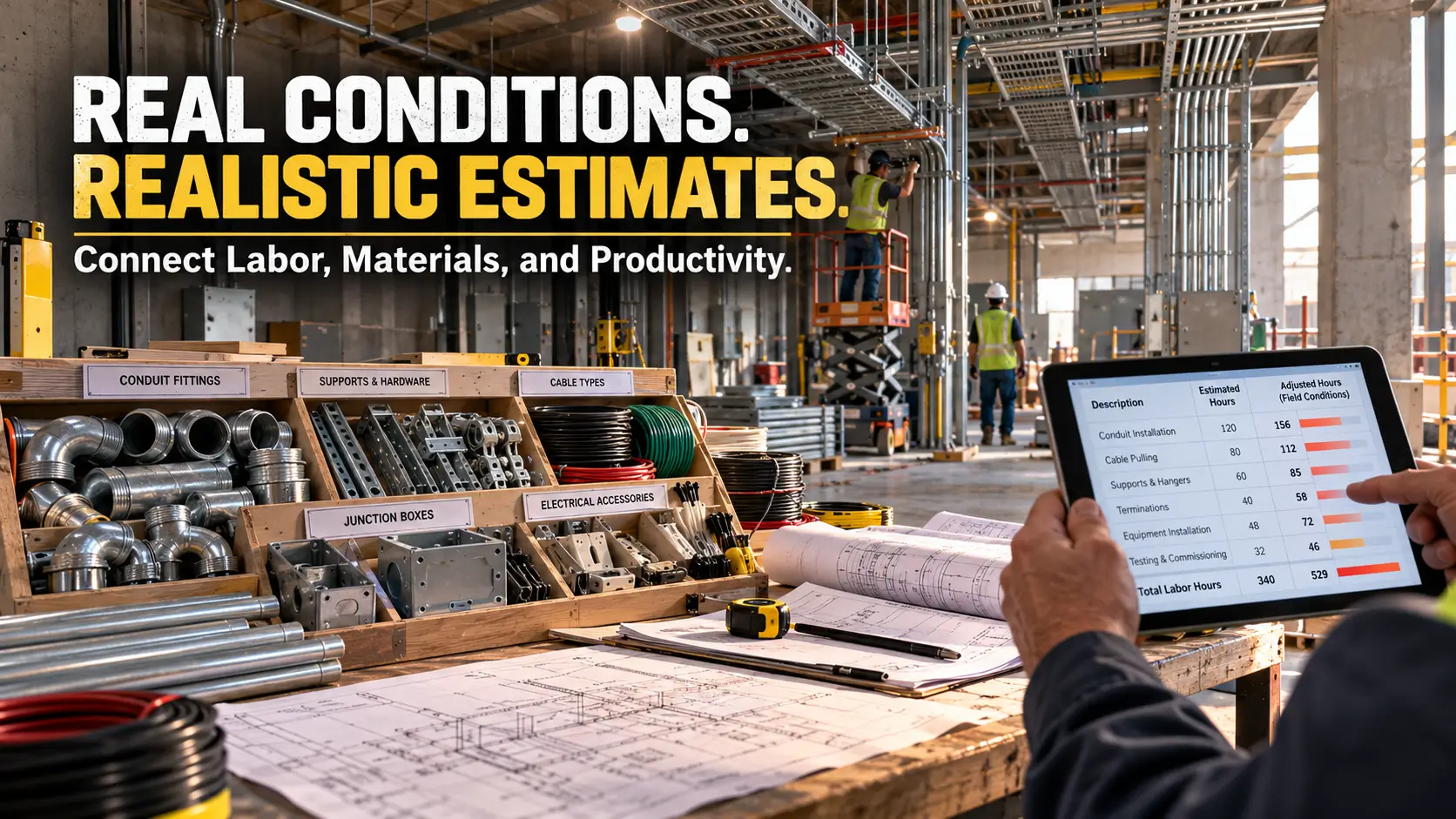
Questions electrical contractors ask about
electrical estimating labor units.
📚 Complete Series Navigation
For electrical contractors, electrical CAD drafting for contractors needs to do more than turn markups into polished sheets. The scope, field…
What if your first electrical estimate felt easier to manage once you stopped treating it as one big number? Electrical estimating for beginners…
The best accubid alternative is not necessarily the one with the longest feature list. It is the one that fits how your team measures, prices, and…
What if the best software to count fixtures and outlets from PDF plans isn’t the one that promises the most automation? A fast count is useful only…
Your estimate is ready, but the supplier quote may expire before the project is awarded. If material prices move before purchasing, which number…
— POST 14 — Assemblies: The Secret Weapon of Great Estimators One of the biggest changes I have seen in electrical estimating over my career is the move from simply counting items to understanding the complete installation. Early in my estimating career, many people thought estimating was about finding quantities and assigning prices. The problem Read more about Assemblies: The Secret Weapon of Great Estimators
A bid can include a healthy markup and still deliver a disappointing profit margin. Calculating profit margin on electrical jobs takes more than a…