Entries by Steve Griffin

Why Good Electrical Estimators Still Matter in an AI World

— POST 10 — Why Good Electrical Estimators Still Matter in an AI World I have watched a lot of changes in electrical estimating during my career. I started when estimates were created with pencils, paper, and a calculator. Today we have powerful computers, digital takeoff, databases, and now artificial intelligence. Every time a new Read more about Why Good Electrical Estimators Still Matter in an AI World

How Electrical Estimating Assemblies Changed My Approach | Steve Griffin

Electrical estimator using assemblies to improve the estimating process

Everybody Has A First · Chapter 8

One of the biggest lessons I share in my book, Everybody Has A First is that some of the most important changes in my career started with something that seemed simple at the time. For me, assemblies were one of those turning points. Learning about assemblies was one thing. Learning how to actually use them was another.

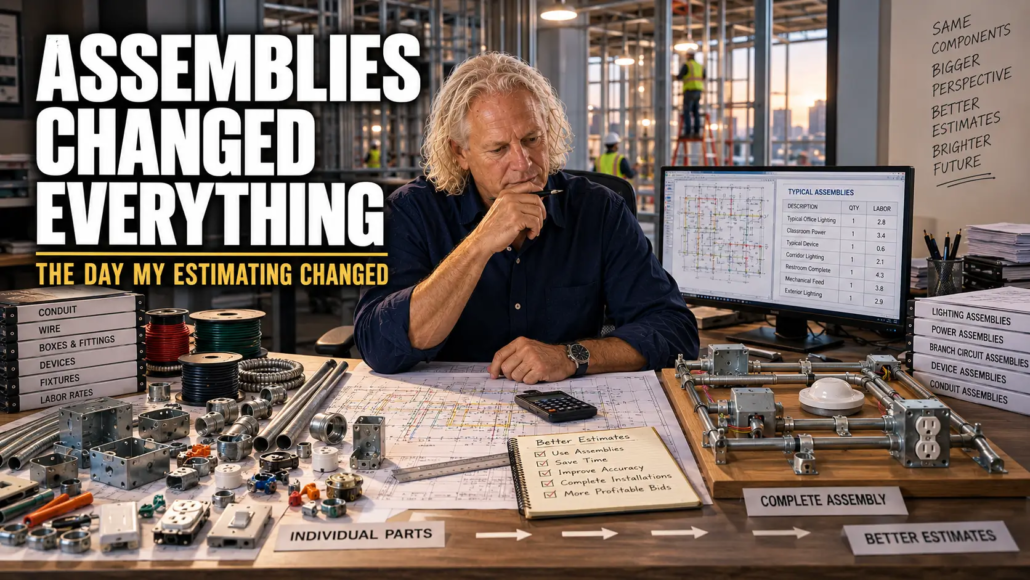
When I first discovered assemblies, I thought I had simply found a faster way to put an estimate together. I didn’t realize I was about to change the way I looked at electrical work. Once I started using assemblies in my Electrical Estimating, I had to rethink the way I counted, organized estimates, and visualized a project before the first electrician ever stepped onto the jobsite.

For years, I had estimated from the bottom up. I looked at the drawings and worked through the project piece by piece. Conduit was conduit.

Wire was wire. Boxes were boxes. Fittings were fittings.

I counted what I could see and built the estimate from those individual components.

Assemblies made me step back and think about the installation itself.

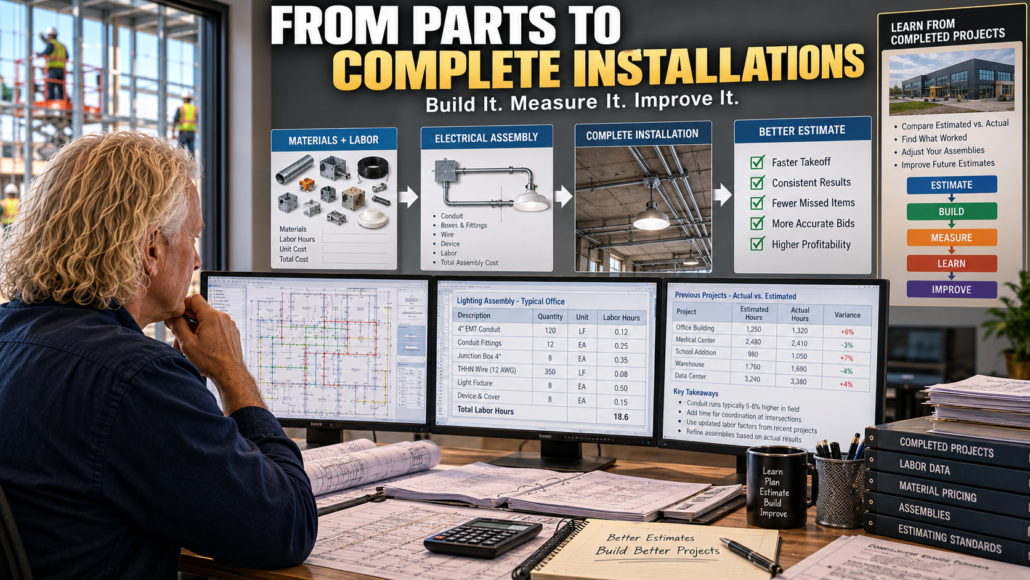
From Parts to Complete Installations

Once I understood the concept, I began creating my own assemblies. I would take a particular electrical installation and think through everything it actually required. What materials were involved?

How much labor would it take? What would an electrician actually have to do to complete the installation?

Then I tested those assemblies against real work.

I didn’t expect my first version to be perfect. If an assembly didn’t produce a realistic labor allowance, I changed it. If the material wasn’t right, I adjusted it. If something happened on the job that I hadn’t considered, I used that experience to improve the assembly.

Every completed project gave me another opportunity to test what I had created. A successful estimate gave me confidence that an assembly was working. A mistake gave me information about what needed to change.

I started realizing that an assembly wasn’t something I created once and forgot about. A good assembly should get better with experience.

Every Project Became Research

This was one of the biggest changes in my approach to Electrical Estimating. I started looking at completed electrical projects as a source of information.

Before that, it was easy to finish a job and move on to the next one. There was always another estimate waiting and another Bid Day coming. But I began asking myself what the last project could teach me.

If I estimated a certain amount of labor and the electricians needed more time, I wanted to know why. Maybe the installation was more difficult than I expected. Maybe access was a problem. Maybe the original labor allowance didn’t account for something I hadn’t considered.

If I consistently estimated too little of something, I wanted to understand why. If I was consistently carrying too much, that was worth knowing as well.

The more I paid attention to those differences, the more useful my estimating process became. I wasn’t simply preparing estimates anymore. I was building knowledge.

Memory Is Useful, But Data Is Better

I’ve relied on my memory for a lot of things throughout my career. After more than 50 years in the electrical industry, experience becomes part of how I look at a project.

But I’ve also learned that memory has limitations. I might remember that a particular installation took about a certain amount of time on an earlier job. But “about” isn’t the same as having actual production information.

Historical data gave me something much better. It gave me evidence.

If I could look back at completed projects and see what I had estimated compared with what actually happened, I could make better decisions on future estimates.

That doesn’t mean I blindly use an old number on a new project. Every electrical project is different. Conditions change, crews change, and installations can have different levels of difficulty.

But historical information gives me a starting point. It gives me something to compare against. It helps me recognize when a number looks unusual. Most importantly, it reduces the amount of guessing I have to do.

The Problem With Not Learning From Your Projects

I’ve seen contractors work on project after project and still make the same estimating mistakes. The information was there. The lessons were there.

The actual production results were there. But nobody captured them or studied them.

That’s a missed opportunity.

If I consistently underestimate a particular installation, I want to know about it. If a certain assembly repeatedly requires more labor than I originally allowed, I want to correct it.

The goal isn’t to prove that my original estimate was right. The goal is to make the next estimate better.

Assemblies Became More Than an Estimating Tool

As I continued working with assemblies, I realized the idea went beyond Electrical Estimating. It affected the way I thought about management, operations, training, and eventually software development.

I started seeing more of the business as a collection of processes that could be measured, reviewed, and improved.

The question became simple: How can I do this better the next time?

The Goal Isn’t Just to Estimate Faster

Speed is valuable in Electrical Estimating, especially when Bid Day is approaching. Nobody wants to spend unnecessary hours doing repetitive work.

But I don’t believe speed should be the only goal. The real goal is to estimate better.

A faster estimate isn’t necessarily a better estimate if important information has been missed.

That’s why I believe an estimator needs to balance efficiency with accuracy and practical judgment.

How Assemblies Influenced Best Bid

Years later, when I was developing Best Bid Electrical Estimating Software, those early lessons were still influencing my thinking.

I wanted the software to reflect the way an experienced estimator thinks about a project.

An Electrical Estimator needs to deal with quantities, labor, materials, assemblies, pricing, and reports. Those things need to work together rather than exist as disconnected pieces.

That’s why I’ve always viewed estimating software as a tool for the estimator rather than a replacement for the estimator.

The software can help organize information. It can reduce repetitive work. It can improve consistency. But the experience still has to come from the person preparing the estimate.

What Assemblies Taught Me

The biggest lesson assemblies taught me wasn’t actually about assemblies. It was about continuous improvement.

I learned that I don’t have to create a perfect system on the first attempt. I need to create something useful, use it, see what happens, and improve it.

That same philosophy works whether I’m building an assembly, reviewing an Electrical Estimating Report, training an estimator, or developing software.

Do the work. Measure the result. Learn from it.

Improve the process. Then do it again.

My Best Bid Rules

Build systems that can improve. Don’t create an estimating process that depends entirely on memory.

Track your results. Your completed projects contain information that can make future bids better.

Study historical data. Actual results are more useful than assumptions alone.

Learn from mistakes. A mistake becomes valuable when it changes what you do next time.

Don’t confuse speed with quality. The objective isn’t simply to finish the estimate faster. It’s to produce a better estimate efficiently.

Keep improving. Even a good estimating system can become better with better information.

For contractors and estimators who want to strengthen their fundamentals, I also believe education has an important place in the process. The Electrical Estimating Online School provides another resource for developing practical estimating knowledge and applying it to real work.

Electrical estimator organizing labor and materials into complete electrical assemblies for more consistent estimates.

Frequently Asked Questions

What is an assembly in Electrical Estimating?

I use an assembly to represent a complete electrical installation by combining the materials and labor associated with that installation.

Why are assemblies useful to an Electrical Estimator?

Assemblies help me improve consistency and reduce repetitive estimating work while keeping the focus on how an installation will actually be performed.

How can historical data improve electrical estimates?

I can compare previous estimates with actual project results and use those lessons when preparing future bids.

Should I use old assembly information on every new project?

No. I use historical information as a starting point, not as an automatic answer. Every project has different conditions.

How can an Electrical Contractor learn from completed projects?

I recommend reviewing what was estimated against what actually happened. Labor, material usage, production, and unexpected conditions can all provide useful information.

Can Estimating Software help manage assemblies?

Yes. Estimating Software can help organize, reuse, and maintain assemblies along with their associated labor and material information.

What is the biggest lesson I learned from using assemblies?

For me, the biggest lesson is that Electrical Estimating should be a continuous improvement process. Every project gives me information that can help make the next estimate better.

My Final Reflection

When I first learned about assemblies, I thought I had discovered a better way to estimate. What I really discovered was a better way to learn.

Assemblies made me stop looking only at individual pieces and start thinking about complete installations. They encouraged me to capture information from completed projects instead of allowing those lessons to disappear. They showed me that historical data could strengthen experience and that mistakes could become useful feedback.

Those lessons eventually influenced much more than the way I prepared an estimate. They influenced how I thought about systems, management, training, operations, and software development.

After more than 50 years in the electrical industry, I still believe the best estimators are students of their own work. Don’t just finish a project and move on. Look at what happened.

Ask why it happened. Capture the lesson and use it.

The goal isn’t simply to estimate faster.

The goal is to estimate better.

That’s what assemblies taught me, and it’s a lesson I still use today.

If you’d like to discuss your Electrical Estimating process or learn how Best Bid can help you organize your estimating work, please call me at 800-941-7028. I’m always interested in hearing from electrical contractors, estimators, and project managers about the practical challenges they face when preparing bids.

You can also learn more about Steve Griffin and my experience in the electrical estimating industry.

About Steve Griffin

Steve Griffin

Founder of Best Bid Electrical Estimating Software

Electrician • Estimator • Contractor • Author • Software Developer

From digging ditches in 1973 to creating one of the industry’s longest-running electrical estimating software systems, Steve Griffin has spent more than 50 years helping contractors win more work and make more money.

Electrical Estimating Assemblies: The Ultimate Balancing Act Between Speed and Accuracy

Electrical estimator using assemblies to improve the estimating process


Electrical Estimating Assemblies: The Ultimate Balancing Act Between Speed and Accuracy | Steve Griffin


Estimating Philosophy  ·  Series Part 8 of 30

Electrical Estimating Assemblies: The Ultimate Balancing Act Between Speed and Accuracy

Assemblies are the most powerful tool in electrical estimating — and the most misunderstood.
Steve Griffin explains how to build and use them to win more profitable work.

By Steve Griffin  ·  Founder, Best Bid Electrical Estimating Software
 ·  July 23, 2026  ·  8 min read

📖 Part of the Complete Series
This article is Series Part 8 of 30 in The Art of Balance in Electrical
Estimating Software
— the complete 30-section philosophy guide by Steve Griffin. Read all
sections in one
place.

Section 8: Assemblies: The Ultimate Balancing Act

Assemblies are one of the most powerful tools in electrical estimating. They are also one of the biggest
sources of imbalance. Assemblies can save enormous amounts of time.

They can increase accuracy. They can reduce
thinking. They can eliminate mistakes.

They can simplify workflow.

But assemblies can also create confusion. Assemblies can create clutter. Assemblies can create complexity.
Assemblies can create frustration.

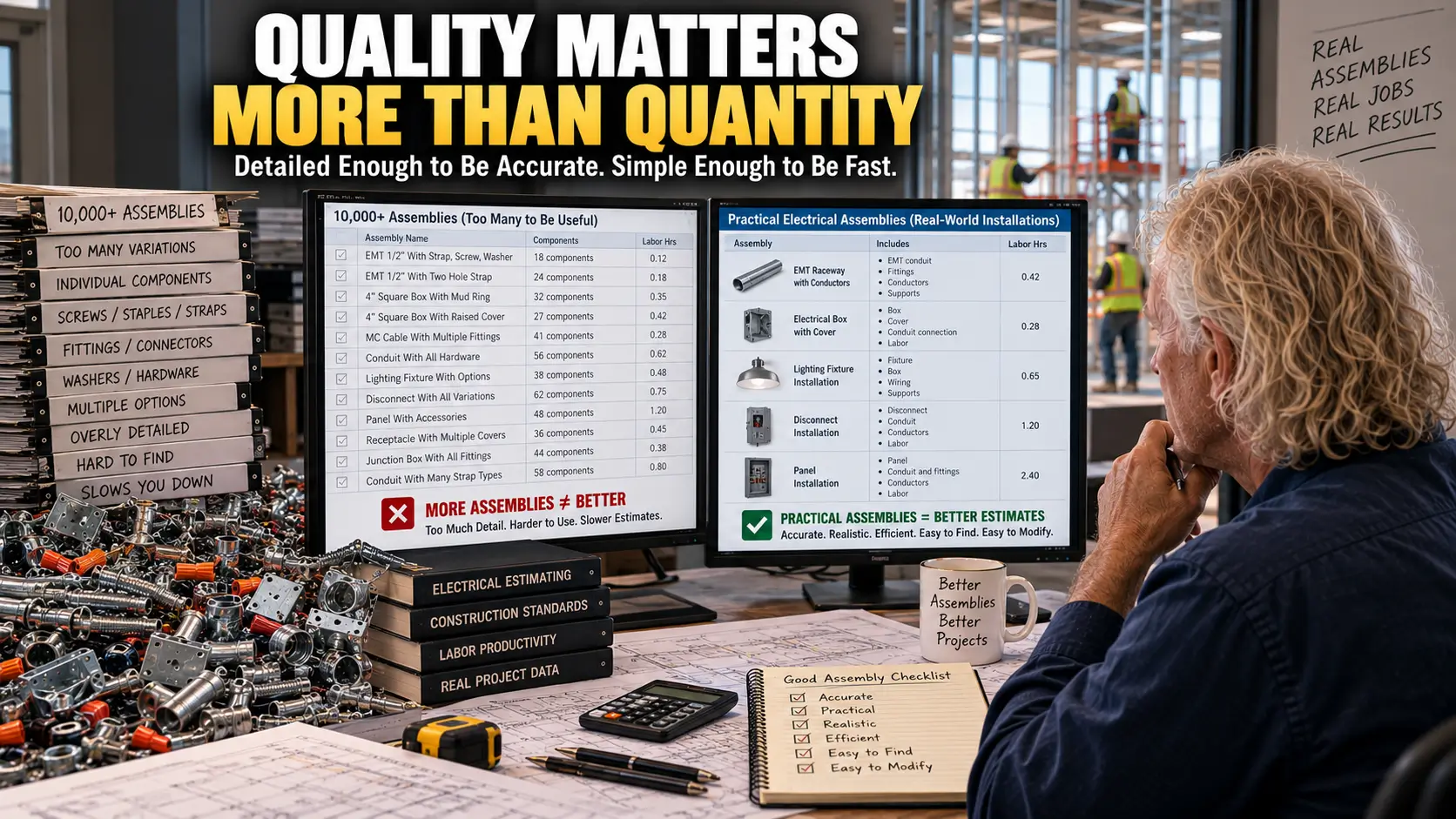
Some companies brag about having 50,000 assemblies.

That sounds impressive — until you try to find the one you need.

Imagine searching through 50,000 assemblies just to find:

1/2" EMT with 3 #12 THHN conductors

It’s not helpful. It’s not efficient. It’s not practical. It’s not balanced.

More assemblies are not always better.

Balance is having:

  • Enough assemblies to cover real world work
  • Not so many that the user gets lost
  • Assemblies that are practical
  • Assemblies that are realistic
  • Assemblies that are actually used
  • Assemblies that reflect real installations
  • Assemblies that match field conditions

Quality matters more than quantity.

An assembly should be:

  • Accurate
  • Practical
  • Useful
  • Realistic
  • Efficient
  • Easy to find
  • Easy to understand
  • Easy to modify

An assembly should not be:

  • Overly detailed
  • Overly complex
  • Overly specific
  • Overly theoretical
  • Overly rigid
  • Overly rare
  • Overly niche

Balance is designing assemblies that reflect real world electrical work — not theoretical electrical work.

Another mistake companies make is creating assemblies that are too detailed. They include every screw. Every
staple.

Every connector. Every strap. Every washer.

Every tiny part. Every tiny detail.

But does that help the estimator? Usually not.

It slows down the software. It slows down the workflow. It slows down the estimate. It slows down the user.

Balance is choosing the right level of detail — not maximum detail.

Assemblies should be detailed enough to be accurate — but simple enough to be fast.

Assemblies should be flexible enough to adapt — but structured enough to be reliable.

Assemblies should be powerful enough to save time — but simple enough to understand.

Balance is designing assemblies that help the estimator — not assemblies that impress the developer.

Another important point: assemblies should not require constant modification. They should not require constant
adjustment. They should not require constant correction. They should not require constant thinking.

Assemblies should work out of the box. Assemblies should reflect common installations. Assemblies should
reflect common materials.

Assemblies should reflect common labor. Assemblies should reflect common field
conditions.

Balance is designing assemblies that feel natural — not assemblies that feel forced.

The best assemblies are the ones the estimator never has to think about. The best assemblies are the ones that
feel automatic. The best assemblies are the ones that feel obvious. The best assemblies are the ones that feel
right.

Balance is the difference between an assembly library that helps the estimator — and an assembly library that
overwhelms them.

Key Principle

The principle in this section is one of 30 that together form a complete philosophy of electrical estimating
— built from 50 years of real-world experience bidding and winning electrical work. Every principle connects
to every other. Master them together.
Frequently Asked Questions

Questions electrical contractors ask about
electrical estimating assemblies.

What does this principle mean for my daily estimating practice?
Every principle in this series translates directly to daily estimating decisions. The
concepts covered here affect how you set up assemblies, calibrate labor units, price materials, calculate
markup, and present your final number. Applying even one principle consistently improves the quality and
reliability of every estimate you produce.

How does electrical estimating assemblies affect bid competitiveness?
Getting this right directly affects your ability to submit bids that are both accurate and
competitive. Contractors who understand and apply this principle consistently win more profitable work because
their numbers reflect reality — not guesswork, not padding, and not systematic error. Bid competitiveness is
ultimately a function of estimating discipline.

Does Best Bid Electrical Estimating Software support this approach?
Yes. Best Bid Next Generation was designed with all 30 principles in this series in mind.
Every feature, every assembly structure, every reporting tool reflects the philosophy Steve Griffin developed
over 50 years of real-world estimating. The software is the philosophy made practical.

How do I apply this to a real electrical project estimate?
Start by evaluating your current estimating process against the principle described in this
article. Identify where your workflow drifts away from the principle — whether in assembly calibration, labor
unit selection, overhead allocation, or markup calculation. Each gap is an opportunity to tighten your process
and protect your margin on the next bid.

Where can I read all 30 principles together?
All 30 sections are published together in the complete guide: The Art of Balance in Electrical Estimating Software. Reading
the full guide gives you the complete picture of how each principle connects to the others and why the whole
is greater than the sum of its parts.


5 Signs You Need Electrical Estimating Software Instead of a Spreadsheet

If you’re re-typing the same numbers into two or three places, missing labor adjustments on every job, or spending more time formatting a proposal than estimating the actual work, a spreadsheet has stopped helping you and started slowing you down. Professional electrical estimating software like Best Bid is built to take over exactly those tasks. Read more about 5 Signs You Need Electrical Estimating Software Instead of a Spreadsheet