Electrical Bidding Spreadsheet Alternatives: What Works for Contractors in 2026

What if the best electrical bidding spreadsheet alternatives aren’t the ones with the longest feature list, but the ones that eliminate the most repeat work? If you’re re-entering takeoff quantities, checking copied formulas, and updating prices across separate files, you already know how quickly a familiar spreadsheet can become a bottleneck.
Spreadsheets can still suit straightforward bids, but connected estimating work often calls for a more integrated workflow. Electrical estimating software can bring takeoff, pricing, and labor assumptions together. A better spreadsheet template may be enough if inconsistent formats are the main problem, while outsourced estimating can add project-based capacity when your team has overflow work.
This guide compares practical alternatives by what they help you do, not by feature count. You’ll see which tools fit different project types and estimating processes, what electrical-specific capabilities matter, and how to move from spreadsheets in manageable steps. We’ll also look at how built-in on-screen takeoff and assembly-based workflows, such as those in Best Bid, can reduce disconnected manual tasks while keeping your estimating process grounded in the way electrical contractors work.
Key Takeaways
- Recognize when spreadsheet flexibility is outweighed by the effort of maintaining connected takeoff, pricing, labor, and revisions.
- Compare electrical bidding spreadsheet alternatives by workflow fit, electrical focus, takeoff support, and how much hands-on work they leave your team.
- Test a full representative bid, not just isolated features, to see how each option handles calculations, updates, and revisions.
- Plan a smoother transition by documenting your estimating assumptions, material categories, labor logic, and reusable assemblies before changing tools.
- Consider dedicated electrical estimating software when connected estimating tasks are slowing bids, while allowing time to learn and refine a new workflow.
When Does an Electrical Bidding Spreadsheet Stop Being Enough?
Spreadsheets have earned their place in electrical estimating. They’re flexible, easy to access, and give you direct control over a simple estimate. For a repeatable job with familiar quantities and a stable pricing process, a well-organized template may do exactly what you need.
The strain appears when a bid becomes a chain of connected tasks. A takeoff quantity moves from plan review into a tracking sheet, then into material pricing, labor calculations, and the final bid summary. Revisions can mean updating multiple files and checking that every linked value reflects the latest scope.
That’s when electrical bidding spreadsheet alternatives become worth considering. The issue isn’t that spreadsheets are inherently wrong, but that managing the handoffs may take too much time and attention.
An electrical estimate has outgrown a spreadsheet when keeping its quantities, pricing, labor assumptions, and revisions aligned takes more effort than evaluating the work. General Construction estimating software can combine estimating tasks in a software workflow, but the right next step depends on where your process is breaking down.
Which estimating tasks become difficult to manage in a spreadsheet?
The challenge is often the manual handoff. An estimator reviews drawings, records device and equipment counts, transfers quantities to another sheet, applies material prices, and carries totals into the bid summary. When the scope changes, each affected figure needs to be traced and updated. Copied templates or formulas can make that trail harder to follow, especially if the estimate’s assumptions aren’t recorded alongside the numbers.
One awkward revision isn’t necessarily a reason to change tools. Look for a recurring bottleneck: repeated data entry, uncertainty about which file is current, or time spent verifying formulas instead of reviewing scope and labor. If those problems keep appearing across bids, examine the process itself. For example, note how often a quantity is entered more than once and how many separate places need an update after a plan revision.
When is a spreadsheet still a reasonable choice?
A spreadsheet can remain practical for simple, repeatable bids with limited revisions, consistent assumptions, and one person maintaining the estimate. The key is whether the template stays clear and auditable as the work moves from quantities to pricing and final totals. Use consistent labels, keep assumptions close to the figures they affect, and make it easy to identify the current version.
Assess your bid frequency, project complexity, and number of contributors. A detailed project with frequent scope changes may put more pressure on a spreadsheet than several straightforward estimates, even for a small contractor. You don’t need dedicated estimating software just because you work in electrical contracting. Change tools when the current workflow repeatedly makes bids slower or harder to check.
What Are the Main Alternatives to Electrical Bidding Spreadsheets?
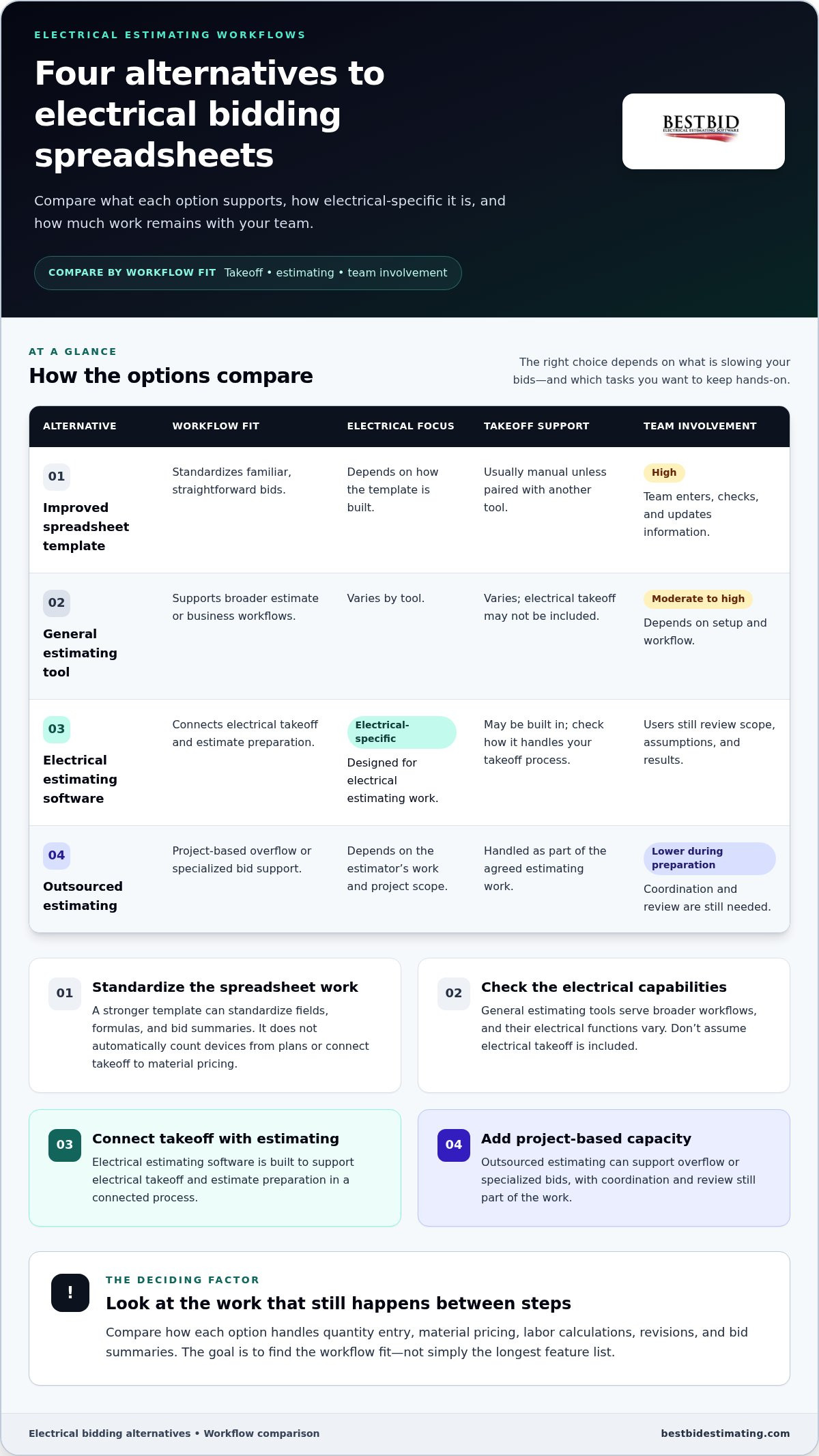
There isn’t one replacement that suits every estimating process. Some options organize the spreadsheet work you already do; others connect electrical takeoff and estimate preparation, or add outside estimating capacity. Compare them by what they take off your plate and what work still stays with your team.
| Alternative | Workflow fit | Electrical specificity | Takeoff support | Ongoing user involvement |
|---|---|---|---|---|
| Improved spreadsheet template | Standardizing familiar, straightforward bids | Depends on how the template is built | Usually manual unless paired with another tool | High: the team enters, checks, and updates information |
| General estimating tool | Supporting broader estimate or business workflows | Varies by tool | Varies; don’t assume electrical takeoff is included | Moderate to high, depending on setup and workflow |
| Electrical estimating software | Bringing electrical takeoff and estimate preparation into a connected process | Designed for electrical estimating work | May be built in; check how the tool handles your takeoff process | Users still review scope, assumptions, and results |
| Outsourced estimating | Project-based overflow or specialized bid support | Depends on the estimator’s work and project scope | Handled as part of the agreed estimating work | Lower during preparation, with coordination and review still needed |
Templates and general estimating tools: what do they solve?
A stronger template can standardize fields, formulas, and bid summaries. That can reduce variation between estimates, but it doesn’t automatically count devices from plans or connect takeoff to material pricing. General estimating tools may serve a wider business process, while their electrical-specific functions vary. The key distinction: electrical estimating software is built to support electrical takeoff and estimating, while general estimate-and-invoice tools focus on broader estimate and business tasks.
Electrical estimating software and outsourced estimating
Electrical-specific software can connect plan takeoff with estimate preparation in one workflow. Best Bid includes on-screen takeoff and assembly-based workflows, with real-time pricing integration through NetPricer. Its user-controlled database lets contractors manage estimating data as their methods change. For a broader overview of the category, see this introduction to Electrical Estimating Software. You can also explore the Best Bid Next Generation guide for a closer look at an electrical estimating workflow.
Outsourced estimating is different: an estimator prepares project work rather than providing a tool your team uses on every bid. It can help with overflow or specialized support, while your team remains responsible for reviewing scope and bid decisions. Best Bid offers Freelance Estimating for project-based support, alongside software for contractors managing estimates in-house. Explore Best Bid’s electrical estimating solutions.
How to Compare Spreadsheet Alternatives for Electrical Bids
Compare the parts of estimating that have to work together, not just the features listed on a product page. A tool may offer takeoff or pricing functions, but the practical question is whether it helps your team carry a bid from plan review through calculations, revisions, and a checked summary. Use the same representative project to assess each step and record where manual transfers remain.
| Criterion | What to assess |
|---|---|
| Takeoff | Can you count from the plans within the estimating workflow, or must quantities be transferred separately? |
| Material calculations | Can you apply the calculations and assemblies your electrical estimates rely on? |
| Pricing updates | How are material prices brought into the estimate, and can you identify which values need review? |
| Database control | Can your team manage the estimate data and adjust it as company methods change? |
| Revisions | Can you trace changes from updated scope or quantities through to the bid total? |
| Learning and support | How much training will your team need, and what help is available as you learn the workflow? |
Does the alternative connect takeoff to the estimate?
Test a real sequence: review a plan, count devices or equipment, carry those quantities into the estimate, and revise the count after a scope change. If your process requires repeated manual transfer, that handoff remains part of the work. On-screen takeoff lets an estimator count from a digital plan within the software workflow rather than counting separately and entering totals later.
Best Bid includes built-in on-screen takeoff, bringing those tasks closer together. Assess whether that approach fits the way your team reviews plans and organizes quantities.
Can you control pricing, assemblies, and estimate data?
Check how the tool handles material price updates and whether reusable assemblies reflect the way your team builds estimates. A flexible, user-controlled database matters when material categories, labor logic, or preferred methods evolve. Best Bid combines a user-controlled database and assembly-based workflows with real-time pricing integration through NetPricer. Review the electrical estimating tools guide for a closer look at the software category.
Then test a complete bid, including a revision, with the people who will use the system. Note where data is entered, what needs checking, and how long it takes the team to understand each step. Learning curves differ, so assess the workflow with your own estimating conventions rather than assuming every team will get the same result. That hands-on comparison makes electrical bidding spreadsheet alternatives easier to judge by the work they remove.
How to Switch from Spreadsheet Bidding Without Disrupting Your Workflow
A change in estimating tools doesn’t have to mean starting from scratch. Treat the transition as a process review: keep the estimating knowledge that still serves your bids, and examine old formulas before carrying them into a new workflow. These steps help you test electrical bidding spreadsheet alternatives without moving every estimate at once.
- Map your current workflow. Trace a bid from plan review through takeoff, material pricing, labor calculations, revisions, and final summary. Note where information is entered more than once and where someone has to check a calculation manually.
- Organize the information you rely on. Gather current templates, material categories, labor assumptions, reusable assemblies, and recurring estimate formats. Mark which assumptions are still trusted and which formulas need review.
- Choose a representative bid. Pick a completed or active project that reflects your usual work and includes enough detail to test the full process. Avoid beginning with every estimate type at once.
- Run a pilot and compare. Have one estimator work through the bid in the new workflow. Review quantities, pricing, labor logic, revisions, and the final summary against your established process.
- Refine, then standardize. Record what changed, resolve unclear steps, and document team conventions. Expand to other estimators or project types once the workflow is understood.
What spreadsheet information should you organize first?
Start with the working materials, not just the spreadsheet files. Inventory estimate templates, material lists, labor assumptions, assemblies, and the formats used for recurring bids. Identify duplicate fields and calculations that require manual checking.
Preserve reliable estimating logic, but don’t assume every inherited formula is correct. Separating sound trade knowledge from legacy spreadsheet mechanics gives you a cleaner basis for setting up the next process.
How can a team learn the new workflow steadily?
Let one estimator test a representative bid end to end, then review the result with the people who will use or approve estimates. Capture practical conventions, such as how quantities are grouped and how labor assumptions are recorded, before broadening the pilot. A slower, documented rollout gives the team room to learn without forcing every bid into an unfamiliar process at once.
Best Bid’s Online School for Electrical Estimating offers training in estimating methods and related business topics. Combine structured learning with a practical pilot so your team can apply the workflow to the bids it actually prepares. Explore Best Bid’s electrical estimating tools.
When Does Electrical Estimating Software Make Sense as the Spreadsheet Alternative?
Dedicated electrical estimating software is worth evaluating when the same handoffs keep slowing bids down: takeoff quantities are entered again elsewhere, pricing needs repeated updates, assemblies are rebuilt manually, or revisions make it hard to track what changed. Those are signs that connected electrical bidding spreadsheet alternatives could fit your process better. The aim isn’t to replace a familiar tool for its own sake. It’s to make the estimating work easier to follow and manage.
A new system does involve an adjustment. Estimators need time to learn where information goes, how the estimate is organized, and how the team will review revisions. Start with a representative bid and compare the workflow with your current method. Connected tasks matter most when they address a real bottleneck, not simply because software offers more features.
What changes when takeoff and estimating work together?
With built-in on-screen takeoff, an estimator can count from a plan within the estimating software instead of counting separately and entering totals into another tool later. Best Bid includes on-screen takeoff, connecting plan review with estimate preparation. Its assembly-based workflow supports building estimates around structured groups of work, while the estimator continues to review scope and assumptions.
Explore the Best Bid Next Generation guide to see how that workflow is presented in a specific product. Consider whether it suits your estimating habits and the kinds of bids your team prepares.
How does Best Bid support ownership beyond the initial switch?
Best Bid uses a one-time purchase model that includes lifetime software updates and support, with no recurring subscription fees. Its user-controlled database lets contractors manage estimating data as company methods evolve. Best Bid also offers real-time pricing integration through NetPricer. Together, these features support electrical-specific estimating in a workflow your team can manage.
The product’s trade context matters, too. Founder Steve Griffin entered the electrical trade in 1973 and brings more than 50 years of industry experience to the work behind Best Bid. That background connects the software to practical electrical estimating, rather than treating a bid as a generic estimate form.
If connected takeoff, pricing, assemblies, and revisions are recurring pressure points in your current process, evaluate Best Bid’s electrical estimating software with a representative project.
Build a Bidding Workflow That Fits Your Next Project
The right electrical bidding spreadsheet alternatives depend on where your estimating process needs help. A well-maintained spreadsheet can still work for straightforward bids, while connected takeoff, material pricing, assemblies, and frequent revisions may call for a more integrated electrical estimating workflow. Compare tools using a representative bid, and make the transition in stages so your team can carry forward reliable assumptions while refining the process.
Best Bid brings built-in on-screen takeoff together with real-time pricing integration through NetPricer. Its one-time purchase model includes lifetime updates and support, giving contractors an electrical-specific option when disconnected steps are taking too much effort. A new workflow takes time to learn, so focus on how it fits your estimating habits and project needs.
Frequently Asked Questions
What is the best alternative to an electrical bidding spreadsheet?
The best alternative is the one that handles your main estimating bottleneck without adding unnecessary complexity. For straightforward, repeatable bids, a well-maintained template may be enough. If you need to connect electrical takeoff, material pricing, assemblies, and revisions, dedicated electrical estimating software may be a better fit. Compare electrical bidding spreadsheet alternatives by testing a complete representative bid, from plan review through the final estimate, rather than judging a tool by its feature list alone.
Can general estimating software handle electrical takeoff and material calculations?
Some general estimating software may support parts of electrical estimating, but capabilities vary by tool. Don’t assume it includes electrical-specific takeoff, material calculations, or workflows for assemblies. Check how quantities move from plan review into the estimate and how material and labor assumptions are applied. If you still need separate tools or repeated manual entry for key electrical tasks, a dedicated electrical estimating system may connect more of the workflow.
Is electrical estimating software better than a spreadsheet for small contractors?
Not automatically. A spreadsheet may suit a small contractor who prepares simple, repeatable bids with few revisions and a clear review process. Dedicated software becomes more useful when estimates regularly involve connected takeoff and pricing, repeated revisions, or multiple contributors.
Judge the fit by project complexity and the time spent maintaining each bid, not company size alone. A pilot on a representative estimate can show whether a new workflow helps your team.
How do I move electrical estimates from a spreadsheet into estimating software?
Start by documenting your current workflow and organizing the information you rely on: material categories, labor assumptions, reusable assemblies, templates, and estimate formats. Review formulas instead of copying them blindly. Then select one representative completed or active bid and test the new process from takeoff through revisions and summary.
Record any differences, refine team conventions, and expand gradually. This staged approach helps preserve useful estimating knowledge while you learn the software.
What features should electrical bidding software include?
Prioritize capabilities that support the way electrical bids are assembled: takeoff, material calculations, pricing updates, reusable assemblies, database control, revision tracking, and useful training or support. Consider whether quantities can move from plan review into the estimate without repeated entry and whether your team can manage estimating data as its methods change. The right combination depends on your projects and workflow, so test the full estimating process rather than isolated features.
Can electrical estimating software perform on-screen takeoff?
Yes. Some electrical estimating software includes on-screen takeoff, allowing estimators to count or measure directly from digital plans within the software rather than recording quantities separately and entering them later. Best Bid includes built-in on-screen takeoff. Test it using a representative drawing and the takeoff tasks you perform regularly to see how well it connects plan review with estimate preparation.
Does Best Bid require a monthly subscription?
No. Best Bid uses a one-time purchase model rather than a monthly subscription. The purchase includes lifetime software updates and support.
Contractors evaluating a change from spreadsheets can compare that ownership model alongside workflow fit, learning needs, and the estimating tools included. Test the software with a typical bid and consider how its support and update approach fits your process.
Ready to move beyond disconnected estimating steps? Explore Best Bid electrical estimating software and see how its built-in takeoff, pricing integration, and assembly-based workflow fit your next bid.