The Computer That Changed Everything | Steve Griffin
Everybody Has A First · Chapter 9
I didn’t set out to become a software developer. I was trying to become a better electrical estimator. That distinction is important because most of the major changes in my career didn’t begin with a grand business plan. They began with a question I couldn’t get out of my head.
One of the biggest lessons I share in my book, Everybody Has A First, is that curiosity can take you places you never planned to go.
If the biggest electrical contractor in town was estimating with assemblies, I wanted to know what assemblies were and why they worked. I wasn’t interested in copying somebody else’s system. I wanted to understand it.
At the time, finding information wasn’t easy. This was before Google, YouTube, online forums, and instant answers. If I wanted to learn something, I had to hunt for it. I asked questions, read manuals and books, talked to people, and worked through problems myself.
Eventually, I understood the basic idea behind assemblies. Instead of estimating every nut, bolt, connector, fitting, strap, screw, and coupling separately, I could group the materials and labor that normally belonged together into one complete installation.
One receptacle. One light fixture. One hundred feet of conduit.
One feeder. Each assembly could represent the labor and incidental material required to install it.
The concept was simple, but it changed the way I thought about Electrical Estimating.
It Still Didn’t Fit
Understanding what an assembly was didn’t mean I immediately knew how to use one effectively. I knew assemblies made sense. I knew they could make estimating faster. I knew successful electrical contractors were using systems like this.
But I couldn’t make everything fit the way I had been estimating. So I continued doing estimates the way I always had. Piece by piece. Project by project.
Yet the idea stayed with me. Every estimate seemed to bring me back to the same question: There has to be a better way.
The more electrical projects I estimated, the more I realized that estimating wasn’t really about counting things. It was about systems.
A good Electrical Estimator doesn’t simply know electrical work. A good estimator develops repeatable methods that produce consistent results. The better the system, the more consistent the estimate becomes.
I didn’t fully understand it at the time, but I was beginning to think differently. Most people were trying to estimate faster. I was trying to estimate better.
Timing Is Everything
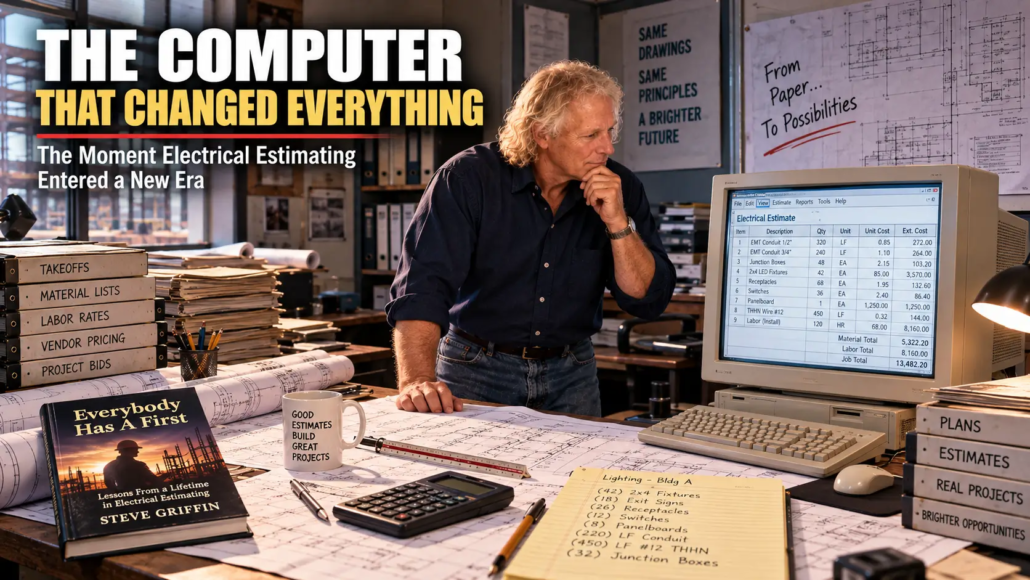
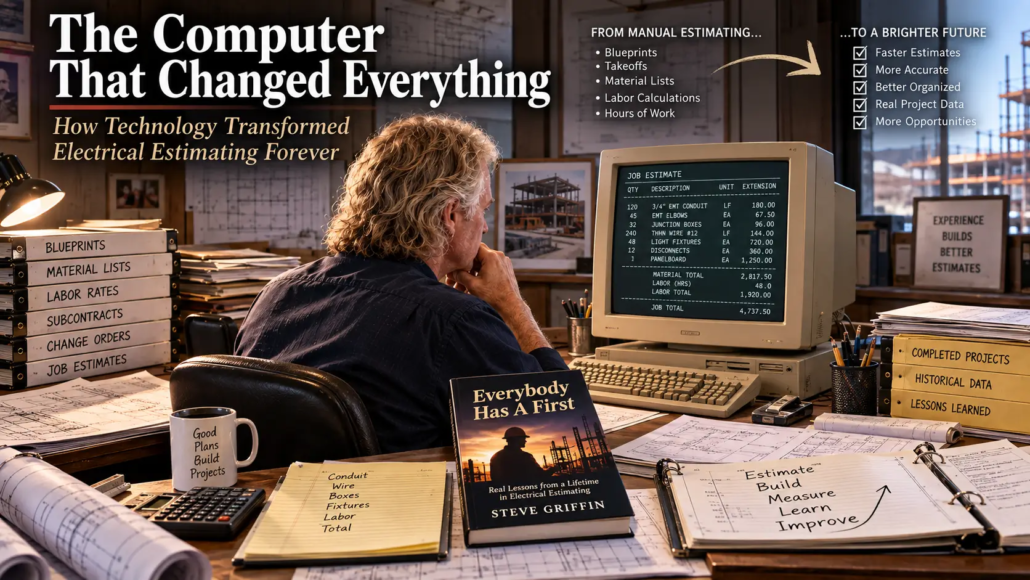
Some time later, something happened that changed my life again. Our company hired a secretary, and she convinced the owner to buy a computer.
This was a long time ago, when computers weren’t sitting on every desk in every electrical contractor’s office. They were expensive, complicated, and, to me, a little intimidating.
The only software installed on that computer was WordPerfect. She used it for typing letters and documents. Then she left the company.
The computer stayed. Nobody knew what to do with it, and nobody particularly wanted it. So they pushed it into my office.
Not because I knew anything about computers. Because nobody else wanted it.
To be honest, I kept it partly because I thought having a computer in my office made me look important. I had absolutely no idea what I was doing.
Becoming a Computer Expert in One Hour
One day, curiosity got the better of me. I turned the computer on. That alone felt like an accomplishment.
After fumbling around for about an hour, I managed to type a paragraph and print it. I was unbelievably proud.
I had typed something on a computer. Today, a five-year-old could probably do the same thing. Back then, I felt like I had joined NASA. I was officially a computer expert — at least in my own mind.
The truth was that I knew almost nothing. But something important happened that day. The computer stopped being intimidating.
It became interesting. Then it became fascinating.
The more I learned, the more possibilities I started seeing.
The Collision
For a while, assemblies had been sitting in the back of my mind. Now I had a computer sitting in my office. One represented a better estimating system. The other represented a better tool.
Eventually, those two ideas collided.
I started asking questions. Could labor be automatically attached to material? Could assemblies be stored?
Could calculations happen instantly? Could historical information be saved and reused? Could I stop starting every estimate from scratch?
Those questions eventually changed the direction of my career.
At the time, I wasn’t trying to build software. I wasn’t trying to revolutionize electrical estimating. I wasn’t trying to create a technology company. I was simply trying to become a better estimator.
That has been true for most of my career. I wasn’t chasing success. I was chasing improvement. Success usually showed up later.
Looking Back
I’ve often wondered what would have happened if that estimator had answered my original question differently.
What if he had spent an hour explaining assemblies? What if he had shown me everything? What if he had never spoken to me at all?
The funny thing is that his lack of an answer may have helped me more than a complete explanation ever could have. He didn’t teach me everything. He challenged me.
And throughout my life, challenges have motivated me more than easy answers.
That one word — assemblies — eventually led me to spreadsheets, databases, and estimating software.
Those ideas eventually became part of Best Bid Electrical Estimating Software. Looking back, it is amazing to think about: one question, one word, one old computer, and an entirely different future.
What I Learned
Technology alone isn’t the solution. A computer without a good system is simply an expensive typewriter.
The real breakthrough for me was combining a better estimating process with a better tool.
Technology should help an Electrical Contractor organize information, reduce repetitive work, learn from historical data, and make better decisions. It should support experience, not replace it.
I’ve carried that philosophy into the development of Best Bid and into the way I approach Electrical Estimating Reports, databases, assemblies, and estimating workflows.
For contractors who want to improve their estimating knowledge, I also recommend continuing to learn through practical training such as the Electrical Estimating Online School.
I also discuss the relationship between estimating systems and technology in The Art of Balance in Electrical Estimating.
My Best Bid Rules
Always ask why, not just how.
Learn the system before you learn the software.
Stay curious longer than everyone else.
Use technology to improve your thinking, not replace it.
Never stop looking for a better way.
Frequently Asked Questions
How did computers change my approach to Electrical Estimating? A computer showed me that repetitive estimating tasks could be organized and automated.
Why are assemblies important in electrical estimating? Assemblies allow me to group the materials and labor required for a complete installation rather than repeatedly estimating every individual component.
Does estimating software replace an experienced Electrical Estimator? No. I believe software should support the estimator. Experience, judgment, project knowledge, and field understanding still matter.
What should an Electrical Contractor learn before using estimating software? I believe the contractor should first understand the estimating process. Software works best when it supports a sound system.
Why is historical data important? Historical data lets me compare estimates with actual project results and improve future labor and material assumptions.
What is the biggest lesson I learned from technology? Technology is most valuable when it solves a real problem. I became interested because I could see how computers might improve estimating.
Where can contractors learn more about Best Bid? I encourage contractors to explore Best Bid Electrical Estimating Software and its estimating resources.
My Final Reflection
When I look back at that old computer sitting in my office, I don’t see a piece of technology. I see an opportunity I almost didn’t recognize.
I didn’t know where that computer would lead me. I didn’t know that assemblies would eventually become connected to databases, spreadsheets, and estimating software. I certainly didn’t know that those ideas would eventually contribute to Best Bid.
I was simply curious.
That’s why I included this story in Everybody Has A First. Major changes don’t always begin with a plan. Sometimes they begin because you refuse to stop asking questions.
If someone won’t give you the answer, don’t quit. Go find it.
You might discover something much bigger than the answer you were originally looking for.
Everybody has a first. This was one of mine.
If you would like to discuss your electrical estimating needs, estimating software, or ways to improve your estimating process, please call me at 800-941-7028. I welcome conversations with electrical contractors, estimators, project managers, and business owners.
You can also visit my Steve Griffin page to learn more about my background and experience.
About Steve Griffin
Steve Griffin
Founder of Best Bid Electrical Estimating Software
Electrician • Estimator • Contractor • Author • Software Developer
From digging ditches in 1973 to creating one of the industry’s longest-running electrical estimating software systems, Steve Griffin has spent more than 50 years helping contractors win more work and make more money.