Labor Burden in Electrical Bids: 2026 Contractor Guide

Why does your bank account often look empty even when your crew hits every estimated labor hour on the job? It’s a common, painful reality for electrical contractors who are tired of watching their hard-earned profit bleed away into overlooked payroll taxes and insurance hikes. You likely already feel that a simple hourly wage doesn’t cover the real cost of a journeyman on a commercial site, but the confusion between general overhead and labor burden makes it difficult to pin down a number you can actually trust.
We’re here to help you stop the guesswork. This guide will teach you exactly how to account for labor burden in electrical bids by mastering the “hidden” costs of employment. With health insurance premiums projected to rise by 6.5 percent in 2026 and FICA taxes remaining a mandatory 15.3 percent split between you and your team, your bidding strategy needs to be more precise than ever. We’ll show you how to build a fully burdened labor rate that protects your margins and reflects your true field expenses. You’ll learn how to separate these costs from your general overhead and discover a faster way to apply these rates to complex commercial bids, ensuring every project leads to higher net profit.
Key Takeaways
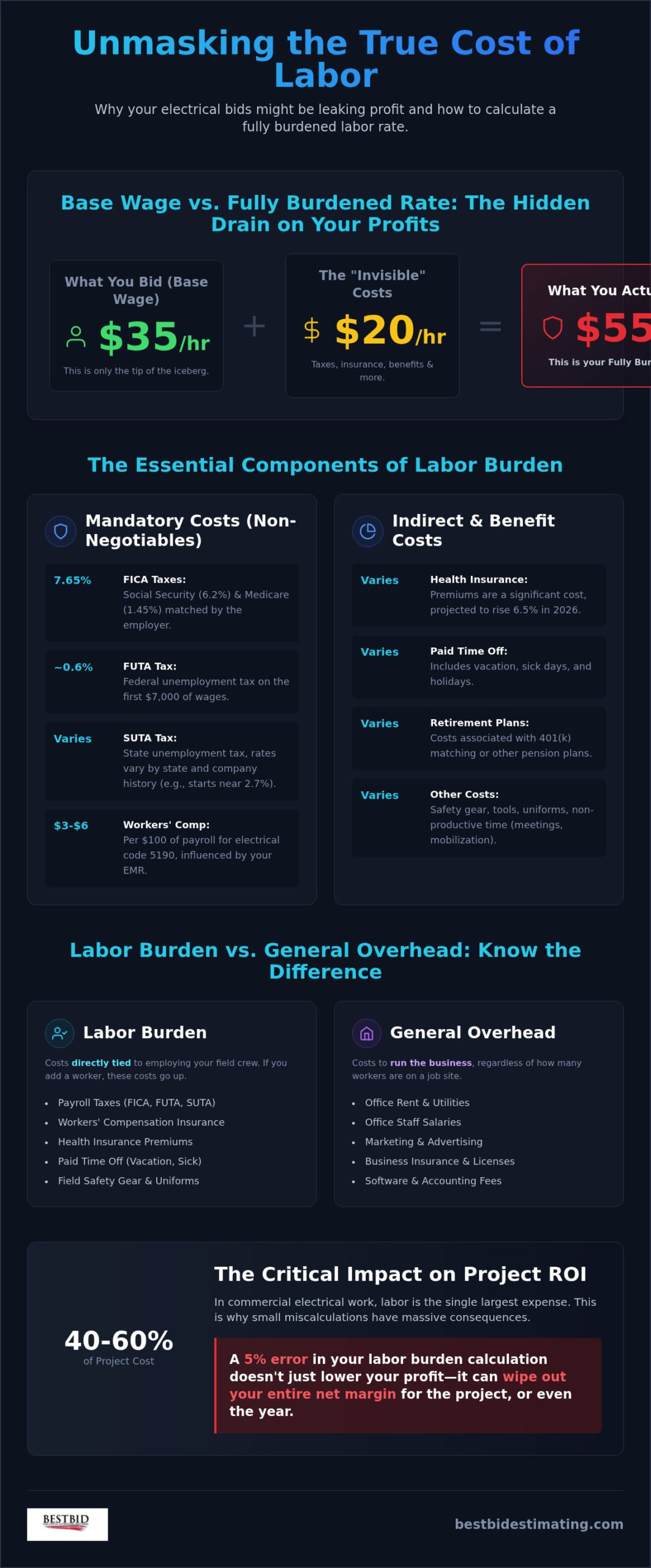
- Understand why a $35 per hour journeyman actually costs your company $55 or more after factoring in 2026 tax and insurance rates.
- Learn exactly how to account for labor burden in electrical bids by identifying the mandatory payroll taxes and insurance requirements that often go overlooked.
- Stop profit bleed by clearly distinguishing between general business overhead and the specific costs tied directly to your field labor.
- Discover a step-by-step process to calculate a “fully burdened” labor rate that reflects the true financial reality of every project.
- Streamline your bidding process with tools that allow for global labor adjustments, replacing manual spreadsheets with a modern, one-time purchase system.
What is Labor Burden and Why Does It Kill Electrical Profit Margins?
Did you ever wonder why a project that looked perfect on paper ended up draining your bank account? It’s usually not because your crew was slow. It’s because you didn’t account for the invisible costs of having those boots on the ground. In the electrical trade, labor burden is the total financial weight of employing a worker beyond their gross hourly pay. Understanding What is Labor Burden is the first step toward stopping the profit bleed that haunts so many shops. Learning how to account for labor burden in electrical bids means moving beyond the gross wage and seeing the full picture of your payroll liabilities.
Think about sticker shock for a moment. You hire a journeyman at $35 per hour. On your bid, you carry $35. But once you add payroll taxes, workers’ comp, and benefits, that worker actually costs you $55 or more. If you haven’t mastered how to account for labor burden in electrical bids, you’re essentially donating $20 per man-hour to the project. You “win” the job, but you lose the business. This oversight is why many contractors struggle with cash flow despite having a full schedule of work.
Direct Wages vs. Fully Burdened Rates
Base pay is just the tip of the iceberg. It’s the starting point, not the finish line. When we talk about a “fully burdened” rate, we’re looking at the true price of a man-hour.
This includes everything from FICA and unemployment taxes to safety gear and vacation time. Using only base wages in a bid is a recipe for business failure because it ignores the actual checks you have to write every Friday. You aren’t just paying for their time; you’re paying for the right to employ them.
If that cost isn’t in your estimate, it’s coming directly out of your pocket.
The Impact of Labor Burden on Electrical Project ROI
In most commercial electrical work, labor accounts for 40% to 60% of the total project cost. That’s a massive chunk of your budget. Because this percentage is so high, even a small error in your burden calculation can be devastating.
A 5% mistake in your labor rate doesn’t just lower your profit; it can wipe out your entire net margin for the year. Precision isn’t just a goal; it’s a survival requirement. Labor burden is the sum of all indirect labor costs that must be accurately calculated to ensure every bid reflects the true expense of performing the work.
The Essential Components of an Electrical Labor Burden Rate
Building a profitable bid requires looking past the gross hourly wage. If you want to know how to account for labor burden in electrical bids, you have to break down the specific costs that trigger every time an employee clocks in. These costs fall into two categories: the non-negotiable taxes and insurance mandated by law, and the indirect expenses required to keep a skilled crew in the field. Ignoring even one of these components creates a gap in your job costing that no amount of field hustle can fix.
Mandatory Taxes and Insurance (The Non-Negotiables)
Your 2026 tax obligations are the foundation of your burden rate. For every dollar you pay in gross wages, you must match FICA taxes at a total rate of 7.65 percent. This consists of 6.2 percent for Social Security up to the $184,500 wage cap and 1.45 percent for Medicare.
Federal unemployment (FUTA) typically adds an effective 0.6 percent on the first $7,000 of wages. State unemployment (SUTA) varies significantly across the country. While new employer rates often start near 2.7 percent, these can climb much higher depending on your company’s history of unemployment claims.
Workers’ Compensation insurance is often the largest single burden item for the 5190 electrical code. In 2026, these rates generally range from $3 to $6 per $100 of payroll. Your Experience Modification Rate (EMR) is a critical multiplier here. A safe company with a low EMR pays much less than a competitor with a history of accidents. For a more granular walkthrough of these variables, check out this Step-by-Step: How to Calculate Labor Burden guide. Accurate bidding means knowing your specific EMR and current state tax rates before you hit submit on a proposal.
Indirect Labor Costs: The “Invisible” Expenses
Beyond taxes, you have to account for the time and tools that don’t show up on a blueprint. Non-productive time, such as mobilization, shop loading, and mandatory safety meetings, can consume 10 to 15 percent of a worker’s week. You’re paying for those hours, but they aren’t wrench time billed to the client.
You also need to factor in the 2026 reality of rising benefits. Employer health costs are projected to rise by up to 6.7 percent this year, with total benefits now averaging between $11 and $14 per hour for private sector employees.
Trade-specific extras like Personal Protective Equipment (PPE), small tool consumables, and continuing education also belong in your labor burden, not your general overhead. These are costs that exist only because you have people in the field. If you find these calculations overwhelming, using professional electrical estimating software can help you automate these percentages and ensure your margins stay protected. Every drill bit, safety vest, and 401k match must be captured to reflect the true cost of your crew.
Labor Burden vs. Overhead: Clearing the Confusion
Where do you draw the line between your office rent and your journeyman’s health insurance? Many contractors struggle with this distinction, often lumping every expense into a single “overhead” percentage. This is a mistake. Overhead includes costs that exist whether you have a project or not, such as your office lease, utility bills, and executive salaries. Labor burden, however, is strictly tied to your field crew. These are expenses that would vanish if you let that specific employee go. Understanding this split is vital when learning how to account for labor burden in electrical bids because it prevents you from inflating your overhead and losing your competitive edge.
Double-counting is a silent profit killer. If you include a worker’s cell phone allowance in your general overhead but also add it to your burdened labor rate, you’ve just priced yourself out of a job. To get it right, you must follow a clear methodology on how to calculate the true cost of an employee. Generally, a worker costs 1.25 to 1.4 times their base salary. By keeping these buckets separate, you ensure your bids are lean enough to win but thick enough to stay profitable.
Where Does Your Estimating Software Fit?
Most estimating tools today are sold as monthly subscriptions. These recurring fees are a permanent drain on your overhead. They never go away; they eat into your net profit every single month. We believe there’s a better way. A one-time purchase like Best Bid Next Generation moves your software from a recurring liability to a business asset. By owning your tools, you reduce your administrative overhead and simplify your long-term financial planning. This shift allows you to focus on the work rather than managing another monthly bill.
The Productive Hours Problem
A common trap in learning how to account for labor burden in electrical bids is assuming an employee works 2,080 hours a year. They don’t. Between holidays, sick days, and mandatory training, a typical electrician only provides about 1,800 billable hours. You are still paying for those 280 “missing” hours through PTO and benefits. To protect your margins, you must spread your annual burden costs over these 1,800 productive hours, not the full 2,080. For more strategies on managing these field realities, see our Electrical Estimating Tools: The Comprehensive Guide.
Step-by-Step: How to Calculate Labor Burden for Your Next Bid
Calculating your labor burden shouldn’t feel like a guessing game. It’s a mathematical formula that, once mastered, gives you total confidence in your numbers. When you understand how to account for labor burden in electrical bids, you move from “hoping for profit” to “planning for profit.” This process requires looking at the total cost of an employee over a full year and then distilling that down into a single, usable hourly figure. Follow these steps to build a rate you can actually trust.
- Step 1: Determine the annual base salary or total gross hourly wages paid to the employee.
- Step 2: Add up all mandatory taxes (FICA, FUTA, SUTA), insurance premiums (Workers’ Comp and General Liability), and benefit costs like health insurance and 401k matching.
- Step 3: Factor in non-productive hours. Subtract holidays, vacation days, and training time from the standard 2,080-hour year to find your actual billable hours.
- Step 4: Divide the total annual cost (wages plus burden) by the total billable hours to find your true burdened rate.
- Step 5: Apply this rate to your estimating software to ensure global accuracy across every line item in your bid.
A Practical Calculation Example
Let’s look at the math in action. Suppose you have a journeyman earning a base wage of $40 per hour. After adding up 2026 payroll taxes, a 6.7 percent increase in health insurance costs, and retirement contributions, you find your total burden cost is $18 per hour.
Your fully burdened rate is now $58 per hour ($40 + $18). This means for every hour that worker is on-site, your company is spending $58 before you even consider profit or overhead. Workers’ Compensation insurance for electrical code 5190 can swing this final figure by several dollars depending on your specific state rate and EMR safety rating.
Adjusting for Different Labor Tiers
You can’t use a “one size fits all” burden rate for your entire crew. Apprentices, journeymen, and foremen all require separate calculations because their wages and benefit packages differ. A foreman might have a company truck or a higher tool allowance, while an apprentice may require more paid time for continuing education and certifications. Managing these tiers is essential for how to account for labor burden in electrical bids on large commercial projects. If managing these complex tiers feels like too much for your current team, you might want to learn When to Hire a Freelance Electrical Estimator to bridge the gap.
Updating these rates manually across thousands of items in a complex bid is where most contractors fail. To ensure every project is profitable from day one, you need a system that allows for global labor adjustments with a single click. Stop fighting with spreadsheets and take control of your labor costs with Best Bid Next Generation today.
Automating Labor Burden with Best Bid Estimating Software
Manual spreadsheets are a liability in a fast-moving market. Steve Griffin, a Master Electrician with over 50 years of experience in the field, built Best Bid because he understood the “sticker shock” of labor burden first-hand. He didn’t want a tool designed by corporate programmers who have never stripped a wire; he wanted a system built by someone who has lived the daily grind of the trade. When you’re refining how to account for labor burden in electrical bids, you need a system that thinks like a contractor, not an accountant.
The reality of 2026 is that costs are shifting faster than ever. With health insurance premiums rising by up to 6.7 percent and FICA taxes remaining a steady 15.3 percent obligation, your estimates must be dynamic. Best Bid Next Generation allows you to integrate these “hidden” costs into your workflow without performing manual math on every new project. By automating the burden, you replace the stress of potential profit bleed with the security of a modern, reliable system.
Global Labor Adjustments and Assembly Workflows
One of the most powerful features of Best Bid is the assembly-structure workflow. This system morphs to fit any item in your database, which saves you thousands of clicks over the course of a single commercial bid. Instead of hunting through endless rows to update your labor rates, you can perform global labor adjustments in one click.
This ensures that your entire project database reflects your true 2026 burdened costs, including updated SUTA rates and workers’ comp premiums, in seconds rather than hours. You get the precision of a field veteran with the speed of modern technology.
The Best Bid Advantage: No Monthly Fees, No Ultimatums
Most estimating software companies today have adopted a “subscription trap” model. They charge you every month for the right to access your own data, creating a permanent overhead drain that eats into your net profit. We challenge this market norm with a “Buy it and Own it” philosophy.
When you choose Best Bid Next Generation, you get a one-time purchase model with no recurring fees. This eliminates the “software burden” and turns your estimating tool into a permanent business asset.
Our software includes built-in On-Screen Takeoff (OST), reducing the hours you spend on manual counting and further lowering your administrative costs. You receive lifetime updates and support, ensuring your system stays current as labor laws and tax rates evolve. It’s time to stop paying rent on your tools and start investing in your company’s long-term success. Own your software and master your bids today.
Take Control of Your Profit Margins Today
Mastering the “hidden” math of non-productive hours and mandatory 2026 tax rates is the only way to stay competitive in an evolving market. You’ve seen how a single miscalculation in your labor tiers or a 5 percent error in burden percentages can wipe out your net profit for an entire project. Understanding how to account for labor burden in electrical bids is no longer just a best practice; it’s a survival requirement for every serious electrical contractor. By separating your field costs from your office overhead and factoring in the true price of a man-hour, you protect the financial health of your company.
You shouldn’t have to fight your software just to get an accurate number. Steve Griffin built Best Bid with over 50 years of field experience specifically to solve these problems for the trade. With our one-time purchase model, you get lifetime ownership and built-in On-Screen Takeoff without the drain of recurring fees. It’s time to move away from the “subscription trap” and adopt a system that respects your bottom line. Stop paying monthly fees and start bidding accurately with Best Bid Next Generation. You’ve done the hard work in the field; now make sure your bids reflect the true value of your expertise.
Frequently Asked Questions
What is the average labor burden rate for electrical contractors in 2026?
The average labor burden rate typically falls between 25 percent and 40 percent of an employee’s base salary. In 2026, this means for every dollar in wages, you’re likely spending an additional 30 to 40 cents on taxes and benefits. You have to account for the 15.3 percent FICA split and the projected 6.7 percent increase in health insurance costs. Using a generic number is dangerous; you must calculate your specific state’s SUTA and workers’ comp rates to be safe.
Is labor burden the same as payroll taxes?
No, payroll taxes are only a fraction of the total cost. While FICA, FUTA, and SUTA are mandatory, your labor burden also includes workers’ compensation, general liability insurance, and employee benefits like 401k matching. It even covers “invisible” costs like paid time off and continuing education. If you only look at taxes, you’re missing roughly half of the actual expense of keeping an electrician on your payroll.
How do I calculate labor burden for an apprentice vs. a master electrician?
You must run separate calculations for each tier. An apprentice often has a lower base wage but might require more paid time for schooling and certifications. A master electrician or foreman usually has a higher wage and a more expensive benefits package, possibly including a tool allowance or company vehicle. Learning how to account for labor burden in electrical bids requires recognizing these different cost profiles to ensure your project’s composite labor rate is accurate.
Should I include specialized tools and PPE in my labor burden or overhead?
Specialized tools and PPE should be part of your labor burden. These are direct costs that exist only because you have a worker in the field. General overhead is reserved for fixed expenses that don’t change based on your crew size, such as office rent or executive salaries. Lumping PPE into overhead makes it harder to see the true cost of a man-hour and can lead to inaccurate job costing on large commercial projects.
How often should I update my labor burden rate in my estimating software?
You should update your rates at least once a year or whenever your insurance premiums change. The 2026 market is particularly volatile, with health insurance costs rising at the fastest rate in 15 years. If your workers’ comp EMR changes or your state adjusts SUTA rates, you need to reflect that in your estimating software immediately. Regular updates prevent profit bleed and ensure your bids are always grounded in current financial reality.
Can I use a flat percentage for labor burden on all electrical bids?
Using a flat percentage is a common mistake that leads to inaccurate bids. Different projects carry different risks and insurance requirements. A commercial project might require higher liability limits and more non-productive mobilization time than a residential service call.
If you apply a single percentage across the board, you’ll likely overbid small jobs and underbid complex ones. Precision requires calculating a specific burdened rate for the type of work you’re performing.
How does Best Bid software simplify labor burden calculations?
Best Bid Next Generation features a global labor adjustment tool that allows you to update rates across thousands of items in seconds. Instead of manual spreadsheets, you use an assembly-structure workflow that morphs to fit any item. This software was built by Steve Griffin, who has 50 years of field experience, so it handles the practical realities of labor management without the complexity of a subscription-based system. It’s designed to give you total control over your data.
Does labor burden change for commercial vs. residential electrical work?
Labor burden definitely changes based on the sector. Commercial electrical work often involves higher insurance requirements, more stringent safety certifications, and significant non-productive time for site orientations and meetings. Residential work might have lower workers’ comp rates and fewer administrative hurdles. When you’re learning how to account for labor burden in electrical bids, you must adjust your calculations to match the specific regulatory and safety environment of the job site.