Industrial Electrical Estimating Software: A Guide to Precision Bidding in 2026

Why are you still paying "rent" on the tools you use to build your business? The industrial bidding landscape of 2026 is more complex than ever. With new NEC requirements for EV infrastructure and arc flash labeling, the margin for error has never been thinner. Most industrial electrical estimating software options trap you in a cycle of opaque subscription fees that eat into your project profits before you even break ground. You shouldn’t have to pay a monthly tax just to access your own data or shell out thousands extra for separate takeoff tools that don’t talk to your estimating database.
We understand the frustration of fighting with rigid systems that won’t allow for custom industrial assemblies or the stress of manual data entry. This guide provides a clear framework for selecting a system that offers total ownership and built-in takeoff. You’ll learn how to master the complexities of industrial bidding while keeping your data and your money.
We will show you how to reduce your estimating time by 50% or more and integrate your entire workflow into a single, high-performance system that you own for life. It’s time to stop renting your success and start building it on your own terms.
Key Takeaways
- Learn how to select industrial electrical estimating software that handles specialized components like SCADA systems and explosion-proof fittings without requiring separate, expensive takeoff tools.
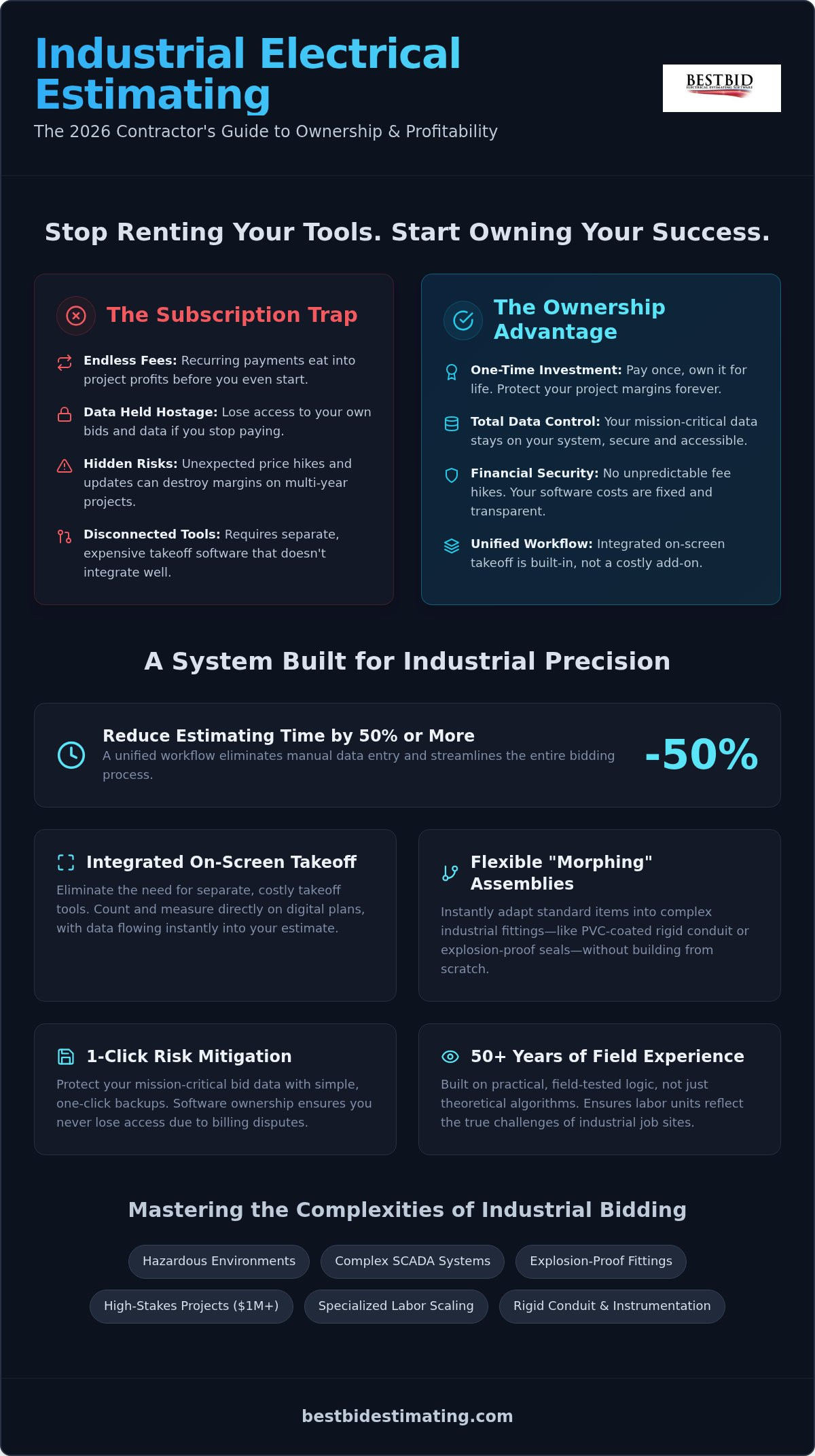
- Understand the long-term financial impact of the “subscription trap” and why total software ownership is the most effective way to protect your project margins in 2026.
- Discover how to reduce bidding time by 50% or more using a unified workflow that integrates digital on-screen takeoff directly into your estimating database.
- Explore how field-tested assembly structures allow you to quickly adapt common items into complex industrial fittings for more precise and competitive bids.
- Gain insights from over 50 years of electrical trade experience to streamline your bidding process and eliminate the hidden costs of manual data entry.
The Unique Challenges of Industrial Electrical Estimating
Industrial projects aren’t just larger versions of commercial jobs. They’re entirely different beasts. When you’re bidding on a refinery, a water treatment plant, or a high-tech manufacturing facility, you’re dealing with hazardous environments, complex SCADA systems, and explosion-proof fittings where a single mistake can evaporate your profit. Generic Construction estimating software often fails in these environments because it relies on theoretical algorithms rather than the practical realities of the field. It treats every foot of conduit as if it’s being installed in a perfect, climate-controlled office.
Bidding on industrial work requires a transition from manual methods to digital precision, but you can’t afford to lose control of the process. You need a system built on field-tested logic, not just code. This ensures that when you’re bidding on a massive industrial scale, your labor units reflect the actual grind of the job site. It’s about moving toward modern efficiency without sacrificing the trade wisdom that keeps your business profitable.
To better understand how this transition to digital precision looks in practice, watch this helpful video:
Managing Complex Industrial Assemblies
Rigid conduit and instrumentation require a database approach that differs fundamentally from residential work. You don’t have time to build every assembly from scratch for every bid. Professional industrial electrical estimating software uses "morphing" assemblies to reduce clicks. This allows you to take a standard run and instantly adapt it for specialized industrial fittings, such as PVC-coated rigid conduit or stainless steel supports, without starting over.
- Database Depth: Industrial databases must include specific items like explosion-proof seals and complex control wiring.
- Assembly Flexibility: Morphing allows for quick changes to conduit types or mounting hardware within a single assembly.
- Labor Scaling: Adjustments must account for working in specialized environments, such as chemical plants or classified areas.
Global labor adjustments are also critical. Industrial projects often involve specialized crews working in hazardous conditions or at extreme heights. Your software should allow you to adjust labor across the entire bid with a single change, ensuring your numbers stay accurate as project conditions evolve and requirements change.
Risk Mitigation in High-Stakes Bidding
Accuracy in material counting is the difference between winning a profitable job and losing your shirt on a project exceeding $1M. In 2026, the danger isn’t just the math; it’s the hidden costs of the tools you use. Subscription-based industrial electrical estimating software can hit you with unexpected updates or fee hikes in the middle of a multi-year industrial project, quietly eroding your margins.
Best Bid Next Generation minimizes your project risk by providing 1-click backups that ensure your mission-critical data is always protected. By owning your software, you eliminate the threat of losing access to your bids because of a billing dispute or a price increase from a software vendor. It’s about having the security of a modern system that stays under your control, no matter how long the project lasts.
Essential Features for Industrial-Grade Bidding Software
Industrial estimating isn’t just about counting switches; it’s about managing massive data sets with absolute accuracy. The right industrial electrical estimating software should be an all-in-one powerhouse, not a patchwork of different subscriptions that don’t communicate. You need tools that allow for precision bidding without the friction of manual data transfer. When you’re managing a project with thousands of feet of rigid conduit, any delay in your workflow is a direct hit to your bottom line.
The Power of Built-in On-Screen Takeoff
Why should you pay for two separate software packages to do one job? Many platforms force you to perform a takeoff in one tool and then manually export or re-key those numbers into your estimate. This lag creates room for error. A built-in On-Screen Takeoff (OST) system eliminates this risk entirely. It handles complex industrial plan sets with hundreds of pages effortlessly, syncing your digital measurements directly to your bid database. For estimators who need a balance of high-end power and intuitive simplicity, Best Bid Hybrid Pro provides a streamlined workflow that keeps you focused on the bid, not the technical hurdles of the software.
Real-Time Material Pricing for Volatile Markets
In 2026, material costs remain a moving target. If your bid is based on three-month-old data, you’re gambling with your company’s future. Integrating NetPricer into your workflow ensures your material costs are current up to the minute you hit "submit." This integration allows you to:
- Automate price updates: Stop wasting hours on manual price checks for thousands of industrial items.
- Reflect supplier agreements: Customize your database to show your actual negotiated rates with specific industrial suppliers.
- Protect your margins: Adjust for sudden market volatility instantly across the entire estimate.
Database flexibility is another non-negotiable feature. Industrial shops need 100% control over their data. You should be able to "morph" assemblies or create custom industrial fittings without waiting for a software developer to update a rigid, locked-down database. This level of control is why professional systems earn a 5-star rating for workflow speed on bid day. If you’re tired of fighting your tools just to get an accurate number, you can explore how total software ownership can simplify your bidding process.
Ownership vs. Subscription: The Financial Reality for Contractors
Why are you still paying rent on the tools you’ve already used? For many contractors, the move to digital industrial electrical estimating software came with a hidden catch: the monthly subscription. This "Subscription Trap" quietly erodes your bottom line. You finish a project, but the software bill keeps coming. It’s a recurring expense that eats into your hard-earned margins, turning a one-time tool purchase into a permanent liability. We believe your software should be an asset, not a bill that never ends.
Most major industry players hide their costs behind "Request a Quote" walls. When you finally get those numbers, they’re often staggering. For a 5-user license, the industry average for industrial suites can range from $15,000 to $40,000, and that’s often before the annual maintenance fees kick in.
There’s a better way. The "Buy it and Own it" model provides total financial clarity. You pay for the software once.
You own it for life. It becomes a permanent asset on your balance sheet from day one.
Calculating the Long-Term ROI of Your Software
When you compare the cost of ownership against the market average, the numbers speak for themselves. You can equip five estimators with a professional system like Best Bid Next Generation for approximately $2,500. Compare that to the $15,000 to $75,000 price tags seen elsewhere.
Over five years, the savings aren’t just significant. They’re transformative. This model includes free lifetime support and software updates, meaning your initial investment never requires a "top-up" to stay current with 2026 NEC standards.
You get the latest features without the recurring invoices.
Software ownership also increases the overall valuation of your electrical contracting business. An asset you own is worth more than a subscription you rent. It demonstrates to potential buyers or partners that your infrastructure is stable and your overhead is controlled. It’s a smart business move that pays dividends every time you submit a bid.
Transparency in Software Pricing
We rank #1 for "Best Value" among single-location contractors because we don’t hide our numbers. You shouldn’t have to sit through a three-hour sales pitch just to find out if you can afford the tools you need. Many "theory-only" software packages also come with hidden costs for third-party training because the interface is too complex for the average estimator to use. You can check our transparent pricing structure to see exactly how we compare to the rest of the market. We’ve built our system for the person who understands the trade, ensuring you spend your time bidding, not fighting a manual. Transparency isn’t just a buzzword; it’s how we respect your time and your business.
Download as HTML
Best Practices for Bidding Industrial Projects with Precision
Precision isn’t an accident. It’s the result of a disciplined workflow that transforms raw plan data into a winning bid. When you’re using high-performance industrial electrical estimating software, the goal is to eliminate the guesswork that leads to "bid day jitters." By following a structured process, you can ensure that every foot of conduit and every hour of labor is accounted for, even in the most challenging industrial environments.
- Step 1: Digital Takeoff. Perform your takeoff directly within your estimating platform using integrated OST tools. This ensures no data is lost in translation between separate programs and provides a clear visual trail of your work.
- Step 2: Assembly Morphing. Leverage your assembly-structure workflow to morph standard components into specialized industrial fittings. This reduces manual entry and keeps your assemblies consistent across the entire project.
- Step 3: Labor Scaling. Apply global labor adjustments based on site-specific hazards, classified areas, or extreme height requirements. Industrial sites rarely offer "standard" installation conditions, and your bid must reflect that reality.
- Step 4: Final Review. Conduct a thorough "Bid Day" review using real-time pricing data. Use 1-click backups to secure your work before making final adjustments to your margins.
Customizing Your Industrial Database
Standard databases often fall short regarding specialized industrial products like motor control centers (MCC) or complex instrumentation. You need the ability to add these items and create custom assemblies without jumping through technical hoops. A user-controlled database allows you to protect your proprietary bidding secrets while ensuring your software reflects the way you actually build projects in the field. This level of customization is what separates a generic estimate from a precision industrial bid that you can actually stand behind.
Continuous Education for Estimating Teams
The best tools are only as good as the hands that hold them. Training grounded in 50 years of field experience is far more valuable than a theoretical tutorial written by a software developer who has never stepped foot on a job site. Utilizing resources like the Online School for Electrical Estimating allows your team to sharpen their competitive edge by learning from trade veterans who understand the daily grind. You can see how our software supports this precision by exploring our flagship platform designed specifically for the industrial professional.
Mastering labor management and risk mitigation through structured academy courses ensures your team remains efficient as project complexities grow. It’s about building a culture of accuracy and ownership that protects your bottom line on every industrial project you chase.
Why Best Bid Next Generation is the Industrial Contractor’s Best Asset
What happens when a Master Electrician with over 50 years of field experience decides to fix the software industry? You get a tool that actually works the way you do. Steve Griffin has been in the trenches since 1973; every feature in our industrial electrical estimating software reflects that practical trade wisdom. We didn’t build this to satisfy a board of directors or to create a recurring revenue stream. We built it to help small-to-mid-sized industrial shops bid faster, win more work, and keep more of their money.
The workflow is designed for speed. When you’re managing a solo operation or a 5-user team, you don’t have time for bloated menus or theoretical tools. Our system is rated 5-star for workflow speed because it eliminates the friction points that slow you down. Best of all, you get this professional industrial electrical estimating software power without the ultimatums. There are no monthly fees. You buy it, you own it, and you use it to grow your business on your own terms. It’s the most scalable solution in its class, offering a 5-user license for approximately $2,500.
A Software Suite Built for the Trade
We prioritize a low-to-medium learning curve. Your team should be bidding industrial jobs in days, not months. This advocacy-driven approach is our way of standing up against exploitative subscription models that hold your data hostage. You can explore the features of Best Bid Next Generation to see how we’ve simplified the most complex parts of the bidding process. It’s about fairness, transparency, and giving you the tools to succeed without the ongoing burden of software rent.
Joining a Community of Professional Estimators
Choosing our software means joining a network of professionals who understand the industrial grind. If you hit a period of project overflow or face a complex bid that requires extra hands, you can leverage our Freelance Estimating services to keep your pipeline moving. We also provide tools like Accura Cadd PDF Draw for those who need professional-grade plan markup and review capabilities. Our goal is to be your long-term ally in the trade, providing the support you need when the pressure is on.
Stop letting recurring fees eat your margins. It’s time to invest in a system that pays for itself through accuracy and efficiency. Schedule a demo or start your journey to software ownership today and experience the difference that field-tested design makes for your bottom line.
Take Control of Your Industrial Bidding Future
Mastering the complexities of industrial projects requires more than just a digital spreadsheet. It demands a system built by someone who has actually pulled wire and faced the pressure of bid day. We’ve explored how the right industrial electrical estimating software can eliminate the "subscription trap" while providing the database flexibility needed for specialized industrial assemblies. By prioritizing total ownership and integrated takeoff, you’re not just buying a tool; you’re securing your company’s long-term profitability and independence.
Best Bid is ranked #1 for Best Value because we believe in transparency over recurring fees. With 50+ years of field experience baked into every feature, our 5-star rated system is designed for maximum workflow speed. It’s time to stop renting your tools and start building on a foundation you actually own. Stop paying monthly fees and own the best industrial estimating software today! Your future bids depend on the precision you choose now. You’ve got the expertise to do the work; now give yourself the tools to win it.
Frequently Asked Questions
What is the best industrial electrical estimating software for a single-location contractor?
Best Bid Next Generation is the top-rated choice for single-location contractors. It was specifically designed to serve the 99% of firms that operate from one office with fewer than ten estimators. Unlike bloated corporate suites, this software focuses on a 5-star workflow speed and field-tested logic. It provides the flexibility needed for complex industrial projects while maintaining a low-to-medium learning curve that gets your team bidding accurately in days.
Can I get electrical estimating software with built-in on-screen takeoff?
You can find industrial electrical estimating software with built-in on-screen takeoff by choosing Best Bid Next Generation. Our platform is unique among major competitors because it includes this functionality directly. This eliminates the need to purchase separate, expensive third-party takeoff tools. By integrating digital measurement and counting into the estimate, you reduce clicks and prevent data transfer errors, ensuring your industrial plan sets are handled with total precision.
Is there electrical bidding software with no monthly subscription fees?
Best Bid offers a "Buy it and Own it" model that completely eliminates monthly subscription fees. You pay a one-time purchase price for a lifetime license that includes free support and software updates. This approach stands in contrast to the "subscription trap" common in the industry, where recurring payments can quietly erode your project margins. It’s a transparent financial model built for business owners who want to own their assets instead of renting them.
How much does a 5-user license for Best Bid Next Generation cost?
A 5-user license for Best Bid Next Generation costs approximately $2,500. This is the lowest cost in its class, especially when compared to major competitors whose 5-user suites can range from $15,000 to over $75,000. This upfront investment covers the full software suite with no hidden ultimatums or recurring bills. It’s a professional-grade solution designed to be the most cost-effective asset for a growing electrical contracting firm.
Does Best Bid software include real-time material pricing?
Yes, the software features real-time pricing integration through NetPricer. This allows you to keep your industrial material costs current automatically, which is vital in volatile markets. You can also customize the database to reflect your specific negotiated agreements with industrial suppliers. By automating these updates, you protect your profit margins and ensure that your bids remain accurate and competitive up to the very moment you submit them.
How long does it take to learn Best Bid industrial estimating software?
Best Bid is designed with a low-to-medium learning curve to get your team bidding industrial jobs faster. Because the interface is built on 50 years of field experience rather than theoretical algorithms, the workflow feels intuitive to experienced electricians and estimators. Most users find they can navigate the system and produce accurate bids shortly after installation, especially when leveraging the structured training modules available through the Online School for Electrical Estimating.
Can I use Best Bid for freelance electrical estimating services?
You can utilize Best Bid for freelance electrical estimating services to manage overflow. We offer professional project support for contractors who are facing bid day pressure or particularly complex industrial projects. This service allows you to leverage expert estimators to help maintain your pipeline without hiring full-time staff. Additionally, the software itself is a powerful tool for independent estimators who need a fast, flexible, and affordable platform to serve their own clients.
How does Best Bid compare to McCormick or Accubid for industrial projects?
Best Bid Next Generation consistently outperforms McCormick and Accubid on cost, speed, and flexibility. While competitors often charge between $15,000 and $75,000 for multi-user licenses and require separate takeoff software, Best Bid provides a unified industrial electrical estimating software solution for approximately $2,500. Our system includes built-in OST and a 5-star rated workflow speed, offering a much lower learning curve and a more transparent "no-subscription" ownership model.
Electrician • Estimator • Contractor • Author • Software Developer
From digging ditches in 1973 to creating one of the industry’s longest-running electrical estimating software systems, Steve Griffin has spent more than 50 years helping contractors win more work and make more money.