Electrical Bid Proposal Template: 2026 Contractor Guide

What if the electrical bid proposal template you rely on is actually the silent killer of your profit margins? It’s a tough question to face, but in a market where copper prices have surged up to 36% and labor shortages are driving billable rates higher than ever, a static document just can’t keep up. You’ve likely felt the sting of winning a major commercial project only to realize that a missed material spike or an underestimated labor cost turned your win into a break-even struggle. We understand that the daily grind is hard enough without worrying if your bidding process is setting you up for a loss before the first wire is pulled.
You deserve a system that reflects your expertise and protects your hard-earned revenue. In this guide, you’ll learn how to build accurate, winning proposals that stand out to general contractors while ensuring every penny is accounted for. We will show you why moving beyond a manual template is the key to protecting your profit and how to take total ownership of your tools without the burden of monthly fees. From navigating 2026 NEC updates to mastering repeatable bidding workflows, it’s time to stop guessing and start bidding with professional precision.
Key Takeaways
- Identify the critical differences between a simple price quote and a professional bid contract to safeguard your business from legal and financial risks.
- Learn how to move beyond a static electrical bid proposal template to an automated system that eliminates manual data entry and “profit bleed.”
- Master the seven essential elements every proposal needs, including detailed project scopes and itemized material lists that prevent costly scope creep.
- Discover how integrated On-Screen Takeoff (OST) and professional PDF markup tools can drastically reduce bidding time while improving your professional appearance.
- Understand the long-term value of owning your estimating tools outright, allowing you to build a repeatable process without the burden of monthly subscription fees.
Why Your Electrical Bid Proposal Template Might Be Costing You Money
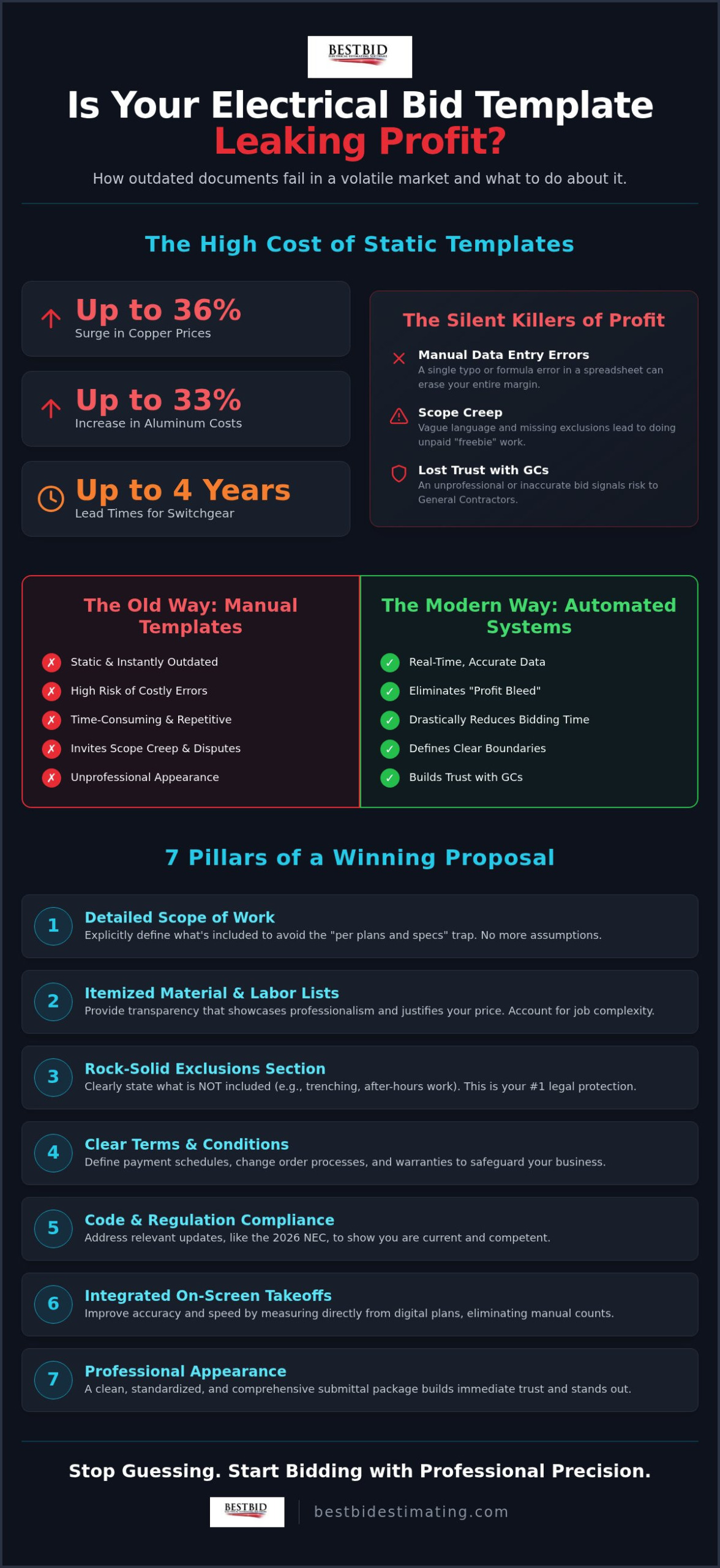
Starting with a basic electrical bid proposal template feels like a shortcut, but it often leads to a dead end. In 2026, the industry is more volatile than ever. Copper wire costs have spiked up to 36% year-over-year.
Aluminum products are up 33%. If your template is a static document, it’s already obsolete the moment you save it. A simple price quote is just a number on a page.
A professional bid proposal is a binding contract that protects your margins from the unexpected.
Your business lives or dies by the accuracy of your cost estimate. Manual data entry in Excel or Word invites “profit bleed.” It’s not just about the time you waste. It’s about the risk of a single formula error or a typo that goes unnoticed until you’re halfway through the rough-in and realize the numbers don’t work.
To see how a professional approach changes your win rate, watch this brief breakdown:
The Hidden Risks of Manual Templates
Manual templates are dangerous because they lack real-time intelligence. They don’t account for the fact that switchgear lead times now reach four years in some markets. You can’t afford to spend hours recreating a bid from scratch for every project. This is why many are moving to Best Bid Next Generation to automate the heavy lifting. Formula errors are silent killers. They stay hidden until the job starts and your bank account takes the hit. Vague language in a generic electrical bid proposal template also invites scope creep. Without specific exclusions, you’ll end up doing “freebies” that destroy your profit.
Winning the Trust of General Contractors
Commercial GCs want more than the lowest price. They look for a comprehensive electrical submittal package that proves you’re a professional. A standardized proposal format builds immediate trust.
It shows you have a reliable system in place. Clear terms and conditions are mandatory. If your bid doesn’t address 2026 NEC updates, like the new GFCI requirements for outdoor HVAC units, you’re telling the GC you aren’t keeping up.
A professional appearance is your first step to winning more commercial work and building lasting partnerships that don’t rely on being the cheapest guy in the room.
7 Essential Elements of a Professional Electrical Proposal
A winning proposal is more than just a total dollar amount. It’s a roadmap that defines exactly what you’re providing and, more importantly, what you aren’t. If your electrical bid proposal template only lists materials with a price at the bottom, you’re leaving yourself open to disputes and profit loss. In a year where copper prices have surged up to 36%, guessing is no longer a viable business strategy. You need a document that acts as a legal shield while showcasing your professional standards.
Defining Your Scope of Work
Relying on the phrase “per plans and specs” is a trap that many contractors fall into. Plans change, and specs are often contradictory. You must explicitly define your scope to avoid doing free work.
Does your bid include temporary power for other trades? Who handles site cleanup and haul-off? You need to be clear about these details from day one.
The Exclusions section is the most important part of your legal protection. By listing items like trenching, spoils removal, or after-hours work as exclusions, you set the stage for profitable change orders rather than absorbing those costs yourself.
Labor and Material Transparency
Commercial projects in 2026 require a level of detail that a basic spreadsheet simply can’t handle. You need labor unit breakdowns that account for job complexity. Installing conduit in an open warehouse is vastly different from working in a high-traffic hospital wing. Using Best Bid Next Generation allows you to use pre-built assemblies to automate these calculations instantly. This ensures your labor hours reflect the reality of the 499,000-worker shortage currently facing the U.S. construction industry.
True transparency also means separating your base bid from taxes, permits, and overhead. GCs appreciate seeing exactly where their money is going. It also protects you from eating permit fees that come in higher than expected. When you move beyond “lump sum” guessing and provide itemized material lists, you prove that your bid is grounded in data. This level of precision is exactly what GCs look for when awarding high-value contracts. If you want to ensure your bids are both competitive and profitable, it might be time to look into professional estimating software that builds these elements into every proposal automatically.
Finally, never overlook your payment schedule. Healthy cash flow is the lifeblood of your business. Define your deposit requirements, progress billing dates, and net terms clearly.
With switchgear lead times extending up to four years, you can’t afford to have your capital tied up because of vague payment language. A professional proposal ensures you get paid on time, every time.
Manual Templates vs. Automated Estimating Software
While a free electrical bid proposal template looks like a money-saver on the surface, the hidden costs are staggering. Think about your billable rate. In 2026, the national average for a licensed electrician’s billable time ranges from $75 to $130 per hour.
If you spend five hours manually entering data into a spreadsheet for a single bid, you’ve already “spent” over $500 in labor before you even send the proposal. Automation isn’t just a luxury anymore; it’s a necessity for protecting your time and your bottom line.
The difference in workflow is night and day. Manual templates require you to call suppliers for every quote, wait for callbacks, and manually type those numbers into your document. Modern systems use real-time pricing integration, like NetPricer, to pull current market costs for copper and aluminum instantly. When you can back up your entire project with a single click instead of hunting through folders for “v2_final_final_final.xlsx,” you gain the security that manual processes can’t offer.
The Takeoff Advantage
The biggest bottleneck in any bid is the takeoff. Using on-screen takeoff for electrical plans eliminates the “ruler and highlighter” errors that lead to $273 billion in annual losses across the U.S. construction industry due to avoidable errors. Instead of re-typing counts from a piece of paper into your estimate, the data transfers directly. This reduces bid time from days to mere hours. You aren’t just working faster; you’re working with a level of precision that ensures your counts are exactly what the job requires.
Ownership vs. Subscription
We believe you should own the tools you use to build your business. Many software companies trap you in a cycle of monthly fees. If you stop paying, you lose access to your data and your history. That’s why the “Buy it and Own it” model is the best electrical estimating software for small contractors who want permanence. You get a professional system without the ongoing burden of a subscription.
- Data Security: Your bids stay on your machine, not a third-party server you might lose access to.
- Financial Clarity: A one-time purchase means no surprise price hikes on your monthly bill.
- Long-term Asset: Free lifetime updates and support turn your software into a lasting business asset rather than a recurring expense.
Moving away from a manual electrical bid proposal template to an automated system is the most significant ROI move you can make. It replaces the stress of manual labor with a reliable system designed by people who understand the daily grind of the trade. You deserve to focus on the work, not the paperwork.
Best Practices for Customizing Your Bid to Win More Jobs
Customization is the bridge between a generic quote and a signed contract. A static electrical bid proposal template provides the structure, but your field wisdom provides the value. GCs are tired of seeing “copy-paste” bids that ignore the unique complexities of their projects. If you want to stop competing on price alone, you have to show that you understand the job better than anyone else. This starts with how you present your expertise.
Start with a personalized cover letter. Don’t just attach a price list and hope for the best. Use this space to address the GC’s specific pain points.
If the project has a tight deadline or requires working around other trades in a confined space, explain your strategy for managing those hurdles. This shifts the conversation from “how much?” to “how will you do it?”. It proves you’ve actually read the specs and aren’t just throwing numbers at a wall.
Visual Proposals and Markups
Professionalism is visual. Using Accura Cadd PDF Draw to create clear plan markups and as-built visions during the bidding phase gives you a massive advantage. It’s much easier to justify higher-quality material choices when you can show exactly where they fit into the system.
These visual aids act as a proof of concept. They show the client that you’ve already “built” the project in your mind, which drastically reduces their fear of future change orders or delays. You’re no longer just a name on a bid; you’re the expert with a plan.
The Steve Griffin Approach to Bidding
Steve Griffin founded Best Bid with 50 years of field experience in his pocket. He knows that being the lowest bidder is often a trap that leads to business failure. Instead, he advocates for being the most accurate consultant on the job.
In 2026, where 92% of contractors report difficulty filling skilled positions, your ability to accurately estimate labor is your most powerful sales tool. Use professional language that reflects your deep roots in the trade. When you speak like a peer who understands the daily grind, GCs see you as a reliable ally rather than just another subcontractor.
Bid Day is the ultimate test of your system. When last-minute material price spikes or scope changes come in, you can’t afford to fumble with a spreadsheet. You need to make adjustments with confidence and hit “send” knowing your profit is safe. If you’re ready to elevate your professional appearance and win more jobs, explore our professional estimating tools to see how we help contractors take total ownership of their bidding process.
Best Bid Next Generation: The Final Template You’ll Ever Need
If you’re still hunting for the perfect electrical bid proposal template, it’s time to stop looking for a document and start looking for a permanent solution. Best Bid Next Generation isn’t just a file on your hard drive; it’s a complete bidding ecosystem that has been ranked #1 for “Best Value” by industry professionals. We’ve built this tool specifically for contractors who are tired of being nickel-and-dimed by software companies that hold your data hostage. Our “Buy it and Own it” philosophy ensures that your business tools remain a permanent asset, not a monthly liability that eats into your overhead.
The reality of 2026 is that you can’t afford to rent your success. When you use subscription-based tools, you’re essentially leasing your own company’s history. If you stop paying, your bids, your data, and your past projects disappear.
We find that practice exploitative. Instead, we offer a one-time purchase model that gives you total ownership. It’s a straightforward, transparent approach that mirrors the way you do business in the field.
You buy the tool, you own the tool, and you use it to build your legacy.
A Complete Bidding Ecosystem
Moving from a complex takeoff to a final, polished proposal shouldn’t feel like a cross-country trek between three different programs. With built-in On-Screen Takeoff (OST) and seamless NetPricer integration, you have a complete system in one box. This assembly-structure workflow slashes the number of clicks required to build a bid, which is a massive relief for contractors who hate spending their nights behind a screen. The learning curve is low to medium because the logic is trade-specific. It speaks your language. If you want to sharpen your skills even further, you can access our online school for electrical estimating to master every feature of the software at your own pace.
Getting Started with Professional Bidding
Transitioning from your old, error-prone spreadsheets into a modern system is easier than you think. We’ve designed the process to help you bring your years of field wisdom into a structured environment that prevents “profit bleed.” For growing shops, the 5-user license advantage is a game-changer. It allows your team to collaborate on different projects without multiplying your costs every time you hire a new estimator. This is the security of a modern, reliable system designed by people who truly understand the specific niche of electrical contracting. You don’t need another generic template; you need a professional system that protects your margins and helps you win. View Best Bid Pricing and Own Your Software Today to start your journey toward total business ownership.
Secure Your Profits and Own Your Process
In a market defined by 36% copper price spikes and a massive labor shortage, your electrical bid proposal template needs to be more than a document. It needs to be a shield. We’ve explored how moving from manual entry to automated precision isn’t just about saving time; it’s about business survival. You’ve seen why detailed scopes and visual markups win GC trust and how owning your tools eliminates the “subscription trap” that drains your bank account month after month. The transition from traditional methods to modern efficiency is the most important step you can take for your shop’s long-term health.
You deserve a system built by someone who has been in the trenches. Best Bid was created by Steve Griffin, a Master Electrician with over 50 years of field experience. It’s why we’re consistently ranked #1 for Best Value. You get a professional, all-in-one system for a one-time fee with zero recurring costs. It’s time to stop paying rent on your own data and start building a permanent asset for your business. Stop Renting Your Software; Own Best Bid Next Generation Today. You have the expertise to do the work. Now, give yourself the tools to win it with confidence.
Frequently Asked Questions
What is the difference between an electrical bid and an estimate?
An estimate is your internal calculation of what a project will cost your business in materials, labor, and overhead. A bid is the final proposal you submit to the customer. While the estimate helps you understand your potential profit, the bid is the legal document that sets the price for the client. Accurate estimating is the foundation for a winning bid.
Should I include my profit margin as a separate line item in the proposal?
You should avoid listing your profit margin as a separate line item. Doing so encourages clients to negotiate your earnings instead of the project’s actual value. It’s more professional to bake your profit into your labor units and material markups. This keeps your electrical bid proposal template clean and prevents unnecessary friction during the contract negotiation phase.
How do I handle price fluctuations in my electrical bid proposal?
Use material escalation clauses and short validity windows. In 2026, copper and aluminum prices can change overnight. State clearly that your bid is only valid for a specific timeframe, such as 15 days. You can also include a clause that allows for price adjustments if material costs increase by more than a set percentage before the contract is signed.
Is it better to use a Word template or specialized bidding software?
Specialized bidding software is a much safer investment than a manual electrical bid proposal template in Word. While Word is fine for simple letters, it can’t handle the complex calculations needed for commercial electrical work. Software like Best Bid Next Generation automates your workflow and integrates takeoff. This reduces the risk of manual errors that lead to profit bleed and lost revenue.
What are the most common mistakes in electrical bid proposals?
The most frequent mistakes are vague scope language and missing exclusions. If you don’t explicitly exclude trenching or site cleanup, the GC might expect you to do it for free. Other errors include failing to account for labor complexity or using outdated material prices. A professional proposal should always include a detailed list of what is and isn’t included to protect your profit.
How can I make my electrical bid look more professional to a GC?
You can make your bid stand out by including visual markups and a detailed submittal package. Use tools like Accura Cadd PDF Draw to show the GC exactly how you’ve planned the installation. Providing a professional cover letter that addresses specific project challenges shows that you are a consultant, not just a subcontractor looking for a quick paycheck.
Do I need separate software for digital takeoff and bidding?
You don’t need separate tools if you choose a complete ecosystem. Many competitors force you to buy a bidding tool and a separate takeoff tool, which can cost tens of thousands. Best Bid Next Generation includes built-in on-screen takeoff. This allows you to count items and measure runs directly on the screen, transferring that data instantly to your estimate without re-typing.
What happens to my bids if I stop paying for my software subscription?
If you stop paying for a subscription-based tool, you typically lose access to all your past bids and project data. We believe this is unfair to the contractor. That’s why we use a “Buy it and Own it” model.
This philosophy comes from Steve Griffin’s 50 years of field experience. You pay a one-time fee and own the tool forever. Your data stays on your machine.