On-Screen Takeoff vs Manual: 2026 Electrical Profit Guide
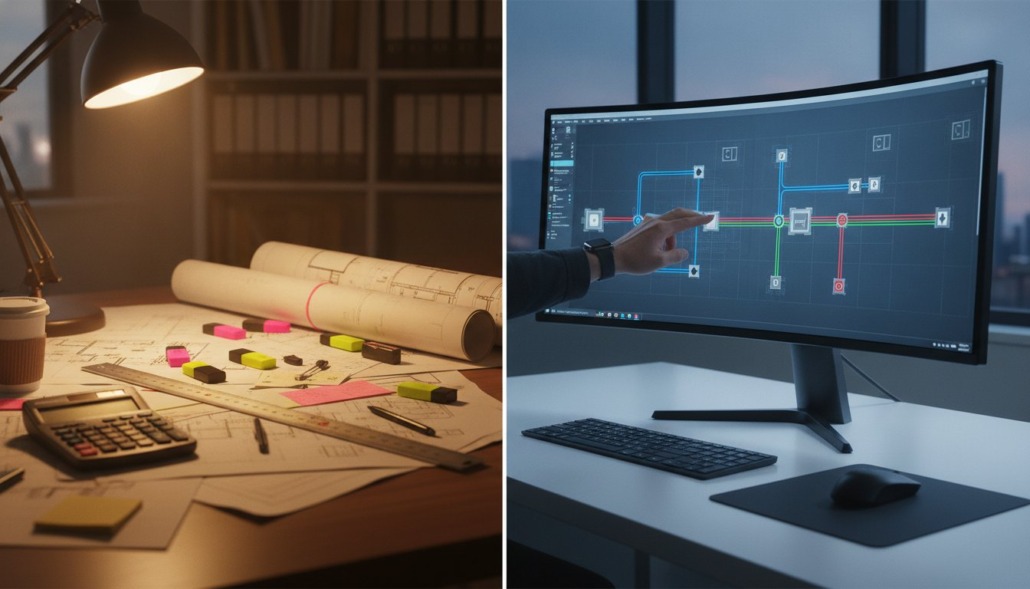
How many 20-hour weekends have you spent hunched over a paper set of prints, squinting at symbols, only to lose the bid by a razor-thin margin? It’s a common story in the trade, where the grind of manual tallying feels like a second job you never signed up for. When comparing on-screen takeoff vs manual estimating for electrical projects, the stakes aren’t just about speed; they’re about the survival of your profit margins.
Most estimators lose tenders because of missed symbols or miscounted circuits, not poor judgment. It’s time to stop letting manual errors eat your lunch.
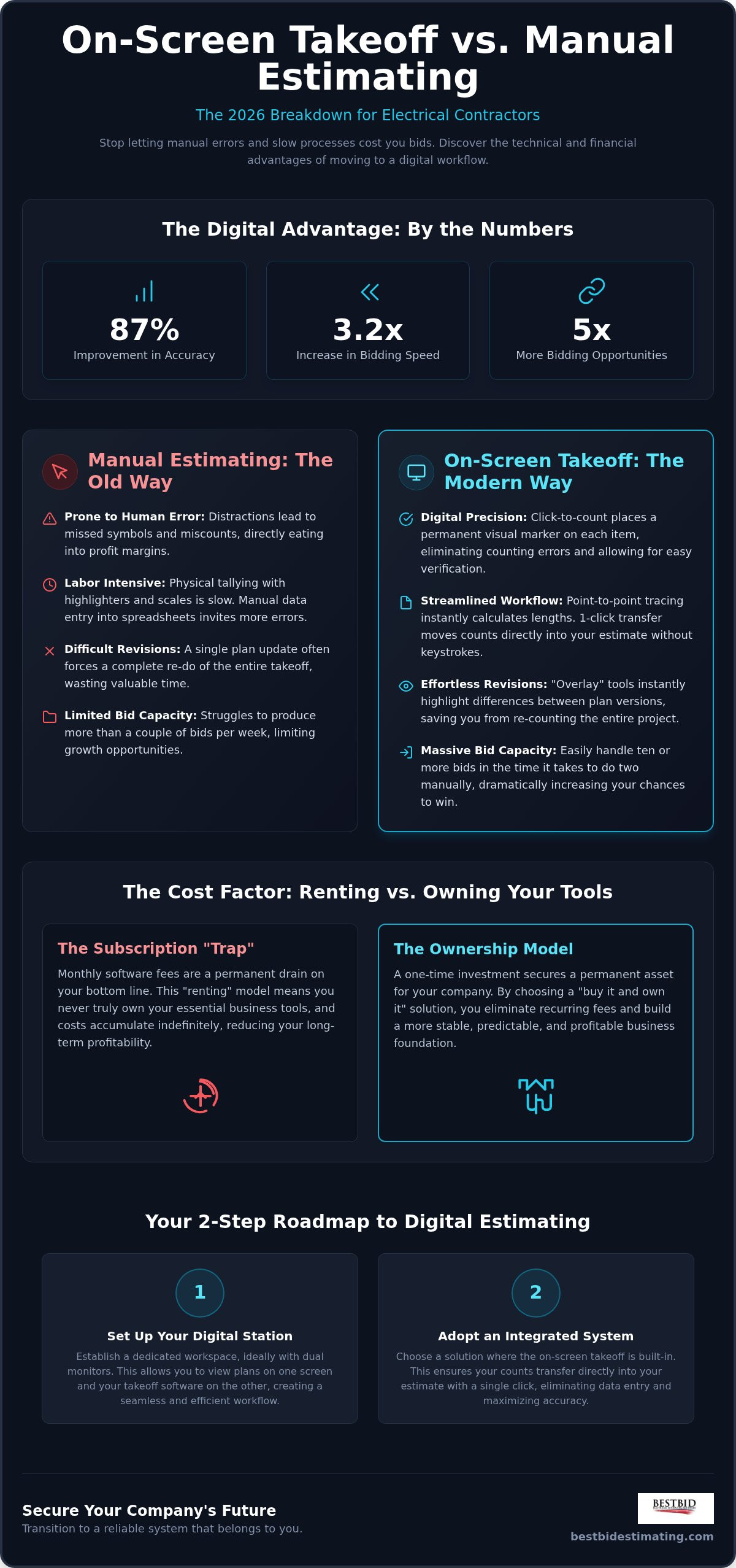
We understand the daily pressure of getting bids out the door without letting a single mistake ruin your estimate. Industry data shows that contractors who move away from paper see an 87% improvement in accuracy and a massive 3.2x increase in bidding speed. You deserve a system that works as hard as you do, providing the precision of modern technology without the burden of a never-ending monthly “tax” on your business. You can slash your bidding time by 50% and finally escape the subscription trap that keeps so many contractors on a digital treadmill.
In this 2026 guide, you’ll discover how to reclaim your time and eliminate counting errors for good. We’ll show you how to transition to a more efficient workflow that lets you bid more projects in half the time. Most importantly, we’ll explore how you can own your tools outright, securing your company’s future with a reliable system that belongs to you, not a software company.
Key Takeaways
- Cut your bidding time by up to 80% by moving from paper blueprints to a streamlined digital workflow that handles the heavy lifting for you.
- Protect your profit margins by replacing manual tallying with precise digital symbol counts that prevent the costly errors common with highlighters and scales.
- Understand the fundamental technical differences in on-screen takeoff vs manual estimating for electrical work to see which method truly scales with your business growth.
- Learn why “renting” your software through monthly subscriptions is a permanent drain on your bottom line and how to transition to a “buy it and own it” model.
- Follow a practical, two-step roadmap to set up a digital estimating station that keeps your plans and your takeoff in perfect sync for maximum efficiency.
The Evolution of Electrical Estimating: From Paper Plans to Digital Reality
For decades, the electrical trade relied on the familiar sight of oversized tables covered in blueprints. This traditional process, known as manual estimating, involves using highlighters, architectural scales, and physical paper to quantify a job. It’s a tactile, labor-intensive method that many veterans still swear by because it feels grounded in the physical reality of the site. On the other end of the spectrum is On-Screen Takeoff (OST). This modern approach uses digital blueprints to count devices and measure conduit runs directly on a computer screen. When we look at on-screen takeoff vs manual estimating for electrical work in 2026, the gap between the two has never been wider.
Some contractors try to find a middle ground by using a basic PDF viewer alongside a spreadsheet. This is often the worst of both worlds. You lose the tactile connection of paper but don’t gain the automated speed of a dedicated system. You’re still manually typing numbers into cells, which invites data entry errors and breaks your concentration. As we move through 2026, paper plans are rapidly becoming a relic of the past. General contractors and engineers now expect digital-first communication. Transitioning to a professional system like Best Bid Next Generation ensures you aren’t left behind as the industry moves toward total digital integration. A professional construction takeoff is now the baseline for staying competitive.
Why Manual Estimating Still Hangs On
Many estimators stick with paper because of the “Trust Factor.” There is a deep-seated belief that you only truly understand a project when you touch every page and trace every line by hand. It feels safer than trusting a computer. Plus, the entry cost is virtually zero; you just need a desk and a scale.
For “old school” pros, the fear that a new digital tool will slow them down is a significant hurdle. They’ve spent years perfecting their manual rhythm. The thought of relearning their craft on a screen feels like a step backward, even if the long-term gains in accuracy are undeniable.
The Limitations of the Highlighter Method
The reality of the highlighter method is that it’s prone to the “distraction factor.” A single phone call or a knock on the office door can lead to a missed outlet or a forgotten light fixture. These small misses directly eat into your profit. Revisions are an even bigger nightmare.
When an engineer sends a “small” plan update, a manual estimator often has to redo the entire takeoff from scratch. This inefficiency severely limits your bid capacity. While a manual shop might struggle to turn out two bids a week, competitors using digital tools are often submitting ten.
This gives them five times the opportunity to land the next big project without increasing their overhead.
Manual Estimating vs On-Screen Takeoff: A Technical Breakdown
When you get down to the brass tacks of on-screen takeoff vs manual estimating for electrical work, the technical differences become clear. It isn’t just about moving faster. It’s about the mechanical way you interact with plan data. Manual tallying requires a physical clicker or a highlighter. If you get a phone call, you might lose your place on the page. Digital “click-to-count” systems place a permanent visual symbol on every counted device. You can verify your work at a glance.
Measuring linear runs follows a similar logic. Hand-scaling conduit paths with a wheel is a slow, error-prone process. Digital “point-to-point” tracing calculates lengths instantly based on the plan’s scale.
This eliminates the risk of using the wrong architect’s scale on a crowded drawing. Once the count is finished, manual estimators spend hours typing numbers into a spreadsheet. Integrated takeoff allows for a 1-click transfer.
Your counts move directly into the estimate without a single keystroke. When revisions arrive, “Overlay” tools show you exactly what changed between plan versions, saving you from re-counting the entire project.
The Electrical Assembly Advantage
A major benefit of digital systems is how they handle complex assemblies. Morphed assemblies allow you to change one item in a count and have the labor and material update globally across the entire bid. This level of automation is impossible with a paper-and-pencil approach.
Automatic Conduit Calculation is a tool that multiplies linear feet by user-defined labor units and material multipliers. This ensures your conduit and wire runs are priced accurately every time. It’s about precision that stays consistent across every project you bid.
Built-in OST vs Third-Party Add-ons
Many shops fall into the trap of “Frankenstein” software. They pay for an estimating program and then pay again for a third-party takeoff tool like PlanSwift. This creates a disjointed workflow where two different programs have to talk to each other. The Best Bid approach is different. By providing built-in OST, Best Bid Next Generation creates a seamless, 5-star rated workflow. You aren’t juggling multiple subscriptions or fighting with data imports. You own a single, unified tool that handles everything from the first click to the final bid. If you’re tired of paying multiple vendors for one job, it’s time to simplify your estimating process.
The Real ROI: Comparing Time, Accuracy, and Software Costs
Time is the most visible gain when moving away from paper. A complex 10-hour takeoff on a physical set of prints can be reduced to just 2 hours of digital work. This isn’t just about finishing early; it’s about your capacity to grow. When you weigh on-screen takeoff vs manual estimating for electrical bids, you’re really looking at the opportunity cost of those lost hours. Those extra eight hours could be spent on four more bids, project management, or finally getting home for dinner on time. Every hour saved is an hour you can reinvest into the profitability of your shop.
Calculating the Cost of Manual Errors
Accuracy is where the real money is made or lost. Manual counts are notorious for the “Forgotten Material” factor. It’s easy to miss the small but essential items like boxes, covers, and supports when you’re tallying by hand.
Digital tools act as a safety net, prompting you for these connected items so they never slip through the cracks. The financial impact is staggering; a 5% error in a $100k bid can wipe out the entire net profit margin. Missing even a single $500 circuit during a manual count doesn’t just cost you $500.
It costs you the labor, the overhead, and the potential profit that circuit should have generated. By using software pre-loaded with field-tested labor units, you replace “gut feelings” with data-driven precision.
Subscription Fees: The Hidden Profit Killer
Beyond accurate counting, the success of a major contract often hinges on how you handle the formal bidding process. To maximize your chances of winning, you can explore Request For Proposal (RFP) Management and Negotiation Assistance to ensure every aspect of your proposal is optimized for success.
The “Rent vs Own” debate is the most important financial decision you’ll make regarding your tools. The math of SaaS (Software as a Service) is designed to benefit the software developer, not the contractor. If you’re paying $200 a month for a tool, you’ve spent $12,000 over five years and still own nothing.
If you stop paying, you lose access to your historical bids and your workflow grinds to a halt. This “subscription tax” eats into the profit of small contractors every single month.
We believe in a different philosophy: total ownership. Investing in a one-time license provides permanence and financial clarity that a rental model can’t match. Best Bid offers a “Buy it and Own it” model that includes lifetime updates and support without a recurring bill. For shops looking to equip a full team, our 5-user licenses offer the lowest cost in their class. This allows you to own a professional-grade system at a fraction of the cost of subscription-heavy competitors. You can view our transparent pricing options to see how ownership provides a better long-term ROI for your business.
Transitioning Your Electrical Shop to Digital Takeoff Without the Headache
Moving from highlighters to a screen can feel like learning a new trade entirely. It’s a common fear among contractors who’ve spent decades perfecting their manual rhythm. But the transition to on-screen takeoff vs manual estimating for electrical workflows is smoother when you follow a logical path. First, choose a tool with a low-to-medium learning curve. You don’t need a system that requires a PhD to operate. Second, invest in a dual-monitor setup. Having your digital plans on one side and your takeoff software on the other is the single biggest productivity hack for modern estimators. It allows you to keep your focus sharp without constantly switching tabs.
To build trust in the software, try parallel bidding. Take a small project and bid it manually, then do it again digitally. You’ll likely see the digital version is more accurate and significantly faster.
This side-by-side comparison proves the value of the system without risking a major contract on a new process. Finally, stop entering data by hand. Use pre-built electrical databases that already know the labor units for a 4-square box or 10 feet of EMT.
This eliminates the tedious task of building an estimate from scratch every time, allowing you to focus on the strategy of the bid rather than the data entry.
Overcoming the “I’m Not Tech-Savvy” Barrier
Most construction software is built by generic programmers who have never stepped on a job site. That’s why they feel clunky and unintuitive. When tools are “from the trenches,” they follow the same logic you use in the field. Steve Griffin used his 50 years of experience as a Master Electrician to ensure our software thinks like an electrician. It speaks your language and understands the specific assemblies you use every day. If you still feel hesitant, our Online School for Electrical Estimating provides a guided start to get you up to speed without the stress.
Managing Your Data Assets
Ownership means you control your data. You don’t need an IT degree to keep your bids safe. A 1-click backup system ensures your hard work is protected and easily accessible whenever you need it. When material prices fluctuate, you can’t afford to update every item line by line. Global adjustments via NetPricer allow you to update your entire database instantly, reflecting current market conditions in seconds. This level of efficiency is why we’ve been ranked #1 for “Best Value” among single-location electrical shops. You get professional power without the complexity or the recurring fees. If you’re ready to stop the paper chase, see how Best Bid Next Generation simplifies your workflow.
Best Bid: The Built-in OST Solution with Zero Monthly Fees
Best Bid Next Generation isn’t just another software package; it’s a tool forged by 50 years of field experience. For small to mid-sized contractors, it represents the fastest possible workflow because the takeoff and the estimate live in the same house. Unlike competitors who force you to buy separate takeoff and estimating modules, we believe a unified system is the only way to eliminate data transfer errors. When you weigh on-screen takeoff vs manual estimating for electrical work, the winner shouldn’t be the tool that costs you the most in monthly “rent.” It should be the one that gives you the most control.
Our “Buy it and Own it” philosophy is a direct challenge to the industry’s obsession with recurring subscriptions. We provide total financial clarity. You pay once, and you own your tools forever.
This includes real-time pricing integration, ensuring your material costs reflect the current market without you having to chase down every wire nut or conduit fitting. Beyond the software itself, we offer the Best Bid Academy and professional support to ensure you never feel like you’re out on a limb alone. It’s about empowering your shop with the same precision used by the biggest players in the trade.
Why One-Time Licensing Wins in 2026
One-time licensing provides a level of financial predictability that monthly bills can’t offer. In 2026, business owners need to know their overhead is stable. With Best Bid, there are no “locked out” scenarios.
If you have a slow month and need to cut expenses, your historical bid data remains yours. You can still open old projects, check past labor units, and refine your strategy. We provide free updates and support for the life of the license because we view our users as partners, not just revenue streams.
You own the asset; you don’t rent the permission to work.
Getting Started with Best Bid
Growing shops benefit from our flexible 5-user licensing, which allows your whole team to work from the same playbook at a fraction of the cost of individual rentals. If your plate gets too full, you can even leverage our Freelance Estimating services to handle the overflow. This keeps your bidding engine running even during peak seasons without the need to hire full-time staff. The transition from paper to digital doesn’t have to be a gamble. It’s an investment in your company’s permanence. Explore Best Bid Electrical Estimating Software today and take back control of your profit margins.
Take Control of Your Bidding Future
The choice between on-screen takeoff vs manual estimating for electrical projects isn’t just about software; it’s about the long-term health of your shop. You’ve seen how digital tools eliminate the “forgotten material” factor and slash bidding time, allowing you to secure more work without the weekend burnout. By moving away from the highlighter and scale, you protect your margins and ensure every foot of conduit is accounted for with precision. This transition is about more than speed; it’s about reclaiming your time and your profit.
Stop letting monthly subscription fees act as a permanent tax on your hard work. With 50+ years of field experience baked into every feature, Best Bid provides a built-in OST included system that’s ranked #1 for best value among contractors. It’s time to trade the stress of manual tallying for the security of a professional system you actually own.
You’ve put in the years to master your trade. Now, give yourself the tools that match your expertise and start winning the bids you deserve.
View Pricing and Own Your Software Today
Frequently Asked Questions
Is on-screen takeoff really faster than manual estimating for electricians?
Yes, digital methods are significantly faster. Industry data shows contractors see a 3.2x increase in speed. When comparing on-screen takeoff vs manual estimating for electrical work, the elimination of physical scaling and manual tallying removes the bottlenecks that slow down paper-based shops. You can submit more bids in less time; this directly increases your chances of winning projects without adding more hours to your workweek.
Can I use Best Bid without paying a monthly subscription fee?
Absolutely. We believe in a “Buy it and Own it” model that eliminates recurring financial burdens. You pay for your license once and you own the software for life.
This transparency gives you total financial clarity and ensures your tools remain an asset rather than an ongoing expense. Unlike many other providers in 2026, we don’t believe in the subscription trap that forces you to keep paying just to access your own work.
Does Best Bid include built-in on-screen takeoff (OST)?
Yes, Best Bid Next Generation features built-in OST at no extra cost. This eliminates the need for expensive third-party add-ons like PlanSwift. Having the takeoff and estimating tools in a single, unified system creates a 5-star rated workflow for speed and accuracy. You can count devices and measure linear runs directly on your screen, with all data transferring instantly to your estimate without any manual typing or data entry errors.
How long does it take to learn electrical estimating software?
Most estimators are up and running within a few days. Because our software was designed by Steve Griffin, a Master Electrician with 50 years of experience, the logic follows the natural flow of the trade. It feels intuitive rather than clinical.
While some complex platforms require weeks of classroom training, our system is built for busy professionals who need to bid jobs now. We also offer the Online School for Electrical Estimating for guided support.
Can I import my own material pricing into Best Bid?
Yes, you have total control over your material database. You can easily import your specific pricing from local suppliers or use our real-time integration with services like NetPricer. This flexibility ensures your bids reflect the actual costs you pay in the field. Maintaining accurate pricing is a critical part of on-screen takeoff vs manual estimating for electrical projects, as it prevents the margin erosion that happens when you rely on outdated or generic price lists.
What happens to my data if I stop using a subscription-based software?
Usually, you lose access to everything. Most subscription models lock you out of your historical bid data the moment you stop paying. This is why we advocate for total ownership.
With our one-time licensing, your data belongs to you forever. You can open, review, or revise old bids years later without a recurring bill. This permanence provides the security and historical record that every growing electrical shop needs to stay profitable.
Is Best Bid suitable for small, one-man electrical shops?
It is specifically designed for shops of all sizes, including one-man operations. In fact, we are ranked #1 for “Best Value” among single-location contractors. Small shops often have the least amount of time to spend on bidding, so the speed gains from digital takeoff are even more impactful. You get professional-grade power that fits your budget, helping you compete with larger outfits without the massive overhead or complex IT requirements.
How does Best Bid compare to McCormick or Accubid in terms of cost?
Best Bid offers professional-grade features at a fraction of the cost of those larger, enterprise-level systems. While McCormick and Accubid are powerful, they often come with high entry prices and ongoing maintenance fees that can strain a smaller shop’s budget. Our “Buy it and Own it” philosophy provides a much lower total cost of ownership over time. You get the same precision and speed without the heavy financial burden or complex corporate structure.